
I spent the back half of last year doing something most people never quite get around to. I sat down and went through my own working life, line by line. Not for an accountant. For me. Income, outgoings, what stayed, what didn’t, where the difference had ended up. I’ve worked as a self-employed actor on two continents - 20 years of my career in the UK, and over a decade here in Australia - so there was a fair bit of it to wade through.
I won’t bore you with the numbers, they’re mine and they’re not the point, the point is what happened in my head somewhere around the third day of the exercise, when the spreadsheets stopped being a financial document and started being something else.
What I was looking at, I slowly realised, wasn’t a record of my choices at all. It was a record of the machine those choices had been feeding. The choices I’d thought were mine - where to live, what to charge, what to save in, what to buy - had all been shaped and channelled and clipped along the way by something a great deal bigger than me. And I could see the shape of that something in the numbers. Not a metaphor - an actual arrangement, with inputs and outputs and beneficiaries, that my working life had been quietly feeding into for decades without my ever quite looking at it head-on.
Once I’d seen the shape of it in my own ledger, I started seeing it everywhere else. And most of all, I started seeing it in the country I’ve been living in for the last fourteen years.
We argue about Australia the way a tenant argues about a landlord. Is he a good landlord or a bad one? Is the rent fair? Is he fixing the gutters? Should we vote for the other landlord at the next election? The whole conversation assumes a relationship that was never on the table.
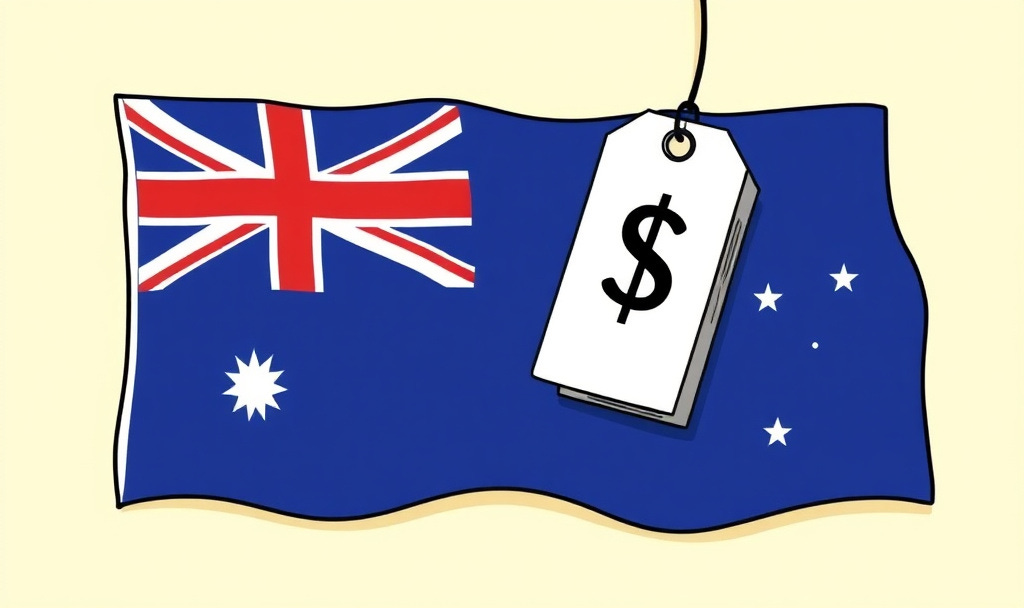
Because here’s the thing nobody quite says out loud - this country (Australia) wasn’t founded as a country. Not in the sense most of us were taught at any rate. There was no Mayflower moment, no Declaration of Independence, no group of people setting sail with a vision of building something new and free on the other side of the world. It was basically a logistics operation. A penal solution wrapped around a strategic harbour. The continent wasn’t claimed as a homeland. To put it bluntly, it was claimed as inventory.
Everything that came afterwards was built on top of that founding logic, and the founding logic has never been replaced. It’s just been redecorated. It’s been given a flag (or flags if you’re Albo), an anthem, a Constitution, a Parliament, and even a national broadcaster, but underneath it all, the original organising principle is still running, and it’s still doing exactly what it was set up to do.
It’s now blindingly obvious in my opinion that Australia is not a nation that happens to have a resources sector - Australia is a resources business that happens to have a population!
Look at what the country has actually done, as opposed to what it says about itself. There was a brief window - roughly the late forties through to the early fifties, the Chifley years and the very early Menzies ones - when the Australian state genuinely behaved like a nation-building project. The monument to that window is the Snowy Mountains Scheme - a quarter of a century to build, a hundred thousand workers from thirty-odd countries, sixteen dams, the largest public engineering project in the country’s history. It started nearly eighty years ago, and was finished half a century ago. It’s been treated ever since as some sort of holy relic. And the reason it’s treated as a holy relic is that nothing of comparable ambition, conceived in the same spirit, has been attempted since. Nothing. The window closed. The operating system reverted to its older programme. And that older programme is the one we’ve been running, with great consistency, for the entire period since. That programme is simple. Find a thing in the ground or on the ground. Sell it to someone off-shore. Take a small clip on the way past. Distribute the clip thinly enough to keep the population from rioting. Rinse and repeat.
Wool. Wheat. Gold. Iron ore. Coal. Gas. Lithium, now, apparently. The product changes. The structure doesn’t. We don’t refine it here. We don’t manufacture from it here. We don’t build sovereign wealth from it the way Norway did with oil, because building sovereign wealth would require treating the proceeds as belonging to the sovereign - to us - and that has never been the deal. The deal has always been that the stuff in the ground belongs to whoever’s got the licence to dig it up, and the licence belongs to whoever’s got the lawyers and the lobbyists, and (spoiler alert!) the lawyers and the lobbyists are not, by and large, working for you.
Meanwhile the population - that’s us, the citizens, the supposed point of the whole exercise - gets handed a different deal entirely. We get to participate in the economy by going into debt to buy an sell houses from each other, at prices set by the willingness of foreign capital to lend against Australian dirt. The mortgage isn’t a path to ownership. It’s the mechanism by which thirty years of your working life gets converted into interest payments that flow upwards and outwards to people who have never set foot in your suburb - and never will!
We call this “the great Australian dream.” It is, in fact, a very efficient capture system. And we cheer for it. We watch auction results on the news the way other countries watch sport!
Here is where the conventional response kicks in, and the conventional response is - well, vote for someone who’ll change it. Tax the miners properly. Build sovereign manufacturing. Reform negative gearing. Bring the gas reservation in. We’ve all heard the policy menu. Some of it’s even good policy.
But the policy menu assumes the politicians are the operators of the system. They aren’t. They’re the interface. They’re the bit you interact with so that you don’t have to think about the bit you can’t interact with. Their job - their actual job, as distinct from the one on the brochure - is to absorb your frustration on a three-year cycle, rotate out when the frustration gets too high, and let the machine carry on running underneath. They’re not failing at running the country. They’re succeeding at a completely different job, which is making sure you never quite get around to noticing that the country isn’t really being run at all. It’s being operated. By people whose names you don’t know, in offices you’ve never visited, on behalf of shareholders who live somewhere else.
This isn’t a conspiracy. Conspiracies require co-ordination. This is just the unmolested working-out of a structure that was set up decades and decades ago and has never been rebuilt. There’s no villain at the top of it. There’s just a machine, doing the thing the machine was designed to do, with great efficiency and no malice whatsoever.
Which, when you think about it, is worse.
The reason I tell you all of this is not to recruit you to some movement, because there isn’t one - and I’m not going to start one! I am, as regular readers know, politically homeless and intend to stay that way. The major parties are two slightly different uniforms worn by the same staff. The minor parties are a pressure-release valve dressed up as an alternative. I have given up expecting any of them to fix something they were never built to fix.
What I’ve done instead - and this is the only ‘advice’ I’ll give in this piece, and even then I’d rather call it an observation - is started reducing my own surface area to the machine. Not in a dramatic way. Not in a bunker-and-tinned-beans-and-biltong way. Just in the sense that, once you’ve seen the shape of the extraction, the rational response is to give it less of yourself to extract.
That means owning things the system can’t repossess. It means holding forms of money the system can’t print. It means reducing your dependency on the supply chains, energy grids, and credit lines that are the actual leash. It means producing more than you consume - where you can. It means owing nothing to anyone - again, where you can. It means building, instead of borrowing. It means making, instead of mortgaging.
None of this is preparation for collapse. The machine isn’t going to collapse. The machine is in extremely good health. The machine is, by its own internal metrics, having one of its best decades ever. This is preparation for continuation. For the machine carrying on doing exactly what it’s been doing, perfectly, indefinitely, and you deciding - quietly, without announcing it - that you would like to be a slightly smaller line item on its balance sheet each year going forward.
I started this essay by saying I’d spent months staring at the ledger of my own working life. I’ll finish it by telling you what I actually learned, which has very little to do with money.
I learned that I have spent most of my working life assuming the country I lived in was, in some basic sense, for me. That if I worked hard and paid my taxes and played by the rules, the things called the UK and Australia would, broadly speaking, look after the interests of people like me. Not perfectly. Not generously. But fundamentally.
That assumption was utterly wrong. Not because the country has been mismanaged. Because the country was never the point.
Once you accept that - and I mean really accept it, not as a complaint but as a piece of plumbing diagnostics - a lot of other things start making sense. Why housing is the way it is. Why energy is the way it is. Why the major parties feel interchangeable. Why every ‘reform’ somehow ends up benefiting the same handful of interests. It isn’t a series of failures. It’s a series of features.
And the only sensible response, as far as I can see, is to stop arguing with the landlord about the gutters, and start quietly building something he doesn’t own.
No ads, no sponsor, no boss. Buy me coffee here if you’d like to keep it that way.
See you on Tuesday for more of Albo’s Diary - when the jokes come back out!
No posts
Comments
Nothing yet. Say the first thing.
Sign in to join the conversation.