

The World Cup got me thinking about some of the best teams in history to have never won it. Some reflect on the Brazil team of 1982 but I always think of the fantastic Dutch team of the 1970s. Led by legendary Johan Cruyff they played a revolutionary style known as “Total Football,” and the Cruyff turn became one of the game’s most iconic moves.
The shift away from pure high frequency trading is seeing all the players in the professional trading firm (PTF) world overlapping more and more. Can the Dutch trading firms ever compete like Cruyff and his teammates did?
The big are getting bigger in the PTF world. Scale has advantages. The ability to dominate distribution networks. The ability to price and hedge across financial instruments and asset classes. The ability to invest in large new opportunities and hire the best talent to do it.
The top 3 firms: Jane Street, Citadel Securities and Hudson River Trading together generate more than $65 billion of annual revenues and have a combined equity capital base of around $100 billion!
But they are not alone - there are another 10 or so firms that I would include in an elite super league of the industry including Jump Trading, DRW, Tower Research, Susquehanna, G-Research, XTX Markets, Virtu, Quadrature and the two Dutch options giants – Optiver and IMC Trading.
As I wrote in The Traders of Amsterdam the Dutch equity options market has a rich history and has been one of most vibrant in Europe going back several decades.

Against this backdrop of a super league of PTF giants, Thomas Spitz has the hardest job in the PTF and nonbank market making world - turning around Flow Traders, a firm definitely nowhere near that super league.
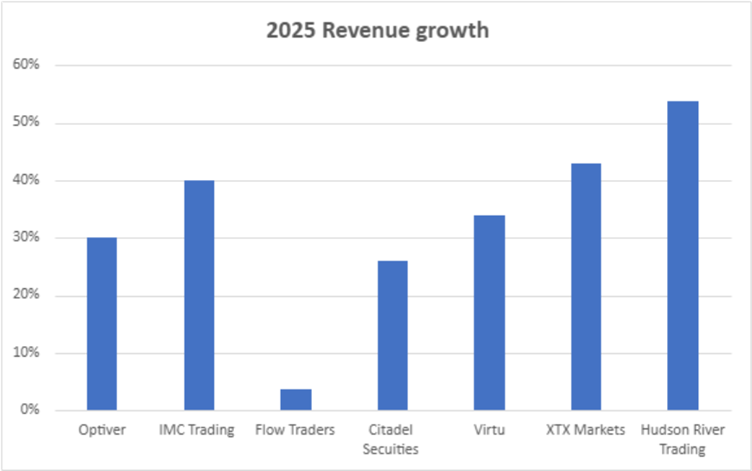
At its recent Investor Day, Flow Traders announced a target of €1bn in revenues by 2030. That number might sound familiar as it was the target they gave at the 2022 Investor Day for 2026 revenues. Not only have they dramatically missed this target, they have done it at a time when the competitors are printing money.
A few years ago in Why Jane Street wins and keeps winning over and over again I referred to Jane Street as the Amazon com of the industry and Flow Traders it’s one time competitor as more like Poundland, the rather scruffy British discount retailer, usually found in dodgy or low-income neighbourhoods.
In 2020, Jane Street’s revenue was around 10x larger than Flow Traders. By 2025, this gap was a gigantic 73x. This year the gap will be even greater.
The good news is that unlike others before him the newish CEO realizes that Flow Traders is the burning platform - a house on fire.
At its recent Investor Day, he admitted the company had lost its way by trying to do too many things, most of them not very well. He acknowledged that despite a decent market share in European ETF market making the trend over the medium term even in this core product has been downward.
He wants to focus. Deploy more capital but focus it on its core ETF business and to venture more into the world of slightly longer duration systematic proprietary trading, where the likes of Jane Street - the best hedge fund in the world - have made ungodly amounts of money.
He is right.
But the bad news is that it may be too late already for Flow Traders.
The competitors have just got too big and powerful and they keep getting bigger.
They attract the best talent. They have far superior technology and distribution.
And then there is the not so small matter that “geography is destiny”, as they say. Flow Traders is largely a European business with limited exposure to much larger and faster growing fee pools in the US and Asia.
To be true, there are businesses like XTX Markets that have made a truck load of cash from areas like European cash equities. By contrast, Flow Traders market share in European ETFs declined from 35-40% in the 2018-2022 period to just over 25% today.
In addition, Flow Traders expansion outside of Europe over the last decade has been nothing short of a disaster. This contrasts with the success that their Dutch peers have seen in targeted niches in the US and Asia.
Nothing in the recent Flow Traders Investor Day told us what their “edge” was though. 10 years ago, the firm had a right to play. Today it is hard to see how it could attract and retain the necessary talent in the most competitive hiring market for quant and tech talent in history. They are not just competing with the PTFs but giants of the hedge fund industry.
Am I the only one so sceptical about how Flow Traders could succeed in a turnaround?
Mr. Market suggests I am not.
The stock price of Flow Traders has fallen 25% over the last 5 years and is barely up this year. Meanwhile laggard Virtu – which has been losing out to Jane Street, HRT and Citadel Securities - has seen its share price rise by 125% in the last 5 years and 78% this year.
ETF Stream gave a balanced and fair take on Flow Traders recent Investor Day: “But there will be scepticism aplenty given the intense competition from Jane Street and others, as well as a track record of disappointment that long pre-dates the current management team. The greater use of directional risk adds to the uncertainty.”
Sell side analysts at ING wrote, “I think positioning has been eroded by the bigger players who have more capital but more importantly better trading algorithms,” while ABN Amro analysts told ETF Stream “Directional trading lifts the risk profile and investors will demand higher returns as a result… We agree the setup needs a shake-up, but Flow Traders has limited quantitative pedigree and native infrastructure. That makes this a call option not a growth engine, in our view.”
Spitz held senior roles like running trading at Credit Agricole but it isn’t obvious that he himself has the systematic trading track record of those who have built top tier firms like Peng Zhao at Citadel Securities or Alex Gerko at XTX Markets. He could be a great conductor of the orchestra but there is no sense that Flow Traders still has an orchestra to conduct.
Just like other markets, ETF industry-wide trading volumes have surged in 2026 but Flow Traders lagged once again. In Europe and the US Flow Traders ETF trading volumes grew with the overall market but its revenue capture was weak and trading revenues lagged volumes. More significantly, H1 2026 was characterized by record activity levels and revenues for the investment banks in APAC and regional ETF market trading volumes more than doubled. By contrast, Flow Traders activity levels in APAC were flat year-on-year. The decline in crypto valuations also impacted digital assets trading volumes across the market and for Flow Traders.
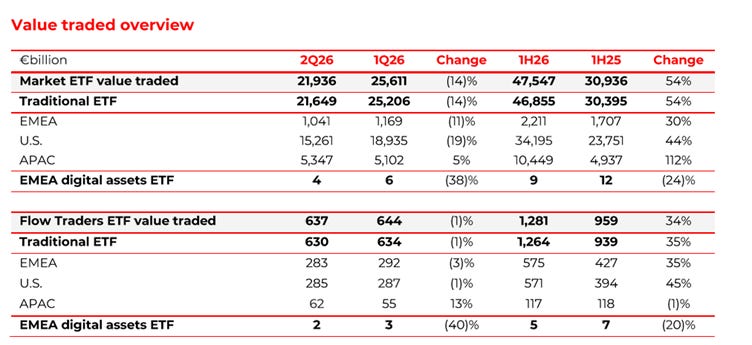
The continued underperformance in ETFs, lack of product innovation and the downturn in crypto markets resulted in negligible revenue growth for Flow Traders in a first half when investment banks and PTF peers were seeing a surge in revenue and profits. As the table below illustrates Flow Traders profits barely grew in one of the hottest trading markets in history.
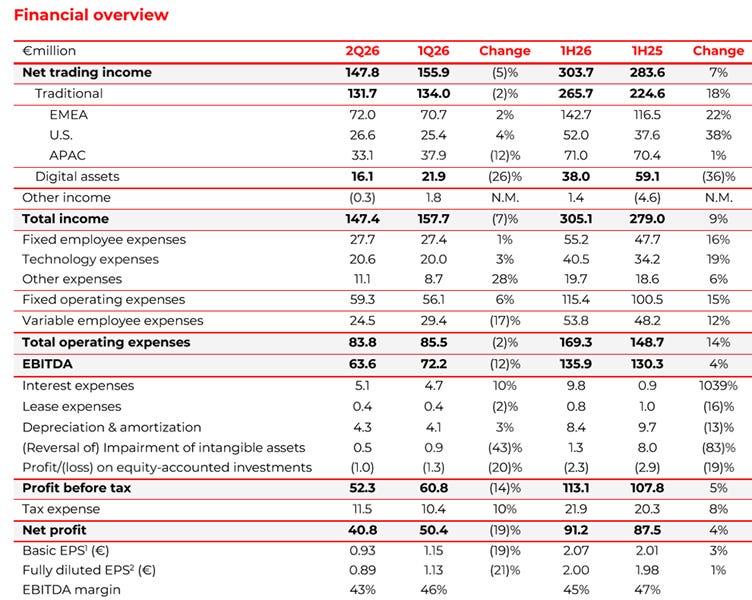
Flow Traders have ambitions of using more capital in trading but organic cash generation is woeful given the lack of growth in recent years. At the end of Q2 2026 it had trading capital of €1.15bn a tiny fraction of what competitors are able to deploy. Second half fixed costs are expected to be line with the first but given seasonality and some normalization revenues are likely to be much lower driving a substantial half on half decline in profits.
Given the high degree of competition, Flow Traders is running out of time. The best solution may be for Flow Traders to be acquired by one of the two larger Amsterdam peers - Optiver or IMC Trading. The firm had been founded by ex-Optiver employees in 2004.
With a current market capitalization of €1.2bn, even with a takeover premium a deal would be easily affordable for Optiver or IMC Trading. Beyond their billions of organic cash flow generation, at the end of 2025 the equity base of Optiver was €5.4bn and for IMC Trading it was $2.58bn.
US competitors including Jane Street, Citadel Securities and Jump Trading have tapped the bond markets in recent years and given the strong profit profile and scale of Optiver and IMC Trading there is no reason why they couldn’t do the same.
Flow Traders current market cap is around the same as its trading capital and slightly above the firm’s shareholder equity of €970m at the end of H1 2026. Even assuming a sharp decline in the second half from the €91.2m of net income in the first half, the valuation is very low. Any takeover premium to the 2026E PE multiple for Flow Traders of 7-8x would be negated by significant cost savings potential.
A Dutch solution would also have far fewer cultural issues than a deal with a large US nonbank trading firm or even a slow moving and bureaucratic European bank.
On the face of it both Optiver and IMC Trading are doing well. Optiver and IMC Trading 2025 revenues are up 42% and 90% respectively versus 2020, while Flow Traders revenues have almost halved. This was an exceptionally strong year for Flow Traders, so a comparison versus 2019 or 2021 is probably more relevant. Relative to the latter, Optiver and IMC Trading have doubled in revenues while Flow Traders has only grown 27%. I was unable to find IMC Trading revenues for 2019, but Optiver’s revenue is up fourfold while Flow Traders’ revenues have doubled.
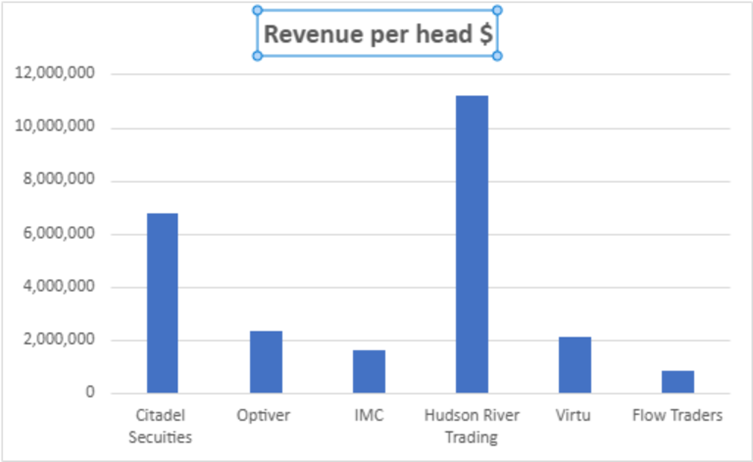
But 2025 revenues of €4.5bn for Optiver and €2.7bn for IMC Trading are dwarfed by US competitors. The productivity in terms of revenue per head of the three Dutch firms also lag market leading firms.
Optiver and IMC Trading both offer compelling synergy opportunities in a combination with Flow Traders. But the former has much more overlap with Flow Traders current business.
Read on for more detailing potential product synergies, cost synergies and moving up the value chain….
Comments
Nothing yet. Say the first thing.
Sign in to join the conversation.