
With H1 2026 in the books, Asia has been a major source of alpha for some of the largest hedge funds in the world and local players have also led the global hedge fund industry in terms of returns.
But is the Asian hedge fund industry just a one-trick pony reliant on rampant rising stock markets, and can it compete with international players in an industry where scale matters much more than ever before?
In this piece I look at:
the Asian hedge funds benefiting from the equity bull market,
international multi-manager giants going to Asia,
the Asian multi-manager platforms like Dymon Asia,
systematic managers in Mainland China, and
Quantedge - the new quant powerhouse.
Many large, Asian equity hedge funds with significant net long bias have delivered eye-watering investment returns in the first half of 2026. Bloomberg reported that $9bn TAL China Focus was up 95%, $6bn Keystone was up 63% and $11bn+ FengHe was up 29%.
The growth of Singapore based FengHe Fund Management was profiled by Bloomberg earlier this year. The fund was started in 2012 and has only had one down year. It has broad exposure to Asia across not just China but the tech supply chain and other areas. It runs a centralized model where a team of 20 analysts make recommendations including filling out long online questionnaires about potential new stock investments. Founder Matt Hu is the only person at the firm who can fully sign off on a new investment.
The fund has benefited from the equity bull market. It’s AUM has jumped from $4bn at the end of 2024 to almost three times that today. Net returns in 2025 were 27%.
But FengHe’s growth is not unique. Greater China stocks-focused Keystone was only launched in 2022 after spinning out of Schonfeld. Underpinned by strong returns, its AUM rose from $2bn to $6bn over the last 2 years. Aspex Management was founded in 2018, hit $9bn of AUM by 2024 and is $14bn today.
The largest hedge fund in Asia is likely to be HHLR Advisors, the public markets side of Asian private markets giant Hillhouse. Exact AUM numbers are difficult to estimate though given HHLR has a mixture of hedge funds and long only funds. As I have discussed before there are many hedge funds in the West that are essentially hedge funds because of the regulatory wrapper rather than any attempt to being anything but a long only portfolio.
Asia’s much greater diversity relative to other regions can also be seen with some funds specializing in specific countries. Japan’s economic and capital markets renaissance has also led to significant growth of interest in the region. Decades old Japan specialists such as Ichigo Asset Management and Effissimo capital management have relatively sizeable AUMs of $7-8bn today.
The big US multi-manager platforms have been expanding aggressively in Asia. Balyasny COO Kevin Byrne told Bloomberg earlier this year that its Asia revenues rose 82% in 2025, and that the combined headcount across the firm’s Hong Kong, Singapore and Tokyo offices increased by 40% over the prior two years to about 250. Of this around 130 were investment staff. And they, like all their peers, define Asia as APAC with the fast-growing UAE offices, of course part of an EMEA regional grouping.
Although APAC remains on average only around 10% of the largest multi-manager platform’s global headcount, in absolute terms these numbers still make them amongst the largest hedge funds in Asia. It is twenty years since Citadel and Point72 (under the SAC Capital brand) opened their Hong Kong offices, which remains for most US firms their largest in Asia.
As well as competing with local players for talent, these US multi-manager platforms are competing in Asia with other multi-strategy firms such as Brevan Howard in the fixed income relative value and macro space. Brevan’s Asia presence is led by Minal Bathwal’s MB Macro Fund, which combines fixed income relative value with directional macro bets. Bloomberg recently did a profile on Bathwal who manages around $6 billion and has averaged an annualized return of 12.7% between 2008 and 2025 with a Sharpe ratio of 1.7. In this period, he has not had a single loss-making year. His returns have been a little weaker over the last decade.
Some big international multi-strategy firms also have strategic relationships in Asia. For instance, Capula sold a 15% stake to Japanese insurer Dai-ichi Life.
The diversity of Asia with its local stories and capital markets ecosystems specific to an individual country makes it more challenging for hedge fund business development teams that need to source talent on the ground.
In line with their strategy in other markets, US giants, particularly Millennium, are also backing local players with capital. For instance, in 2024 it gave $1.5 billion to the new multi-strategy macro focused fund Aeonea, run by a former Balyasny portfolio manager (PM) who had been a Goldman Sachs macro trader. In this case, it was to manage money exclusively for Millennium.
In 2025 former Goldman Sachs commodities trading co-head Qin Xiao launched Singapore-based Nexus commodities with $1 billion from Millennium but on a non-exclusive basis. Pan-Asia equity long/short manager Optimus Capital, a fund that had been around for 10 years but with only a few hundred million dollars of AUM also received a billion-dollar allocation from Millennium last year.
Next up for Millennium in Asia is backing former Citadel quant researcher Paul Dou’s Hong Kong-based Third Epilson with an allocation that could exceed $1 billion.
This is a path which has been fruitful for Millennium already in Asia as it has been in other geographies. The biggest of these successes was Symmetry Investments launched in 2014 with $1bn from Millennium and $0.2bn from external investors. The firm’s co-founders Feng Guo and Michael Robinson worked at Millennium. Guo remains CIO of Symmetry today and its $13 billion in client AUM is highly leveraged given its focus on macro and fixed income relative value trading not just in Asia but also in areas like the US Treasury basis trade. The firm has established a strong reputation as a Tier 1 player in their niche.
That said, as we saw with Modular Asset Management (ex- Millennium PM who had been managing $600 million for Millennium), these deals can come to an end when either or both parties outgrow each other.
But Millennium is not the only global multi-manager giant that has made successful allocations. Schonfeld had invested more than $1 billion with Hong Kong-based equity stat arb specialist Y-Intercept, which had been running money exclusively for it until recently.
The Asian multi-strategy space was shaken when a major scandal led to the implosion of Segantii, a relative value equities and event-driven fund in 2024. The firm had been founded in 2007, was known as the “block trade king” of Asia. At its peak Segantii’s AUM hit $6.2 billion in 2021.
But homegrown Asian multi-manager platforms are emerging and achieving a decent scale. As well as hiring from Asian single managers, they are competing with the big US multi-manager platforms in the talent war. The geographical diversity I mentioned earlier in the last section also creates an opportunity for these Asian multi-manager platforms with their local market knowledge and connections.
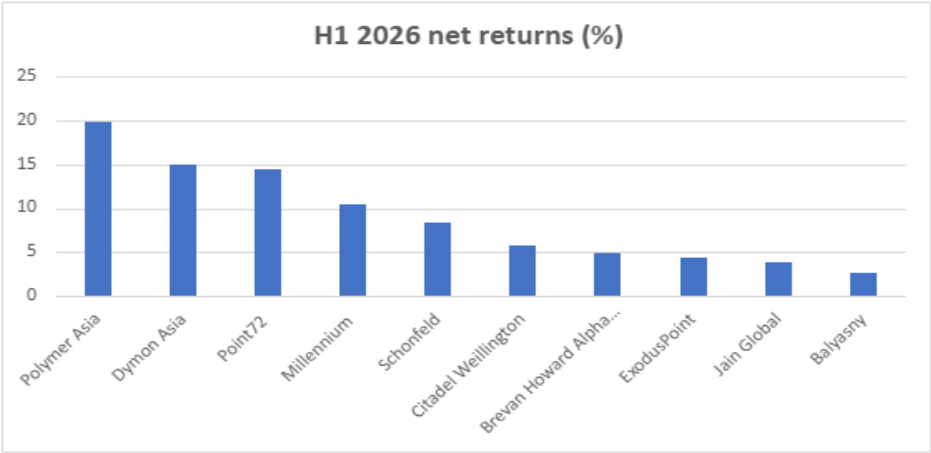
In the first half of 2026, Dymon Asia and Polymer Capital Asia - which have AUM of $9 billion and $6 billion respectively - generated net returns well ahead of the top US multi-manager platforms. The chart below shows performance statistics sourced from Bloomberg.
Dymon Asia launched a macro hedge fund run by founder Danny Yong in 2008 with high teens net returns over the first few years. By the time President Jay Luo joined from SAC Capital in 2012, Dymon Asia was managing $2.5 billion in its macro fund. In 2014, Temasek helped fund the firm’s fundamental equities buildout.
Today macro and equity long/short remain Dymon Asia’s biggest asset class/investing styles. But following three negative years from 2017 to 2019, Yong stepped back from managing the macro funds to a coach role and in 2020 the firm transitioned from single manager to a multi-manager platform investing across a wide varies of styles including fixed income relative value. Asia accounts for 90% of Dymon Asia’s fund exposure and three-quarters of its clients.
Dymon Asia has grown considerably in the last 5-6 years. It has more than 75 PMs in Singapore, Hong Kong, Shanghai, Mumbai and most recently Japan, London and Dubai. A new office is opening in Seoul, Korea soon. Like its larger US competitors, it deploys a pass-through fee model, tries to ensure low correlations between pods and has a steady turnover of around 20% of PMs in any given year.
Dymon Asia founder Danny Yong is integral to monitoring and nurturing the investment side, but its President Jay Luo was the head of SAC Capital in APAC from 2006 to 2012 so has a long background in the space. He believes that the minimum size for a pod shop is to have 40 PMs.
Dymon Asia’s AUM has doubled in the last 2 years, and its headcount rose 50% in the last year or so to more than 350. This growth has been underpinned by strong net returns. The chart below shows Dymon Asia’s net returns versus the median net returns of 6 leading multi-manager platforms (Millennium, Citadel, Point72, Balyasny, Schonfeld, ExodusPoint).
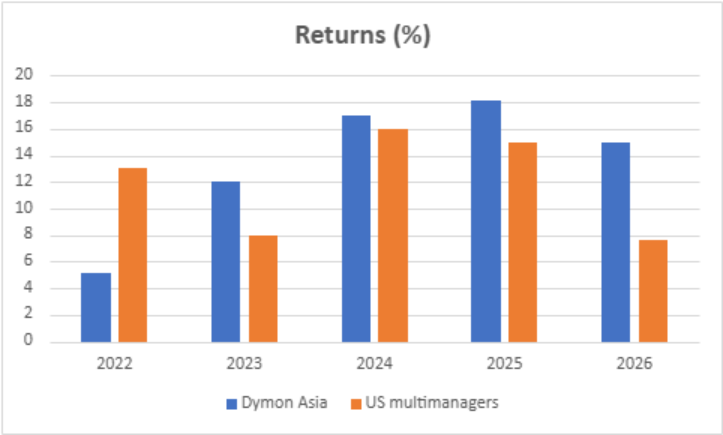
Since 2023, Dymon Asia has outperformed. The average for the 6 competitors in 2022 was also skewed by Citadel’s monster 38% which was driven by its energy trading business. Excluding that the median net return was around 9% for the peers in 2022.
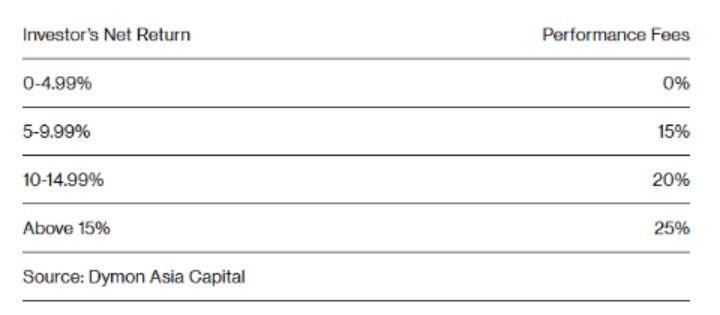
Dymon Asia’s growth has also been underpinned by a shift to a new fee structure in early 2024, with a hurdle rate of 5% and then a scale where the greater the performance, the higher the performance fee percentage. The table below illustrates this innovative structure. The only one of the big US multi-manager platforms to adopt a hurdle rate before charging performance fees is ExodusPoint.
The second largest Asian multi-manager platform Polymer Capital Management was set up in 2019 by Angus Wai and Asian alternatives firm PAG. Wai spent a decade at SAC Capital/Point72, including succeeding Dymon Asia’s Jay Luo as head of APAC for the firm. The flagship fund is market-neutral but focused on equities, without the asset class diversification of US multi-manager platforms. Since 2024 Polymer has expanded into single country funds focused on China A-shares and Japan.
More recently, in 2024 the former Millennium Asia Co-Chief Executive Officer Jonathan Xiong launched a Singapore based multi-strategy hedge fund with $0.5 billion. Backers included Canada Pension Plan, Blackstone and a unit of Temasek. Arrowpoint’s AUM and headcount have grown to almost $2 billion and 140 employees respectively. Its returns have been less explosive than Dymon or Polymer Asia this year, but the firm is increasingly well diversified across multiple asset classes and investing styles.
Read on for the sections on systematic hedge funds in Asia…
Comments
Nothing yet. Say the first thing.
Sign in to join the conversation.