

In his autobiography decades ago Mike Bloomberg talked about the advantages of keeping his company private. Is this still true given its massive scale?
The media outlet Semafor reported last month that Bloomberg management had early discussions with investment bankers about an IPO or a strategic transaction. A Bloomberg spokesman later said that the firm had no IPO intentions and that its co-founder was happy with its private status.
This is part of ongoing speculation about the future of the firm beyond the cult like hero that is Mike Bloomberg. The assumption is that when he is no longer with us the charitable trust that takes over control of Bloomberg will look to crystalize value.
But a move from private ownership into life as a publicly listed company anytime in the next decade - whether under the watch of Mike Bloomberg or the charitable trust - would be a big mistake destroying long-term shareholder and customer value in my view.
An acquisition by a big tech giant like Microsoft has always been touted as a potential end game for the Bloomberg empire. These firms of course have the firepower to finance a deal and would bring AI and tech expertise to Bloomberg. But one shouldn’t forget that in most of their strategic alliances with financial services firms they are largely focused on selling as much compute as possible and may not care about nurturing the capital markets focused depth that has given Bloomberg such a formidable moat.
Earlier this year I wrote about how Bloomberg’s success was turbo-charged in its early days by a crucial strategic partnership How the Merrill Lynch deal made Bloomberg - by Rupak Ghose and about the depth of Bloomberg’s moat in the wake of the threat from AI as LLM giants like Anthropic launched a finance vertical https://rupakghose.substack.com/p/bloomberg-is-dead-long-live-bloomberg
Since then, the response of Bloomberg to these developments has diverged even more compared to others.
Competitors are willing to or need to share the prize with big tech.
Bloomberg wants to keep it all. Bloomberg needs to keep it all.
In this piece I wanted to look at 6 reasons that Bloomberg should stay a private company:
Most to gain and most to lose from AI disruption,
A slowing growth trajectory and most exposed to a financial bear market,
Intense competition from niche data players,
ICE MarketAxess tie-up and Tradeweb look for growth,
The industry is moving from an M&A binge to organic growth, and
Bloomberg is a product first company.
Bloomberg has both the most to gain and the most to lose from AI disruption. It has the deepest moat by far amongst its peers but it is the most closed and vertically integrated model in the OTC data and trading platform universe. That drives its premium pricing and stickiness. It also creates a risk should that walled garden be unbundled.
What if an open world eats into Bloomberg’s competitive advantage?
Building in-house with ASKB rather than giving up distribution to OpenAI and Anthropic is the right strategy and recent improvements to the offering are notable. For all the talk of Bloomberg killers it is worth remember how much is available on the Bloomberg terminal but not currently used by the vast majority of customers. If ASKB could unlock this an LLM era may increase not reduce Bloomberg’s moat.
But the battle will be expensive and non-linear. This could create a contrast between rising capex and costs that are a major short term drag on Bloomberg’s financial metrics and the easier and cheaper path chosen by many of its competitors to partner with large tech companies.
It’s almost four years since LSEG announced its long-term strategic partnership with Microsoft. As the Generative AI drumbeat accelerated and share prices of publicly listed companies in the space got hammered, their management teams responded with a continuous flurry of announcements. Since then, all of the competitors in the space have announced partnerships with the likes of OpenAI and Anthropic to provide their data.
The pitch is simple. As Ben Jackson, President of Intercontinental Exchange said on its recent second quarter earnings call, “The answer to the view that a frontier model will commoditize software like ours: It has the direction backwards. The model is the commodity. The key is the governed network of record, its role-based permission map, and the behavioral data that only it holds, none of which a model owns and all of which it needs to be useful. AI does not shrink that advantage. It widens the surface area where our network creates value.”
This argument is constantly repeated by CEO after CEO in the data and analytics space not just in financial market data.
And the pain has been seen across a variety of other industry verticals. For instance, in legal data and analytics RELX and Thomson Reuters that own the two leading businesses have seen their share prices crushed in the last year while legal AI start-up Harvey has seen its valuation skyrocket with a current fund-raising round said to value the company at $15.5bn.
At this moment the threat to financial market data firms of disintermediation by LLMs is theoretical. Revenue growth across the peer group remains solid. For instance, in Q2 2026 ICE’s data business generated 8% revenue growth year on year above its long run growth rate.
But the risk is however that when and if the warning bells appear around disintermediation, then it will be too late to shift course. The challenge for building as a public company is that such course corrections and their costs are in full glare of the public. As much as sunk financial costs, the threat for publicly listed companies in the space is reputational damage having been forced into making bullish statements to shareholders previously.
The added element here is that the strategic partners at the table are few and could be fewer in the future. The likes of OpenAI and Anthropic are partnering with everyone in the space, making previous announcements that are made to sound unique partnerships appear increasingly commoditised.
Bloomberg’s advantage is that it can build quietly without disclosing any financial information around costs and revenue, and it can use adoption metrics selectively for marketing rather than having to feed public investors constantly.
A Bloomberg IPO would be a big event for Wall Street. It would garner a huge valuation as a public company and its brand strength would likely mean that it would start out trading at a premium valuation multiple relative to the peer group.
But markets are fickle and care most about financial metrics.
Unlike firms I have written about a lot in this newsletter like Jane Street and Hudson River Trading that are private but have financial performance data leak out owing to reporting to debt holders, Bloomberg doesn’t issue debt and its financial performance is not disclosed regularly. Most media coverage focuses on estimated revenues. This is typically a good proxy as the vast majority of revenues come from the Bloomberg terminal that rarely discount fees. But terminal numbers are not reported regularly on a systematic basis. Moreover, it is harder to track non-terminal revenues that have over time become an increasing part of the group.
Nevertheless, Bloomberg’s revenue growth has slowed. I wrote earlier this year that “In the decade 2001–2011, group revenues grew at 10% per year and in the following decade the pace halved.” I also noted that more recently Bloomberg has benefited from some decent price increases given it has a long-term policy of adjusting terminal pricing in line with inflation.
But it is hard to imagine that it has outgrown a publicly listed peer group.
FT Alphaville looked into this last month on the back of fresh data from BCG Expand. The chart below illustrates Bloomberg’s dominance in the pure financial market data and analytics space.
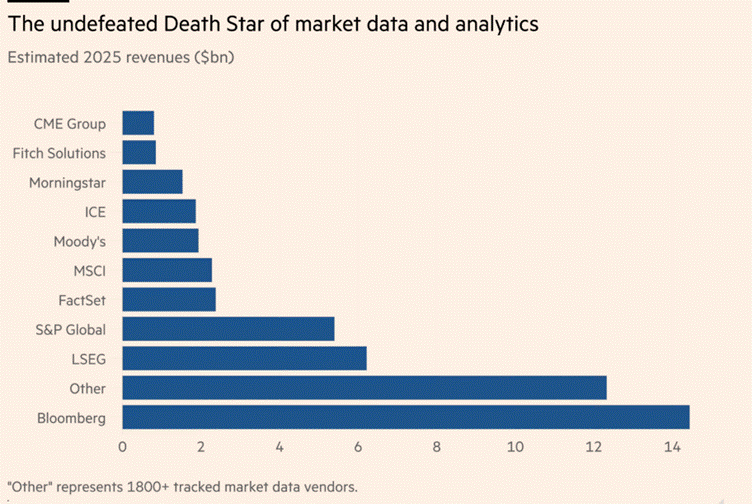
FT Alphaville noted that BCG Expand’s estimate of $14.4bn of Blomberg revenue in 2025 compared with an estimate from Burton-Taylor of $11.6bn in 2021. This would imply a revenue CAGR of just over 5% in line with larger competitors but slightly below BCG Expand’s estimate for the overall industry of a 7% revenue growth CAGR for the period.
The data is also unsurprising given terminal revenues across the industry have lagged the faster high single digit percentage revenue growth in Indices, Analytics, Pricing and Reference data. Bloomberg has a footprint across all these areas but the mix towards the all-in terminal bundle has been a drag.
Profitability metrics for Bloomberg are even more well-guarded than revenue growth. The business model should be very profitable and the firm has generated tens of billions of dollars for Bloomberg Philanthropy over the last few years. However, the huge cost base of Bloomberg News is likely a drag on profitability and it is notable that firms like S&P Global make substantially higher operating margins in their ratings and index businesses than in financial market data.
The risk is also as I have written in the past that if and when the bull market ends and headcount in the capital markets industry shrinks, Bloomberg may be more exposed than peers. Have you ever met a hedge fund or bank trader using anything but a Bloomberg screen?
Bloomberg’s customer base is more than just those users but it is notable that the financial market data industry did contract after the years following 9/11 and the GFC albeit bouncing as the next bull market built. As I noted in my last piece on the firm: “Like a swimming pool, there is a deep end and a shallow end to Bloomberg’s moat.” The risk particularly if we had a sustained bear market is that the tools and technology exist today in a way they didn’t in the past for customers in the shallow end (e.g. outside of fixed income trading) to substitute their very expensive Bloomberg terminals.
The BCG Expand highlighted that the fastest growth (and consequently market share gains) in the industry have come from the more than thousand smaller firms. The earlier chart shows that the “other” category generated $12bn of revenues in 2025. That includes long established brands like Argus Media in energy data but also newer firms.
Despite the collapse in public market investor sentiment around the financial data infrastructure industry, fund raising and valuations in the private markets remain robust. This is not unique to this sector and often the private markets lag the public ones. But in many cases, these are firms with faster growth catering to new emerging areas or attacking an existing area in a slightly different way.
The most obvious area is private markets data where large firms have paid up to get access to the niche. In June 2024 Blackrock agreed to acquire Preqin, a leading independent private markets data for $3.2 billion. This was 14x revenues or 69x adjusted EBITDA. S&P Global acquired With Intelligence for $1.8bn, and IHS Markit that is now part of S&P Global also made expensive purchases in this space earlier. In recent weeks Bloomberg followed the trend of expansion into private markets data and tools with the estimated $0.8-0.9bn deal for Canoe Intelligence.
But there are also firms that created niches reinventing data for equity and debt markets. AlphaSense recently completed a funding round that saw its valuation almost double from $4bn in 2024 to $7.5bn today.
Credit data intelligence firms with deep focus on leveraged finance, private credit, distressed debt and restructuring that cater to not just investors and bankers but also lawyers have been booming. Some started collecting court filings and sending journalists to court hearings but they are pivoting hard to AI backed by plentiful private capital.
Octus (formerly known as Reorg) has seen its valuation increase from $1.3bn in 2022 to around $4bn currently and its smaller rival 9fin which was valued at $500m in December 2024 completed a large fund-raising round at a $1.3bn valuation 4 months ago.
There are other asset classes where new firms are redefining the data available and building very sticky must-have platforms. Kpler started in LNG data over a decade ago and the global physical trade and maritime intelligence platform was recently valued at almost $4bn in a major fund-raising round.
These firms may be small compared to Bloomberg’s more than $14bn of annual revenues but they are growing very fast and well-funded. More than the larger well-known publicly listed peers they are the ones that have eaten away at Bloomberg’s domination of the data space.
Comments
Nothing yet. Say the first thing.
Sign in to join the conversation.