
Run It Back offers carefully researched articles on lesser told parts of black history. But I’m only able to do this work with your help. Please consider getting a paid subscription to Run It Back to help me keep writing these stories and making them widely available to students, educators and lifelong learners.
“If a race has no history,” Carter G. Woodson once said, “it becomes a negligible factor in the thought of the world, and it stands in danger of being exterminated.”
To Woodson, telling the black story was a matter of life and death. One hundred years ago, in February 1926, he founded Negro History Week to ensure the trials and achievements of black people would not be forgotten.
Woodson came of age in a time when few Americans knew much about the collective history of Black people. Black history was rarely taught in schools, and the first-hand accounts of Black life from those who had truly lived the history, such as the formerly enslaved, were not valued in academic circles. Woodson, a one-time coal miner from rural Virginia, experienced this erasure firsthand. While he was studying to earn his PhD at Harvard University, a famed professor told him “the Negro had no history.” Determined to prove him wrong, Woodson dedicated his life to chronicling black life and creating an infrastructure to ensure that black history would never again be ignored.
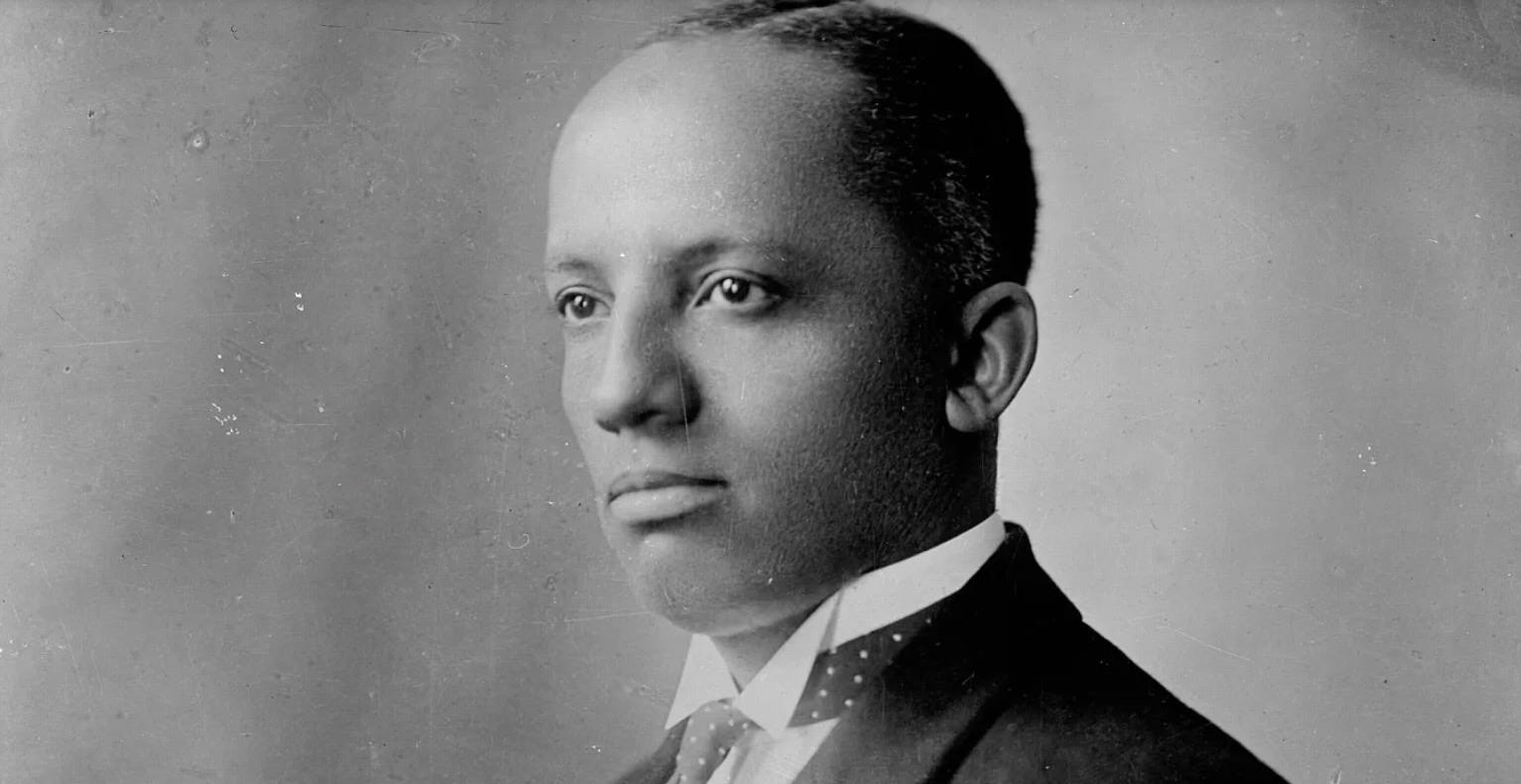
In 1915, while working as a high school history teacher, Woodson co-founded the Association for the Study of Negro Life and History (ASNLH). Based in Washington D.C., the organization’s mission focused on “the collection of sociological and historical documents and the promotion of studies bearing on the Negro.” ASNLH launched an academic periodical, the Journal of Negro History, and a Black-focused publishing imprint called Associated Publishers. As the editor of both enterprises, Woodson published hundreds of works of scholarship about Black life, ranging from analyses of black labor trends to firsthand slave narratives to explorations of the African diaspora. Many of the most preeminent black writers and thinkers of the 20th century came into Woodson’s orbit; Langston Hughes did clerical work for ASLNH as a young poet, while Zora Neale Hurston’s groundbreaking research on Cudjoe, one of the last living formerly enslaved African Americans, was funded in part by Woodson’s organization.
Woodson fought ferociously to keep ASNLH independent, often clashing with his primarily white donors at the Rockefeller Foundation and the Carnegie Foundation. Ultimately deemed a “radical” by the white establishment, he and his organization were largely cut off from philanthropic funding in the 1930’s. Instead, Woodson turned to working and middle class black people for support. Black schoolteachers, businessmen and ministers rubbed shoulders with academic scholars at the annual ASNLH conference. Monetary contributions flowed in from 28 states. Though many donations were less than a dollar, they illustrated how widespread the thirst for black history was becoming.
Among ASNLH’s most active members was Chicago’s Vivian Harsh, who became the first black woman in the country to lead a branch of a public library. Harsh built an impressive collection of books at the library and spearheaded a lecture series that brought in the leading black intellectuals of the day. Adult education was also emphasized; Harsh co-founded a history club at the library that welcomed black Chicagoans of all ages to learn about their people’s past. “If we Negroes knew the full truth about what we, as a race, have endured,” Harsh remarked, “our respect and hunger for education would triple overnight.” She was one of many who shared black history at the local level without being perched in an ivory tower.
By the time Carter G Woodson died in 1950, he was being hailed as the “Father of Black History.” His most wide-reaching achievement in his varied career, however, was without question the establishment of Negro History Week. Initially devised by Woodson to help generate funding and publicity for ASNLH, Negro History Week quickly became popular in black communities, prompting lectures, parades, and special school curricula. As early as 1932, some white schools were also acknowledging the occassion. By the 1970s, Negro History Week had grown into Black History Month, with President Gearld Ford granting the celebration federal recognition in 1976.
Woodson did not live to see Black history become a ubiquitous part of American education, nor to see it systematically removed from school curricula over the course of the current decade. But there are lessons in his approach. He was prolific in his proudction of scholarly work, laying a rich soil of scholarhsip for future generations to sift through. He didn’t brook compromise with those who would neuter his message. Most importantly, he saw history as an oppportunity for everday people to make sense of their own place in the world. Woodson worked not only to preserve a Black past, but to ensure a Black future.
This piece was originally published at the Gilder Lehrman Institute of American History.
If you’d like to support this work, please share this article on your social networks, or forward this email to a friend.
No posts
Comments
Nothing yet. Say the first thing.
Sign in to join the conversation.