
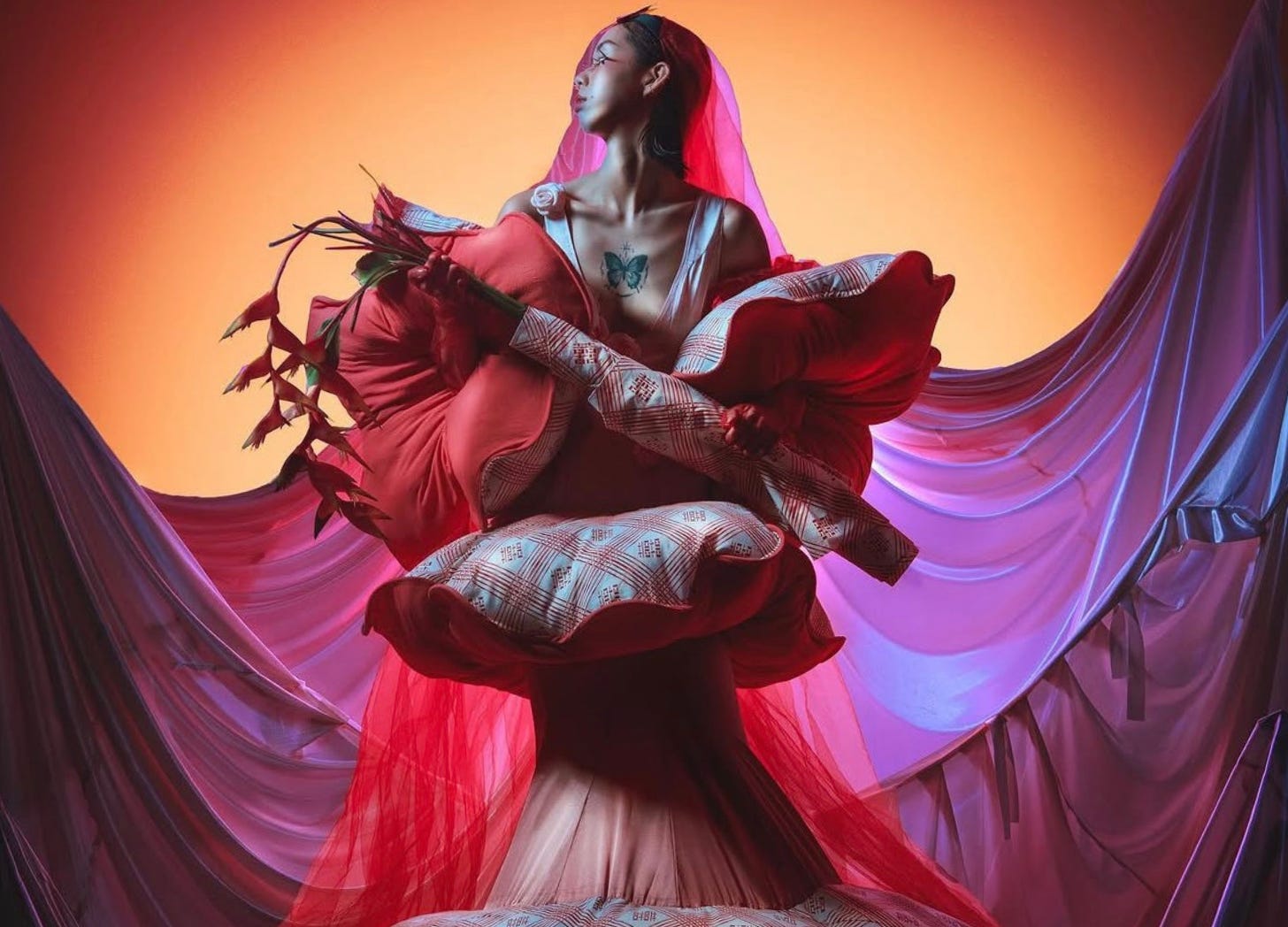
谢伊颖 Ellie Xie, a recent graduate of the NYU Gallatin School of Individualized Study, works across graphic design, fashion design, art criticism, and creative direction.
As co-founder of the geolocation-based social app CUPE, Xie transforms her experiences with missed encounters, cultural displacement, and social anxiety into opportunities for meaningful interaction. Drawing from her Chinese heritage and life across the Midwest, New York, Paris, and London, she creates work rooted in movement, change, and chance.
Across Borders spoke with Xie about finding expression beyond language, taking ownership of her Chinese identity, and the invisible pressure of building a creative career as an international artist in the United States.
The following interview has been edited for length and clarity.
Across Borders: How do you describe yourself as an artist? Has that definition shifted over time?
Xie: I see myself as a creative director and artist. I was always creative because my dad is really creative, and when I was younger, he always taught me how to draw, and he took me to the museums when I was in China. I was always really into art. I go to the galleries a lot, and I’m really obsessed with the philosophy of conceptual arts, which really inspired me a lot. Art doesn’t have to be a painting; it can be anything.
Across Borders: How has moving across places, geographically or culturally, shaped your work?
Xie: I get inspired by a lot of traditional Chinese elements. That’s who I am. I feel really privileged that this is what my people give me and that I can really take ownership of my “Chinese-ness”. When I came to New York, I was really inspired by this boldness of the style, more chic, avant-garde, and just really conceptual. London is posh and elegant. All those are different places that really add to the layers of me being an artist, and it’s through my experiences that I get inspired and make that art.
Across Borders: What does it mean to be an immigrant artist from China in America for you?
Xie:. I hate to say it, but when I first moved here, I was really insecure about being the odd person in the room. I was just a little Chinese girl who didn’t even speak English, I learned English in Michigan and Ohio, and I was the only Chinese international student. I tried really hard to fit into the culture and just separate myself from my Chinese side as much as possible. Now, 8 years have passed. Only recently have I started taking pride.
Across Borders: Why do you think that shift happened?
Xie: When I was in Ohio, we had a small community, and it was really local-based. I had a group of artists. I was the only international person within the artist friend group. They were always really interested in my perspective. Everybody just gave me so much love and support, and I went from having this insecurity to people loving the Chinese side of me. My friends really give me the confidence that being Chinese is something I should be proud of, and it’s something beautiful.
Across Borders: Reflecting on your arts, do you have specific references, values, or experiences that you consistently show up in your work?
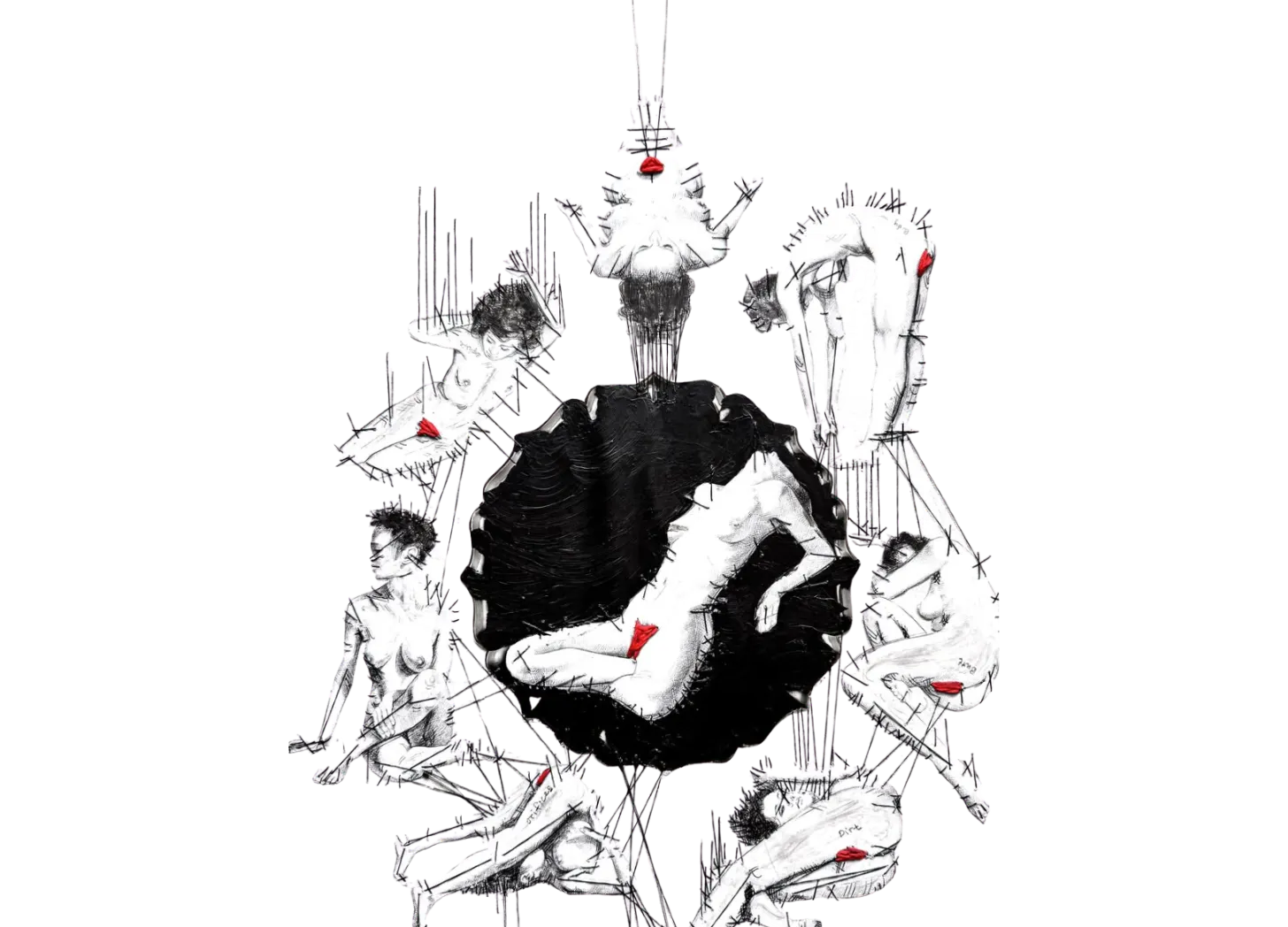
Xie: As an immigrant, I didn’t speak the language. So fashion was the first medium that I grabbed because I don’t really need to speak for myself. It spoke for me. I’m really a maximalist. Everything that I create is sort of in relation to myself. For example, Missed Encounter: I was timid when I was in high school because I was from a different country, and I let so many moments slip away. That’s why I created Missed Encounter to help other people. Through this process, I’m also able to open myself up and inspire other people.
Across Borders: What has been the hardest thing to navigate, structurally, as an artist working across borders?
Xie: At the end of job applications, there’s this question: “Would you need sponsorship in the future?” When you check that, you already know you’re not gonna get it. It’s really brutal. Sometimes I wish I could just take on a shift in a coffee shop, but we cannot even get that kind of job because under OPT, jobs have to be relevant to all your studies. It’s just really difficult for you to pursue your career like everybody else, and especially in the creative industry, the budget is so thin. It’s not a tech company. They can just pour money in. As an independent artist, it’s just hard to even apply for the O-1 visa, which would be $10,000.
Across Borders: Are you on OPT right now?
Xie: I’ve been waiting for my card for a long time, but it’s still not here. I applied in April. It’s already July 12th. So it’s been 3 months, and I think I put the start date on June 1st. It’s still processing.
Across Borders: You take on a lot of different jobs and different sectors of the creative industry? Do you think it’s because you felt you had to do double the work that everyone does to fill a resume?
Xie: Nobody else can really understand if they’re not in our shoes. I always know that there’s a time crunch and the pressure is invisible. I wake up every day and I just know I have to do whatever I can to get this visa. I cannot just sit around.
Across Borders: What kind of other compromises, if any, have you felt you’ve had to make to practice and live across borders as an artist?
Xie: I don’t like AI, but the compromise is that I have to take on work that doesn’t really purely align with my values. I got that because CUPE is a social app, but I made that app to encourage people to hang out in real life. The app landed me jobs in the top companies in AI, which is super contradictory to what I do. What I love doing is analog, hands-on processes of creating art.
Across Borders: Why is it important to allow artists to move across borders?
Xie: For me, art is the highest form of hope. Science and art are all extremely fundamental things for us to move forward. If you are somebody who’s able to say something, make something, and bridge the gap between different countries, I think you should be given more chances.
About the Author: Rosella Nguyễn
Rosella (Thùy An) Nguyễn (she/her) is a Vietnamese creative strategist, cultural producer, and arts journalist based between New York and London. She is a recent graduate of NYU Gallatin, where she developed an individualized concentration in Cultural Innovation: Performing Arts, Global Media, and Social Psychology, with a minor in the Business of Entertainment, Media, and Technology. She is currently pursuing a dual MA/MSc in Media, Culture, and Global Cities through the London School of Economics and NYU Steinhardt.
Drawing from her own experience as an international arts student, Rose is the co-creator and program lead of Run Artist Run’s Across Borders s, an editorial arts column and advocacy initiative aimed to support immigrant artists and creatives navigating visibility, access, and belonging.
Across Borders is an international arts column spotlights immigrant and transnational artists working across countries, disciplines, and systems of belonging. The series expands RAR’s mission to consider artists as they move through borders, creative industries, institutions, and the structural realities of building a creative life across geographies. Through artist interviews, the series explores visibility as advocacy, access, and support.
Thanks for reading RAR's Across Borders! If you enjoyed this article, please consider sharing it with others! :)
Comments
Nothing yet. Say the first thing.
Sign in to join the conversation.