
This post is primarily a reflection on both attending and acting when the political stressors are many. And how does climate fit into it all? Plus upcoming book groups and a few odds-n-ends I have in circulation these days.
It’s late February in an already-long year. Seemingly every week of 2026 has held multiple new lows, concurrent distressing revelations, and geopolitical brinkmanship. I’ll spare you and me alike an exhaustive/exhausting litany. (Press time addition: today’s U.S.-Israel strikes on Iran.) To pay attention to and engage everything happening is simply untenable. It would be unbearable.
It’s never been more clear to more of us that the way out won’t involve fiddling around the edges in the vain hope of preserving a status quo that works only for the few. The fight for a livable climate and a functioning society (they go together) requires overthrowing the interlocking system that bell hooks called imperialist white-supremacist capitalist patriarchy. What got us here, as the phrase goes, won’t get us there.
This presents a moment for more of us to face what Black and Indigenous and people of color have been experiencing and saying for a long time about U.S. fascism and state-sponsored violence. As Tressie McMillan Cottom points out, more of us are now able to see it, or see it differently, because we are now recognizing our vulnerability to it.
When we are facing crises—and indeed, some gradation of worldview collapse—it’s easy (perhaps especially for us white folks who haven’t gone through it yet) to go in one of two directions: a) reactive, urgent, and manic, or b) checked out and numb.
The former mobilizes us in an unsustainable and often individualistic way; the latter immobilizes us. (And yes, I’m personally familiar with both.) Both options offer some form of short-term relief from discomfort, but long-term, neither gets us where we need to go.
In light of all of this, over the last month or two, there’s been a lot of conversation about emotional regulation. How to stay regulated so you’re not acting out in unintentionally harmful ways? But without the alleged apoliticism (which is itself political) of “protecting my peace”? Can you even stay regulated under fascism and bearing witness to layers upon layers of atrocity? Is that even a worthy goal?
I want to validate that this is an important conversation to keep having, and fully feeling and processing difficult experiences is important work. The climate mental health space has addressed this dynamic—trying to stay upright while living through system collapse—for some time and offers helpful frameworks. Practitioners talk about learning how to stay within the “window of tolerance” or “resilience zone”: taking actions that keep your nervous system in a place you can sustainably engage with the realities and face the distress, but without sending yourself into hyperarousal which will make you act frantic and reckless and soon flame out, or simply shut down.
(Note: this is in no way to tone-police the utter rage and grief many people are rightly living with right now. Actually feeling grief is essential. And rage has an important place in and can fuel social action. It’s just a difficult one to maintain long-term and yet stay in the work that is lifelong work.)
As a horizon to aspire toward on the path of difficult feelings, I like climate therapist Leslie Davenport’s framing of emotional resiliency. She defines it as “cultivating the ability to remain grounded, empathetic, clear-minded, open-hearted, in the face of increasing distress.” This is something more robust than a sort of “keep calm and carry on” staidness, and more active than some definitions of resilience which amount to, conveniently for the powerful I may add, “the ability to withstand and take more injustice.” Rather, in this kind of resilience, we experience the full range of emotional states but nonetheless find ways, through practice, to use them productively and strategically.
Cultivating this ability through practice is what another climate psychotherapist Caroline Hickman has termed “internal activism.” Researcher Britt Wray calls it “inner activism” and pairs it with “outer activism.” Part of our work right now is to practice inner activism, not only outer activism. But we know they go together and turn one another, like interlocking gear teeth. In fact, in lived experience the boundary between the two is unclear. Nonetheless I’ve found these concepts of emotional resilience and inner activism to be helpful concepts for grappling with the climate crisis—and related crises of separation and domination—without looking away.
Here are two further resources on this:
Unthinkable Resource Hub: a site to explore mental health, including a quiz for free personalized recommended resources
Climate Mental Health Network’s Emotional Resilience guide, and its simple three-step process: Let Be, Let Flow, Let In
These are geared toward processing eco-distress. But learning to live with the weight of climate while staying engaged translates to other political issues, which are of course linked. (More below.) Whether it’s in facing and responding authoritarian and state violence, genocides, economic precarity, pedophilia and sex trafficking, or ecological destruction, it is essential to take up practices and forms of care that enable one to continue in the work of bearing witness and acting boldly in community.
This brings us to the heart of what many of us are wondering: with everything going on, is it out of touch to still be focusing on climate at all right now?
One way to answer this question is to examine what stories we’re being exposed to. This is explored by journalist Sammy Roth in a piece about the mediascape as it relates to the Washington Post news. (If you missed it, Bezos laid off about a third of the staff, including an estimated 14 climate journalists. Yes, this feels like a long time ago and almost background noise amid all the other chaos.) What happened at WaPo coincides with legacy media “pulling back from climate coverage, even as global warming accelerates.” This has been the case, not just in the U.S., but globally, since about 2021. We’re simply hearing less media about climate.
At the same time, recent studies do not seem to indicate peoples’ lessening concern about climate. After all, globally between 80-89% of people want their governments to take stronger climate action and are willing to contribute their money to solutions (even as most of us underestimate our compatriots’ concern).
Why the disconnect, then? A lot could be said about the capture of corporate media. It could be that there’s too much else happening, that any given “issue’s” prominence is diluted. It could be that real system change is blocked by the same forces undermining democracy and those fighting are fatigued. Probably all of the above.
One persistent challenge with communicating and acting on climate is a sense of psychological distance. Humans have long tended to prioritize more immediate threats over long-term and seemingly distant ones, which makes this particular crisis uniquely challenging for us. Even at a time when more and more people are experiencing the extreme and/or weird weather that is a hallmark of planetary heating, how does one prioritize a collective response, then, when, for example, food and cost of living prices continue to increase, or masked state agents are terrorizing your neighbors? I get it.
But another way to answer whether now’s a time for a climate focus is to recognize the interconnections between all of the issues. (And yes, much is all connected, as journalist Amy Westervelt outlines in her piece: “Yes, Climate Still Matters. Here’s How It Connects to Every Other Crisis in the World Today.”)
Working for a world that prioritizes the will of the people over the interests of the few, where people aren’t snatched off the streets or worse, where abusers are held accountable, where there is value placed on human life and health when making regulatory decisions, is crucial for making any progress towards a livable climate future. It’s not an either-or. And this knowledge can, I think, keep us from paralysis over whether we’re spending our time, resources, and emotional energy on the “right” issue. To the extent we’re addressing any of them, justly and in community, we’re working for a world in which collective action can bring about better possible futures.
For those of us who feel stuck, or daunted by the enormity of political regression, Tressie McMillan Cottom again brings a word. In a video worth watching in full, she says: “We are not exhausted because we’re aware of too much. We are exhausted because we are doing too little.” She continues: “People who feel agentic aren’t as tired. They are not as easily overwhelmed.” An onslaught of negative news “wins when it convinces you that the only thing you can do is watch what is happening.”
This matches my experience, for sure. Yours?
In this way, action of any meaningful form is an antidote to paralysis. In my last newsletter’s interview with Madeleine Jubilee Saito (which I commend for Madeleine’s words and art!), we discussed an important caution about action being the antidote. Bringing hyperarousal and untended grief into collective action spaces can be unhelpful to those around you—and it is unsustainable for you (as discussed above).
At the same time, in an important way, action is an antidote. We oughtn’t wait for a feeling of motivation to act, nor confuse online awareness for actual action. Get in motion. Don’t just scroll. Find your way into community conversation and action. You may be surprised to find yourself feeling more energized, less overwhelmed, and more effective.
Knowing where or how to get into motion isn’t always straightforward. But asking “what’s the next right step (or a next good step) I can take?” is a good one I come back to and recommend often.
There are a number of tools available to explore possible answers to this question. That may be a forthcoming post. But for now: don’t overthink it. It’s easier to see and shift direction once you’re already in motion. A good place to start: find people to talk with, honestly, about what’s going on and where you can get involved. Talking often leads to insights, connections, even collective effervescence. There are lots of local groups taking action of many sorts, and you can find them by talking.
Most basically, in the words of the great Arthur Ashe: “Start where you are. Use what you have. Do what you can.”
Next up in my Eco-Book Groups series in collaboration with the Michigan Climate Action Network (MiCAN):
March 25 (6-7pm): A Psalm for the Wild-Built, by Becky Chambers. A short sci-fi novella in a solarpunk setting!
Looking ahead at April 13 (7-8pm), we’ll be discussing What If We Get it Right? Visions of Climate Futures, by Dr. Ayana Elizabeth Johnson (a third-time group selection; it’s that good). It’s a hefty book, but filled with short interviews, stat sheets, and art. This to say: if you want to read it in full (and it’s worth it), start early. But if you want to pick a few topics/interviews or a section, there will be plenty there to stimulate your thinking to bring to the discussion—you don’t need to read the whole volume.
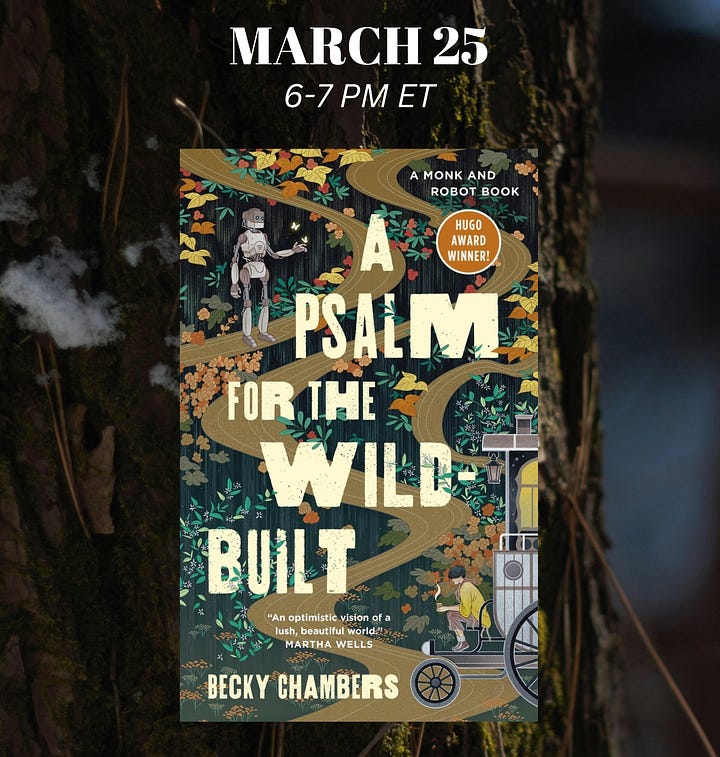
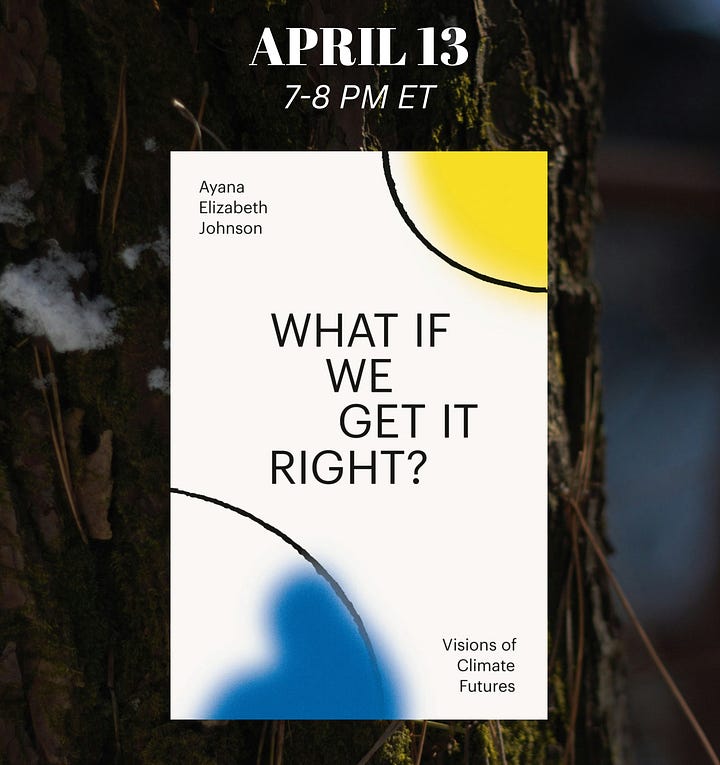
You are invited to join either of these free online discussions. More details and sign up here. (Here’s the Instagram post.)
Some of I’ve been sitting with or has been moving me lately:
Has my attention: well not fully yet, but I know I need to start preparing for spring gardening—the window comes and goes fast!
Working on: just showing up to events, especially when someone is doing creative community-building. (Shoutout to my friend and fellow Substacker Mae for launching a baking club!)
Reading:
King: A Life by Jonathan Eig. It’s a sizeable bio; I’ll be at it for a while.
Plus February’s discussion-provoking Eco-Book Group book, Human Nature: Nine Ways to Feel About Our Changing Planet. A climate modeler, Marvel weaves earth science (what we know and how we know it), with history (how past climatic events inform our present and future), with emotions (how does what we know affect us as whole people and what do we do with that knowledge?). I learned a lot from the strands she weaves, on holding both certainty and uncertainty, the limits of science, and our options from here.
Listening to: Mon Rovîa, an Afro-Appalachian singer-songwriter whose acoustic songs I find thoughtful and calming. (Plus ‘Heavy Foot’ is a song for our times.)
Learning: CPR. I was far overdue to take a class. (Update: I took the sewing class last month. But now I’ve got to practice.)
But I’ll admit: February was a blur and a grind. Hopefully I branch out more in March?
Anyhow, I’d love to hear anything you’ve had circulating in these categories (or others!). Just hit reply.
Note: this post has been edited for more precise and careful language befitting some of the topics explored here, as well as minor formatting changes. Newsletter readers will have received the outdated version.
Thanks for reading. If you found this post beneficial, I’d appreciate a quick like or share—it helps build momentum and community. To learn about future events I’m putting on, watch this newsletter or subscribe to the Movement & Meaning events page, hosted on Luma.
Comments
Nothing yet. Say the first thing.
Sign in to join the conversation.