
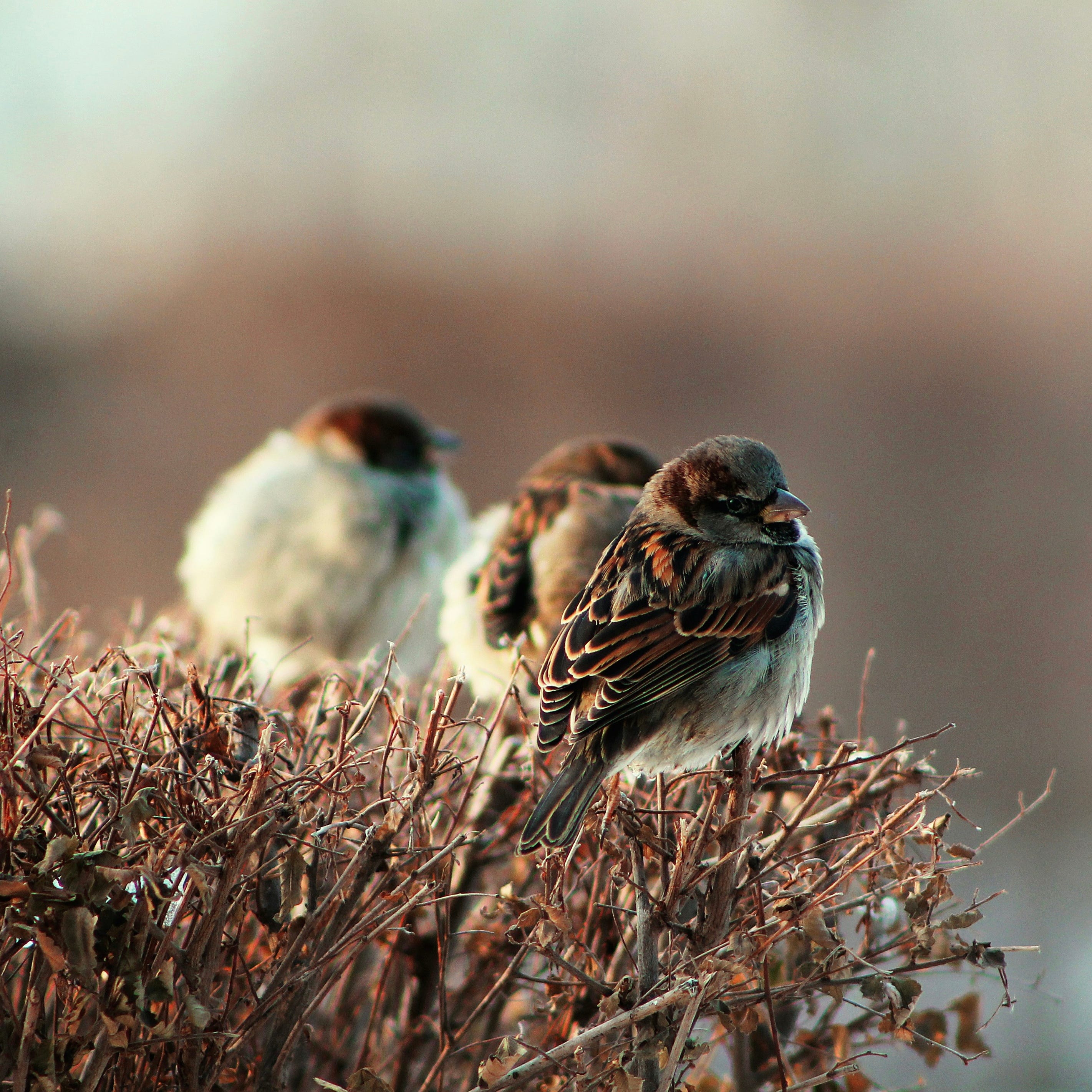
Flocks of sparrows like to perch on my neighbor’s hedge. I see them from where I sit this snowy day. Ready to dive into the thicket of branches below at the first sign of the neighborhood hawk, they chitter back and forth; they conserve precious energy, warming themselves by sun and fluffed feathers; they move together to find food, transcending environments and crossing human-made boundaries. Sparrows’ survival skills—like pigeons’—are considerable, and worth considering. More on this below.
Dear readers,
This will be a shorter post, but I hope you’ll find it useful.
I’ve been quiet on this platform for a season. But offline I’ve been asking many of the same questions, along with new ones, while trying to move my way into answers.
Whether you subscribed more recently, or you signed up for this years ago, here’s what this newsletter explores: how do we make sense of the ecological and climate crises, and the other interrelated crises we face, in ways that yield both meaning and action? To paraphrase philosopher Timothy Morton, how do we pursue thought that is actionable, and take action that is thoughtful?
To ask this—and act on it—remains urgent. You don’t need me to tell you we are in a strange and distressing timeline. All is not well. That’s not new.
There’s a lot that’s difficult to address right now, to say nothing is to tacility accede if not concede.
We’re living in a time of multiple ongoing genocides and ecocide, the consequences of runaway capitalism, the continual legacy of colonialism, and in the U.S., backlashtic responses to racial and gender progress (or perceived progress)—all serving the very serious function of funneling more money and resources to the very richest of the rich. Politically, the imperial boomerang is boomeranging. There are new signs of U.S. fascism daily, with mass government layoffs, an unelected far-right billionaire (whose actions have Nazis and plenty of others believing he’s one of them) at the highest levels, and critical social funding cuts, including resources for lifesaving climate responses through USAID along with domestic climate programs benefiting communities around the country.
Whew. There is more happening than one can keep up with. That’s by design.
In a year we need politics to be working toward climate action, it feels we are going in the wrong direction. The data is in, and 2024 was the hottest year on record, with the last 10 years being the 10 hottest in recorded history, yet fossil fuel emissions again increased (when they need to be rapidly dropping)—with no small help from the military industrial complex. This past month was unexpectedly the hottest January on record. The LA fires finally just stopped burning while Appalachia is still mired in the effects of Hurricane Helene. While yes, wins are also happening—especially global momentum behind the renewable energy transition—the U.S. is causing an undeniable setback.
The list could go on. And there are many excellent newsletters on this site if you’re looking for expert analysis on political news and macro-trends. But going forward, what you can expect from me here are slower, cooler takes; less from the fog of the news cycle (like the above), and more what I’ve found by way of approaches and tools for taking active thought and taking thoughtful action.
Within the chaos of the political moment, I’m sitting with the counsel I keep hearing wise people bring to the forefront:
The overwhelm is the point (so don’t give away your attention and energy);
Work locally to build alternatives and find local groups that are already organizing (including climate groups);
Everything is connected, so you don’t have to be an expert on everything or work on every single area that concerns you;
But do work on what you know best and where you can best contribute;
Be careful about your information intake and mind your well-being without using that as a reason to tune out or tap out.
I’ll add to these a few more I’m trying to remind myself. See if they land for you:
Do what (most) anyone can do (e.g., call electeds, protest, donate, organize, support, etc). And especially do what only you can do (have conversations in your network, contribute your skills, work within the organizations you are part of, make changes you are uniquely positioned to make, etc).
Even more foundationally: check in, and share out.
What I mean by check in: be present to ourselves, actively process, pay attention, show up.
And share out: connect with people, serve your community, circulate what’s helpful, spread out the work.
The opposite, in other words, of checking out—whether by self-distraction, normalcy bias, or doomism—and sharing in—doomscrolling, keeping information, knowledge, and resources for oneself and in one’s own head and body, not problem-solving within or building external community.
When times are overwhelming or confusing, we can at very least check-in (with ourselves and relationships) and share out with/to our communities. These two actions can at the least ground and orient any other actions and keep us contributing to the active work of repair.
On that note, one of the places I think I can best contribute in a small way right now, within current interrelated crises, is on the climate action front. Hence using this platform to share out more consistently. Today that looks like passing on a few resources for any of you who would like to learn / act more in this area.
In addition to anything else we can be doing, we can choose what to read and take in, and how we engage our sources of information. To this end, a few climate-specific recommendations:
I’ve been meaning to do this for a while, so it’s time to move! So many people are writing well and differently on climate on this platform. And if you’re reading this, you’re likely interested in finding these folks. Below are just a few of special note for now, but I will keep sharing recommendations (especially as more communicators move onto this platform):
Talking Climate - climate scientist and communication expert Katharine Hayhoe brings the most reliable and accessible format each time: a) the good news, b) the not-so-good news, and c) what you can do
The Crucial Years - for putting political trends in the context of planetary crisis, from one who’s seen it all, Bill McKibben is peerless
What If We Get It Right? a powerful mix of political analysis, pragmatism, and possibility by Ayana Elizabeth Johnson
The Climate Brink - for climate science, put into context of our possible futures, by two climate scientists
Refugia Faith - for people of faith, and especially Christian-lineage folks, Debra Rienstra delivers this accessible roundup every two weeks at the intersection of faith and climate
Reading independent outlets and journalists, and local ones, is especially important right now, as quality journalism is underfunded, government agencies’ data is continually being removed by the current administration, climate disinformation is spreading, and social media is run by billionaires who don’t have your interests in mind. In this scenario, digital and climate literacy is a form of action taking that can reduce deadly misinformation. Here are a few solid sources on the climate beat:
Most important? Your local and state sources of nonprofit journalism (like Planet Detroit and Bridge Michigan serving Michigan, for example)
Atmos (culture; some of the most beautiful and creative climate content out there)
Grist (nonprofit at the intersection of climate, solutions, justice)
HEATED (investigative journalism that takes climate crime seriously; yes, also a Substack)
Inside Climate News (wide-ranging global coverage)
Carbon Brief (global and scientific, with excellent trackers for those who like data)
Canary Media (clean energy transition focus)
You can see even more under ‘Recommendations.’
A handful of helpful articles from recent months:
Waging Nonviolence’s 10 ways to be prepared and grounded (if Trump wins/now that he’s won/now that he’s in office). List of reminders that have less to do with the person, and more to do with how social change works. Their other recent pieces are similarly helpful.
Atmos’ Climate Wins Are Happening, You Just Aren’t Hearing About Them, contra the negativity bias of traditional media.
Whitney Bauck’s post-election maxims. These are worth framing over a desk or hanging on a fridge.
Ayana Elizabeth Johnson’s short list on acting as if we love the future. Read her whole newsletter (above) or book (below) for more of this energy!
Sarah Lazarovic’s motivational post What my daughter’s running has taught me about climate typifies her fun, witty newsletter Minimum Viable Planet (even if you aren’t a runner! but especially if you are).
Last weekend saw—in addition to the phenomenon that was Kendrick Lamar’s multilayered halftime show, including its protest—the first-ever SuperBowl commercial by a climate nonprofit. Science Moms, a nonpartisan advocacy group, ran a poignant 30-second ad called ’By The Time.’
Dr. Katharine Hayhoe connected the ad to the greatest motivator driving climate action today: love, especially for rising generations. Research she links shows love for the next generation is a much more potent and universal driver to protect and care for our habitable climate than jobs or extreme weather are (yes, there is nuance there).
This has been known by the climate communications field for a while. But especially in this time, it is an important reminder to keep in view: that love is renewable energy, and perhaps the most personally sustainable place to work from for lasting change.
One last note on love as motivator, I appreciated the quote (shared by Whitney Bauck) from the great nature writer Barry Lopez:
"It is more important now to be in love than to be in power...It is more important to live for the possibilities that lie ahead than to die in despair over what has been lost."
A pair of upcoming and past efforts I contribute(d) to, in case either appeals:
The last few autumns, I’ve organized groups to discuss books that relate to this newsletters’ themes. Now I’m holding a winter-spring edition:
These groups are held virtually, open to anyone, as a free session to discuss with others who are interested in these topics.
Here’s the lineup (you can sign up and get more info here):
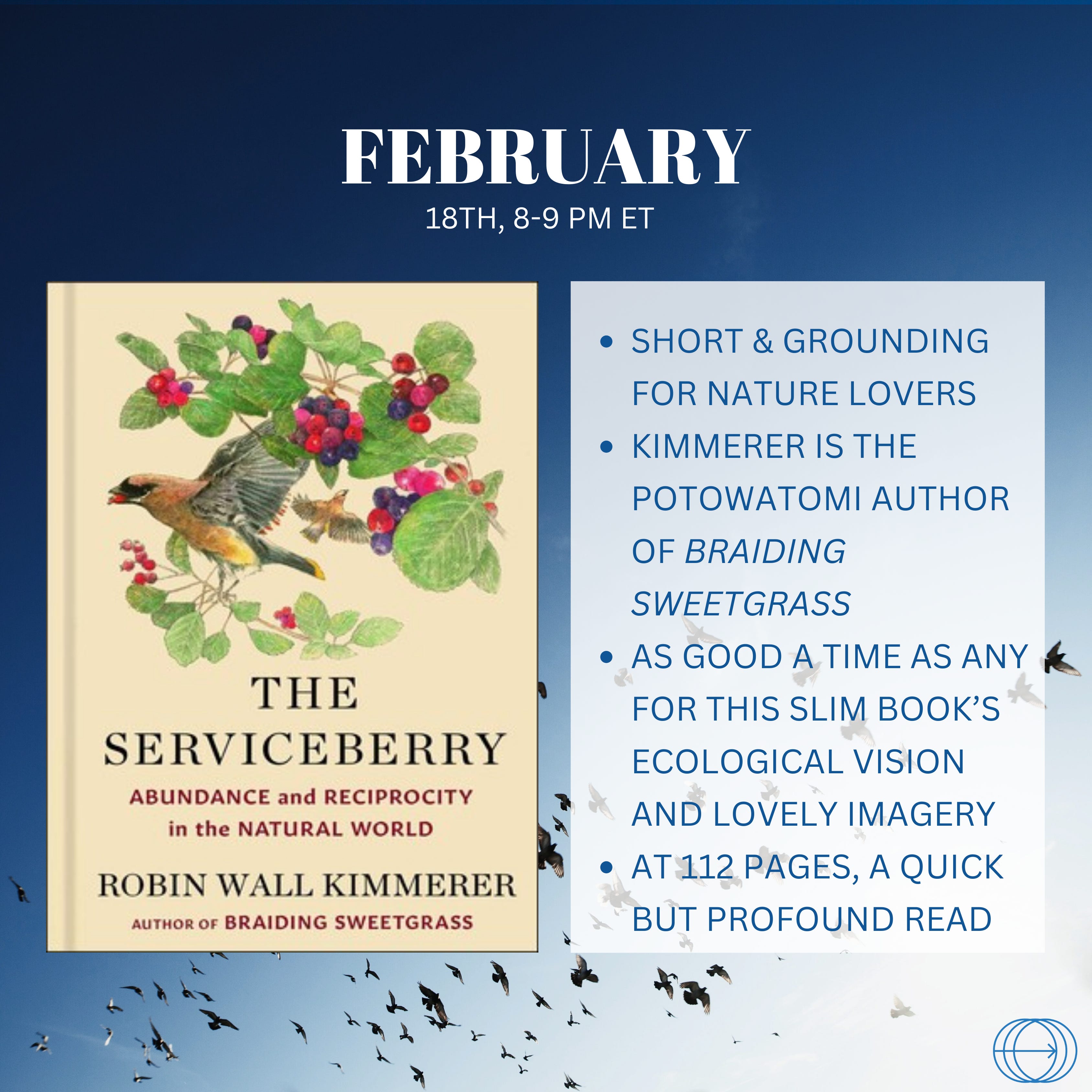
February 18: The Serviceberry by Robin Wall Kimmerer
February 24: Hope in the Dark by Rebecca Solnit
March 15: The Big Fix by Hal Harvey and Justin Gillis
April 16: What If We Get It Right? by Ayana Elizabeth Johnson
May 6: It’s Not That Radical by Mikaela Loach
If any of these especially intrigue you, or have been on your list, I hope you’ll start reading and join our discussion.
Yes, discussion of The Serviceberry is coming up on Tuesday (already!), but the book is slim and approachable. Find a copy (or pick another coming up) and let’s co-read.
Are book groups the most vital way to civically engage times like these? Perhaps not, but they can feed other forms of engagement. Learning and action drive one another.
Eco-facism has been at work for some time in the U.S. as a response to eco-distress (this is not a small claim, which I hope to explore more in the future). Ongoing and new immigration policy reflects this. Alternatives always start in the imagination, so I want to circle back to a piece from two years ago, which my friend Liuan (who writes the excellent Becoming Whole newsletter!) and I wrote together. A lot has happened since. Written in a Christian framework, the hope is that its ideas travel and translate.
Pigeons and sparrows may be surprising sources of inspiration. Per author Jennifer Ackerman, pigeons are sometimes thought of as little more than “rats with wings” but they have broad cognitive abilities and they are brilliant at mental mapping—knowing where they are, and getting to where they want to be. Also they are scrappy and adaptable. These are important traits to mimic and embody in these times, I think.
Similarly with sparrows. The little birds I see out my window may appear numerous, drab at first glance, and common—and they are, as the house sparrow is “the world’s most widely distributed wild bird.” But they got that way by way of remarkable adaptive skills, especially group problem solving. They are experts at congregating and working together for survival. This has led to their matchless ability to switch contexts, food sources, even complex environments—giving them advantages in a dangerously warming world.
In navigating the fraught political landscape of 2025, I think we could stand to learn from savvy flock birds like pigeons and sparrows who learn, move, and survive—who find their way—together.
Of course, even when it is hard to know what to do, singly or in a flock, often the most important thing is just to start. As Octavia Butler reminds us (via my friend Jordan):
Well, this wasn’t that short. Alas. If you made it here to the end, thanks for reading.
Comments
Nothing yet. Say the first thing.
Sign in to join the conversation.