
Precious metals miners are in an interesting situation these days. They’re producing something they expect to appreciate and selling it for more than they need to cover capital spending, dividends, and debt repayment. In other words, they’re generating “free cash flow.”
So why not just keep their excess metal rather than selling it, allowing shareholders to benefit from its future appreciation?
Very few miners do this, but many are probably wondering if they should. And — perfect timing — one of our Portfolio companies just announced that it is indeed hoarding metal. Here’s an overview:
First Majestic Silver (AG) just reported solid Q2 numbers:
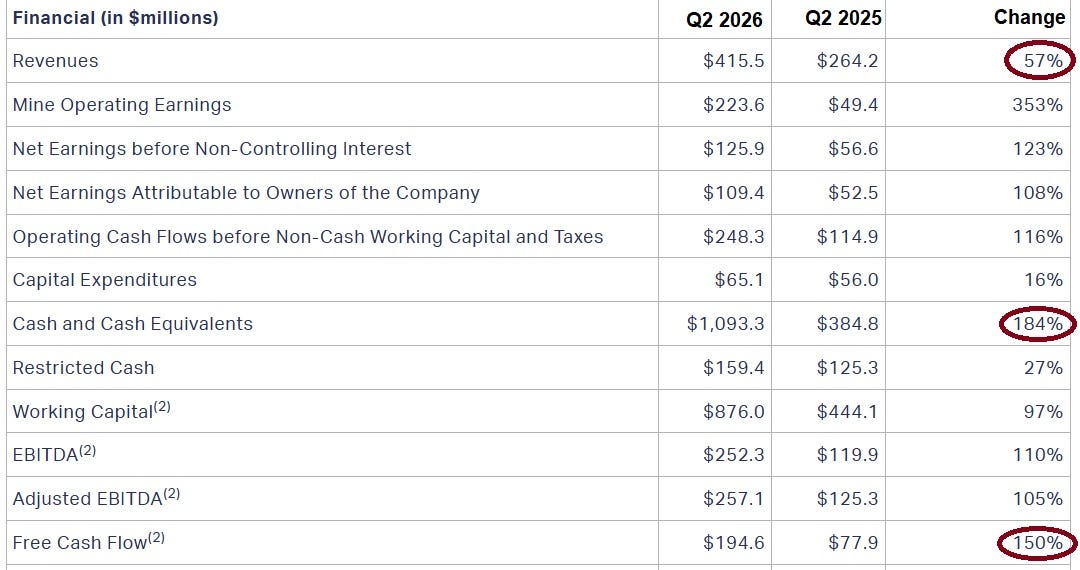
This is not a surprise, given that silver and gold (despite their corrections from Q1 highs) are still well above 2025 levels. But one line item was a (pleasant) surprise. From the quarterly report:
Finished Goods Inventory: The Company held 1,007,450 silver ounces and 4,730 gold ounces in finished goods inventory as at June 30, 2026, inclusive of coins and bullion, compared to 676,637 silver ounces and 2,732 gold ounces as at March 31, 2026. The fair market value of this inventory as at June 30, 2026 was $59.0 million for silver and $19.0 million for gold, which was not included in revenue during the quarter.
In other words, First Majestic could have reported even better numbers by selling all the metal it mined, but instead decided to hold inventory off the market.
A miner hoarding its metal is partially adopting a physical ETF business model. There are several benefits to this:
Gold and silver have appreciated versus cash for most of the past 50 years. So holding metal instead of cash increases First Majestic’s long-term earnings potential.
Removing gold and silver from the market incrementally raises their prices, creating a positive feedback loop. If only a single company adopts this strategy, the market impact is minimal. But if more big producers do it, the result could be dramatic.
Miners keeping their refined metal sends a message that industry insiders have faith in their product, which is good for investor sentiment.
Last but not least, by keeping some of what it produces, a miner gives itself the flexibility to sell some metal in the future to boost revenue and earnings whenever it wants.
In the short run (as investors new to this market have discovered lately), gold and silver are volatile, and occasionally they underperform cash. In those times, hoarding metal will depress a miner’s earnings, which might in turn temporarily depress the share price. The result: Along with higher long-term value comes greater short-term volatility.
I’d call this a price worth paying, so for buy-and-hold investors with eyes on the prize of $10,000 gold and $200 silver, First Majestic’s strategy is a net positive.
Comments
Nothing yet. Say the first thing.
Sign in to join the conversation.