
I have a new essay in the new issue of The Green Bag. It’s about a small linguistic mistery that connects a recent lawsuit against the Securities Exchange Commission (SEC), the U.S. federal agency overseeing public corporations and the stock market, and the Discourses on Livy, a 16th-century political philosophy treatise by Niccolo Machiavelli.
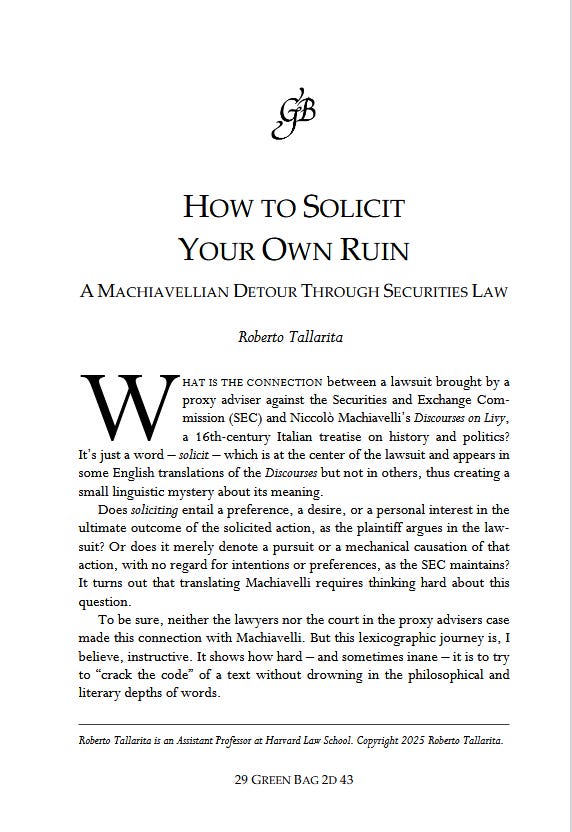
The essay starts from a securities-law dispute over whether, under the Exchange Act of 1934, proxy advisers “solicit” shareholders’ votes (does the word imply intent to obtain a specific vote or just causation?). It detours through English translations of Machiavelli’s Discourses I.53, where translators (including shortly after the enactment of the Exchange Act) rendered the Italian verb disidera variously as “covet,” “seek,” “desire,” “solicit,” and “labour,” each capturing a different shade of the action/intention distinction. It lands on broader reflection on legal interpretation: sometimes dictionaries alone can’t resolve textual meaning; you need histories, communities, and even coincidences.
I realize that the subset of people who are interested in securities regulation, legal theory, lexicography, Reinaissance political philosophy, and assorted antiquarian bibliophily is extremely small; but if you happen to be there, the essay is also available on SSRN.
No posts
Comments
Nothing yet. Say the first thing.
Sign in to join the conversation.