
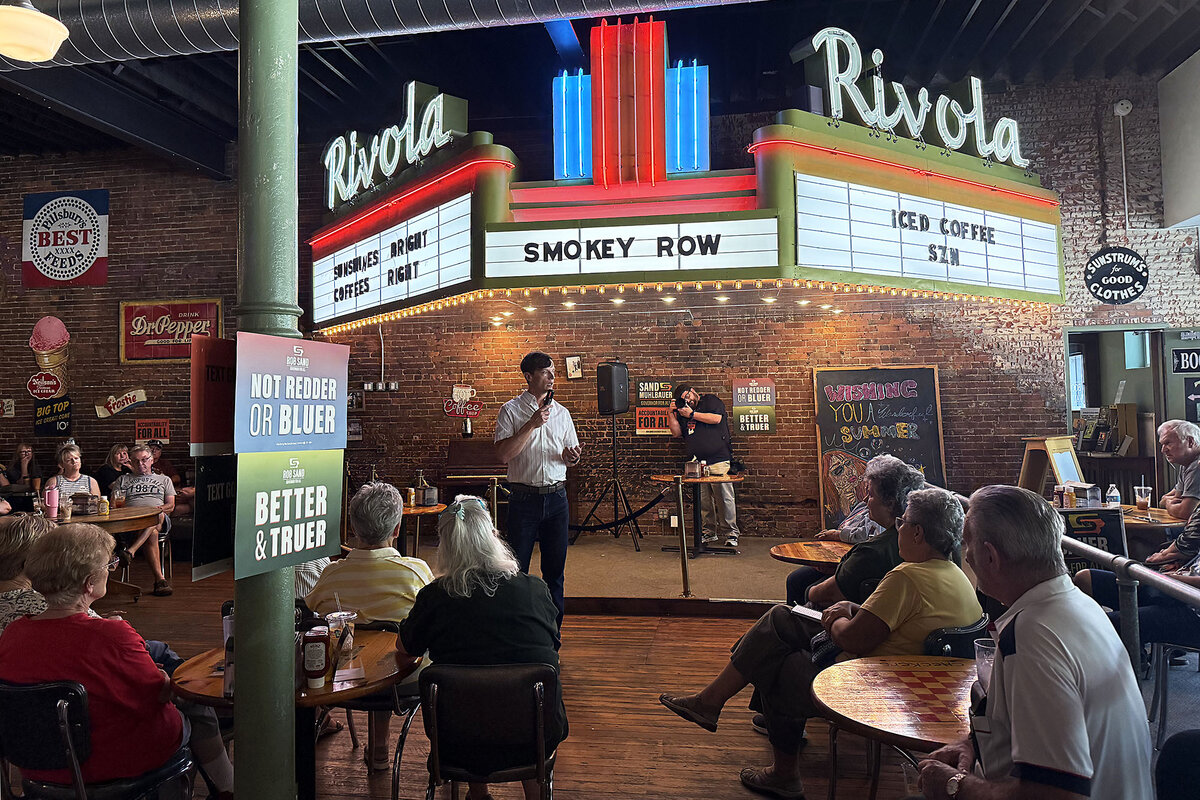
At the start of all his campaign events, Democrat Rob Sand asks the Republicans in the room to raise their hands, followed by the independents. He then leads rounds of applause for both groups, before kicking off a rendition of “America the Beautiful.”
“I like that he brings people together,” says Democratic voter Elizabeth Hanson, who has come to see the gubernatorial candidate at a coffee shop southeast of Des Moines.
It’s been two decades since Iowa elected a Democrat to the governor’s mansion. But this year, the state is suddenly fielding a host of competitive races. State Rep. Josh Turek, a Democrat, is running within range of Republican U.S. Rep. Ashley Hinson for the state’s open Senate seat. Two U.S. House seats are up for grabs as well, after several cycles in which Iowa’s congressional delegation has been entirely Republican.
Why We Wrote This
Iowans could elect a Democratic governor for the first time in two decades. National issues, such as the Iran war’s impact, and local ones, like herbicides, matter deeply in this tight race.
In the race to replace two-term GOP Gov. Kim Reynolds, both major candidates are to some extent running away from their own parties.
Sophie Hills/The Christian Science Monitor
Democrat Rob Sand speaks to potential voters at a coffee shop in Oskaloosa, Iowa, Aug. 11, 2026. Mr. Sand, the Iowa state auditor, is making a concerted pitch to win over not just independents but Republicans.
Mr. Sand, the twice-elected state auditor – and the only Democrat in statewide office – is making a concerted pitch to win over not just independents but also Republicans. He steadfastly avoids culture-war topics on the stump, presenting himself as a pragmatist focused on issues affecting “100% of Iowans.”
His opponent, businessman Zach Lahn, won the Republican primary despite being relatively unknown and facing a candidate President Donald Trump had endorsed. He has broken with President Trump on certain issues, including his executive order shielding herbicide-makers from liability. But he also welcomed Mr. Trump’s endorsement after winning the nomination.
Almost 40% of voters in Iowa are registered Republicans, while just 29% are Democrats. Still, the most crucial voters – for both Mr. Sand and Mr. Lahn – are the 30% who are unaffiliated.
“The no-party voters, by and large, don’t care about the political infighting stuff. It turns them off,” says Timothy Hagle, a political science professor at the University of Iowa. “What they do care about are the traditional kitchen table issues: jobs, economy, healthcare.”
Mr. Sand was leading Mr. Lahn by five percentage points and by 26 points among independent voters, in an Emerson College poll in early August. The same survey found that Mr. Trump was viewed favorably by 43% of Iowa voters, while 51% disapproved of the job he was doing.
Democrats have been busy highlighting all the ways in which Mr. Trump’s actions have been bad for Iowans – from tariffs that have squeezed farmers to the Iran war’s impact on the price of gas and fertilizer.
Charlie Neibergall/AP
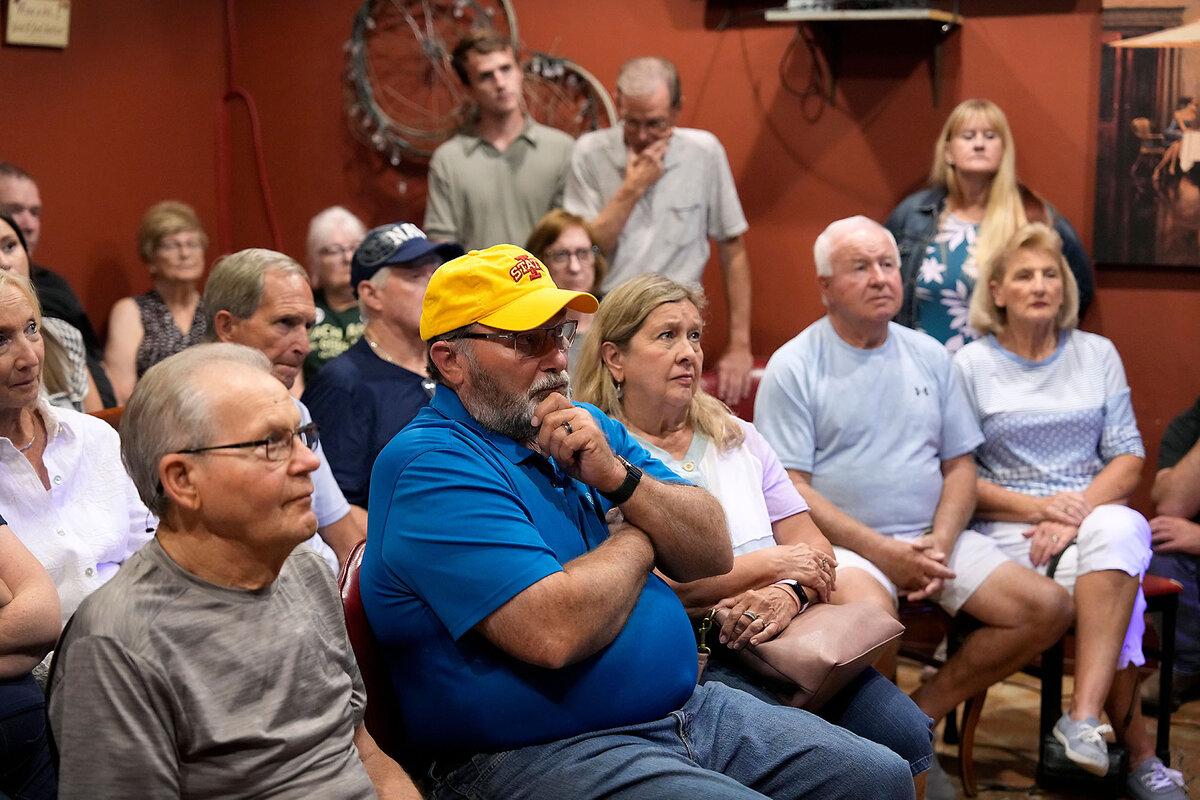
Iowans listen to Republican gubernatorial candidate and businessman Zach Lahn during a meet-and-greet event in Hampton, Aug. 4, 2026.
Most recently, Mr. Trump announced a deal to lower the cost of imported beef, drawing immediate criticism from Democratic and Republican officials alike. Mr. Sand called it “a blow to Iowa farmers and cattlemen,” and Ms. Hinson called it “a bad idea.”
“Democrats are taking advantage of the environment,” says Derek Eadon, an Iowa Democratic strategist. “The policies that we’ve seen from Trump have really hurt Iowa.”
Republicans are also being dragged down by the unpopularity of Governor Reynolds – whose poll numbers are almost as bad as the president’s – and a perception that GOP legislators have failed to deliver on promises, despite holding majorities in the statehouse. At the local level, some Republicans are openly unhappy with the status quo.
“What [Republicans] have been campaigning on and what they’ve been doing in Des Moines have been two totally different things,” says Mark Nelson, the GOP chair of the Woodbury County Board of Supervisors. “It may come home to roost with this election.”
Lahn’s call to fix a “rigged” system
Mr. Lahn walks a fine line, presenting himself as an anti-establishment politician who will buck special interests while at the same time appealing to MAGA voters who love the president.
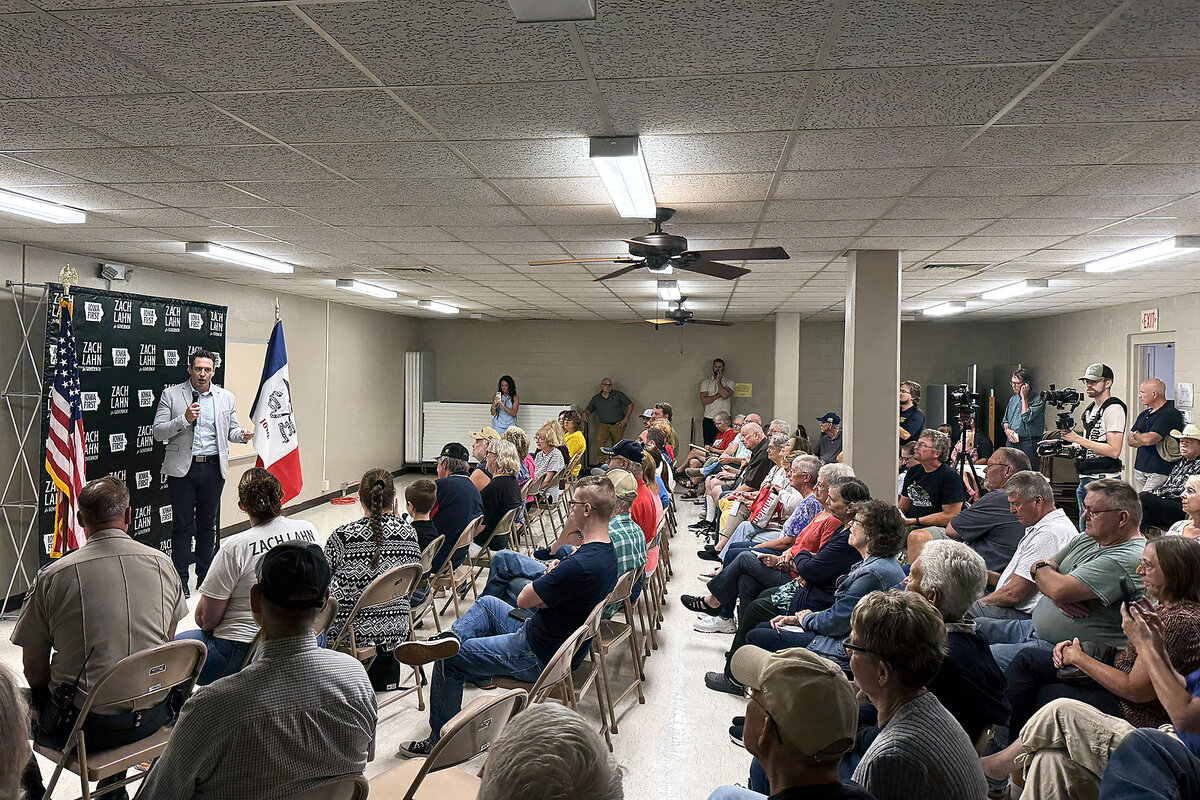
“The system is rigged,” and most politicians are bought and paid for, he tells voters gathered in Tipton, a small town in the eastern part of the state. He assures them he will not sell them out to the same powerful lobbies that have thwarted progress in Des Moines. “I’m here to represent the people of Iowa.”
Sophie Hills/The Christian Science Monitor
Zach Lahn speaks to voters in the basement of the Cedar County courthouse in Tipton, Iowa, Aug. 12, 2026. The Lahn campaign said the event had been moved from a nearby eatery to accommodate a larger audience.
Mr. Lahn started a private, unaccredited school in Kansas in 2018 with financial backing from the Koch family, and he places a particular focus on education, warning that “there’s a battle being waged for [students’] hearts and minds” in Iowa schools.
He still travels regularly to Kansas, where he maintains a residence, leading Democrats to portray him as a wealthy carpetbagger. He and his wife both have children from previous marriages; in 2023, the couple moved to a home built by his great-great-grandfather in Belle Plaine, Iowa. The home’s renovations were featured on television’s Magnolia Network by Chip and Joanna Gaines, the celebrity interior designer and contractor duo.
Jeff Bloomfield, a Republican who voted for Mr. Lahn’s opponent in the primary, says he went to the event in Tipton to “look him in the eye” – and came away satisfied with what he saw. “He’s like an everyday, down-to-earth homeboy,” he says.
Mr. Lahn has a charisma that resonates with voters when they see him up close, says Charley Thomson, a GOP state representative. He recently hosted a meet-and-greet with about 30 Republicans, all of whom were previously ambivalent toward Mr. Lahn. By the end, they were all sold.
“The question is going to be: Can he do that on a mass level for 3 million people?” asks Mr. Thomson.
Mr. Lahn, who spent years working for Americans for Prosperity, the Koch brothers’ political arm, describes himself as a conservationist. He talks about reading poet Wendell Berry, and makes historical references on the stump. He can come across as “a little highbrow,” admits Mr. Thomson, something he worries might hurt the candidate’s chances.
Mr. Lahn blames agricultural monopolies for chemical runoff – his own farm is organic and regenerative, he says – and describes Robert F. Kennedy Jr., the U.S. health secretary, as “a friend.” He has embraced Mr. Kennedy’s Make America Healthy Again agenda.
Charlie Neibergall/AP
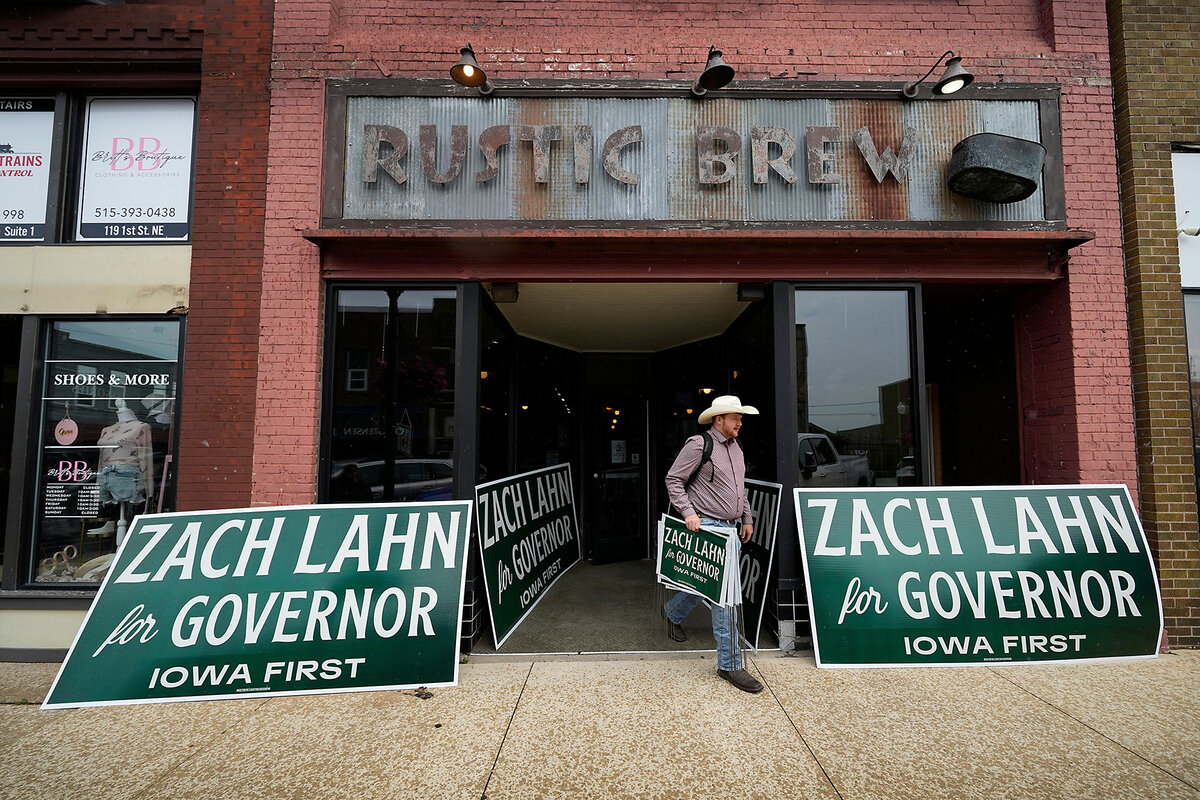
Field organizer Mike Rupp carries campaign signs for Zach Lahn, the Republican candidate for governor, before a meet and greet in Hampton, Iowa, Aug. 4, 2026.
At a campaign stop in Wapello, two moms who voted for him in the primary say their top issues are healthier food for their young children and a concrete plan to address Iowa’s cancer rates, which are among the highest in the country.
The federal government isn’t helping matters, Mr. Lahn contends in an interview. “This is a broader theme of [states] having power taken by Washington D.C.,” he says, adding that the stalled Farm Bill and Mr. Trump’s executive order both give immunity to chemical manufacturers.
Iowa should chart its own course with independent research on the safety of products, he says.
In the courthouse basement in Tipton, a last-minute location switch to accommodate more people, one mother sits on a metal folding chair, bouncing her Chaco-sandaled foot to jostle her baby as she listens to Mr. Lahn. “Yes,” she says out loud in agreement, as he speaks about the need for better schools and cleaner water.
“All my girlfriends are MAHA, crunchy,” she tells him after the event while posing for a picture.
Rob Sand’s profile as a red-state Democrat
Creating distance from his party is a more straightforward task for Mr. Sand. As a young adult, he first registered as an independent, and he’s quick to emphasize ways he still deviates from the Democratic Party line. Asked recently whether Kamala Harris should run for president again in 2028, he gave a one-word response: “Nope.”
After a brief stint as a model in Milan while he attended Brown University, Mr. Sand returned to Iowa, where he went to law school and was appointed assistant state attorney general, prosecuting financial crimes.
Even before this year’s campaign, he drew national attention as the type of candidate who could broaden the Democratic coalition. It’s not about ideology, he says over and over, it’s about results. “No one party has a monopoly on good ideas,” he tells a room full of voters in Sigourney. “We are supposed to be working together.”
At his events and when speaking to reporters, Mr. Sand works to keep the conversation on issues he says are most pressing, such as agricultural runoff.
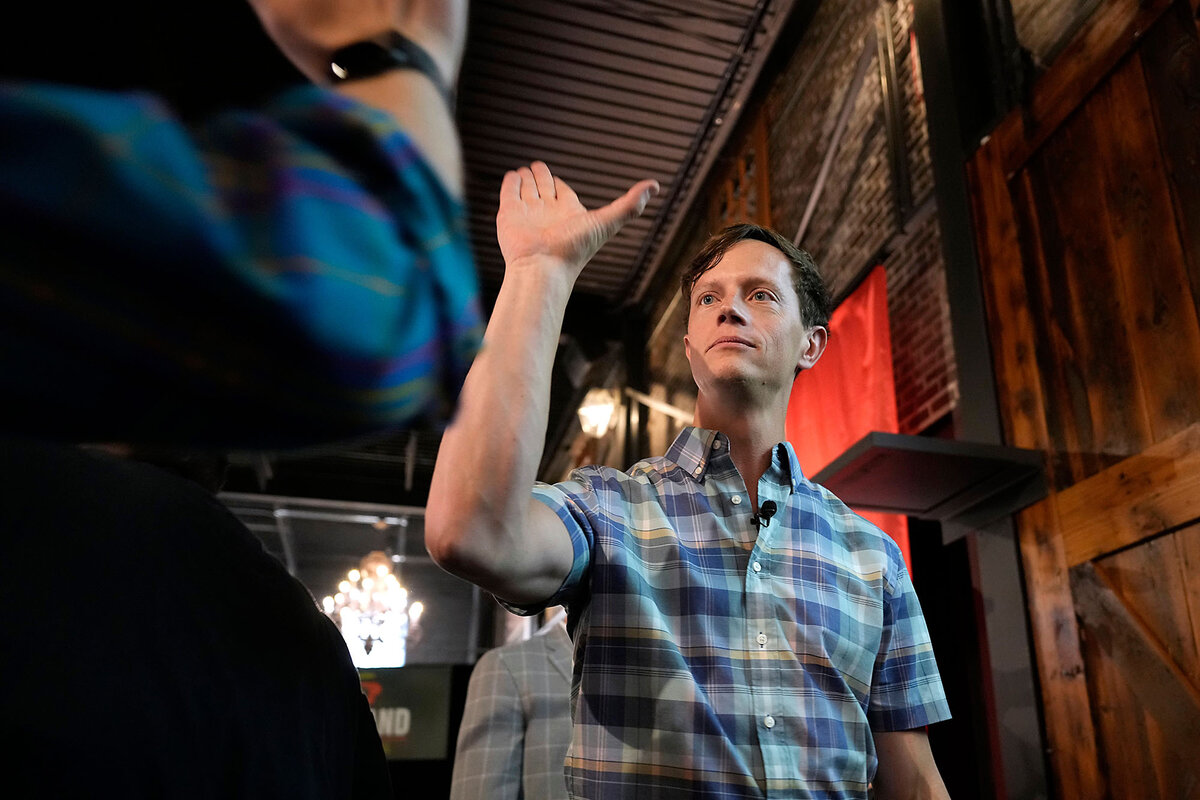
Charlie Neibergall/AP
Iowa Democratic gubernatorial candidate Rob Sand greets a supporter during a campaign rally in Des Moines, June 7, 2026.
“The major problem with water quality isn’t farmers, it’s politicians. Most farmers know that what they’re doing has an impact,” says Mr. Sand in an interview. “They’ve been getting put on wait lists for conservation programs year after year after year.”
Mr. Sand suggests restoring wetlands by asking landowners the lowest price they would take for the government to buy parcels in high-impact areas.
If he wins, Mr. Sand will have to work with a Republican legislature. So, gaining GOP support extends beyond an election strategy and into governing. On the stump, he points to hiring Republicans and independents on his staff as auditor and touts the endorsement of a “Rob-Publican” coalition of conservatives.
Five Republicans show up to hear Mr. Sand’s pitch in Oskaloosa. By the end of the hour, at least one of them, Kendal, is convinced: He’s voting for the Democrat this fall.
After supporting Mr. Trump in the last election, Kendal, who asks not to use his last name because he owns a business nearby, says he has grown disappointed on numerous fronts. And while the president isn’t on the ballot in November, Kendal says he’s looking for fresh thinking on a slew of local issues, from shrinking schools to contaminated water.
“Rob’s campaign is a great focus on just getting back to common sense,” says Kendal. “How can we be better about what we do?”
Wealthy candidates and the demands of retail politics
Since 2024, Mr. Sand’s campaign has received more than $10 million from his wife and her family, who own a holding company for food and biotech businesses – something Mr. Lahn has zeroed in on. The Sand campaign, meanwhile, has run ads painting Mr. Lahn (who seeded his campaign with a $2 million personal loan) as being out of touch with working people, highlighting his travel via personal plane from Iowa to Kansas.
For both candidates, the race might come down to retail politics. Iowans expect their candidates to show up in diners and coffee shops, talking in often minute detail about local matters.
Even before this campaign, Mr. Sand was a familiar face, notes Mr. Eadon, the Democratic strategist. As state auditor, he held town halls in each of the 99 counties every year. “I think Rob’s style of being everywhere is going to overtake everything,” he says.
Iowa has a small population, and connections are always overlapping. Mr. Eadon’s wife’s co-worker’s mother was Mr. Sand’s second grade teacher. “You run into that all the time with Rob,” he says. “That matters here.”
Comments
Nothing yet. Say the first thing.
Sign in to join the conversation.