
In February, the United States launched what was supposed to be a brief, decisive campaign against Iran. Six months later, the war trudges on, indirectly ensnaring much of the world by severely disrupting global trade.
For U.S. allies increasingly concerned that Washington is no longer a reliable partner in maintaining global security, the war in Iran has been something of an exclamation mark.
Both allies and rivals are hardening their impression that the Trump administration acts capriciously and often without an appreciation of the complex consequences. Indeed, the administration’s great concern now is control of the Strait of Hormuz – a problem that did not exist before the war began.
Why We Wrote This
The war in Iran was supposed to last a few weeks. Instead, it has dragged on for six months without an end in sight. That could have far-reaching consequences for how the U.S. is viewed around the world.
“It is largely seen as an ill-begotten war with unclear goals,” says Patrick Keller, a military analyst at the German Council on Foreign Relations in Berlin.
The failure to overthrow Iran’s regime or destroy its nuclear program, meanwhile, has undermined faith in the United States’ ability to project power effectively. As a result, the war’s long-term impact will likely reach far beyond what happens in Iran.
“An unreliable partner”
Indecisive and disruptive American wars are not new. Iran is, in some ways, merely the descendant of Vietnam, Afghanistan, and Iraq. However, there is little precedent for the U.S. to fight an unpopular, unsuccessful, and enormously disruptive war while at the same time actively alienating the allies who would normally rally behind it.
That shift in approach is already leaving an indelible mark.
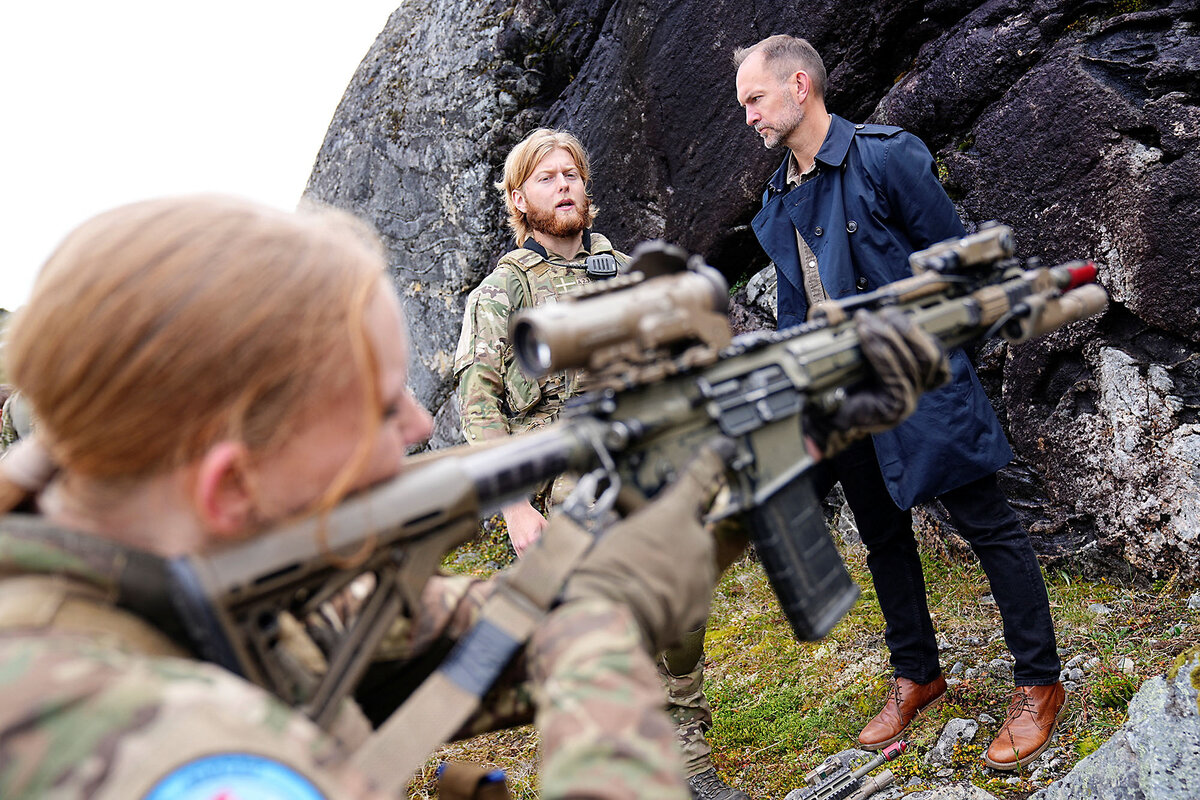
Perhaps nowhere is this clearer than in Europe. The continent’s first wake-up call came shortly before the war began, in January, when it seemed possible that the U.S. would invade Greenland. Something snapped in European capitals as leaders realized the country they once saw as the ultimate guarantor of security and stability had now become a potential threat.
U.S. airstrikes in Iran less than a month later served as unwelcome confirmation.
Ritzau Scanpix/Thomas Traasdahl/Reuters
Danish Defense Minister Jeppe Bruus Christensen, right, visits with members of the military in Nuuk, Greenland, Aug. 26, 2026. Greenland is an autonomous territory within the kingdom of Denmark.
Ironically, most of Europe agrees with Washington’s view of Iran as “an abusive, anti-democratic regime, and an aggressive regional actor with only marginally constrained nuclear ambitions,” says Ian Lesser, a distinguished fellow at the German Marshall Fund of the United States in Brussels.
However, nearly everything about the American approach to these concerns has lessened European confidence in Washington’s leadership and decision making.
To start, Mr. Trump lambasted European countries for not joining a war they had no part in planning and which has cost their residents dearly in higher energy prices.
There is also the fact that the war has diverted attention and military material from Ukraine and America’s European bases, and put even greater stress on keeping the U.S. engaged in NATO.
“The irresponsible planning for a decision that has such impact on the world economy and security issues just shows [European countries] he is an unreliable partner,” says Mr. Keller.
Allies left vulnerable
Elsewhere, American allies are reeling from the realization that the United States’ unambiguous commitment to protecting them might be wavering.
Virginia Mayo/AP
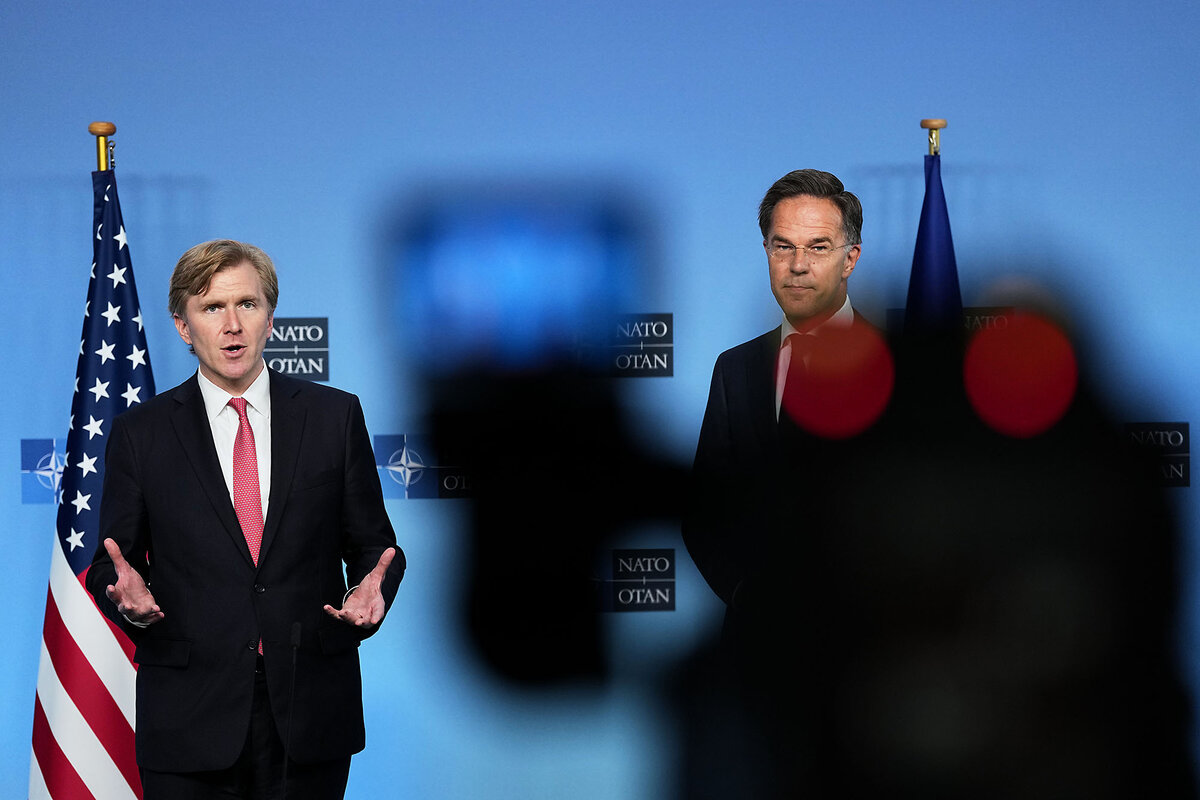
NATO Secretary General Mark Rutte, right, and U.S. Undersecretary of Defense Elbridge Colby address the media in Brussels. Aug. 27, 2026.
South Korea, for instance, watched with alarm in May as the U.S., strapped for resources, redirected crucial missile defense interceptors to the Middle East. Then, earlier this month, the Trump administration abruptly downsized long-planned joint U.S.-South Korea military exercises. One of Mr. Trump’s reasons: He was displeased that South Korea’s president declined to help with the Iran war efforts.
In some ways, the war is a double-edged sword for Seoul, says Cheong Seong-chang, vice president of the Sejong Institute, a South Korean think tank. On the one hand, “it demonstrates that the United States is still willing to use enormous military power when it believes a serious strategic threat is emerging,” he says.
On the other, it has shown that U.S. bases can become targets, and it raised questions about “whether American power can be available in several major theaters simultaneously,” Mr. Cheong says.
That, in turn, might leave Seoul exposed to its capricious northern neighbor, which has its own takeaways from the Iran war.
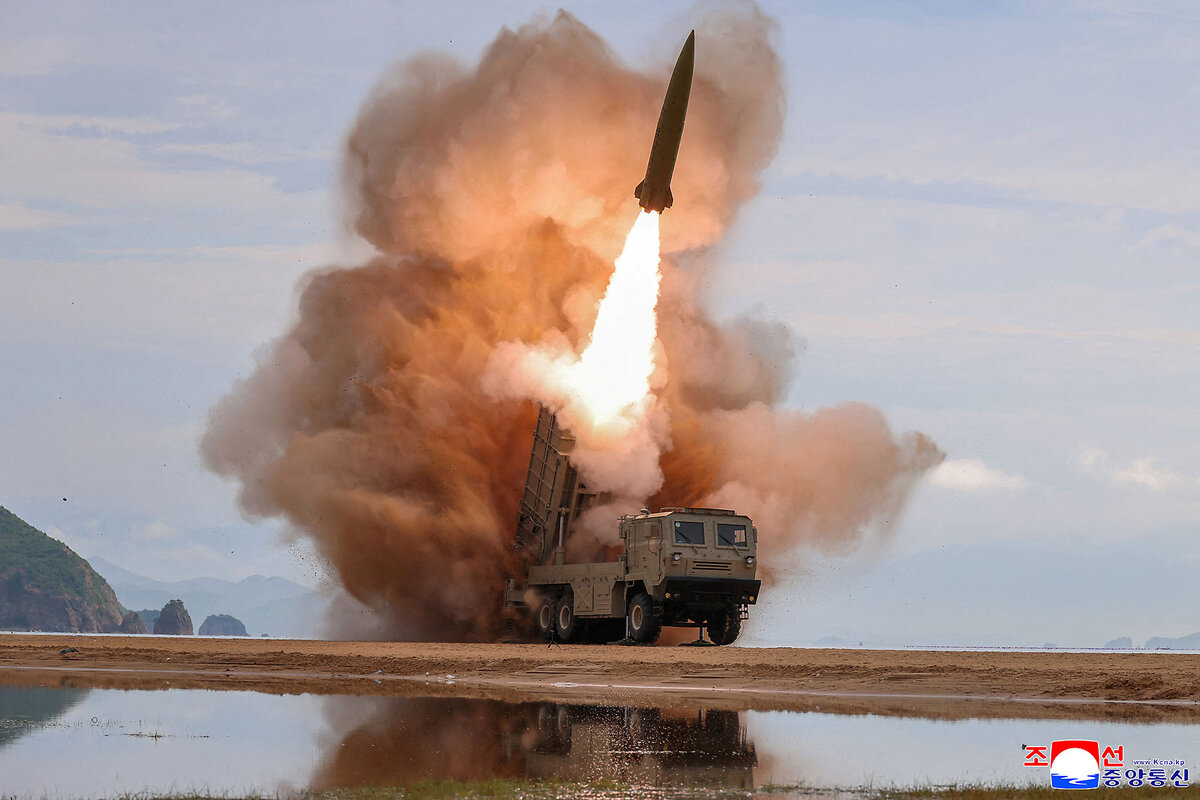
“Pyongyang is likely drawing a stark lesson: Iran remained vulnerable because it stopped short of possessing a survivable nuclear deterrent,” says Christoph Bluth, a professor of international relations and security at the University of Bradford in England. “North Korea must, therefore, never disarm.”
KCNA/Reuters
North Korea test fires a mobile rocket launcher, June 25, 2026.
Beijing presses its advantages
What the reduction of U.S. support for its allies in East Asia means is, of course, in the eye of the beholder. The diminished focus and declining military presence that so concern South Korea are a boon to its neighbor, China. Beijing has used the opportunity to flex its own military might, clashing in recent months with the Philippines, a U.S. treaty ally, in the South China Sea, stepping up maritime pressure on Taiwan, and test-firing a nuclear capable intercontinental ballistic missile in the Pacific Ocean.
Meanwhile, the deepening fragmentation and disorder in the Middle East caused by the war are seen in China as an opportunity to make new diplomatic inroads in the region.
Beijing, which is the primary buyer of Iranian oil, openly supports Tehran’s war efforts, despite U.S. pressure. It provides diplomatic and logistical support for Iran, and this week defied fresh U.S. sanctions targeting some Chinese entities accused of helping Iran export oil and obtain military-related equipment from China. The country will “firmly safeguard its rights,” said Foreign Ministry spokesman Lin Jian at a news conference.
“The U.S.-Israel-Iran conflict ... has undoubtedly accelerated the evolution of the Middle East order towards a ‘post-U.S. era,’” wrote Tang Zhichao, director of the Middle East Development and Governance Research Center at the Chinese Academy of Social Sciences, in Contemporary World, a journal supervised by China’s Communist Party.
Friends or foes?
Not every country thinks U.S. power and influence are in decline, however. Among some right-wing governments in Latin America, for instance, there’s support for the Trump administration and its interventions in the Middle East.
In April, Argentine President Javier Milei declared his country’s “firm support” for the war, calling it “the right thing to do.”
That’s part of a growing appetite in the region for U.S. hard power, fueled at least in part by its successes closer to home. In January, Latin American leaders watched a U.S. military operation successfully oust authoritarian Venezuelan leader Nicolás Maduro. Some observers have suggested that the relative ease with which the U.S. triumphed in Venezuela might have emboldened its efforts at regime change in other places, including Iran.
Mr. Trump himself has drawn parallels between the two. In March, he told reporters that perhaps the U.S. could take control of Iran’s oil, drawing parallels to Venezuela, where he said post-intervention “we’ve done very well. ... It’s sort of like a joint venture.”
In the Middle East, however, U.S. success has been less clear – including for Washington’s closest ally there.
For weeks this past spring, Israelis sought shelter from Iranian ballistic missile barrages, sometimes sleeping in underground train stations and parking lots. For many, that was a price worth paying if the war their leaders embarked on with Mr. Trump could finally quash the looming existential Iranian nuclear threat.
So far, it has not, and the overwhelming consensus in Israel now is that the conflict has been a failure. Many blame Prime Minister Benjamin Netanyahu for pointing the U.S. toward the near-impossible goal of toppling the Iranian government, rather than focusing on eliminating its nuclear capabilities.
That was a “a very big strategic mistake,” says retired Israel Defense Forces Gen. Israel Ziv. As a result, he explains, “relations between Israel and the United States have entered a state of mistrust,” he explains.
Mistrust is also high inside Iran itself.
“[Trump] was supposed to come to our rescue and get rid of this corrupt regime,” says a hospital supervisor called Arya in west Tehran, who asked that only his first name be used for safety reasons. But regime change appears to be off the table; the White House is now threatening an economic “D-Day” of sanctions instead.
“Is this the help he said was coming?” Arya asks.
Reporting was provided by Kelly Kasulis Cho and Scott Peterson in London; Shoshanna Solomon in Tel Aviv, Israel; Ann Scott Tyson in Seattle; Whitney Eulich in Mexico City; and Anna Mulrine Grobe in Brussels.
Comments
Nothing yet. Say the first thing.
Sign in to join the conversation.