
On a humid June morning, two turtle hatchlings flail nervously inside a red cooler faded from Watamu’s sweltering sun. A Kenyan fisher, Angore Kahindi, had found them tangled in his net and stored them in the only container he had. Then he called Fikiri Kiponda, who gives out his cellphone number to fishers in the community for just such an emergency.
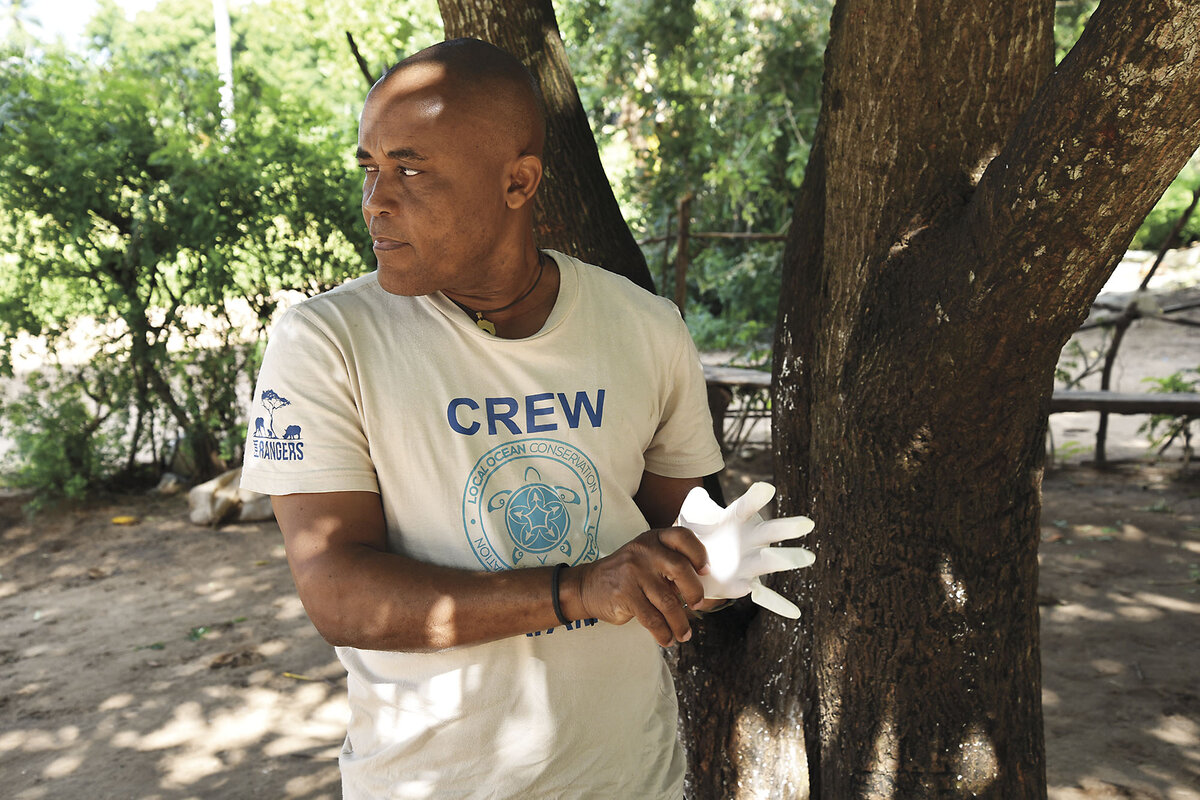
Mouth set in a determined line, Mr. Kiponda arrives quickly and snaps on a pair of white gloves. He gently plucks the turtles from the cooler and records their sizes in a spiral-bound book to help him track turtle populations. Hatchlings can’t survive too long out of the water, so there is little time to waste.
Sophie Neiman
Fikiri Kiponda, with the nonprofit Local Ocean Conservation, enlists community help to protect turtles.
Mr. Kiponda speeds away from the fisher’s house in his pickup truck toward Watamu’s beach. He carefully lowers the turtles to the white sand at the water’s edge and watches them scuttle away until they are imperceptible against the vast ocean. “They’re very vulnerable,” Mr. Kiponda says simply.
Why We Wrote This
Local communities along Kenya’s coast once saw turtles as a valuable source of food and income. Now, working with Fikiri Kiponda of the nonprofit Local Ocean Conservation, they see the animals’ importance to the Indian Ocean’s ecosystem.
Such mornings are standard for Mr. Kiponda. A fisher notifies him about a turtle in distress. He hurries to compensate the caller for their time and the damage to their net, and then returns the turtle to the sea.
That means working closely with local communities, which once saw turtles as a valuable source of food and income. “We used to kill turtles,” says Mr. Kahindi. Now, he explains, “we’ve become conservationists.”
Mr. Kiponda has been doing this for nearly two decades as head of the bycatch release program at Local Ocean Conservation (LOC), a small nonprofit based on Kenya’s southeastern coast.
Sophie Neiman
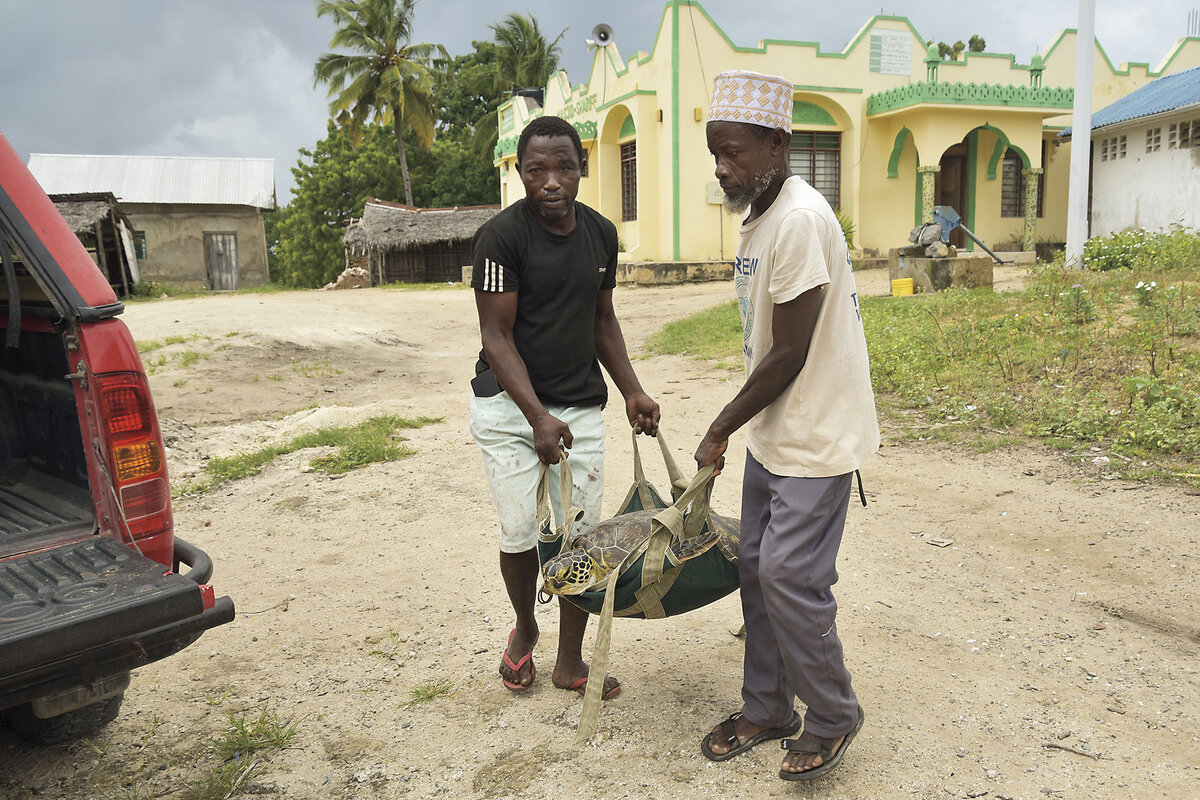
Community liaison volunteer Khamis Omar (left) and a local Kenyan fisher carry a turtle rescued by Local Ocean Conservation to a car, as they prepare to return the animal to the sea in Watamu.
Roughly 1 in every 1,000 hatchlings are expected to make it to adulthood. Even if they survive targeting by crabs and seabirds, turtles swimming along the coast must contend with fishing nets, high-rise hotels encroaching on their nesting grounds, and pollution in warming seas.
Hawksbill turtles are critically endangered, while olive ridley, loggerhead, and leatherback turtles are all classified as vulnerable. Green sea turtles were only removed from the International Union for Conservation of Nature’s endangered species list last year.
Sea turtles are “a keystone species and key indicators of ocean health,” says LOC founding director Nicky Parazzi. They play a particularly important role in the well-being of coral reefs, helping to control fish populations and seagrass growth.
Changing dreams
Mr. Kiponda grew up on the coast, spending his days on the Indian Ocean while his father worked as a chef for wealthy beachgoers. But at the time, he had little interest in what lay beneath the water’s surface.
Mr. Kiponda excelled in mathematics and enrolled in accounting school in 2000. Upon graduation, he landed a job in one of Watamu’s many posh hotels. It should have been a dream opportunity, but “it wasn’t really fulfilling,” he says.
In 2005, during a moonlit stroll on the beach, he stumbled on turtles hatching. He was not sure what to make of the strange creatures cracking through eggshells and shuffling into the surf. But he was mesmerized and had to learn more.
Sophie Neiman
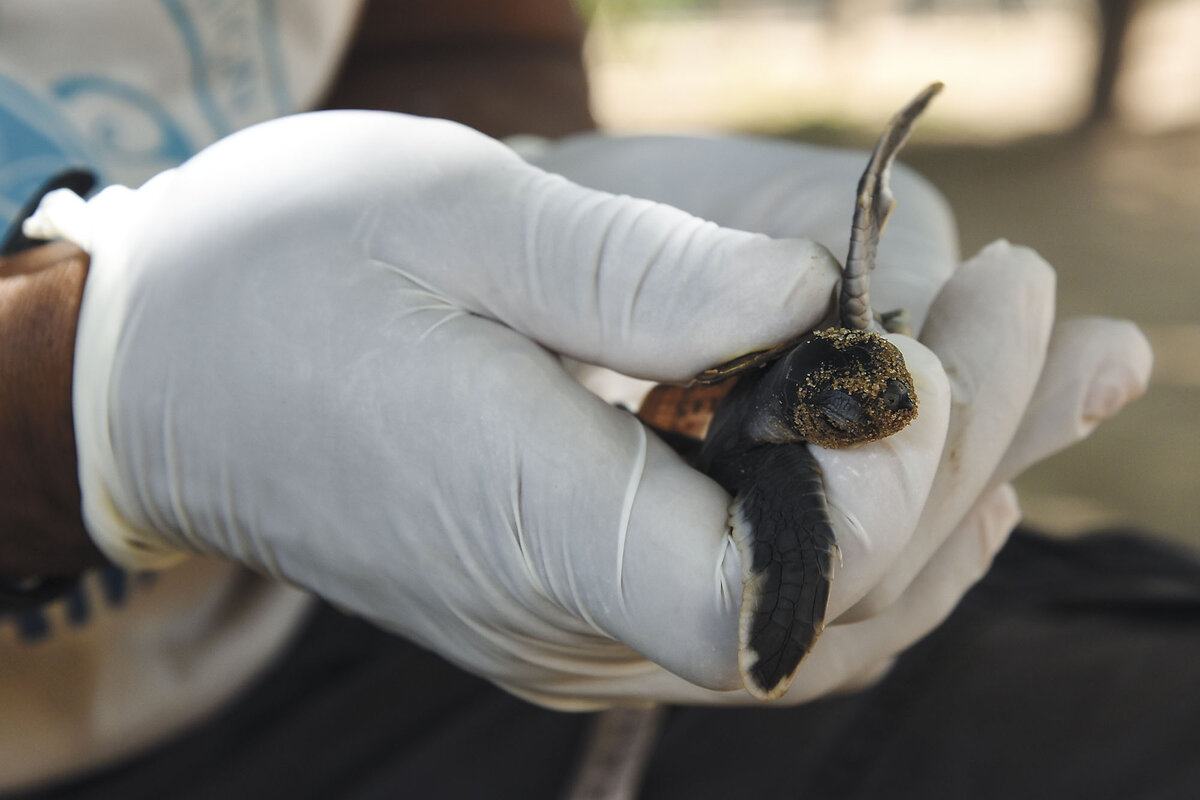
Mr. Kiponda measures a turtle hatchling rescued by the nonprofit.
Mr. Kiponda quit his job and began volunteering with LOC to monitor turtle nests. He walked miles along the beach, ensuring hatchlings and nesting mothers made it safely to the sea. When offered the opportunity to work for LOC’s bycatch release program four years after he started volunteering, Mr. Kiponda jumped on it.
“I’m part of them”
When Mr. Kiponda rushes off to help a turtle, he often does not even bother to turn on his truck radio. “You don’t have music in an ambulance,” he says. “You go out for a mission.”
Mr. Kiponda spends most of his time in the fishing villages bordering Mida Creek, a breeding ground for juvenile turtles that empties into the ocean. He calls out jambo – Swahili for hello – and greets vendors by name. Community relationships are at the heart of his process. He builds close contacts with the fishers who call him about ensnared turtles; supports trash pickup and tree plantings; and hosts “mzee (old man) days” to learn from local elders.
Sophie Neiman
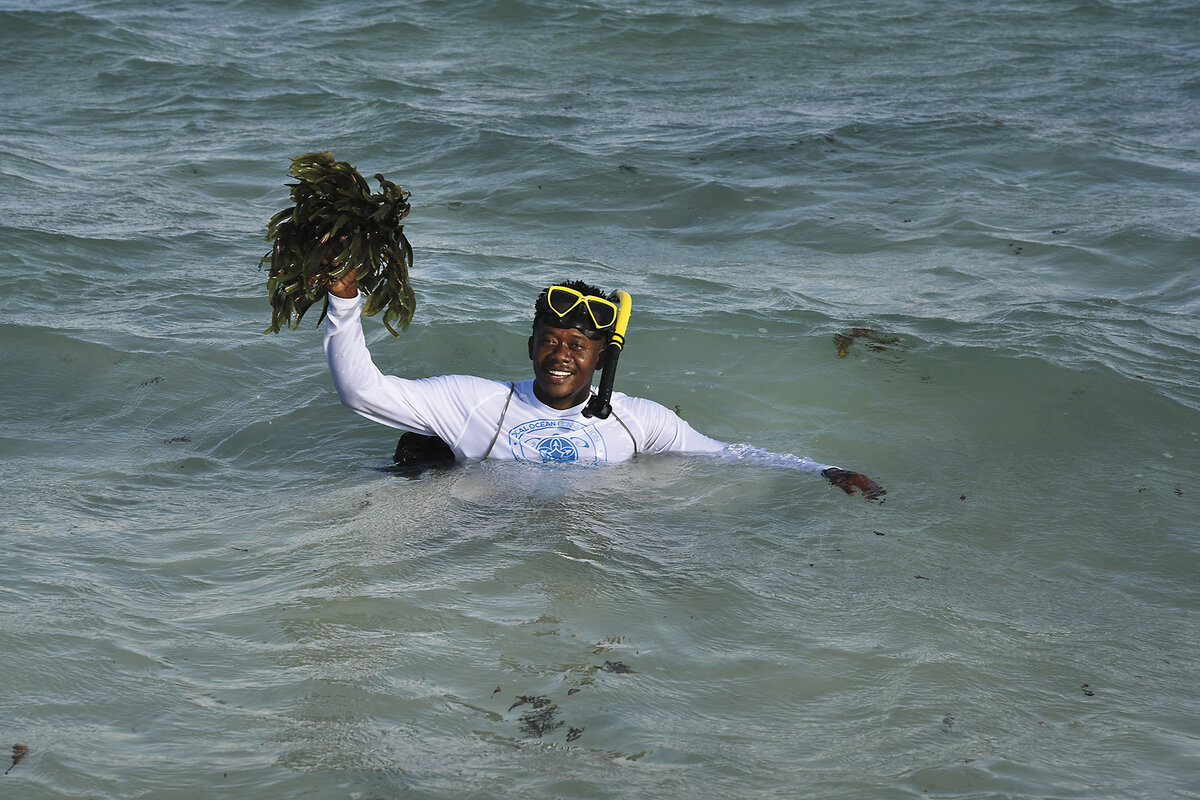
Lameck Maitha emerges from a dive collecting seagrass to feed turtles and make their habitats at the nonprofit Local Ocean Conservation’s turtle rehabilitation center in Watamu.
Protecting the environment today “will benefit even the coming generation,” says Khamis Omar, a community liaison volunteer who often aids Mr. Kiponda in releasing turtles. Mr. Omar’s father, Omar Said, nods eagerly while repotting mangroves to restore the forest in Mida Creek. “I want to be an example to the rest,” adds Mr. Said with a smile.
“It’s a holistic approach,” Mr. Kiponda says of his community engagement. “I’m part of them.”
LOC’s network now comprises more than 100 fishers, according to marine biologist Joey Ngunu, who synthesizes the data that Mr. Kiponda collects. This is a result of deep trust, explains Mr. Ngunu. Turtle poachers can be punished with life imprisonment in Kenya, so fishers are often afraid to acknowledge they caught one.
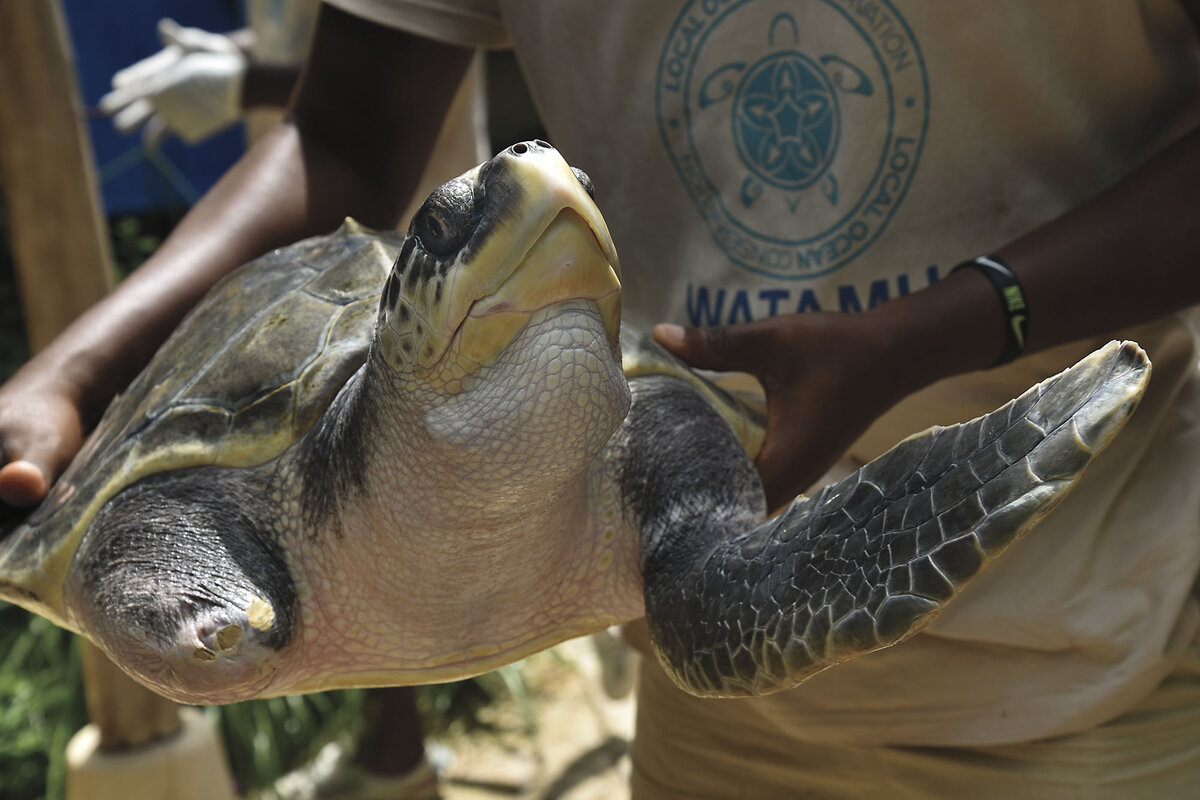
Sophie Neiman
Mr. Maitha holds Safari, an olive ridley turtle who had lost a flipper to a fishing net and was rescued by LOC.
When a turtle can’t be released right away, Mr. Kiponda brings the animal to LOC’s rehabilitation center, where Lameck Maitha looks after it. To Mr. Kiponda, returning a turtle to the sea is the most rewarding part of the job, no matter how many times it happens. Not long after a Monitor contributor departed, LOC released its 25,000th turtle. “The best feeling ever is seeing them go,” Mr. Kiponda says. “It never gets old ... Today, I’ve done this. I wish tomorrow I could save even more.”
Comments
Nothing yet. Say the first thing.
Sign in to join the conversation.