
Growing in water tubes across Saudi Arabia are the roots of the kingdom’s Iran-proofed future.
In the August heat of the central Saudi desert, by all accounts, these vegetables should not be growing: cherry tomatoes, bell peppers, kale.
With daytime highs of 125 F, dropping only to 91 F overnight, growth slows at traditional farms. Cucumbers turn bitter, tomato flowers shrivel, leaves wilt, and pests such as whiteflies and spider mites run rampant across the fields.
Why We Wrote This
Hydroponic farms in import-reliant Saudi Arabia are good for business – and national security as well. With the arid kingdom facing blockades and disruptions on both its coasts, growing food in water, surprisingly, is providing a green line of defense.
Saudi farmers need tens of thousands of gallons of water per day just for a fraction of their crops to survive – outside of date palms – so most farmers don’t bother growing in the summer.
Not at Dava.
In the farm’s cooled greenhouses an hour south of Riyadh, vegetables are growing, and fast, without soil.
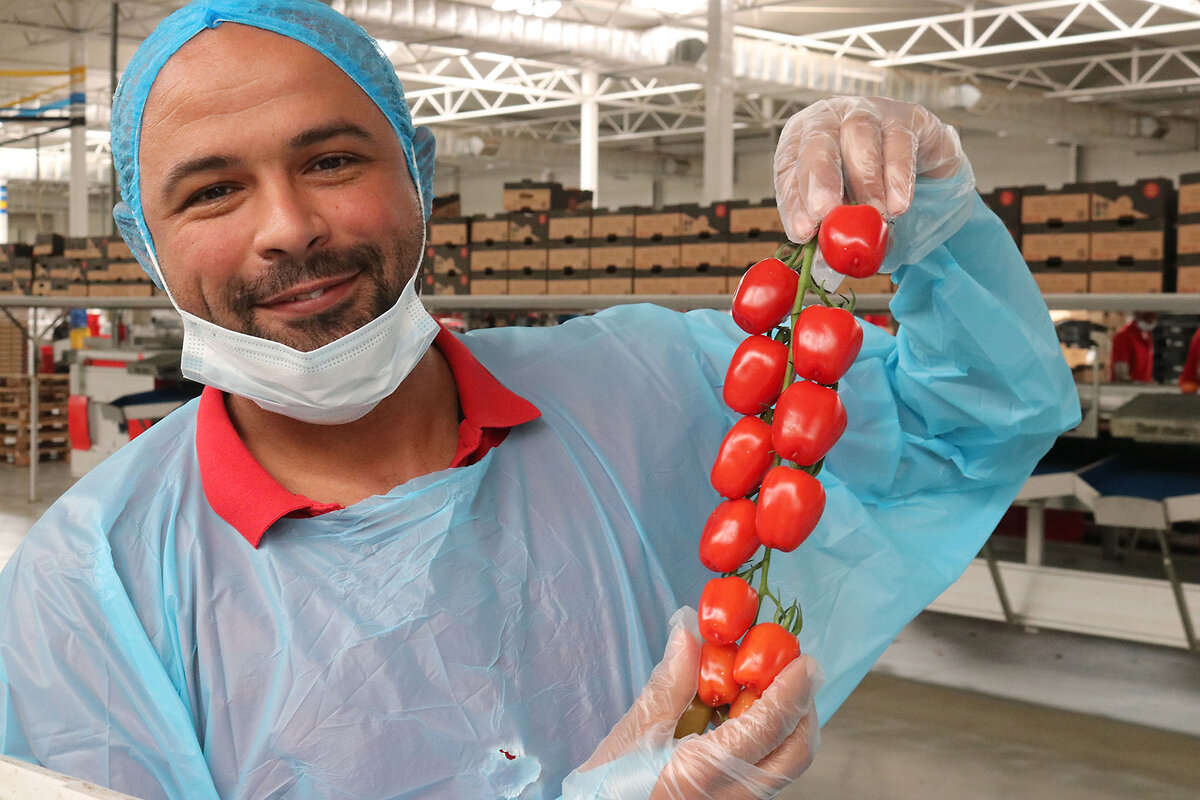
“See how big and ripe these are?” Dava operation manager Lehyani Ali says excitedly, picking out an orange grape tomato from a recently packed carton. “Some people won’t believe this is from Saudi.”
In the kingdom, farmers are increasingly turning to hydroponic methods, growing fruits and vegetables indoors without soil, by placing their roots in nutrient-enriched water.
Taylor Luck
Operations manager Lehyani Ali holds up a vine of grape tomatoes at the Dava farm's packing facility in Al Kharj, Saudi Arabia, March 31, 2026. The farm has plans for rapid growth.
It has been more than good business, but also good for national security.
In import-heavy Saudi Arabia, facing wartime blockades and disruptions on both its coasts, hydroponic farms like Dava and others are growing a green line of defense.
Ending import reliance
Saudi Arabia, a country of 35 million, imports the bulk of its food needs, including 70% of its fruits and vegetables, from India, Russia, the United States, and Europe. That figure reaches near 100% during the summer months.
The perishable fruits and vegetables were long imported through the Strait of Hormuz to Saudi Arabia’s eastern coasts, now closed by dueling blockades and Iranian demands to extract tolls.
With Hormuz blocked, Saudi Arabia has been redirecting shipments to its Red Sea port of Jeddah. Yet this route requires 10 to 14 more days of transit to reach distribution centers, and has become increasingly susceptible to attacks from Yemen’s Iran-allied Houthi group.
But in the local market in Riyadh, one can frequently find a product immune to the wartime closures: Saudi-grown vegetables.
Since 2022, Dava has turned to hydroponic farming in a plot of land in Al Kharj, an arid area with nutrient-rich soil known for its date palms.
In the heat of summer, it remains a comfortable 80-82 F in their greenhouses, with solar panels to help power the cooling.
In its 210 acres of glass hydroponic greenhouses, Dava produces 135 tons per day of tomatoes, cucumbers, peppers, lettuce, and herbs. After scaling up the past few years, the farm now provides Saudi Arabia with 13% of its tomato needs.
Dava plans to reach 250 tons of produce per day by 2028 and 1,000 tons by 2030, and establish renewable energy resources generating 15 megawatts of electricity to power it.
Taylor Luck
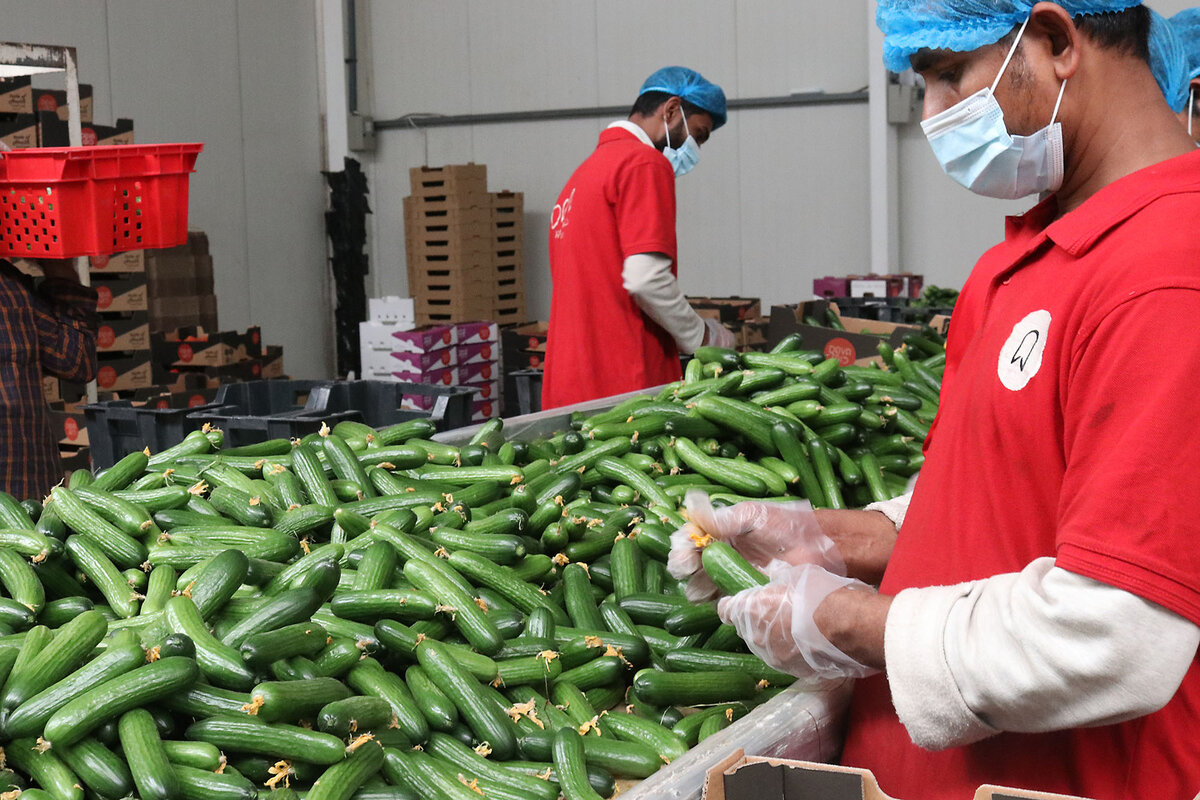
Packers sort and prepare cartons of freshly picked cucumbers at the Dava packing facility in Al Kharj, Saudi Arabia, March 31, 2026. The kingdom imports the bulk of its food needs, including 70% of its fruits and vegetables. In the summer, that figure reaches nearly 100%.
With the soilless, controlled conditions, Dava farmers say they use up to 80% less water and 70% less land – key for a kingdom where water is scarce and desertification is shrinking arable land.
“The hydroponic systems allow us to grow fruits and vegetables when most farms can’t, and save water,” says Wissam Abdel Samad, Dava deputy CEO, in a bustling office looking out at the nursery. “We are not only helping fulfill the Saudi vision for food security, but we are working in an extremely hot climate in a sustainable way that creates quality produce.”
This soilless treatment allows farmers to provide the exact amount of nutrients and water needed, without runoff, while recycling most of the water – key in arid Saudi Arabia, one of the most water-scarce countries in the world. The kingdom is the largest single desalinator of seawater, producing 790 billion gallons per year, and relying on it for 60% of its potable needs.
The U.S.-Iran war exposed these dual vulnerabilities – reliance on imported food and desalination – with both blockades and attempts by Iran and its proxies in neighboring Yemen and Iraq to strike the kingdom’s desalination and power plants.
Saudi media coverage
More Saudis are catching on.
Saudi Arabia Hydroponics runs a farm in eastern Saudi Arabia, using floating systems and aeroponics to produce hundreds of tons of vegetables, fruit, and leafy greens, such as kale, cutting down their water usage by 90%.
The Saudi firm, along with its South Korean partners, says it is also providing technology and building hydroponic greenhouses for other Saudi farmers who are increasingly turning to the technology to adapt and boost yields in the ever-heating climate.
The country’s media regularly highlights Saudi farmers adopting hydroponic farming on news shows.
And amid the current war, Dava has increased exports overland to Saudi Arabia’s Gulf neighbors, who import 100% of their own fruit and vegetable needs, and recently began exporting Saudi vegetables to the Netherlands, marking the first Saudi vegetables ever sold to Europe.
“Saudi Arabia has gone from importing produce from Europe to exporting Saudi produce to Europe,” says Mr. Abdel Samad. “It is a long path to food security, but our roots are growing.”
Comments
Nothing yet. Say the first thing.
Sign in to join the conversation.