
For decades Canada has relied on the American military for its security and the American market for its prosperity. The United States spends more than 20 times as much on defense, while nearly three-quarters of Canadian merchandise exports go south of the border.
So when Canadian Prime Minister Mark Carney walked away from trade talks with the U.S. late Friday night after painstaking, monthslong negotiations, it was not just over trade ledgers and percentage points. Instead it was a political choice that he said was necessary – and tests the influence and limits of Canada as a “middle power.”
The term became a buzzword in 2026 thanks to Mr. Carney, and has evolved to mean those countries challenging global superpowers. He popularized it in a landmark speech in Davos to signal a “rupture” in the postwar order and called for a banding together of middle powers. That lofty rhetoric will now meet reality, demonstrating how much economic pain a nation is willing to face to secure its political sovereignty.
Why We Wrote This
Prime Minister Mark Carney hopes that he can use the collapse of trade talks with Washington to show that Canada and other “middle powers” can navigate geopolitical storms without ceding their sovereignty to nations like the United States.
“This is one of those instances when a country’s resolve to address something goes beyond simply dollars and cents,” says Dwight Duncan, the former finance minister of Ontario.
Negotiations for a deal between two of the globe’s closest allies broke down Friday, with both sides blaming the other. With the collapse of talks, U.S. tariffs of 50% on $20 billion worth of Canadian goods fell into place on Saturday. Canada has announced it would respond to any tariffs with dollar-for-dollar levies starting Sept. 8.
On Monday President Donald Trump made new threats that he will increase tariffs on Canadian cars, car parts, and steel to 50% on Jan. 1. “WE DON’T NEED CANADA, THEY NEED US!” he wrote on social media.
It is unclear exactly which specific concessions made Mr. Carney walk away, but he called it “a question of sovereignty.” He told reporters over the weekend that in the final hour the U.S. wanted to restrict Canada’s ability to forge trade deals with other countries, a move that has been central to Canada’s long-term economic strategy in the face of antagonism by Mr. Trump.
He also said the U.S. took issue with language requirements in Canada. Protections of the French language are carefully regulated in Quebec, where French is the official language. That makes demands on language particularly sensitive in officially bilingual Canada.
“Our culture, our language, is central to our identity, and it is important to exclude that from the negotiating table,” Quebec’s premier, Christine Fréchette, told reporters over the weekend.
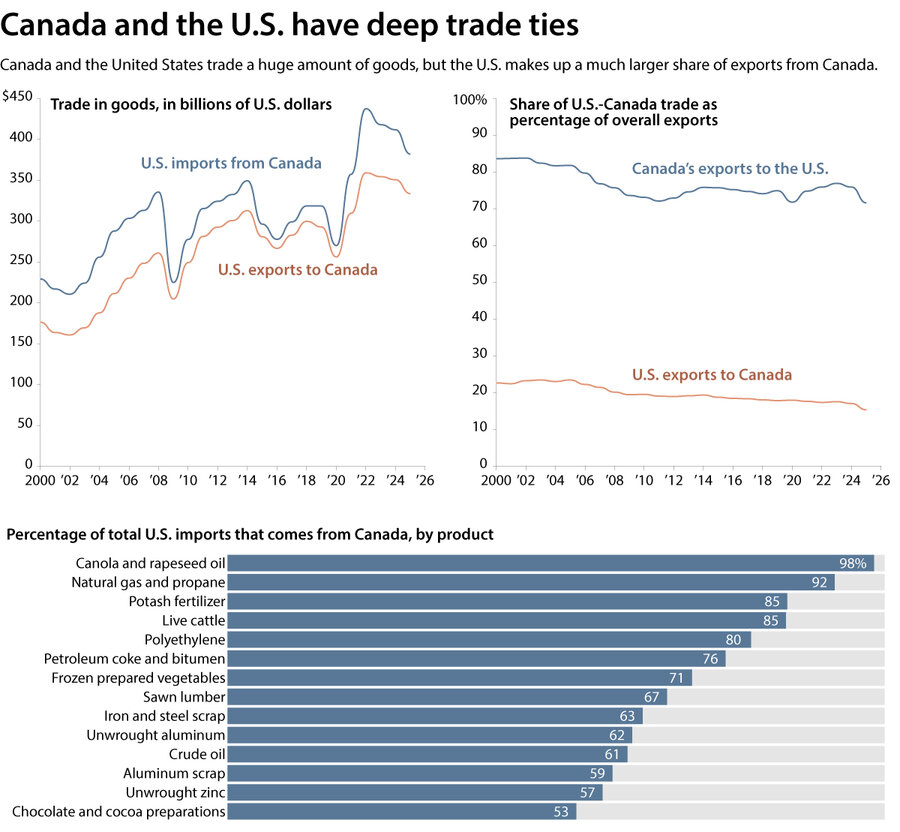
SOURCE:
U.S. Census Bureau, Statistics Canada
|
Jacob Turcotte/Staff
All Canadian premiers united around the prime minister’s initial decision to walk away. Three-quarters of Canadian respondents in a new Angus Reid poll did, too.
But now the hardest work begins. A new report from TD Bank today shows that American tariffs could take 0.3 to 0.6 percentage points from Canada’s gross domestic product, without accounting for support that the federal government is expected to make this week for affected businesses. The assessment doesn’t include Canada’s threatened countertariffs.
Mr. Duncan says he does worry about economic consequences. So do Canadians – with 2 in 5 in the Angus Reid poll saying they are worried about the trade deal hurting their job security.
“We can’t simply sever ties. I don’t think anybody in the current Canadian government believes that,” Mr. Duncan says. “But in order to maintain our sovereignty, in order to protect our own interests, it’s important that we build more global trading relationships rather than rely exclusively on the United States.”
“Looking back I think this will be a defining moment for Canada,” he adds.
Dax Melmer/The Canadian Press/AP
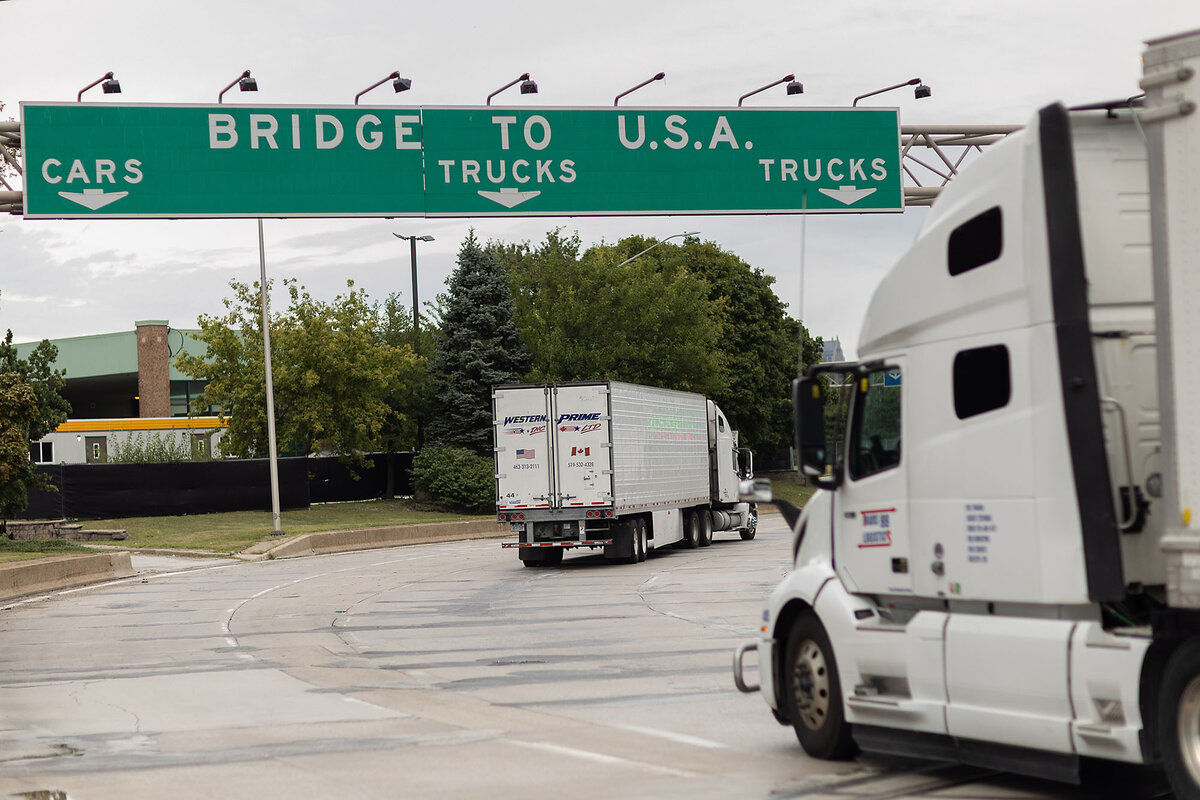
Transport trucks cross the Ambassador Bridge to go to Detroit, in Windsor, Ontario, Aug. 22, 2026.
It could be a moment where other middle powers cleave together, too. Canada’s role as a middle power in the Cold War was based on its position within a multilateral world, a system that the U.S. largely designed. That’s not the reality today, says Peter Jones, an international affairs professor at the University of Ottawa. Instead he sees a grouping of powers from the richest countries like Japan, Australia, the United Kingdom, and other European countries watching as a former American ally adjusts to a new geopolitical reality.
Because of disparities in economy and power compared with the U.S., Canada stands to lose from a trade dispute with Washington. But its bullish position could give the country some bargaining power in future negotiations with the U.S. And if Mr. Trump loses support over his stance against Canada, it could be perceived as a win for Mr. Carney’s approach.
Dr. Jones doesn’t expect a new coalition to suddenly form. Each country has their own security and economic considerations that they must weigh against concession.
“It’s a coming to grips with a sea change in the way the world is, which is the United States is just not the United States anymore in terms of what we’ve all grown up expecting it to be,” Dr. Jones says. “What does that mean? I think we’re all kind of trying to think that through.”
Comments
Nothing yet. Say the first thing.
Sign in to join the conversation.