
When heavily armed Taliban militiamen swept into the Afghan capital on a Sunday afternoon five years ago, a lot of people were concerned about what was coming next. The small gains made by Afghan women during the United States’ 20-year occupation were about to end.
The Taliban said this new government would be different from the brutal regime that ruled over Afghanistan before the U.S. invasion in 2001. One official told The Associated Press there would be an “open, inclusive Islamic government.”
But the years since have largely been years of silence. Human rights groups speak of the total collapse of women’s rights, yet detailed accounts about the lives of women living in Afghanistan are exceedingly rare.
Why We Wrote This
Human rights advocates say women and girls in Afghanistan have seen most of their basic human rights taken away. These accounts from two Afghan women offer a glimpse of what life is like under Taliban rule.
The Monitor has obtained the stories of Ayesha and Zahra to offer a glimpse of what life is like for women in the country today. Their names have been changed and locations withheld to protect them from retaliation by Taliban authorities. Their experiences offer a stark look at the ways Afghan women are treated and their lack of even the most basic individual freedoms under Taliban rule. These two individuals have been intimidated, beaten, and imprisoned – in one case for daring to challenge the authorities, and in the other for allegedly violating harsh dress codes. Both women live in fear that the state can do whatever it chooses to them without recourse.
The restrictions began immediately after the Taliban returned to power but have since escalated systematically, says Laila Basim, leader of the Afghanistan Women’s Spontaneous Movement, which advocates for Afghan women’s rights. She has lived in the U.S. since 2023, though she maintains close contact with women inside Afghanistan.
The Taliban’s first decree banned women from working. Further measures followed, such as mandatory dress requirements, restrictions that require many women to be accompanied by a male guardian when leaving home, the closure of secondary schools for girls, and barring women from attending universities. By 2023, the Taliban had already issued dozens of decrees and directives specifically targeting Afghan women, Ms. Basim says.
It is a “systematic exclusion” of women from society, she argues.
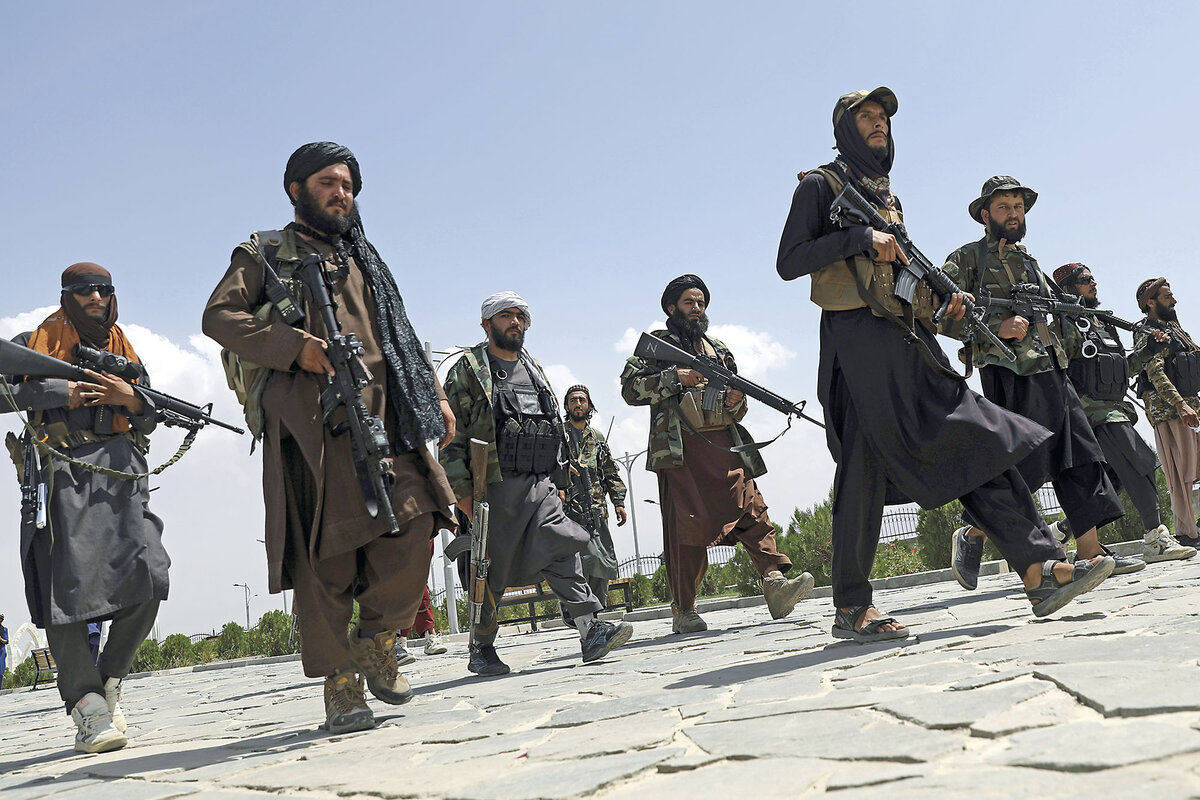
Rahmat Gul/AP/File
Since the Taliban returned to power in 2021, some Afghan women – particularly activists, journalists, former officials, judges, and others who fear reprisals – have gone into hiding, while broader restrictions have forced many more women out of public life.
Ayesha
Ayesha was bold enough to protest. She holds a bachelor’s degree in business administration but was forced to abandon her medical studies before graduating when the Taliban banned women from attending university. She instead completed a midwifery program, opening an examination room while working at a local hospital.
She remembers a different life before the Taliban takeover – a job, her studies, and the freedom to choose her own attire. “I could wear anything,” she says “Jeans, sandals, jacket, whatever I love.”
Traditional Afghan attire always included the hijab, which Ayesha says helps to maintain modesty. But she sees the new mandates as an excuse to erase women from society.
Even routine tasks under the Taliban are often impossible without a mahram (male guardian).
During recent protests, she and other women dressed carefully to give the Taliban no pretext to object. Their slogans, she says, were strictly about basic rights. But Taliban security forces responded by opening fire on protesters.
“Fear spreads everywhere,” she says. Amid the chaos, she heard a girl cry out, “Oh God, we are killed!” Ayesha says she was knocked to the ground, severely injuring her knee, before two Taliban members seized her and forced her into a car. The verbal abuse they unleashed against her during the ride, she says, was unspeakable.
At the prison, Ayesha says she was thrown into a filthy, pitch-black cell that was so small she struggled to breathe. Guards stared at her, she says, “like I’m a murderer,” and she feared she would be sexually assaulted. During interrogations, the guards beat and kicked her, Ayesha says, “like I’m not human.”
She says she went days without food or water, enduring relentless lashings. The hunger was secondary to her desperate prayers for the whipping to stop. After four days, Ayesha says her family secured her release with the help of community elders, paying a ransom, and providing a formal guarantee of her future conduct.
When she learned she was being released, the relief eclipsed everything, she says. “The beating, the lash, and all the mistreatment” were briefly forgotten in that moment of happiness. As she left, however, she recalls that a Taliban guard was laughing and remarking that she wouldn’t dare to take part in a protest ever again.
Following the protests, Ayesha says the surrounding areas were turned into a closed military zone by the Taliban. The Monitor is not naming the specific part of the country, because she fears possible retribution. In recent weeks, women have become afraid even to speak to neighbors, wary that they might be informants. Since her release, she says, not a single person has dared to visit her.
Ayesha says she wants people outside Afghanistan to understand that she does not feel safe, has no basic rights, and that she is consumed by uncertainty about her children’s future.
Yet she also described what hope for the future of Afghanistan looks like to her: girls allowed to attend school and university, women able to support their families, and a return to a democratic political system with “happiness and prosperity.”
She declares that the Taliban haven’t succeeded in silencing every voice, including those of Afghanistan’s bravest women.
Melanie Stetson Freeman/Staff/File
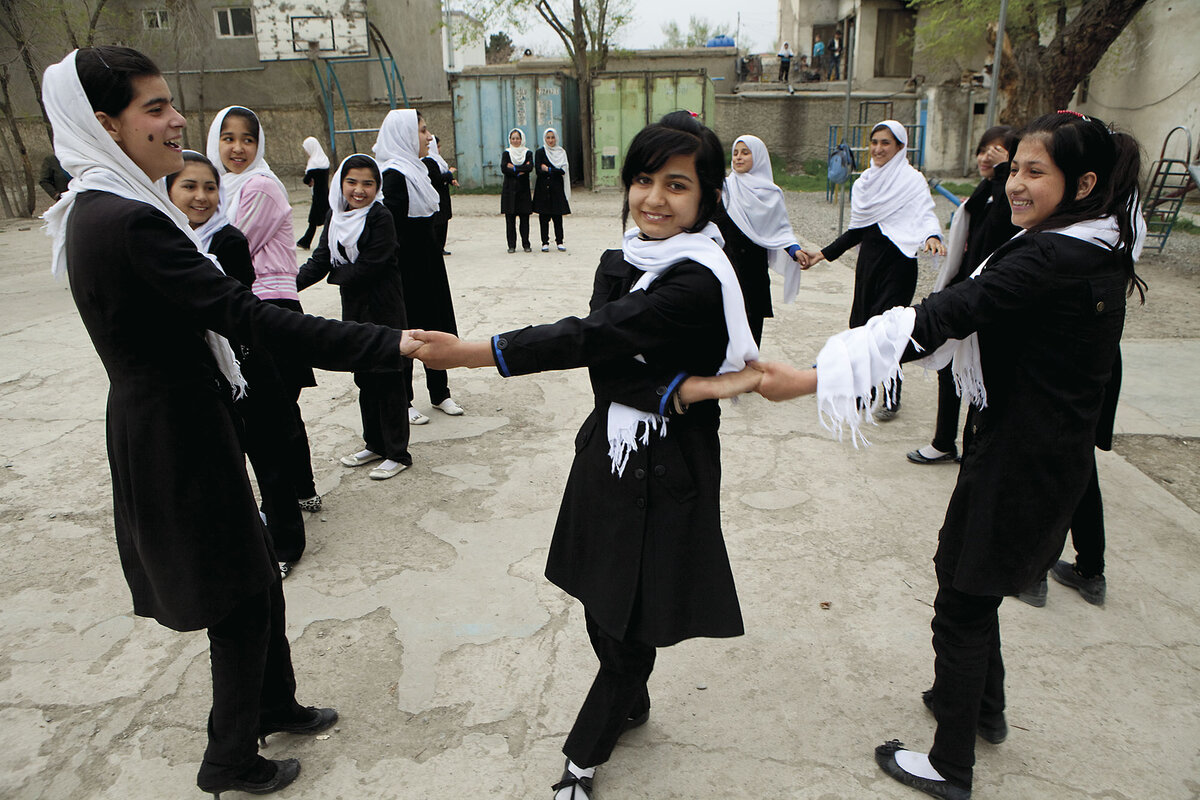
Ninth grade girls play games in the schoolyard during gym class. Girls from grades 1 to 9 attended the Speena Adi school in Kabul, Afghanistan, April 8, 2012. During the first period of Taliban rule, it was a boys-only high school.
Zahra
Zahra graduated from high school during the U.S. occupation of Afghanistan. She studied English with the hope of pursuing higher education abroad. Her dreams were big. With hard work, she might even be able to attend Oxford or Harvard.
Her life has long since withdrawn into unfulfilling days at home. An educational course, she says, would feel like “a sanctuary.”
But she never expected what happened the day she went to the market to buy medicine and other supplies for her family. She was not involved in protests, but the Taliban’s “morality police” detained her during a sweep of the area. “I remember thinking, ‘Oh God, they are here again,’” she says.
Zahra says she was accused of being improperly covered, despite wearing what she described as a proper hijab. When she objected, she says she was insulted and ordered into a vehicle. She says she tried to run but was grabbed and dragged through the crowd, struck in the shoulder with the butt of a rifle, and then forced into a vehicle along with other women.
“They treated me like an animal,” she says.
Zahra says she was held in detention for four days, where she was interrogated and beaten. Her family tried repeatedly to visit her but were turned away. On one occasion, her brother was beaten by the authorities in front of her parents.
Her family, like Ayesha’s, ultimately secured her release through a guarantor and a hefty payment.
Since her release, Zahra says she has lived with intense fear. A knock at the door can trigger panic that she might be detained again. She now avoids the bazaar and limits her movement outside the home as much as possible. “You cannot trust a single soul,” she says.
She recalls how ordinary life once felt in Afghanistan – children walking to school with backpacks, laughing and talking about their lessons in a city that still felt open and functional. On the day of her arrest, she says, the bazaar had a similar atmosphere – with families shopping and women moving freely through the market. But things feel different to her now.
The memories of her life during the pre-Taliban era – meeting friends, attending classes, going out and about as she wished – are the embers of a time that Zahra prays might one day return to her country.
This story was reported and co-written by Mark Sappenfield and an Afghan journalist who will remain anonymous, because of the fear of retribution by Taliban authorities.
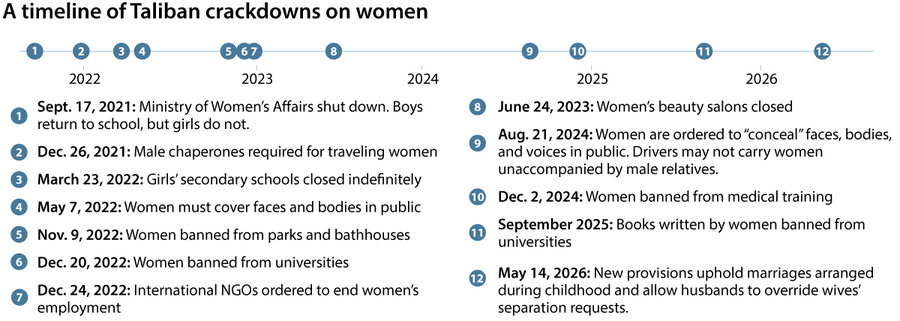
SOURCE:
Al Jazeera, France 24, Human Rights Watch, National Public Radio, GlobalSecurity.org, CNN, United Nations Human Rights Office, Amnesty International
|
Jacob Turcotte/Staff
Comments
Nothing yet. Say the first thing.
Sign in to join the conversation.