
Peninah Ndegwa spent years studying urban planning, but one of her most instructive moments in the field occurred far from a classroom. In 2018, she was walking through downtown Nairobi with her baby strapped to her back when, suddenly and urgently, her daughter needed a diaper change. Ms. Ndegwa scanned the streets around her, but there was nowhere to go – no clean public toilets, no public changing stations.
“That was an awakening,” Ms. Ndegwa says. She realized that her city wasn’t built with her – or her child – in mind.
That is a problem of continental proportions. Sub-Saharan Africa has both the most rapidly urbanizing population on Earth and the youngest. By 2050, one in four people on the planet will be African, and two-thirds of them – about 1.4 billion people – will live in urban areas. But although nearly half the region’s population is under age 18, its cities are often unfriendly places to grow up – crowded, poorly planned, and unsafe. Fixing that, many say, should be an urgent priority.
Why We Wrote This
Africa is the fastest urbanizing region on the planet. It's also the youngest. And as its cities grow at a breakneck speed, gobbling parks, playgrounds, and open spaces, they're becoming more and more unsafe for children.
“If cities are safe for children, they are safe for everyone,” says Ms. Ndegwa, who now runs a social enterprise focused on child-friendly city planning called Wow Mom Kenya. “Designing cities through a child’s lens meets everyone’s needs.”
Urban disadvantage?
Ms. Ndegwa’s experience of scrambling to find a changing station led her to approach the city government of Nairobi and work with officials there to install diaper-changing stations in public toilets and markets.
But when she began to take the changing stations to those crowded, noisy markets, she quickly saw a bigger problem. The reason there were so many children there to begin with was because their mothers, who worked as hawkers, had nowhere else to leave them.
“I saw babies laid on cartons in tiny rooms next to toilets,” Ms. Ndegwa recalls. “It was shocking.”
Her next project was born, and she began setting up daycares in markets across the city.
For trader Winnie Njoroge, having access to such a space has been so transformative that she travels 25 miles each day to hawk stationery in a downtown market instead of in the neighborhood where she lives.
“One of the hardest things for us is to find a safe place where we can leave our children,” she explains. “Where I live, the apartment has no space for children to play. We live close to the road, and it’s unsafe for them to be outside.”
For decades, the conventional wisdom has held that cities are objectively better places for the world’s children to grow up in than rural areas– what experts call “the urban advantage.” The argument is simple: Urban areas have more of nearly everything, from schools and hospitals to jobs and infrastructure.
But the unplanned sprawl of African cities is poking holes in that theory.
“For those who live in planned neighborhoods, who have adequate housing, cities are still usually better,” says Sarah Sabry, founding chair of the Cities4Children alliance and the global lead for urban issues at Save the Children. “But if you look at the conditions that many children in these cities live in, it’s clear why urban life is not always better.”
For instance, more than half of African city dwellers live in slums, meaning their homes are impermanent, overcrowded, and often without easy access to water and toilets. In at least 10 African countries, that number tops 70%, and in Mali and South Sudan, it is more than 90%.
Evans Otieno knows firsthand that these neighborhoods are hard places to grow up.
Finding places to play
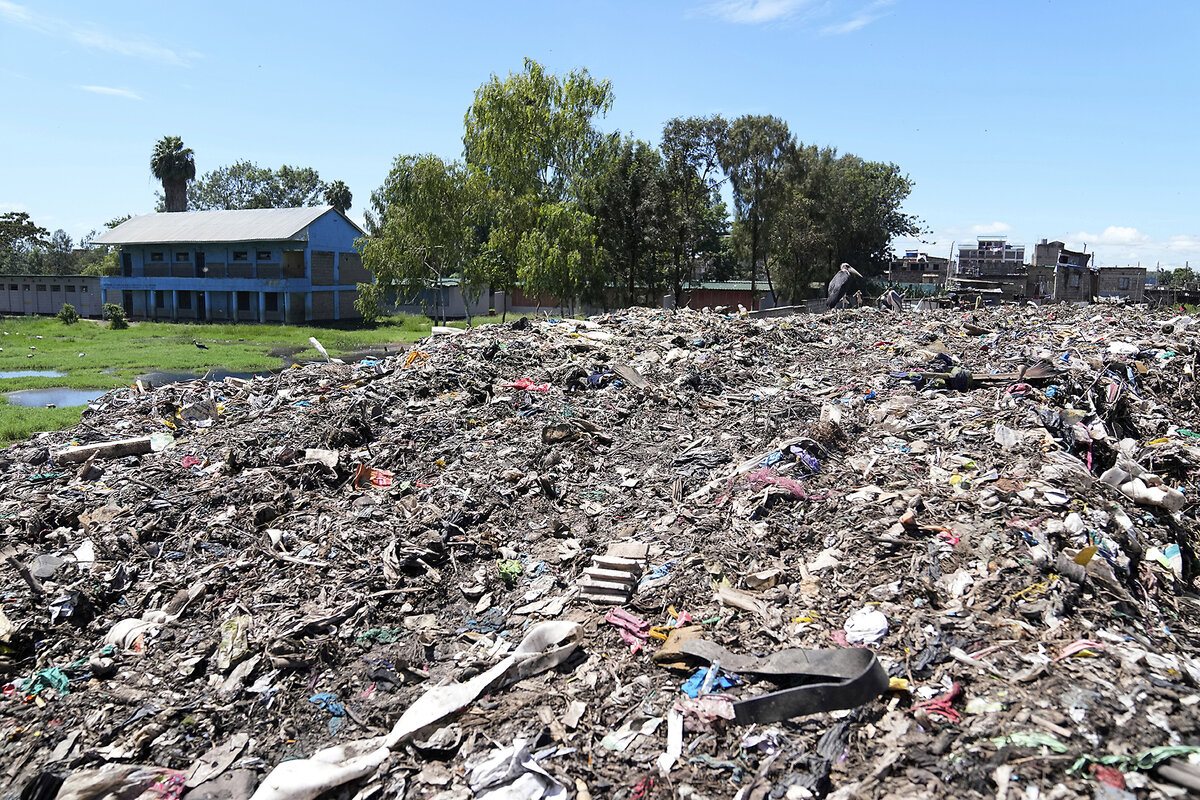
Eight miles from central Nairobi, the air over the Dandora landfill is gauzy with the acrid, chemical smoke of burning garbage. The city’s largest dump borders a densely populated neighborhood of modest concrete homes and apartment blocks, with small shops woven into the spaces between them. It was here that Mr. Otieno spent his childhood. Orphaned at the age of 6, he ended up joining one of the area’s notorious gangs, which fights violent battles for control of the landfill.
After nearly being killed during a robbery in 2009, Mr. Otieno decided he wanted out. And he began considering what had pushed him to join the gang in the first place. “Peer pressure, crime, and unsafe environments shaped [my] daily life,” he says. When he looked across his neighborhood, he was struck by how few places there were for kids to go – almost no playgrounds, parks, libraries, or sports fields. He thought of how his own childhood might have turned out differently if he had access to safe play spaces.
“Growing up here was dangerous,” he says. The “unsafe environment shaped daily life” and pushed him toward the gang, he believed, because it was the only place he felt secure.
Brian Inganga/AP/File
Children at the Dandora Secondary school, who attend classes next to the capital's largest garbage dump, are trying to purify the air with bamboo, in Nairobi, Kenya, April 22, 2024.
For children, “playing is fundamental,” says Anacláudia Rossbach, executive director of UN-Habitat. Not only a source of entertainment, play is also central to how children learn to navigate the world, from developing their motor skills to teaching them how to interact with their peers. And if kids don’t have ready-made places to play, “they create them,” she says.
So along Dandora’s drainage channels and on the edges of busy roads, children improvise. After school hours, makeshift football pitches appear suddenly on dusty patches of land while small clearings and undeveloped plots become informal playgrounds.
“Many children in our community grew up without dignity. But green spaces can change that. They give children a place to feel like children, a place where they can play, interact, and enjoy life in a safe, positive environment,” says Mr. Otieno.
In 2014, Mr. Otieno founded a small community organization called the Believers Transformation League. His team began clearing out an informal dump site, eventually transforming it into a community garden. More gardens followed, and recently, the organization inaugurated the Dandora Community Park, which hosts several sports fields and a children’s arena.
For Princess Adhiambo, a high school student and soccer fanatic, having access to a soccer pitch for the first time has been life changing.
“I’m happy because I can … develop my talent,” she says.
Ms. Sabry of Cities4Children views stories like Mr. Otieno’s as a reminder that while the challenges of making African cities better for children are enormous, they are not insurmountable.
“If governments would use the energy that so many young Africans have, there would be a million positive things happening in a very short time,” she says.
She also sees hope in the fact that the African cities of the future are, in many ways, a clean slate. The United Nations estimates that of all the urban areas in the world that will exist in 2050, more than half have yet to be built.
“We have to start by fixing what isn’t working now,” she says. “But then, going forward, we can start fresh.”
Comments
Nothing yet. Say the first thing.
Sign in to join the conversation.