
In Brazil, no barbecue is complete without a top sirloin steak, known here as picanha.
But these days, the premium cut of beef doesn’t just signal a communal meal – it has become shorthand for President Luiz Inácio Lula da Silva’s pledge to raise living standards after getting elected in 2022.
It was a promise many believed in, looking back at his first two terms in office between 2003-2010, when his policies helped slash poverty by half. But, as the politician known as Lula prepares to seek a historic fourth presidential term in October, his poverty-reduction track record may be working against him.
Why We Wrote This
President Lula is running for a fourth term in October. But his legacy of poverty alleviation in the early 2000s may be working against him today, with public expectations around the economy high.
Lula is struggling to live up to public expectations. Many Brazilians are feeling poorer, not richer, despite the economy growing, albeit slowly at 2.3% last year, according to the national statistics institute. The iconic picanha remains a luxury few can afford, with its price jumping nearly 11% this year alone, well above inflation.
Lula needs the boost that comes with a feel-good economic sentiment to cement his small lead over his main adversary, Flávio Bolsonaro. Senator Bolsonaro is standing in for his father, former President Jair Bolsonaro, who can’t run due to a 27-year jail sentence for an attempted coup, which he’s serving under house arrest.
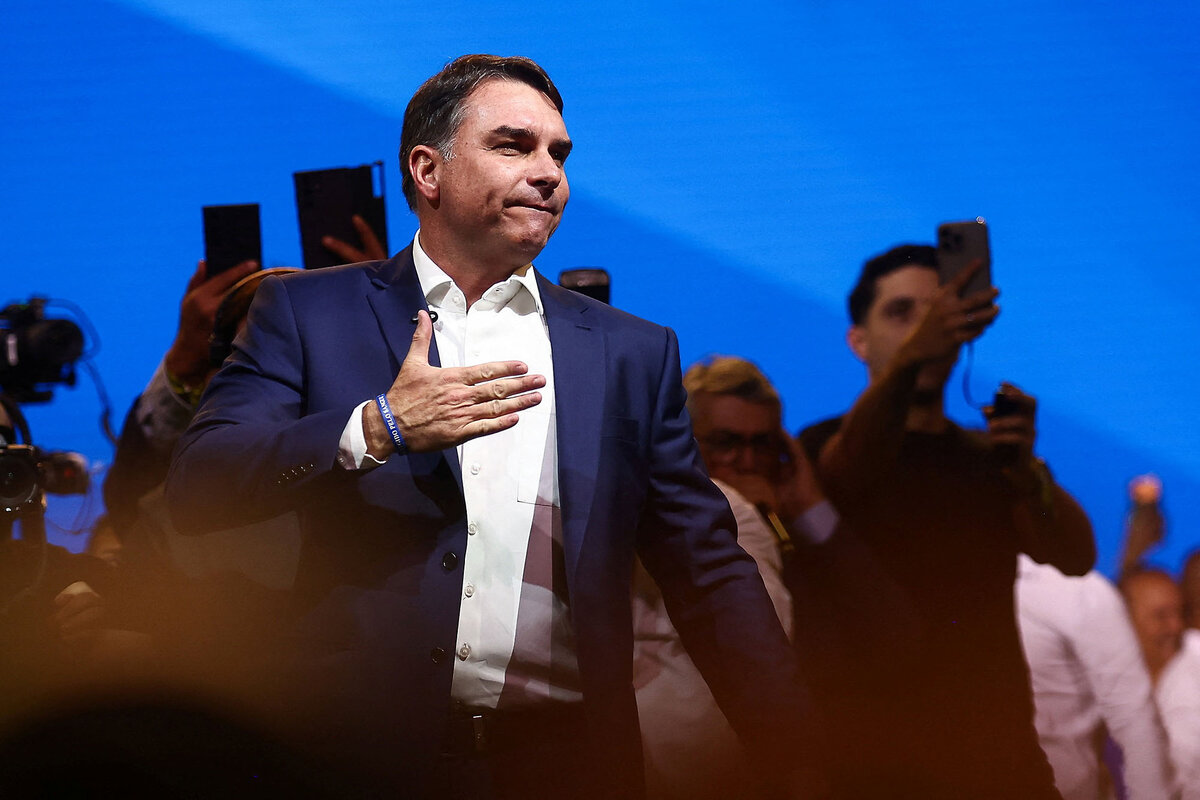
Jean Carniel/Reuters
Brazilian Sen. Flávio Bolsonaro attends the national convention of the Liberal Party (PL) in São Paulo, July 25, 2026, where he was officially announced as the party's candidate in Brazil's October presidential election.
The economy is often central to how Brazilians vote, but the South American nation’s relatively stable economic situation “hasn’t translated into a head start” for Lula’s reelection, says Tiago Oliveira, an economics professor at the Federal Fluminense University in Rio de Janeiro state.
That may have more to do with political polarization, as well as the sky-high citizen expectations for the economy on the heels of two decades of social mobility, experts say.
More of the same?
Unemployment has dropped to record lows over the past four years in Brazil, and poverty and hunger have receded. Yet, in one recent poll, 53% of Brazilians said the economy was bad, and 44% felt it was worse now, under Lula, than it had been during Jair Bolsonaro’s presidency.
Take Bruno Meirelles, who helps run his stepmother’s stall selling soccer jerseys and Brazil-branded knickknacks in a downtown Rio de Janeiro shopping district. “Even though the last administration was during a pandemic, things like purchasing power were better. Nowadays it’s gotten a lot harder,” he says, pointing to the cost of food in particular.
“A carton of eggs that used to cost around 10 reais [$1.94] now doesn’t go for anything less than 18 reais [$3.50],” he says.
When Lula returned to the presidency in 2023, he focused on reprising the social policies that carried millions out of poverty during his first two terms, such as his flagship conditional cash-transfer program, Bolsa Família.

Constance Malleret
Bruno Meirelles helps out at a stall in downtown Rio de Janeiro. He says the economy felt better under Jair Bolsonaro, July 23, 2026.
His government also pushed through a long-awaited tax reform, designed to make Brazil’s tax system fairer. It raised the threshold for income tax exemption for 10 million low earners, while increasing the tax rate for the very wealthy.
But unlike in the 2000s, “it has not been a government marked by innovations, by the launch of great programs,” says Marta Arretche, a professor of political science at the University of São Paulo.
Lula’s Workers’ Party (PT) “comes and goes, but nothing changes much,” says Angélica Pinheiro, a restaurant worker. The PT has held power for 18 of the past 24 years. Ms. Pinheiro says she plans to vote for Flávio Bolsonaro in October.
A regular part of Senator Bolsonaro’s messaging on the economy involves videos of him walking around supermarkets, balking at prices, and drawing comparisons with costs during his father’s presidency.
“People remember the price of picanha from five years ago,” says Dr. Oliveira. Lula “promised cheaper picanha ... and that’s not been the case.”
Record debt – and polarization
Brazilians’ expectations have also shifted after two decades of consumer-driven social mobility and with the advent of platforms like Instagram and TikTok.
“Social media creates consumption aspirations for a large part of the Brazilian population that are clearly incompatible with their income levels,” says Dr. Oliveira, who is also a researcher at the interuniversity Center for Studies on Inequality and Development.
It’s a global phenomenon, but something that’s accentuated here by the country’s deep inequality, he says. And in Brazil, this discrepancy between income and aspirations has contributed to record levels of debt. Today, eight in every 10 Brazilians are in some kind of debt, according to the National Trade Confederation.
“We need to eat, buy diapers, so all our money goes to paying off the credit card, and using it, paying it off, and using it. There’s never anything left over,” says Graziele de Moura, a young mother in Brasília, the capital, who first went into debt when she was 18 years old.
Credit cards, she says, opened up “a life of luxury” she’d never previously experienced. She bought McDonald’s meals, cinema outings, and new clothes, and was only able to climb out of debt by scrimping on rent and working long hours. But, after getting pregnant, a series of unexpected charges on credit put Ms. De Moura in the red again.
She’s not eligible for a debt-relief program launched by Lula’s government in May – one of a series of measures looking to stimulate consumer spending and boost the economy.
Lula has held a small lead over Senator Bolsonaro in the polls since May. The senator’s ratings took a hit after revelations that he approached a banker at the center of a fraud scandal to finance a biopic about the elder Mr. Bolsonaro.
In Brazil’s polarized political climate, anything Lula offers may make less of a difference than they would have in the past, says Dr. Arretche. Around a third of the electorate will never approve of anything Lula does, she says, for the simple reason that they solidly support the Bolsonaro family.
Comments
Nothing yet. Say the first thing.
Sign in to join the conversation.