
Pakistan is a nuclear-armed state run by a powerful military establishment. Other nations rely on Islamabad’s military prowess to maintain regional stability. But within its own borders, the state is struggling to contain a broad range of security threats.
Voters faced heightened security restrictions during the final phase of fraught elections in Pakistan-administered Kashmir on Monday, after violent protests, an internet blackout, and calls for an election boycott disrupted polling. And just last week, a suicide bomb killed at least 17 people and injured dozens more outside a police station in Pakistan’s Swat Valley. The Pakistani Taliban claimed responsibility for the attack, which came amid a continuing separatist insurgency in the province of Balochistan.
Under the leadership of Field Marshal Asim Munir, Pakistan’s military has become more involved in general governance and embraced a hard-line approach to terrorism, but the security situation has only deteriorated. This year, Pakistan climbed to No. 1 on the Global Terrorism Index, which measures the impact of terrorism across 163 countries.
Why We Wrote This
Recent violence in various corners of Pakistan – from a Swat Valley suicide bomb attack to unrest in Kashmir – can be traced back to weak civilian governance, revealing the limits of military power.
This recent wave of violence highlights the limits of military might, observers say, and the need for political solutions.
“There are lots of things that cannot be solved with guns,” says Farzana Ali, who covers the Swat Valley as Peshawar bureau chief for the Pakistani network Aaj News. “Until you allow political people to come forward, you will never fix the issue of instability.”
A cycle of violence
Once a popular tourist destination, the Swat Valley, in the northern province of Khyber Pakhtunkhwa, became a major battleground between 2007 and 2009. That's when the Tehrik-e-Taliban Pakistan (TTP) began to expand its control over the region. Through a major military operation in 2009, the Pakistan army was able to reestablish control, but the valley has continued to experience intermittent terrorist attacks in the years since.
K.M. Chaudary/AP
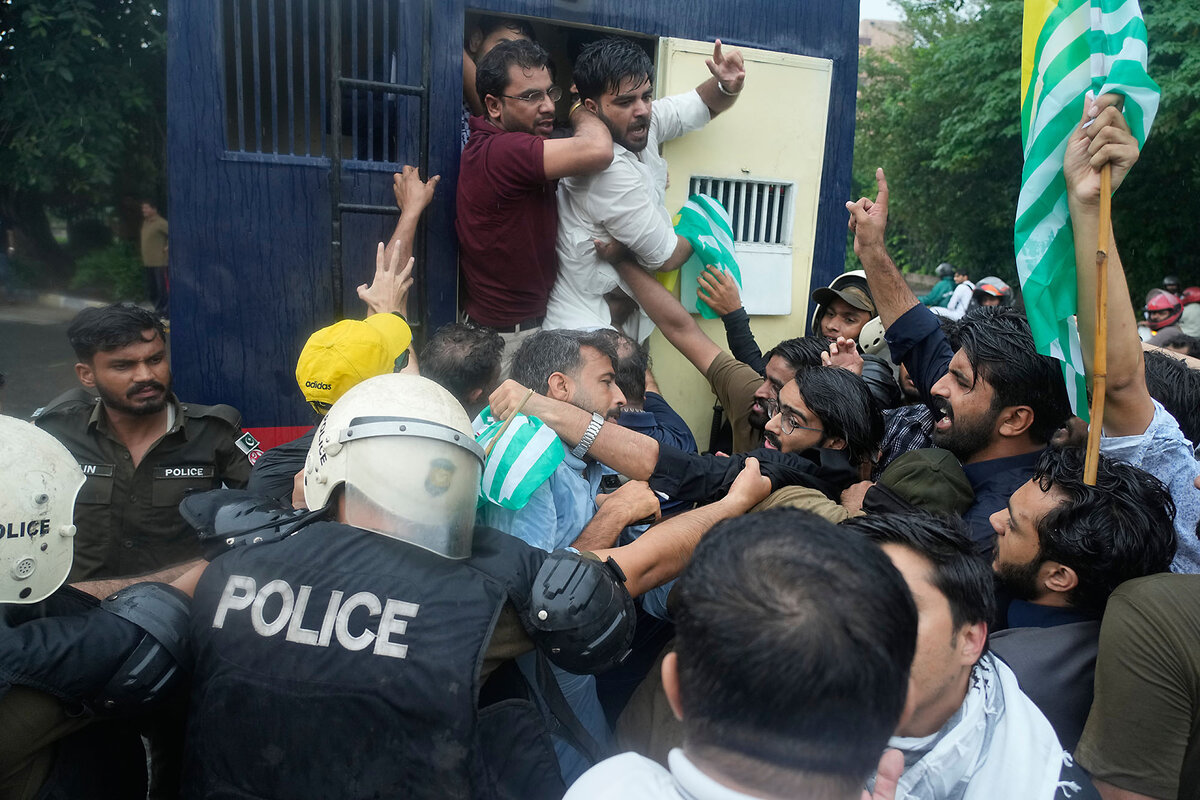
Police officers detain civil society activists during a demonstration in support of Kashmiri protesters in Lahore, Pakistan, July 31, 2026.
After hearing about last week’s attack, local peace activist Saad Khan rushed to Saidu Teaching Hospital to show solidarity with the victims.
“This suicide blast has naturally created deep anxiety and fear in the public,” he says. “The people of Swat have faced this kind of thing before. … We do not want to see our families go through those dark days again.”
Analysts say Pakistanis’ security troubles, in this valley and beyond, stem in part from a chronic lack of political representation.
Military dictators have directly ruled Pakistan for nearly half the country’s history. For the rest, the military has influenced governments from the shadows, propping up civilian governments and tearing them down as needed. Power is concentrated in the hands of the army chief, who crafts critical security policies – including on counterterrorism – behind closed doors.
During the tenure of former military leader Qamar Javed Bajwa, Pakistan embarked on the controversial policy of repatriating Pakistani Taliban fighters from neighboring Afghanistan and allowing them to settle in Khyber Pakhtunkhwa. Supporters of the plan argued that it would persuade these fighters to lay down arms and reintegrate into society. Instead, it allowed the TTP to regroup.
When Field Marshal Munir replaced General Bajwa in late 2022, this policy of repatriation was suddenly reversed. Negotiations with the TTP ended, counterterrorism operations resumed, and the government launched a mass deportation drive of Afghan refugees, citing an uptick in terrorist activity.
Tingshu Wang/AP
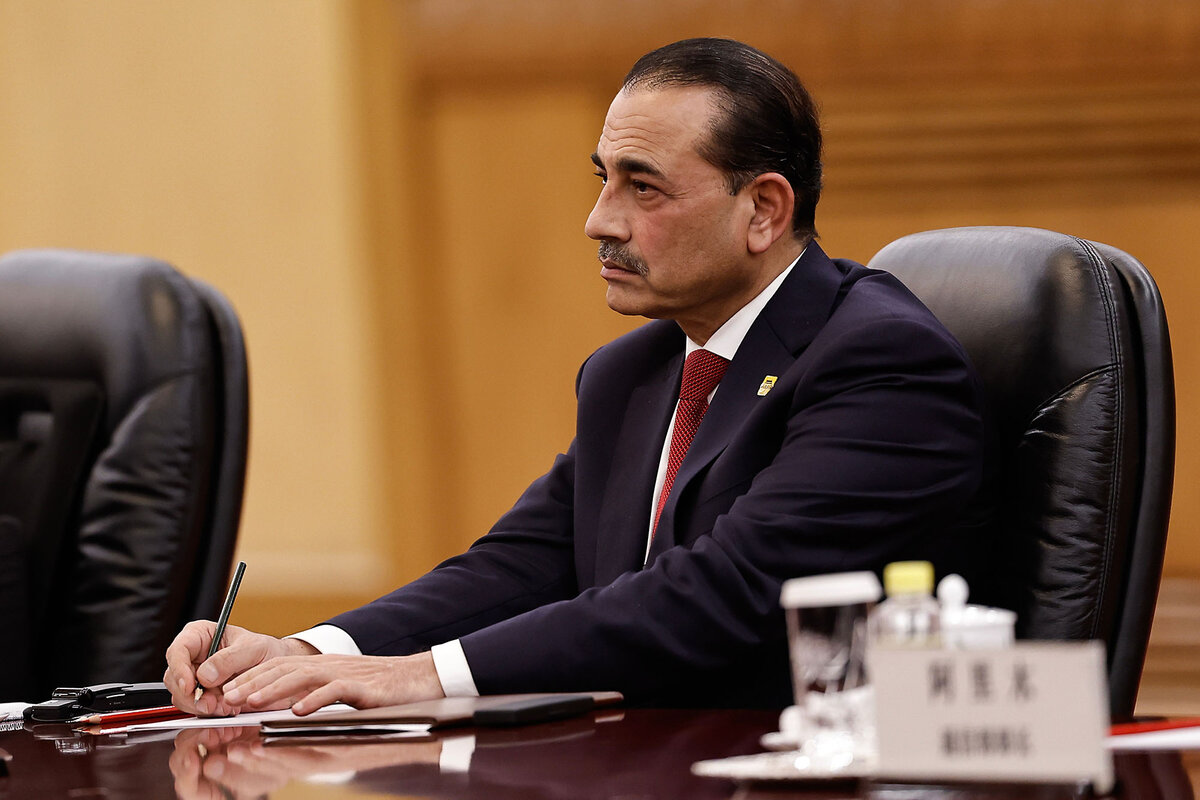
Pakistan's army chief Asim Munir attends a meeting between Chinese leader Xi Jinping and Pakistan's Prime Minister Shehbaz Sharif at the Great Hall of the People in Beijing, May 25, 2026.
Experts criticize both approaches, but say the transition was destabilizing.
“For any policy to be successful, it needs to be consistent,” says Ms. Ali. “For two years, we were talking about resettling and neutralizing these fighters. Then we suddenly decided we needed to crush them. How can such policymaking ever be effective?”
Barriers to political solutions
The current government’s effectiveness is also hindered by its lack of public legitimacy.
Wednesday marked three years since Pakistan’s most popular politician, Imran Khan, was jailed on various charges after his relations with the military publicly broke down. Following a 2024 general election marred by allegations of widespread vote-rigging, the government led by Prime Minister Shehbaz Sharif has struggled to build momentum. This has forced the military to take an even bigger role in day-to-day governance.
The result, say experts, is that the military establishment is stretched too thin. It doesn’t have the bandwidth to properly address the multiple crises unfolding in Pakistan’s provinces.
They point to the state’s violent clampdown on protests in Pakistan-administered Kashmir. In June, an unofficial delegation of senior political leaders tried to visit the region to hear protesters’ concerns but was stopped en route by security forces. Human rights groups have also criticized Islamabad’s use of anti-terrorism laws to jail political activists speaking out about Balochistan, the country’s most volatile province. And just last week, Islamabad announced new guidelines that restrict foreign media’s ability to report on these sensitive regions.
The unrest in these provinces is rooted in economic hardship and feelings of disenfranchisement, but “we are not dealing with these issues when they are political issues,” says Pakistani opposition politician Taimur Khan Jhagra. And as the military adopts an increasingly hard-line approach to unrest, he says it’s backing the government into a corner; the space for political solutions – based on dialogue, negotiation, and compromise – is shrinking.
Comments
Nothing yet. Say the first thing.
Sign in to join the conversation.