
In the public lobby of the U.N. headquarters building, visitors can peruse the portraits of recent secretaries-general of the world’s premier international governmental organization. All are men.
A few feet away hangs a display featuring “women who have shaped the United Nations” – Eleanor Roosevelt, Gro Harlem Brundtland, Amina Mohammed, and nearly two dozen more.
Yet as impressive as the exhibit is, it still feels like a consolation prize for the fact that in its 80 years of existence – and with nine secretaries-general – the U.N. has only elected men to its top leadership position.
Why We Wrote This
In the United Nations’ 80 years, it has been led by nine secretaries-general, none of them women. But as the U.N. begins the process of electing a successor to António Guterres, pressure is mounting to shatter its glass ceiling. Four top candidates are women.
But now, as the world body moves to replace outgoing Secretary-General António Guterres by the end of the year, mounting pressure for a female “SG” aims to make this the year the U.N.’s glass ceiling is shattered.
And hopes are high that the 10th time will indeed be the charm. Four of the seven declared candidates for the job are female – with some having received encouraging early signs from within the Security Council’s arcane system for anointing a secretary-general.
“Whenever I’m asked, ‘Why a woman secretary-general?’ I say, ‘Why not?’” says Jean Krasno, chair of Woman SG, a New York-based group promoting election of a female secretary-general. “Women make up more than half the world’s population, and the U.N. was created based on principles of equity, equal rights, and opportunities for all. So this would be the U.N. living up to its ideals.”
“Essential qualities for the job”
But the professor of international relations at City College of New York says there are perhaps more powerful reasons why a woman would make a good, even great, leader of so complex an institution as the United Nations.
“Women all over the world have learned from the discrimination and barriers they’ve faced that, whether they’re running a family or a business or a whole country, they have to be strategic and diplomatic,” she says. “They need to know how to manage things, including people and finances,” she adds. “Those are all essential qualities for the job of secretary-general.”
Others present the campaign for a female SG in largely pragmatic terms.
“If the countries [of the Security Council] that are going to decide this are serious about wanting the most qualified people to apply, they have to be open to the half of the world’s population that are women,” says Esther Brimmer, a former assistant secretary of state for international organization affairs.
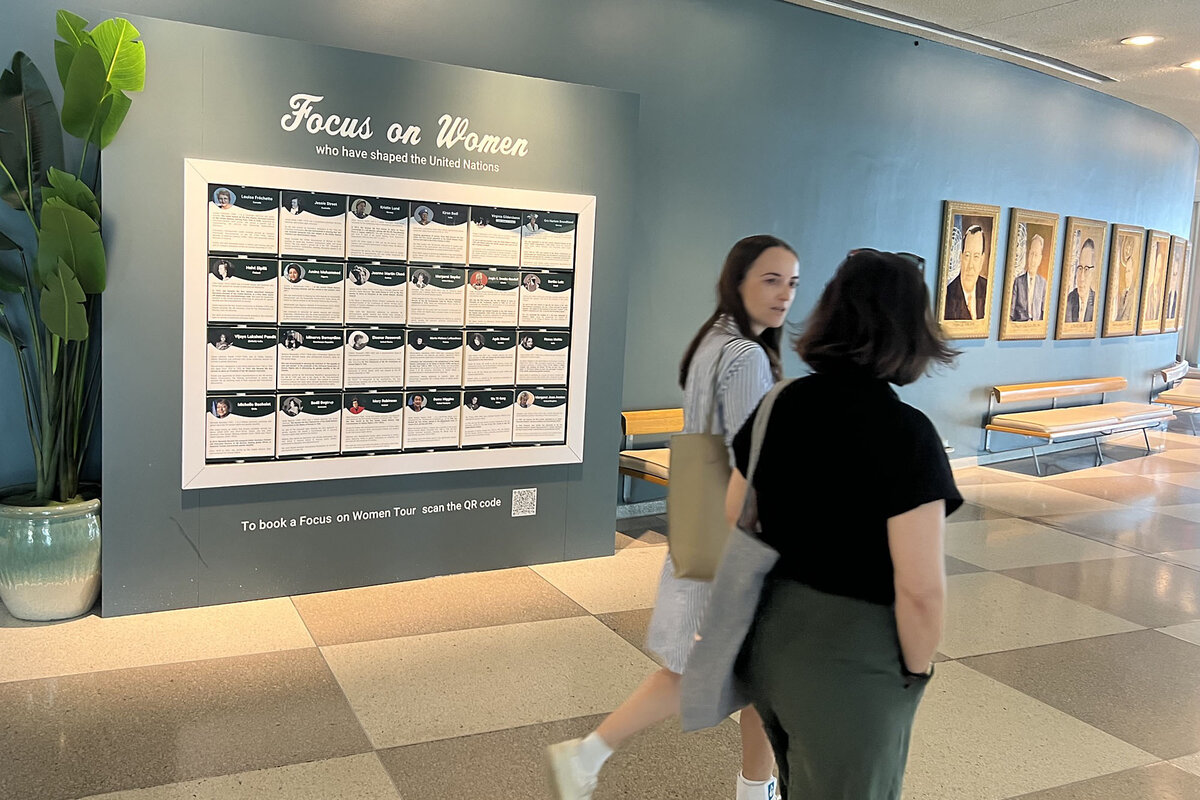
Howard LaFranchi/The Christian Science Monitor
A display at the United Nations headquarters public lobby honors women who have influenced the global body next to portraits of the men who have held its top post, in New York, Aug. 12, 2026.
But beyond that, she says, electing a woman would be an energizing sign to women everywhere of expanding opportunity. Moreover, a woman as SG could provide a jolt to a global behemoth that is under intense pressure to reform, slim down, and become more nimble.
“A woman at the helm would be a much-needed symbol of change and fresh thinking,” says Dr. Brimmer, now a senior fellow in global governance at the Council on Foreign Relations in Washington.
The secretary-general is not elected democratically by the 193 nation-state members of the U.N. General Assembly, but is selected by the 15-member Security Council. And even within that smaller body, it’s the five veto-wielding permanent members – the United States, China, Russia, France, and Britain – that determine which candidate is ultimately presented to the General Assembly for a vote of approbation.
Great-power politics
Some close observers of the U.N. who have followed secretary-general elections for decades question how the advent of a new era of great-power politics, which is sidelining multilateralism and some core U.N. values, might affect the SG race. In particular, the prospects of a woman winning.
“What has been called the most impossible job on the planet has been rendered even more impossible by the shift in geopolitics” to great-power competition, says Waheguru Pal Sidhu, associate professor at New York University’s Center for Global Affairs. “What that context might mean for the drive to make this the year of the woman is unclear,” he adds. “But at the very least it wouldn’t seem to be a plus.”
Perhaps the biggest question mark over the prospects for a female SG is posed by the U.S., he says, where, under President Donald Trump, the gender policies and DEI programs of recent Democratic administrations have been attacked and dismantled.
U.S. officials have suggested that gender will play no role in determining which candidate the United States supports.
But ultimately, the U.S. will go with the candidate it feels it can work with best, regardless of gender, Dr. Sidhu asserts – although there is always the wild card, he adds, of a president who likes to shake things up.
“Trump has demonstrated time and again when it comes to leaders and candidates that he likes colorful and interesting personalities,” he says. “Might we see him applying those criteria in this case?”
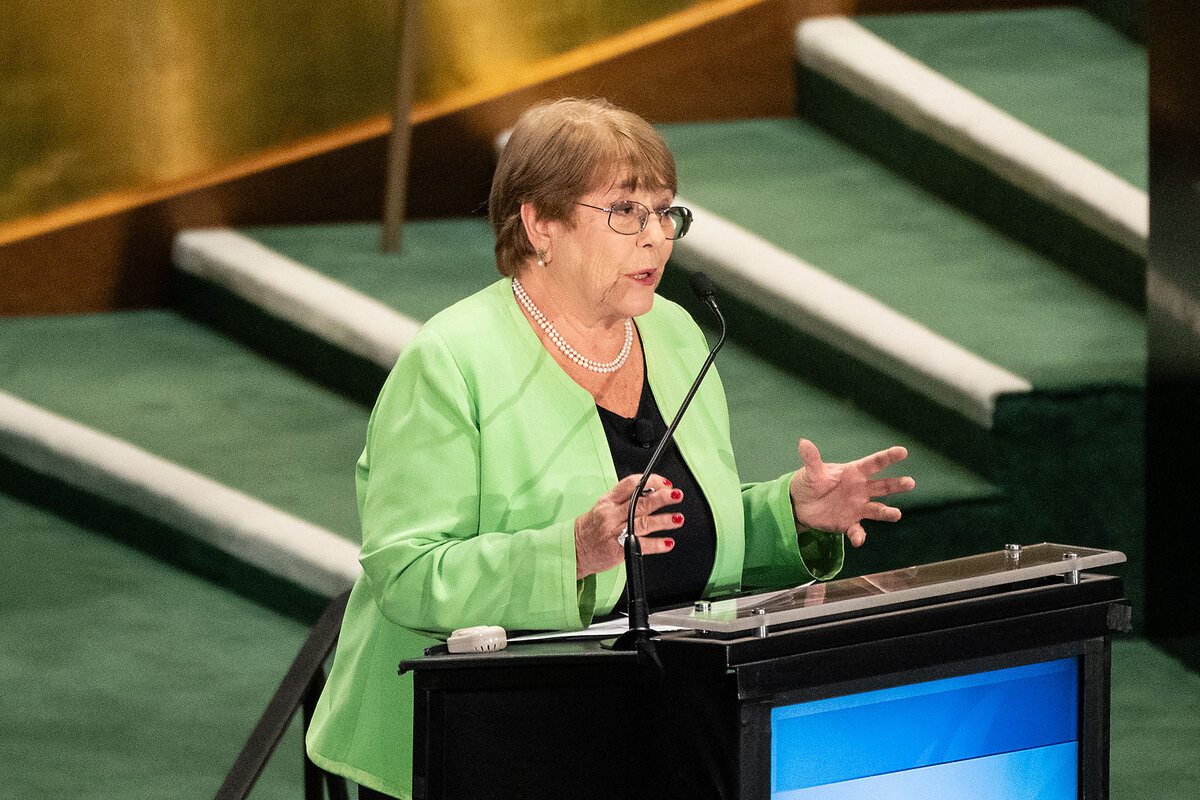
Lev Radin/Sipa/AP
Michelle Bachelet, former president of Chile, speaks as candidates for the position of secretary-general participate in in a televised debate at U.N. headquarters, July 23, 2026.
On the other hand, he and others say, Mr. Trump’s distaste for liberal women very likely harms the candidacy of former Chilean President Michelle Bachelet, a socialist who administered UN Women, the gender equality and female empowerment program, for several years.
China’s U.N. ambassador, Fu Cong, meanwhile, said this year his country would “welcome” a “woman after so many years.”
“Encourage” votes in straw poll
Dr. Krasno, the Woman SG chair, says she’s encouraged that female candidates to succeed Mr. Guterres appear to be not just holding their own, but leading the pack.
In the first informal straw poll of Security Council members last month, women secured the first, second, and fourth positions. Under a voting system in which members indicate if they want to “encourage” or “discourage” a candidacy or offer “no opinion,” former Costa Rican Vice President Rebeca Grynspan came out on top with 10 “encourage” votes. Close behind was Carolyn Rodrigues-Birkett, former foreign minister of Guyana, with nine “encourage” votes.
Argentine diplomat Rafael Grossi, who heads the U.N.’s International Atomic Energy Agency, came in third, with seven “encourage” votes. But he also received two “discourage” and six “no opinion” votes – a mixed result that does not bode well for his candidacy, confides one longtime U.N. official on the condition of anonymity.
With the candidacies of former U.N. General Assembly president María Fernanda Espinosa of Ecuador, as well as Chile’s Ms. Bachelet, all four female candidates are from Latin America.
Rounding out the field of declared candidates is former Senegalese President Macky Sall and Ugandan diplomat Olara Otunnu.
The Security Council is set to hold another straw poll Aug. 21, potentially clarifying candidates’ prospects further. Several Council members have said they hope to reach a decision by October, to give the incoming SG some overlap with Mr. Guterres.
Dr. Krasno notes that Mr. Guterres took up the post in 2017 pledging to bring more women into higher positions in the U.N. “And he did it,” she adds, citing recent numbers that show about half the organization’s senior jobs are held by women.
Yet as much of a “step forward” as that is, it still falls short of the “leap” Dr. Krasno says would demonstrate global progress.
“If you believe in leadership and the big difference the occupant of the top position can make,” she says, “it’s important for the world that we finally make that leader a woman.”
Comments
Nothing yet. Say the first thing.
Sign in to join the conversation.