
 and shares in (in black bars) global income (gross domestic product, GDP) growth by India from the 1990s up to 2030 (where 2025 to 2030 use projected values). The bars show growth in both aspects through time.")
The surest way to lose an election in India is to carry out economic reforms. The government that introduced the 1991 reforms lost the 1996 election. PM Modi introduced the land acquisition reform in 2015, only to take it back after Rahul Gandhi’s “suit-boot ki sarkar” jibe and the Bihar election loss. The BJP government introduced the farm laws in 2020, only to repeal them 15 months later.
Thanks for reading The Indic Prism! This post is public so feel free to share it.
In India, successive governments have always tried to introduce major reforms. Sometimes they’re successful, other times they’re not. Free market reforms are opposed by vested interests because costs are concentrated while benefits are diffuse and accrue to wider society.
Consider the following ways that the Indian government has pursued reforms:
The 1991 reforms introduced liberalization, privatization and globalization into the economy. But quantitative restrictions (QRs) on more than 2,000 items remained. Using the WTO as an excuse to sell it domestically, the government was finally able to remove them in 19961.
India ranked poorly in the Ease of Doing Business Index when the current government came into power in 2014. PM Modi set a target to break into the top 50. The rank improved from 142 in 2014 to 77 in 2017, when the index was scuttled. The push for reforms also led to India introducing the Insolvency and Bankruptcy Code, 2016 which was appreciated by the World Bank as a game changer for the economy.
India appoints world class economists – Manmohan Singh, Raghuram Rajan, Raja Chelliah, Arvind Panagariya and Arvind Subramanian among others – to technocratic positions like the RBI head or as the Chief Economic Advisor to the PM. Their very strong technical ability itself allows them room to maneuver and gives them the credibility to sell reforms.
The pattern is clear. Reforms are unpleasant. But bitter medicine must be taken. In a democracy, free market reforms are always hazardous for the incumbent. So economic research and technocrats come in pretty handy as a credible defence to push through reforms.
By now, I hope the demonstrated examples show why the credibility of economic research must remain high. But what do I mean by research that’s not up to standard? I’ll give some examples here.
A recent paper tried to quantify the number of women missing from Indian streets. To do so, the authors took 4,500 street images containing thousands of visible people. They then estimated the share of women in these images. The number came to 16%.
There are many methodological problems with the paper. Sampling is heavily done in residential areas. Depending on the time of day photos are taken, the presence of women in photos can vary tremendously. Men are more likely to loiter around streets, while women are more transient; this skews the ratio towards men. Finally, Mumbai has a large migrant population that likely skews the sex ratio of the city. Without knowing the exact locations and times when the photos were taken, it would be hard to correct this problem.
This paper made waves on Twitter and found its way into a few newspapers as well. While the headline figure was shocking, the result was counterintuitive to anyone who has stayed in Mumbai. Counterintuitive doesn’t mean wrong, but it does mean that the evidence has a higher bar to clear. When other research cites this work, it will rest on a shaky foundation and slowly erode trust.
There are more egregious examples of trust-corroding research.
Utsa Patnaik says that Britain stole $45 trillion dollars from India. How does she arrive at this figure? India was an export surplus economy in colonial times. Ships left Bombay and Calcutta with goods. Foreign purchases of Indian goods paid for rupees in London with gold or sterling. Exporters based in India were paid in rupees raised through taxes on Indians. So, essentially, the claim is that India didn’t get much for the entire export surplus. Utsa Patnaik then compounds this entire surplus over the colonial period at 5% from 1800 until 2016 and arrives at this $45 trillion figure.
There are two major problems with this.
First, the Indian colonial economy was an open economy that hired personnel abroad. The surplus paid the interest on London-based salaries of foreign personnel. While these personnel would’ve been provided to India at market-monopoly salaries, the services rendered were real, even if highly overpriced. Shipping, insurance, and banking services were also imported, and the sterling debt in London bought these services, even if overpriced.
Second, compounding the entire surplus at 5% is an indefensible assumption. No country in the world has grown at 5% for more than two centuries. A consistent growth rate of 2% per year is considered great for countries at the technological frontier.
Such research is pernicious. It reinforces the stereotype that advanced economies got rich through stealing land or wealth. Domestic constituencies are emboldened by this claim, and free-market reforms become slightly harder to pursue. Already, these reforms are hard to implement when times are good. It becomes difficult when the environment gets poisoned with such rhetoric. Finally, it indicts capitalism, when the real problem was mercantilism.
Another instance is Thomas Piketty’s paper on the Billionaire Raj. The paper’s core claim is that inequality in India is higher today than it was in colonial times.
Inequality is a product of the industrial economy. When agriculture dominates the economy, a person’s output is directly proportional to the amount of land they own. As such, there’s an upper limit on wealth and, by extension, on inequality. But is this society a desirable one? Revealed preferences would indicate that an industrial society with modern amenities would be preferred. And inequality is an unfortunate byproduct of that.
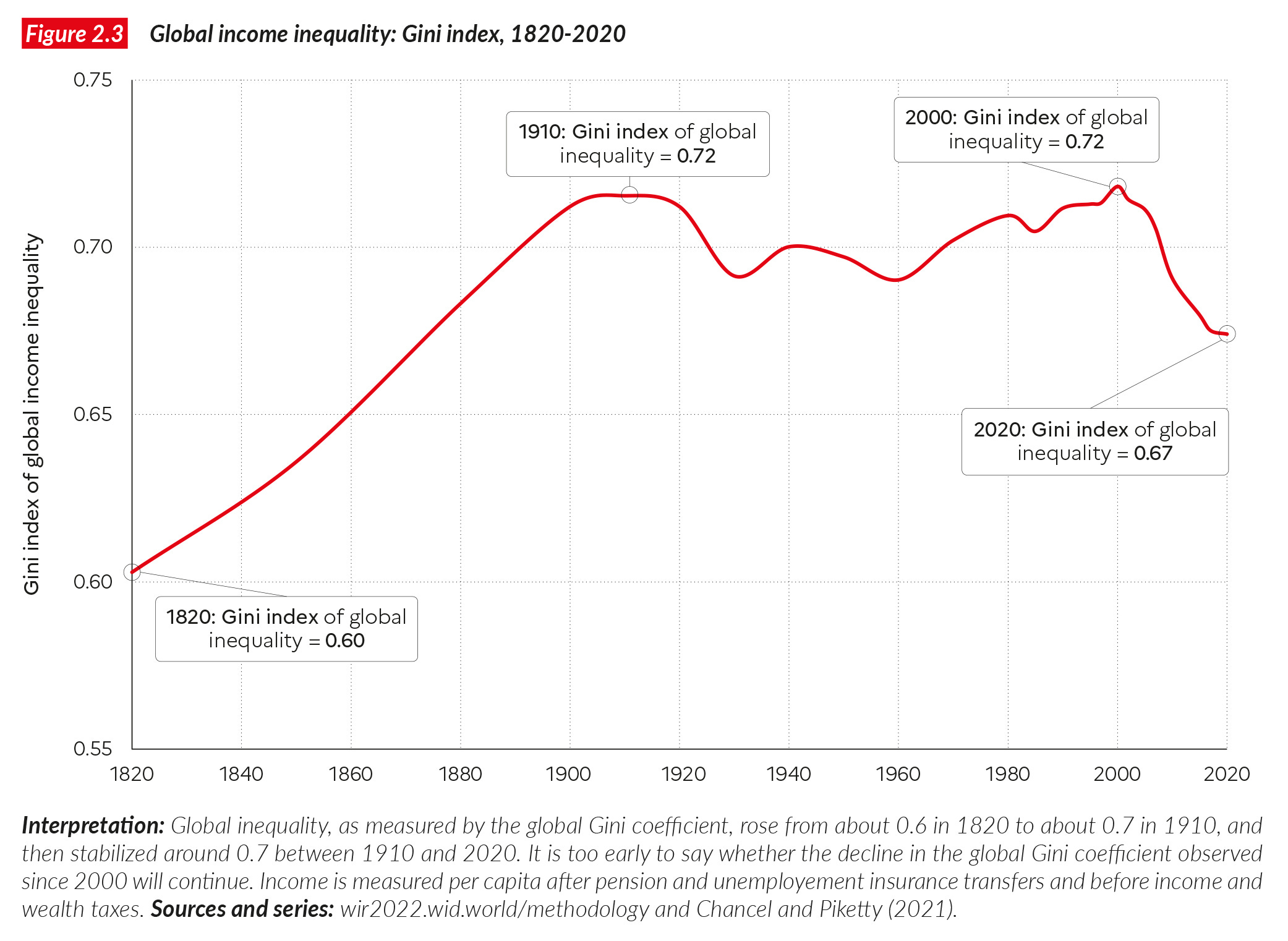
More importantly, as the graph above shows, global inequality is decreasing. A huge chunk of the decrease is driven by the industrialization of India and China that has pulled hundreds of millions out of poverty. Growth rates in these countries have eclipsed the developed world for decades.
A final example of research, which isn’t necessarily bad, but must be taken with a grain of salt are Randomized Control Trials (RCTs). In and of themselves, RCTs aren’t harmful. But of late, they’ve acquired a halo that has turned them into a gold standard for evidence. Because RCTs are an extremely powerful tool in some cases, it is all the more important to protect them from generating bad headlines.
RCTs face problems of generality. If an RCT finds out that a $1,000 monthly payment leads to all sorts of useful outcomes, that will likely fail to generalize across the economy. It wouldn’t take into account inflation and other economy-wide effects that have second order effects on behavior. Even when RCTs are successful, they tell us little about how the effects would translate from Bangalore, India to Kampala, Uganda – and the reverse. I’ll quote Maria May here:
Simply, RCTs almost always yield pieces of unique puzzles, rather than answers that add up to a larger certainty. Even accounting for the caveats of context and program, RCT knowledge cannot be neatly combined with other study results. Even “gold standard” results, taken together, do not produce a full playbook.
What are the biggest problems with economics losing its credibility?
I’ve already described previously how successive governments basically use international organizations and academic superstars as a shield to move the economy towards a more free market position. Economics losing its credibility would rob governments of this incredibly effective weapon.
But there’s a subtler impact. Let’s look towards the US.
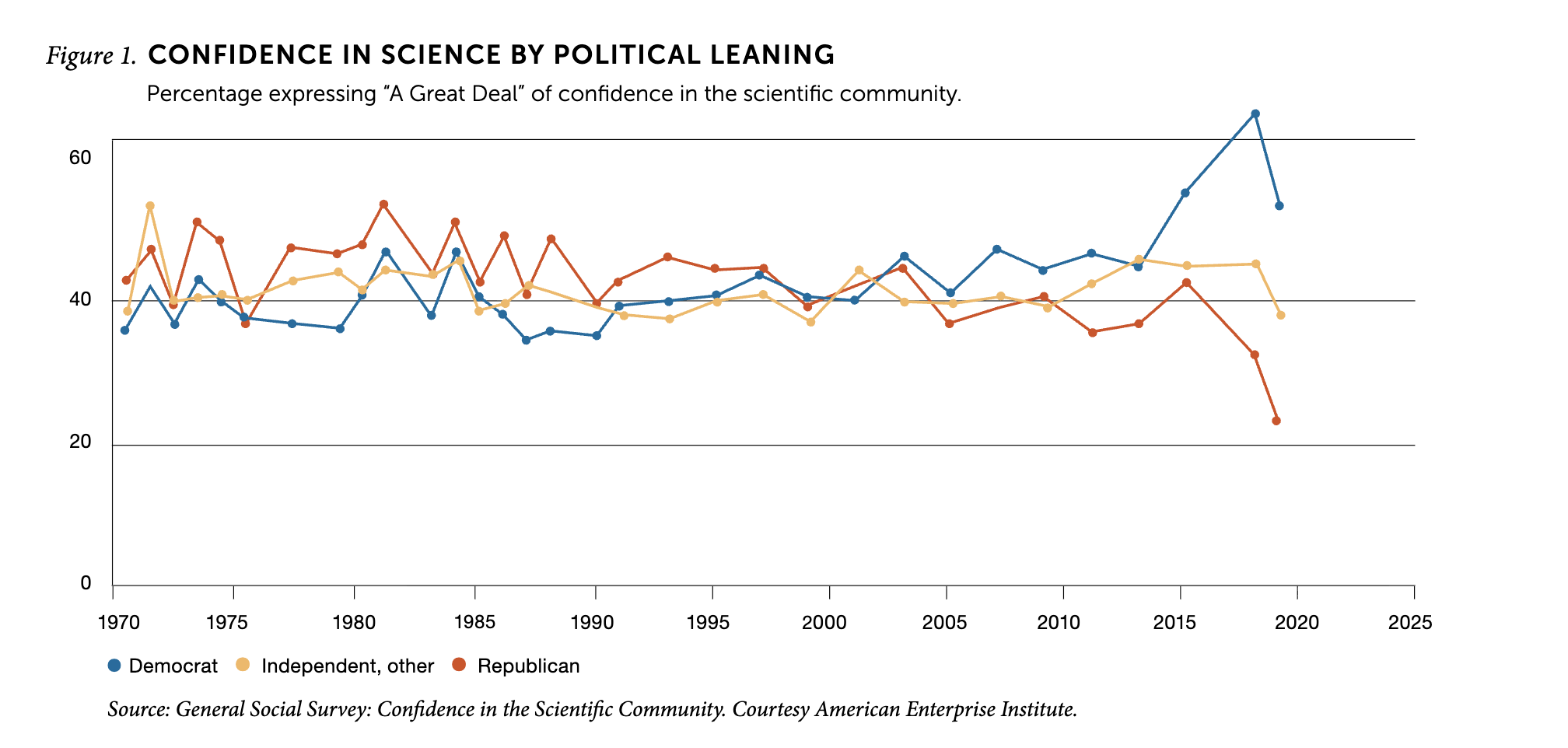
Here’s a graph of trust in science broken out by political leaning. Trust in science was fairly similar across both political parties. Around 2020, both Democrats’ and Republicans’ trust in science collapsed. Anthony Fauci fumbled in communicating about the Covid virus. Various restrictions were ordered in the name of science. Without getting into the weeds of it, there were political games played around the approval and rollout of the Covid vaccines as well. All of this led to a loss of trust in science.
Fast forward to 2026 and suddenly, your opinion on vaccines has become a strong predictor of your political leanings. Anti-science folks like Robert F. Kennedy Jr. have been appointed as the Secretary of Health. And there’s been a general proliferation of climate skepticism to boot.
In India, there’s no surveys of trust in economics as a discipline. But looking at the widespread approval that superstar academic technocrats – like Raghuram Rajan or Montek Singh Ahluwalia – receive on being appointed to government positions, we can conclude that trust in technocrats, and by extension their research, is high.
When research lands punches on some side’s party catechisms, then there should be strong epistemic grounding for the research. While losing trust in science is bad enough, it is worse if the distrust in science gets folded into an identity marker. Once that happens, there’s no indication of when trust in science returns. That’s a societal loss.
What would my ideal framework look like in practice?
Firstly, academics should recognize that they are stewards of public trust. Mismanagement will result in loss of public trust that is hard to regain.
Secondly, research must be communicated well to the lay public. The focus should be on acknowledging that each study only uncovers a newer piece of a much larger puzzle.
Finally, there’s a difference between knowledge that can be encoded versus knowledge that’s implicit. Implicit knowledge doesn’t imply that it hasn’t been written down yet, it implies that it can’t be written down. Academics must have the humility to acknowledge that. Arrogantly scorning someone’s “lived experience” while living in an ivory tower is not a good endearment strategy.
Another example of this is the FEMA reforms that were required for economic liberalizations. Using the IMF obligations as an excuse, India implemented these reforms in 1999.
Comments
Nothing yet. Say the first thing.
Sign in to join the conversation.