
It’s so easy to fall into the trap of either avoiding people or discounting them because we don’t feel comfortable around them.
I’ve had the very great pleasure of upcycling friends and acquaintances.
Let me explain...
I had a massive realisation recently: I was always looking for the same thing in friendships. And when people didn’t react as I expected, I would assume two things:
That person wasn’t my kind of person, and
That there was something wrong with me (of course!!)
It’s like walking down the high street, and in every shop you go into, you’re looking for gardening gloves. (Bear with me.)
Assistant: “Er… we’re a cheese shop… we sell… like… cheese.”
Me: (trying not to cry) “Is it me? Is it my fault? Is that why you won’t give me the gloves? Is it something I’ve said?”
Assistant: “We’ve got good cheese… wanna try some?”
Me: runs sobbing from the shop
Ok, this is a VERY blunt example. But I just wanted to illustrate how simple it is, even though it feels really complicated.
Rapport is great. It’s a beautiful flow thing. You know when you meet someone and they just get you? You can relax around them, they love you no matter what you do, you have similar opinions on SO many things, and they can see past your quirks and challenges because you’re, well, you.
If you experience RSD, these relationships are incredibly relaxing because—for once—we don’t have to worry too much.
I hope you experience flow states with someone. It’s lovely when it’s a life partner; it’s even rarer and more precious when it’s a friend.
But here’s the thing: those kinds of relationships probably make up about 5% of your relationship pie.
The other 95%? Those are the ones you have to work at. You don’t get to experience that magic juice called rapport.
The trouble is, we think they’re not working—but actually, they just work differently. They’re at a much more surface level. And that’s OK.
We find it hard to connect with people who don’t dive deep or share our sensitivities.
But what if, instead of looking to have things easy and receive rapport, we decided to focus on creating harmonywherever we go?
What if we looked to give some happiness (or at least our time) to people we don’t naturally click with?
To be interested in them? To create a warm and welcoming environment?
Too hard? I get it. But I have some more information (and a diagram!!) that may just help.
We fear our boundaries will be overstepped
We fear annihilation of the self
We fear that our fragile selves will be crushed underfoot.
So we avoid these kinds of relationships, because all we have is attack. And we don’t really want that. We’re nice people, really.
Karl. I rejected him.
He just talked at me. Told me about his wife’s bad behaviour, in front of his daughter… I was judging him most harshly. He told me what to do, he told my daughter what to do, he made sweeping statements. There was literally no rapport.
So I threw him out with the trash. “He’s just not my kind of person. We’ll never get along. Oh god, it’s him… he makes me so uncomfortable.”
But what I was really doing was comparing him to the bullseye. If you’re not that, then you’re nothing.
Next time, I was pleased to see him. I gave him my time. I listened about his wife, and we smiled at each other. There was warmth. Community had been restored.
The power was always with me.
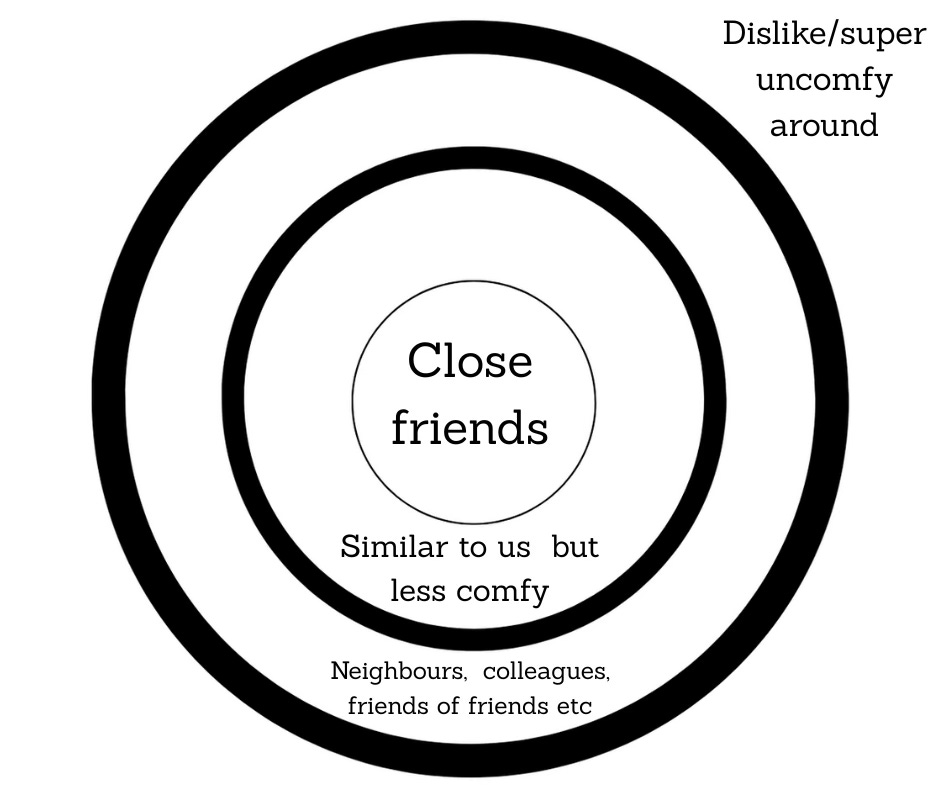
Outside circle: People we can shake hands with, say “hi, nice to see you,” think of something about their life and ask them.
Inner circle: People you care about and/or have to meet with regularly, but you don’t exactly gel (maybe you’re in competition?).
Bullseye: The sweet spot—full-on flow.
We can’t expect the people in the outside ring to give us rapport. They’ll give us politeness, and that’s enough. We have no need to look for anything else from them. That’s the art of conversation.
The inner ring folks will drift in and out of flow. We never feel fully safe to be ourselves around them—and that’s OK.
We don’t have to give our whole selves to everyone.
It’s OK to make them feel safe and talk about what interests them. See if you can leave them feeling good about themselves.
Let go of expecting them to give you anything—they’re not there for that.
Though give them enough time and space, and you might just end up with a lifelong friend… a slow burner.
And then there’s the bullseye: the ones you naturally find a level with. You scratch my back, I’ll scratch yours. There’s rarely an imbalance. You’re overflowing with joy and want to give these people everything you’ve got.
And that’s OK. That’s exactly how it’s meant to be.
The trouble is, we’re so literal. We think we should be the same with everyone.
We think if we don’t get evidence of full-on flow, then people don’t like us.
In my experience (hard-won, I have to add…), very few people actually dislike us—unless we start acting weird because we think they don’t like us, so we decide not to like them first (!!!).
As you go about your life—meeting new folks, running into the usual ones—before you start blaming yourself or making them wrong for not responding how you’d hoped, try putting them on this dartboard.
You’re not disliking them. You’re not being dishonest or mean.
You’re doing the opposite: meeting them exactly where they’re at.
You stop being mean to them, and you stop being mean to you.
It’s the 95% who are going to help you grow, develop, and become your best self.
The 5% rapport relationships are fun and restful—but until we learn to embrace and get along with most people at a certain level, we’ll never truly become all we can be.
So we have to stop looking for it. Like, everywhere… ok?
But I know. These are just words.
When you experience RSD, the pain and preoccupation around rejection and our own wrongness are so intense that we’re in survival mode.
And in survival mode, we’re pretty much hallucinating most of the time.
We have goggles on that are actually looking for people being mean to us.
A wise man once said:
“If the only tool you have is a hammer, then everything looks like a nail.”
So while this advice is sound—life-changing, actually—don’t beat yourself up if it’s too hard to be an instrument of harmony in others’ lives.
I was only able to really get this once I’d stepped my limbic system reaction down from red to amber.
Because our limbic system believes it’s helping. It’s trying to do something positive: keep us safe.
But it’s operating on faulty information.
And until we question its validity and start to retrain its response, it’s like having a two-year-old puppy driving your car.
If this resonates with you, I want to invite you to my new series: Courageous Conversations—ten stand-alone 90-minute workshops designed to help you transform conflict into an opportunity for growth, self-respect, and deeper connection.
We’ll explore:
The art of apology
Boundaries that protect connection (not destroy it)
How to stay present in conflict without losing yourself
Practical tools to move from shame and blame into clarity and respect
The workshops will be running in from November 6th, and they’re intentionally low-cost to keep them accessible.
If you’d like me to know more, just click the button below. 💌
And if this all feels like a step too far, you can also read my book. You’ll find it in my links. It helps you avoid conflict (without feeling like a wimp!)
Comments
Nothing yet. Say the first thing.
Sign in to join the conversation.