
Our 2016 Part 2
2016 started with a win when Geri got a clean bill of health after finishing treatment and surgery for breast cancer. But it wasn’t a pop champaigne and jump for joy kind of victory. It was a deep sigh of relief and gratitude kind of victory. As much as people kept saying there was no way cancer could ever defeat someone like Geri, we knew we were lucky. It wasn’t god. It wasn’t Geri’s fierceness. It was doctors, nurses, technology, and timing. Of course Geri is a badass. But when cancer wins, it does not mean the person was any less of a badass or put up any less of a fight. Cancer is cancer, and when it is discovered is just as important as how and by whom it is fought.
So as 2016 began, we had some hope. The Obama years were coming to a close and we, like so many, assumed the Clinton or Sanders years would proceed. Go ahead and take a moment to cry.
But if 2016 started with hope for our family and close friends, a lot of it was due to Geri surviving cancer. She worked almost full time as a dentist through all of chemotherapy and radiation. She kept her office running, so all of her staff kept their jobs. They scheduled a few minutes in between patients, so Geri could lay her hairless head on her desk and rest before seeing the next patient. There were tears every day at the office, as her staff watch Geri grind through the day, knowing that most people don’t work through chemo. For those of you not familiar, chemotherapy is basically putting poison in your body to kill the cancer cells. But it is poison, and it makes you feel terrible.
So, here are more depressing highlights from our 2015. If you’re like me, you enjoy a sad song or a dark, depressing poem. I still cry every time I revisit this blog. But life being what it is, things get better and they get worse. In addition to the ICE fuckery, I think it’s good to keep in mind other parts of life. There are people right now sitting in chemotherapy rooms, quietly battling cancer. There are people suffering tremendously in Gaza and lots of other places. The Epstein files are still unreleased. We are certainly living through the worse right now in this country. Here’s to the better days, even as we keep our humanity in mind.
Journal entry by Scott Okamoto — Apr 22, 2015
First, some really good news. Geri’s BRCA test came back negative. That is good news for both her and Audrey. And now the possibility of a mastectomy is gone for now.
We met with the last oncologist this morning, and he was really helpful. Basically, there are several different drugs used for chemotherapy. If you’re like me, you imagined a single drug called, “chemo” used in chemotherapy. What doctors do is use a combination of different highly toxic drugs to kill cancer cells. Each one kills the cancer in different ways, and each has its own set of side effects. Some have more risk of neuropathy (nerve damage to fingers and toes), damage to the heart, loss of white blood cells, bone marrow damage, and about a zillion other possibilities. It’s poison, after all. And each person responds to each drug in his or her own special way. I can’t remember all the names. I’ve been referring to them as “booberol,” “boobafix,” or “boobaheal.” There is one newer drug that has been known to be effective with fewer side effects, but because it is expensive, it has not been approved by insurance companies. We’ll call it “boobafix.”
More good news. After visiting the oncologist at The City of Hope, Geri learned about a clinical trial that uses boobafix. Geri got one of the last spots on the trial, so there is already an impressive record of women who have been completely healed by this particular regimen of chemo drugs. 55% have been completely cancer free at the end of chemo, and the rest ALL had significant shrinkage of the tumors. We’re sorting out the insurance mess, but we are now committed to getting started. The lead doctor was excited about Geri because she fits the profile of the study perfectly. She has a few tests to do, and will begin chemotherapy next Friday, May 1. There are still potential risks of neuropathy and bone marrow damage. Chemo is serious stuff.
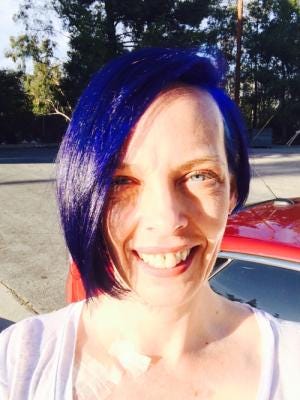
Friday, Geri will get her hair dyed purple. The doctor estimated she will begin losing her hair after two weeks. Aileen has already knitted Geri a new hat, and she has ordered a wig from the cosmetologist at the cancer center in Pasadena.
I’ve been feeling confident in Geri’s prognosis for the past couple of weeks, but this morning, the oncologist reminded us that women die from this diagnosis. It all depends on how the patient’s body responds to the chemotherapy. Geri’s chances of survival are excellent, but there is always that 10% chance. Any semblance of a cavalier attitude on my part was definitely put in check today. There are countless perils to fear in the chemotherapy and the cancer itself.
In the coming days, I’ll be posting about how we talk about cancer. Susan Sontag’s Illness as Metaphor book comes to mind. Right now, we use figurative language to describe the “fight” against cancer. A lot has been written about the usefulness of that view. Does it blame the victim if he or she “loses” the fight? I don’t have an opinion either way. I think it’s always well-intentioned. More to come.
Oh, and this Friday we’ll have a purple hair karaoke party if anyone wants to come over. We’ll have some purple chalk if anyone wants to join Geri in having purple hair. Let’s sing “Purple Rain” together!
Journal entry by Scott Okamoto — Apr 30, 2015
I picked up Geri from work yesterday and brought her to the City of Hope’s main hospital in Duarte. We are so lucky to live less than 10 miles away from a world class cancer research and treatment center. Geri was there for a biopsy of the tumor so City of Hope can have its own for the clinical trial. I sat down in the waiting room to possibly write something for this blog, but immediately started to fall asleep. I decided to go for a walk, having heard that the grounds of City of Hope are beautiful. And they are.
I walked towards a rose garden and sat down on a bench in the shade. It was over 90 degrees, but the smell of roses and the sound of a small fountain were relaxing. And then I noticed the pathways were lined with small rectangular plaques. I realized these were miniature gravestones of people who had lost their lives to cancer. The row next to me was from 1994, the year Geri and I got married. It was overwhelming to then look around and see the hundreds of little rectangles along the winding paths of the garden. As peaceful and comforting a place this was, death is clearly, if peacefully, present. People come here with hopes of being healed, but cancer is a powerful foe.
In the politics chapter of the book I’m working on, I tell the story of a hardcore conservative student in a composition class who argued against anything the “evil” government did. When we got to the topic of healthcare, he softened a bit. He told the class the story of his father who was diagnosed with cancer. I can’t remember what kind of cancer it was, but it was serious. At City of Hope, the doctors outlined a treatment plan they were confident would be effective, giving the family a great deal of hope. Then, like so many, they discovered their insurance did not cover that treatment, nor any treatment at City of Hope. He was sent to a local hospital (I think he was from the central valley) where the doctors did not know of the City of Hope treatments, nor would the insurance cover them anyway. The student used some choice words for the doctors whom he described as uncaring and ignorant. His father died a few months later. We all cried with him, and another student asked him if he would be ok with a universal health care that everyone received, so his dad could have been treated at City of Hope. He wiped a tear away and then took a deep breath. He then stunned us by saying he would rather live in freedom from the government than have his dad back. At this point I wasn’t even pretending to be his professor, and someone said something to the effect of, “You don’t really believe that.” He broke down again and tried to say, “no.”
The world can be a fucked up place. Everyone should be able to receive the best treatment. Even those who might argue against it. Why do some people have the BRCA genes while others don’t? Why do children have to lose their parents to cancer? And why do children have to suffer terrible things like cancer?
I walked towards what looked like a Japanese-style garden. As I passed the building where Geri was getting her biopsy done, a man and his pre-teen daughter came out of the doors with two doctors. I watched them take a picture and exchange tearful hugs. “Thank you so much for everything,” the father said to the doctors. Successful outcome.
I sat at a bench next to the pond and watched orange fish and turtles swim around. A group of women across the pond huddled together, praying. A man in a business suit entered the garden and sat down at a bench, put his face in his hands and then stared at the water. I wondered what their stories were. The possibilities terrified me. Outcomes unknown.
Geri emerged through the double doors, smiling. You’d never guess she had just had a minor operation. She was excited because she had seen the samples of her tumor which she described as white noodles because they were extruded from a needle. We wondered at the cruel irony of how our own cells can turn on us. For some reason, it was important for Geri to see the tumor directly, instead of just on an MRI scan or ultrasound. She has seen the enemy, and it is, in some bizarre, cruel twist of fate, her.
I suppose I could end on this down note, but I won’t. Life can surely suck in this world. There are wars, natural disasters, diseases, and tragedies everywhere. And if those don’t hit us, our own cells can turn against us. And I recognize the narcissism in my own words on this blog as I’ve claimed “good news” for some of the test results we’ve gotten. I am hoping, though, that through all that Geri and our family must endure in the coming months, we will be present with each other and all of you. I am hoping we can celebrate life together. I am hoping to remain mindful of the suffering of so many others around us and in the world. To quote the late Stuart Scott, “You beat cancer by how you live, why you live, and the manner in which you live.”
Journal entry by Scott Okamoto — May 1, 2015
Just a quick update. We arrived at City of Hope in South Pasadena to meet with Dr. Yeon, our oncologist. She answered all our questions, and then we went down to the second floor for Geri’s first chemotherapy infusion. It is a big room with two rows of lounge chairs facing each other. The room was crowded when we arrived, and the front desk woman told us to pick any seat available. It was like a surreal Southwest flight. We picked one of the last couple of seats and sat. The other people in the room were almost all women, all of whom were older than Geri. Despite the grim situation of such a room, there was a sense of calm. The world of cancer exists somewhere between life and death.Outside the window was Fair Oaks Blvd and South Pasadena, the land of the living where we once lived. Beyond life is the unknown. In rooms like this, people come for anywhere between one to four hours to hook up to an IV bag which drips saline, drugs, and poisons into the bloodstream with the hopes of sending them back into the land of the living.
The nurses were friendly and light-hearted. I watched, trying not to wince, as they connected hoses to Geri’s new port on her chest. It’s like a USB port. They can take blood or infuse with the IV through it. And then they sent the drugs into Geri. It was all rather anti-climactic. She thought about sleeping but fired up her kindle and started reading Naomi Hirahara’s latest series of mysteries. People came and went. My heart sank when a woman entered with a girl about Audrey’s age (12 or 13). The girl wore a cap, and I could tell she had lost her hair. Seeing kids with cancer always gets to me. I feel for the kids, naturally, but I really feel for the parents. We try so hard to be there for our kids, but to have so little control/power over their well-being must be...the worst. Most of the people we saw were older women. They seemed to know the routine, bringing snacks, books, and iPads. Their calm was a kind of courage that was inspiring.
I hate seeing Geri go through this. The tests, the port, the biopsies, and now this. She’s one of the strongest people I know, but this really sucks. We will be here every Friday for 15 more weeks. At some point, they’ll see how the chemo is working and schedule the lumpectomy, which we hope won’t need to be done. And then radiation for a couple of months. The road ahead looks so treacherous and impossibly long.
BUT, we feel the love and support of everyone so clearly. We have no words to express our gratitude for the kind messages from everyone.
Geri just sent a picture of her new hair, which she will rock until it begins to fall out. Into the breach we go.
•
Journal entry by Scott Okamoto — May 4, 2015
We ask this question and get asked this question all the time. I’ve long been conscious of the fact that we live in America in a mostly middle-class existence, so the issue of privilege generally looms large in our response to and even the asking of the question. There is an assumption that we have food and shelter, and we have not encountered war or natural disaster. But, aside from all that discussion of social justice and privilege, I have always been someone who doesn’t want to cause worry or discomfort. It’s not just being a private person or of Japanese descent. I’ve just always identified myself as someone who is there for people. I find peace and purpose in helping other people. This is a good and bad thing. On good days I am philanthropic or altruistic (I know the philosophers will have a field day with that one...I too question the existence of true altruism). On less good days I am being codependent or seeking validation. Believe me, I’ve thought a lot about identity and community.
All this just to say that it’s been really hard to publicly and individually admit that I am hurting and I am afraid. My instincts are to put on a smile, say something witty (at least in my mind), and be positive. But it has been an amazing experience to allow myself to trust and be vulnerable. I’ve had tears and a lump in my throat when talking to many of you. Apparently, I’m not as good at masking it as I thought I was. I was telling Paddy about how grateful I was to our friends and family for their overwhelming support, and she gently noted that I was speaking with a lump in my throat at that moment. Damn.
And of course, you would be right to be wondering why I’m making this all about me. I’m not the one with cancer or going through chemo. Our lives are inextricably tied together, though. I’ve always known that to be true about Geri and me. I am realizing now that the bonds of love and friendship with so many of you are also wonderfully and mysteriously deep. If you are still reading this blog, you are willingly sharing in our hurt and fear.
I am so grateful when you ask how we are doing because there is no pretending or assuming that I’m just going to say, “Great!” You are asking because you know things are tough, and I am telling you how much you mean to me when I answer that it’s really hard, but that you are helping us get through this. All the purple hair pics have been so moving. And now I’m tearing up again.
Oh, and about Geri. It’s the end of the 2nd day after her first chemo infusion. She woke up a little nauseous and spent most of the day in bed. She’s feeling a little better at around 11pm now. We will see how her week goes at work.
Journal entry by Scott Okamoto — May 9, 2015
On Friday, we went to the second chemotherapy infusion. This one would only be a single infusion of Abraxane. I used to call this one “Boobafix.” I still like that name better. We arrived at 10AM and took a seat in the half-full infusion room. Like last week, I looked around, fearfully and curiously at the other patients. Most were older women with a friend or son or daughter with them. One woman came in, got settled, and looked across the room. She recognized another woman, and they exchanged greetings. “How you doing?” one woman called across the room. The other woman gestured toward the IV bag above her and said, “Well...you know how it is.” They smiled and got comfortable in their chairs.
I find myself wanting to know and not wanting to know what everyone’s story is. Everyone sitting in these chairs has been through the same process we have, which forms a kind of awkward bond. We’ve all been diagnosed with the gut-wrenching news. We’ve all waited tortuous days for test results. And we’ve all received terrible news. Then there was the freaking out, the face to face conversation with death, and eventually, the acceptance of the cancer and the resolve to face it. So here we sit. Facing each other in an open room, being cared for by sensitive and cheerful nurses and technicians who connect the bags of the drugs we need to cure us.
I’m speaking in the first person plural, yes. Both my mom and our friend Aileen have told us that it’s just as hard for the caregivers, if not harder. I would never say it’s harder. But it is uniquely difficult to be the one to sit by a loved one in the struggle against cancer. From the cancer patient’s perspective, their empathy for those around them makes them see how hard it is to be so powerless. It’s not our fight, and we can’t do anything directly. We can only drive and sit, and try not to let our imaginations get the better of us.
I overhear the nurse next to us read out the drug going in to the elderly woman next to us. Because the chairs are so close together, I’m literally underneath the IV bag of the woman. She is getting Taxitol (Booberol). It is a highly effective drug with some severe side effects. The other oncologists wanted Geri to take this one, but the risks of neuropathy are pretty high. I am so thankful to be on this clinical trial.
Not everyone is able to find the better person within. Maybe cancer is like alcohol, in that it enhances what is already there. If you’re an asshole, you become a bigger asshole. An older woman barks out, “I need some tissues! Tissues!” A nurse brings her a box, and the woman snatches it from her hands. She didn’t even say, “thank you.”
But I don’t know her story. Even if her behavior is unforgivable, it may be understandable. But, I just can’t imagine any scenario where Geri would ever treat someone like that.
We went to eat Indian food after. Then Geri came to Midtones all dressed up. She was tired, but she is living and working. Thanks for being a part of both.
Journal entry by Scott Okamoto — May 14, 2015
On the eve of the third chemo session (3rd of 16) Geri has decided to get her hair shaved off tomorrow right after. Her hair hasn’t been coming out in clumps yet, but it’s becoming a steady purple and blue stream.
I was dreading this moment. So far, we’ve been able to have some fun with the purple hair and put a happy, artistic face on our cancer situation. But now with the hair gone, the visual reality will be stark and jarring. I was at my parents’ place with Owen when Geri called to tell me about the shaving appointment. I told my parents, and they became emotional, likely picturing the same images we all are. My mom wondered how the kids would respond. ***warning: tear-jerker moment ahead*** Owen looked up from his homework without missing a beat and said, “Hey! It won’t matter if she has hair or not. She’s still my mom.” My parents had to look away.
Still, the thought of Geri now looking like a cancer patient is jarring to my imagination. I should note here that we DO NOT expect members of Team Geri to now shave their heads in solidarity. The purple still works.
The actual beginning of the second half
Journal entry by Scott Okamoto — Jun 26, 2015
So, after much fanfare last week, we were reminded that today is actually the beginning of the 3rd cycle of chemo. After a great week of no chemo, Geri got her dreaded 2-drug infusion to begin the second half. We definitely took advantage of her week off. We went to see a screening of the amazing film, “Awesome Asian Badguys” on Tuesday. A friend hooked us up with tickets to see “Waterfalls” at the Pasadena Playhouse on Wednesday. We went out to dinner on Thursday. And today.
I wrote last time that cancer is the new normal, but that wasn’t completely true. There are still moments of fear and anxiety. I had a doctor checkup/physical last week, and the doctor, also a breast cancer survivor, knows Geri. Doctors, in their efforts to be accurate and professional, often say things meant to be comforting, but, well, aren’t comforting. In referring to Geri’s triple negative cancer, she said something to the effect of, “Yes, lots of women survive triple negative cancer.” What I wanted to hear was something more like, “Given the fact that we caught it early, it hasn’t spread past the lymph nodes, and the tumor is rapidly shrinking, Geri should be perfectly fine.” Hearing, “lots of women survive” sounds more 50/50 to me. I was definitely reminded that cancer is scary and always a mystery. Even with our hopeful prognosis and upbeat attitude, there is always the fear lurking, popping up from time to time. What if...”
We sat next to an Asian American woman today whom we’ve seen before. It was heartbreaking to see her today. She looked so thin and gaunt. When we first saw her, she had hair, but now she was bald and shivering cold beneath a white blanket. Geri overheard recently that her chemo was having a bad reaction, so they had switched her to another set of drugs. I felt horribly for this woman, even as I felt thankful that Geri seemed so alive and energetic compared to her.
Damn. Cancer really sucks. I’ve seen fearful families praying their guts out in doctor waiting rooms, some crying, some staring at nothing, and I know exactly what they are feeling. This isn’t real. This can’t be happening. What if it’s bad news? What if it’s really bad news? What if it’s the worst news? What then? I can’t help but look around in waiting rooms and in the chemo room. The biggest difference is that in the chemo room, there is fear, but there is also a brave resolve. It’s comforting to be actively doing something to treat the cancer. At this point, people aren’t waiting anymore. Well, they may be waiting to see how chemo is working, but they aren’t waiting for the preliminary information. The game plan is set. Every week, I watch people, young and old, get hooked up to the IV machines, and I think these are some of the bravest people I’ve ever seen.
I am mindful of these brave people always. As evil confederate flags come down, marriage equality is lifted up, and innocent people are killed, I come back to the chemo room and watch people fight cancer, drop by drop. It scares me and inspires me. Causes dread and gives hope. If they can do this with such grace and dignity, I should be able to weather life’s difficulties.
I’ll wrap this up in the next installment, so we can get back to fighting ICE and MAGA.
No posts
Comments
Nothing yet. Say the first thing.
Sign in to join the conversation.