
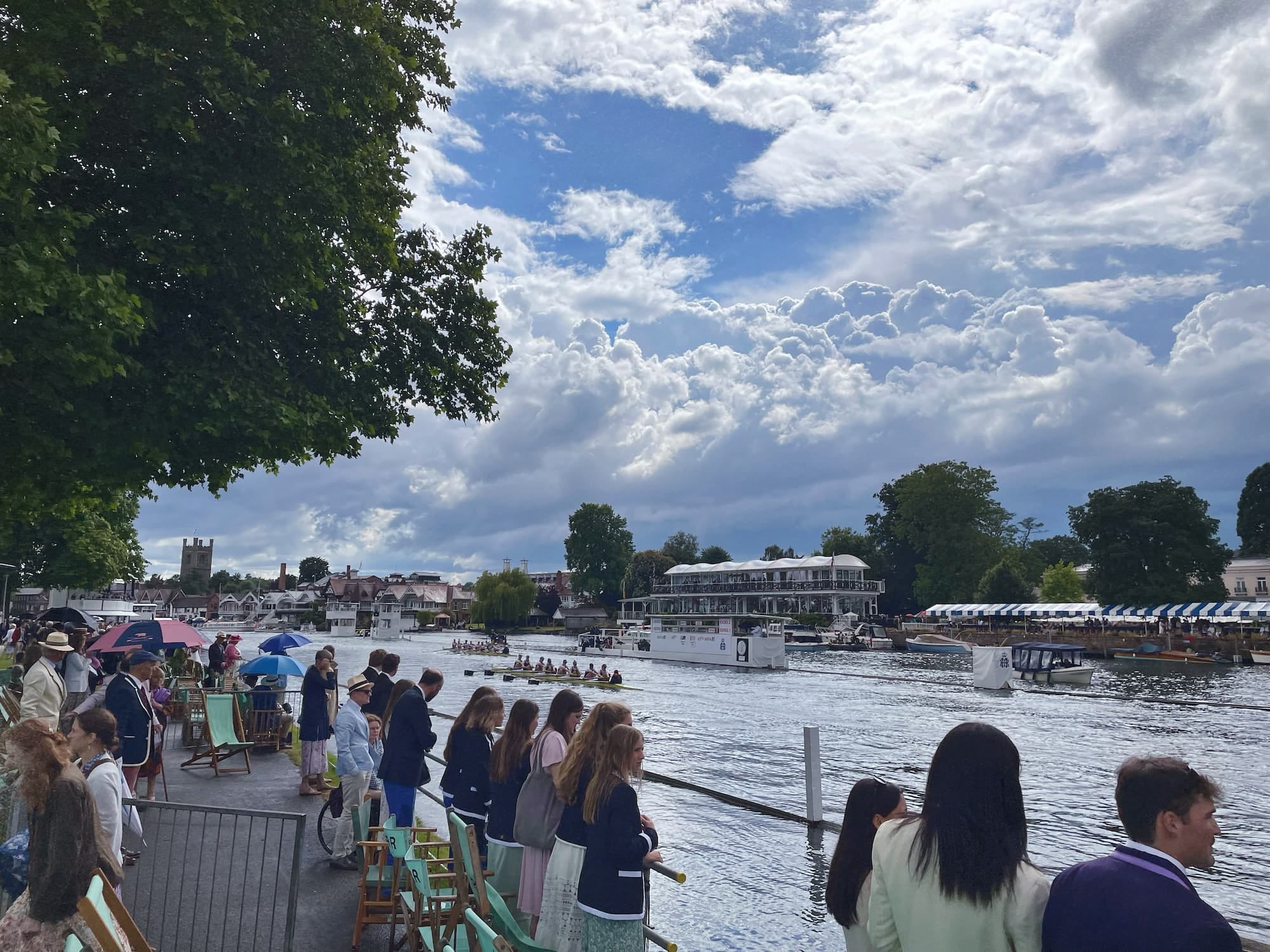
Hello! Checking in with a (very occasional) update just in time for the Head Of The Charles—hope you enjoy it. (Also don’t worry—the photo will make sense, read on!)
If you’ve spent any time on the riverbank at a regatta, you’ve probably noticed something: most spectators are there because they know a competitor, not because they’re there to enjoy the sport itself. It’s not a criticism (mostly…)—rowing is genuinely difficult to engage with as a spectator sport.
But what if there was a way to change that?
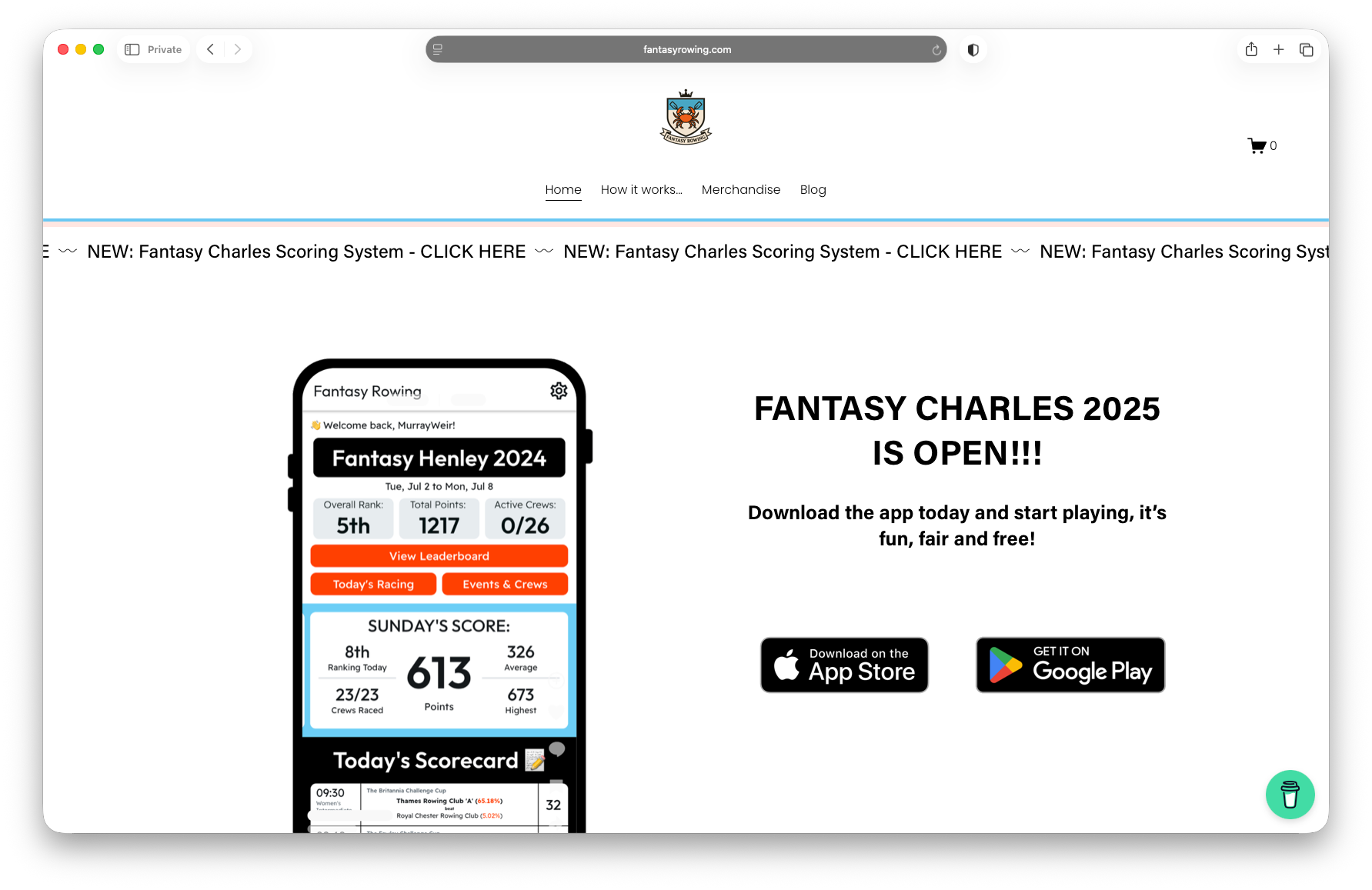
Enter Iain Weir, former London Rowing Club oarsman, Henley Royal Regatta champion, accomplished rowing photographer, and creator of Fantasy Rowing. What started as an observation about spectator engagement has grown into a platform with over 4,000 players that’s changing how people interact with regattas.
Fresh off a successful Fantasy Henley that drew thousands of participants, Iain is now expanding the concept to other major events, including the recent World Championships and this week’s Head of the Charles.
I caught up with Iain to discuss the origins of Fantasy Rowing, why our sport struggles with spectator engagement, and where he sees things going next.
RR: Let’s start at the beginning. What inspired the idea for Fantasy Rowing?
Iain Weir: It really came from being on the towpath more than anyone else during that period—probably around 10 years ago now. I was doing photography at virtually every regatta and head race I could get to, and I kept noticing this disconnect. Everyone was there either because they knew someone racing or because they were competing themselves. No one was there purely to enjoy a sporting spectacle. And I just thought, there has to be a way to bridge that gap.
RR: You mentioned that rowing is inherently difficult to engage with as a spectator. Can you expand on that?
IW: The best analogy I’ve found is that watching rowing is a lot like looking at art. If you’ve studied art, you can walk around a gallery and appreciate the techniques, understand what it says about the time period, pick up on the symbolism—it’s a rich experience. But if you have no artistic background, you might just see a horse by a lake or a boat at sea.
Rowing is exactly the same. You or I can watch a race knowing that crew A has a new coach this season, crew B are rating so high it’s unsustainable, and crew C have won silver in every race but never gold. But to a layperson, they’ll just see boats slowly taking or giving away margins over 2,000 meters with no emotional reaction whatsoever.
RR: Commentary teams work hard to provide that context, though, don’t they?
IW: They absolutely do, and through my work with The Boat Race and Henley Royal Regatta, I’ve seen firsthand how much preparation goes into building that knowledge and crafting an engaging narrative. But there’s only so much they can do in the six or seven minutes where they have someone’s attention. In a time when it’s so difficult to compete for viewers’ attention, that’s not really going to help draw people in—only retain them once they’re already there.
RR: So how does Fantasy Rowing address this?
IW: Fantasy Rowing is really a fun way to create a different narrative around the racing that puts the sport at the heart of the action, but where the story is built around the rules of the game rather than the conventional focal points. This drastically lowers the barrier to entry. Instead of having to immerse yourself in rowing culture for a few seasons to understand what’s going on, you simply pick a few crews and you score points if they win.
And because the game will often cover a broad spectrum of events—by design—players suddenly find themselves following a race they’d never have considered before, because it’s important to the game. That’s when the magic happens.
RR: You mentioned you started putting more effort into this after losing a job. What changed at that point?
IW: Being made redundant made me realize that ‘product’ as a field was somewhere I wanted to put myself. I’d been tinkering with the idea for years, but that was the moment I decided to really commit to it. I started thinking about it not just as a side project, but as something that could genuinely add value to the sport and to events.
RR: Fantasy Henley seems to have been the breakthrough moment. What happened there?
IW: It grew steadily for the first few years, but this year it really leapt forward with thousands of players taking part. That’s given me the confidence to start applying what I’ve learned to other events to see if they can benefit too. I recently ran Fantasy Worlds, which focused on the World Championships, and now I’m doing Fantasy Charles based on a selection of the Head of the Charles events—74 events is far too many to expect people to pick from.
RR: You’ve spent a lot of time photographing events. What else have you observed about how regattas operate?
IW: Another thing I noticed on the towpath is that rowing events are so bootstrapped that they don’t have capacity to think about how to make themselves more appealing to spectators. All their energy goes into making the event happen. And—without wanting to offend anyone—a lot of events are run by committees of officials who are very competent, professional people who do an amazing job managing the processes that allow regattas to run smoothly. Without them, we’d be screwed. But they’re not creative risk-takers, so very few events are actually innovating.
RR: And you’re happy to fill that void?
IW: Exactly. I think Fantasy Rowing is at the point now where it’s no longer a risk—it’s proven to drive engagement before, during, and after events in a fun and wholesome way. It’s fun, fair, and free to play.
RR: Beyond just engagement, what else can Fantasy Rowing offer to events?
IW: The game doesn’t just engage people—it can also generate a lot of interesting data for commentary teams. We can see who the favorites are based on picks, and which races are likely to be close based on the thoughts of hundreds or thousands of engaged rowing fans. That’s valuable insight that events can use to enhance their broadcasts and coverage.
RR: What kind of feedback have you received from the community?
IW: The community of players—over 4,000 now—have given me lots of feedback around the kind of events they’d like the game to focus on next. But I’m also interested in working directly with events to help them make their regattas more accessible to spectators. It’s a two-way street.
RR: So after 10 years, where do you see Fantasy Rowing heading?
IW: That’s the exciting part—while it’s 10 years old, it also feels like it’s just getting started. The model works, the community is engaged, and there’s a real appetite for this kind of thing in rowing. Now it’s about scaling it intelligently and working with the right events to maximize impact.
Fantasy Charles predictions close at 7pm Eastern Time on Thursday, October 16th—though Iain mentioned he might relax this to midnight if there’s a surge of interest. If you want to get involved or learn more, head to FantasyRowing.com or contact Iain at info@fantasyrowing.com.
Whether you’re a seasoned rowing fan or someone looking for a new way to engage with the sport, Fantasy Rowing offers a fresh perspective on race day. And if Iain’s vision continues to gain traction, it might just help solve one of rowing’s oldest problems: getting people to care about the sport (who aren’t already rowing athletes themselves).
Author’s note: Iain and I were teammates at London Rowing Club from 2007-2008, and he’s been a longtime contributor to RR.
Photo by the author.
Comments
Nothing yet. Say the first thing.
Sign in to join the conversation.