

We’re excited to be releasing plane-wave DFT for modeling periodic systems powered by Quantum ESPRESSO! We’re also expanding FEP access to all subscribing academic groups, and we have a few blog posts we’re excited to share (including a new open-source library for efficient molecular data splitting).
In 2024, we added periodic simulation capabilities powered by neural network potentials (NNPs), which are often quite accurate and much faster than DFT. So why bother with DFT? Plane-wave DFT is the ground-truth method that NNPs approximate, meaning that it’s useful for generating training data if nothing else. However, we believe that DFT will have continued relevance beyond just dataset creation:
DFT natively provides electronic structure, which can be used to determine partial charges, band structure, density of states (DOS), Fermi level and band gap, optical and magnetic properties, electron–phonon coupling, and much more.
DFT should be used to evaluate whether NNPs can accurately model your area of chemical space, and in the case that a system isn’t accurately modeled by extant NNPs, DFT remains a powerful tool.
Perhaps least importantly, we expect that journals will continue to expect DFT results in supporting information.
Molecular and periodic calculations are very different beasts (see our earlier post on the topic for more), and we want to provide first-class support for both. Quantum ESPRESSO is a leading open-source plane-wave-DFT program, and we’ve begun integrating it into our platform.
We provide all major DFT functionals and the Standard Solid-State Pseudopotentials (SSSP), a library of curated and benchmarked pseudopotentials covering the first 103 elements of the periodic table. The open-source community has largely centered on these pseudopotentials, and we’ve made them easier to use by automatically loading the suggested plane-wave and density cutoffs (though you can override these yourself). We have also implemented automated selection of plane-wave and density cutoffs based on the SSSP suggested values, along with k-point (the reciprocal space grid points on which the electronic structure is sampled) selection based on cell and the materials density (the user can also manually set all of these values).
For more details on the specifics of modeling with plane-wave DFT, check out our blog post and documentation. When publishing Quantum ESPRESSO calculation, make sure to cite Quantum ESPRESSO, your functional, and the SSSP pseudopotentials that you use. (As with all programs that we host, you can check out our citations page for links.)
To run a Quantum ESPRESSO DFT calculation, you can do so like any other calculation:
Upload your structure (CIF, xyz, etc.) or draw your structure in our 3D editor
Optionally, set your cutoffs and k-points
Select your smearing (very important for metals)
Choose which tasks you would like to run (e.g. Optimize, Charge, or Energy)
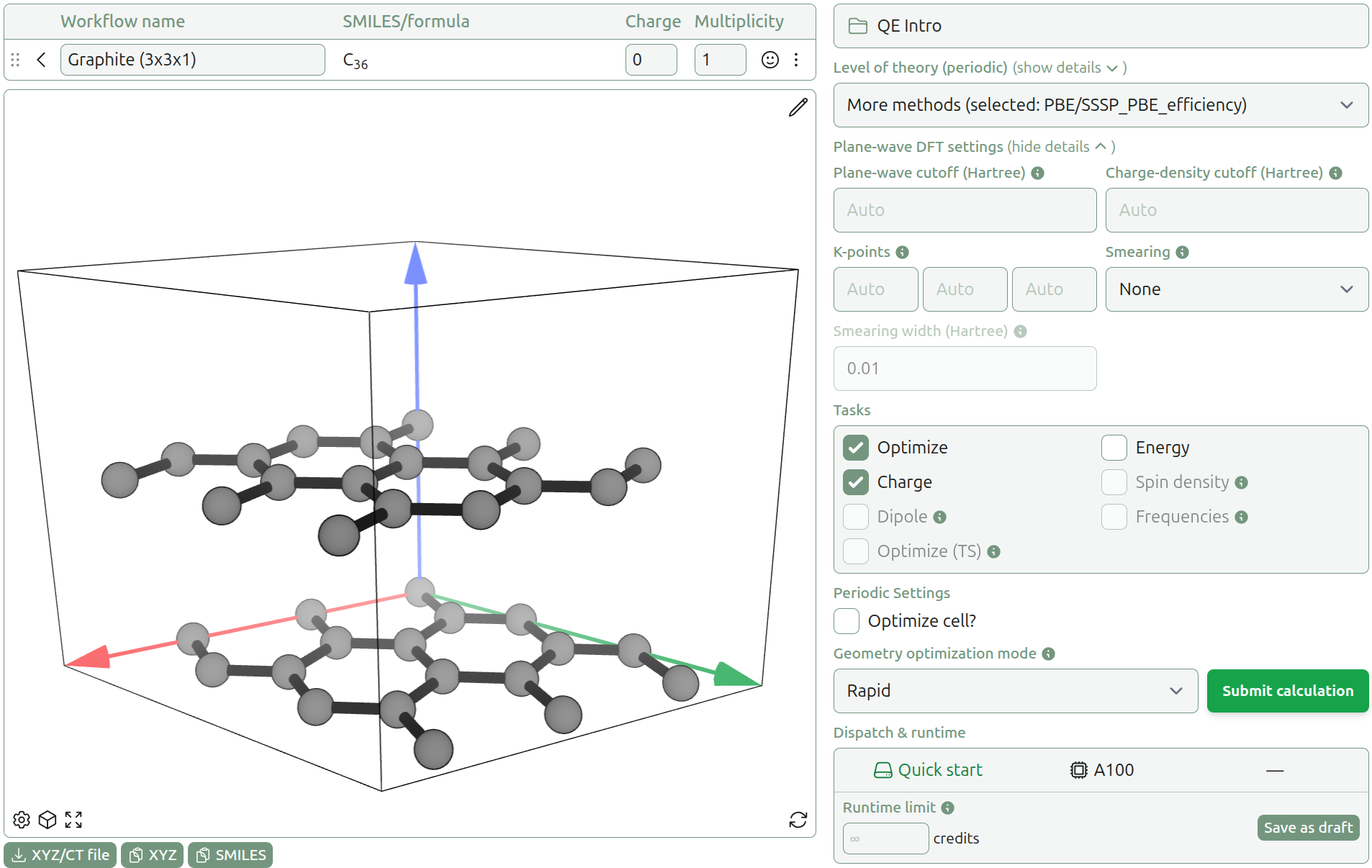
Once submitted, calculations are routed to an A100 GPU running QE 7.3.1 (compiled by NVIDIA). The results are streamed back to the user while running, showing optimization steps, cell parameters, partial charges, and other values.
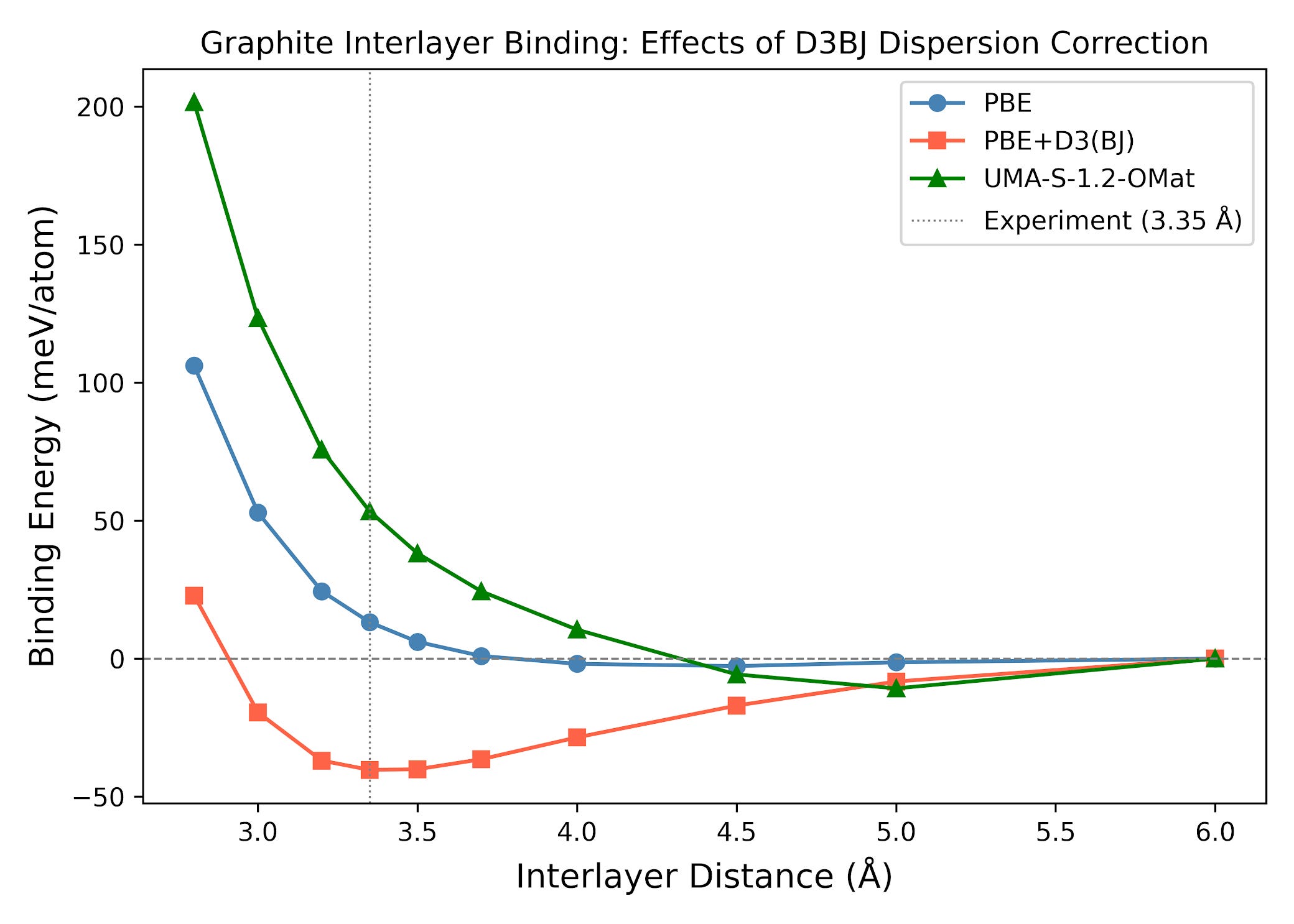
If we calculate the binding energy of graphite at a bunch of different interlayer distances, we can find the optimal spacing and compare the performance of different methods. Dispersion correction is important to capture the inter-layer binding and pure PBE binds the layers too weakly, predicting a much too large inter-layer spacing. UMA-S-1.2-OMat also vastly underpredicts the binding and overpredicts the spacing, since it is trained on PBE without any dispersion correction.
This initial release of Quantum ESPRESSO only covers basic calculations and scans, but we plan to add workflows to accelerate common materials-science-property predictions, such as modulus, XRD, band structure, density of states, defect-formation energies, and more. To do so, we are joined this summer by Raphael Stone, a 3rd year Materials Science Ph.D. in the ACME Group, and we look forward to a summer of building materials-science-specific workflows with him. If you are interested in learning more about our plans or working with us to develop new materials-science workflows, please reach out.
Several months ago, we announced that Rowan’s FEP workflow was coming out of private beta and was now generally available to subscribing organizations in industry. We’re happy to share that we’re now expanding this access to subscribing academic groups—as of today, all academic groups can run RBFE calculations through Rowan for no extra charge. In the same vein, we’ve also made batch docking accessible to all subscribing Rowan users.
If your academic group is interested in running RBFE (or other workflows), please reach out! Academic group rates start at $250/month and come with full access to all Rowan workflows, as well as easy collaboration and sharing.
In case you missed, here’s a few highlights from our blog:
Building on our earlier work on the OpenBind EV-A71 release, Corin did a deep dive investigating how different FEP settings fared on different subsets of the data. Pose selection, simulation length, and local-versus-global FEP settings all make a difference! If you’re interested in applying FEP to real-world problems, check out the post.
We also released Chalcedon, a fast, memory-efficient Butina-clustering package that makes robust splitting of chemical datasets practical on consumer hardware. Chalcedon is faster and more memory efficient than existing open-source methods by an order of magnitude and is all written in NumPy. For more information, read Eli’s full post on our blog.
No posts
Comments
Nothing yet. Say the first thing.
Sign in to join the conversation.