

We’re excited to introduce a new phonon workflow as our intern Raphael closes out his summer internship work helping us add materials capabilities to the Rowan platform. This workflow can be used to determine a material’s phonon band structure and zone-center modes, predict its response to infrared (IR) and Raman spectroscopy, and examine its thermal properties.
Atoms in a material are never still. Even at absolute zero, they have zero-point vibrational energy that smears them around their lattice points. As the temperature rises, excited vibrational modes further displace the atoms. The coupling of the atomic vibrational motion leads to collective motion, termed phonons. As the size of the crystal increases and the unit cells couple, an effectively continuous spectrum of phonons is formed (unlike the discrete spectra of molecules).
Phonons mediate many properties of materials, carrying heat, transmitting sound, and scattering the electrons that carry current. They can be excited by the absorption of light (typically infrared absorption), scatter light when interacting with it (Raman scattering), and mediate the Cooper-pair formation that underlies conventional superconductivity. Our latest workflow computes phonon band structures, thermal properties, and zone-center modes, providing scientists with information about structural stability, preferred polymorphs, and thermal properties.
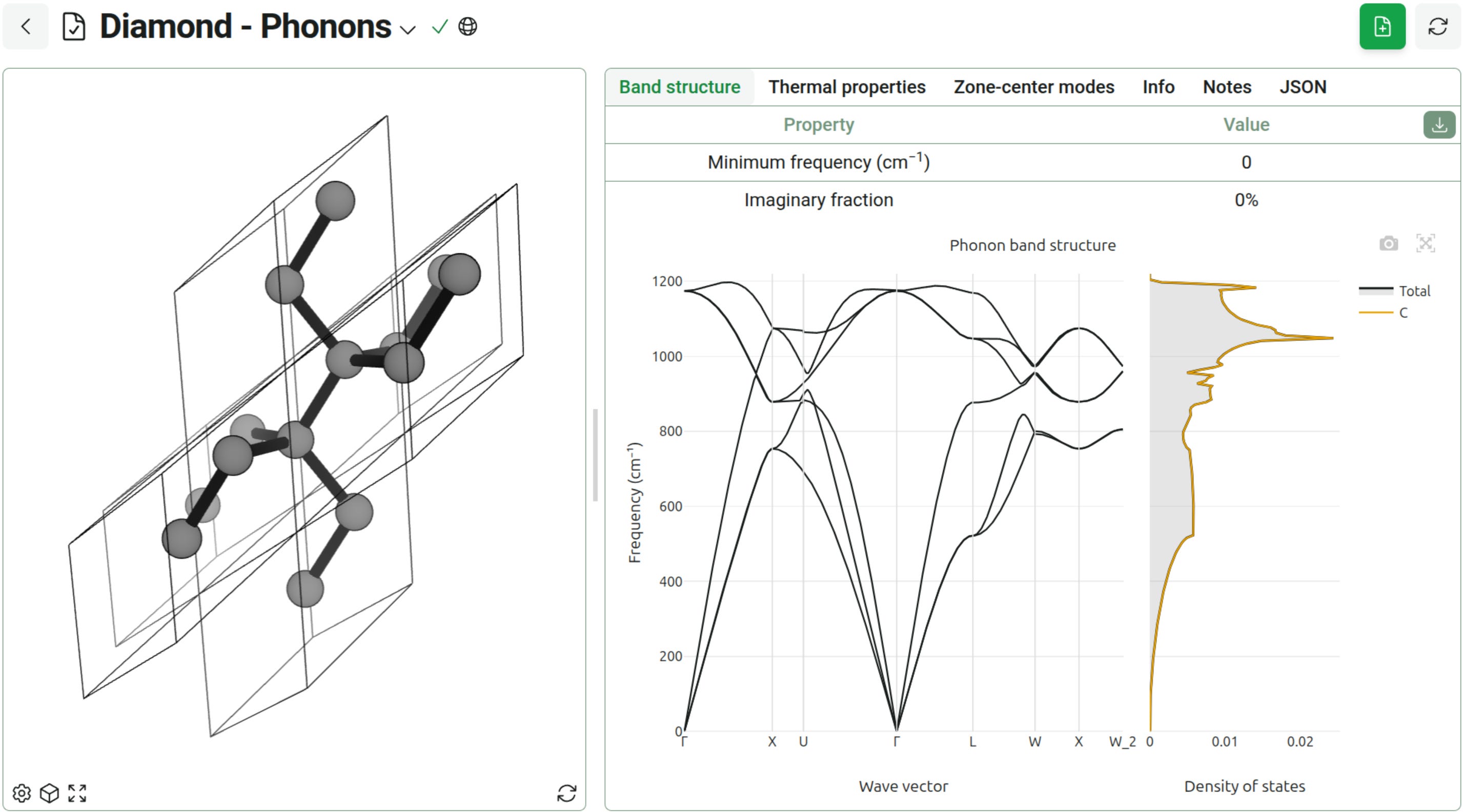
The spectrum of phonons in a material is referred to as the band structure, and the density and identity of these bands vary throughout the Brillouin zone (the primitive cell in reciprocal space). The three lowest-frequency modes are the acoustic modes, arising from the long-range, nearly phase-symmetric vibration of atoms. These phonons correspond to rigid translations of the whole crystal and can propagate sound. The slopes of these modes near the center of the Brillouin zone (also called the gamma point, Γ) indicate how quickly sound travels through the material. Along high-symmetry directions near Γ, the modes neatly decompose into one longitudinal (compression) mode and two transverse (shear) modes.
The remaining branches are often significantly higher in energy, and arise from the out-of-phase motions inside a unit cell. These are termed optical modes due to their interactions with light. Polar modes (where the dipole changes) give rise to IR absorption, while non-polar modes (where the polarizability changes) give rise to Raman scattering.
The highest frequency mode usually reflects the stiffest individual bond or the lightest atom; diamond has one of the highest frequencies of any bulk solid at 1,332 cm–1. The lowest modes dominate low-temperature heat capacity and thermal conductivity. Exceedingly low modes may indicate structural instability, while imaginary modes indicate that a displacement along this mode would lower the material’s energy (these can arise from symmetry-breaking motion that quasi-second-order optimizers don’t follow). Small imaginary modes can also be artifacts of an incompletely converged optimization or numerical instability.
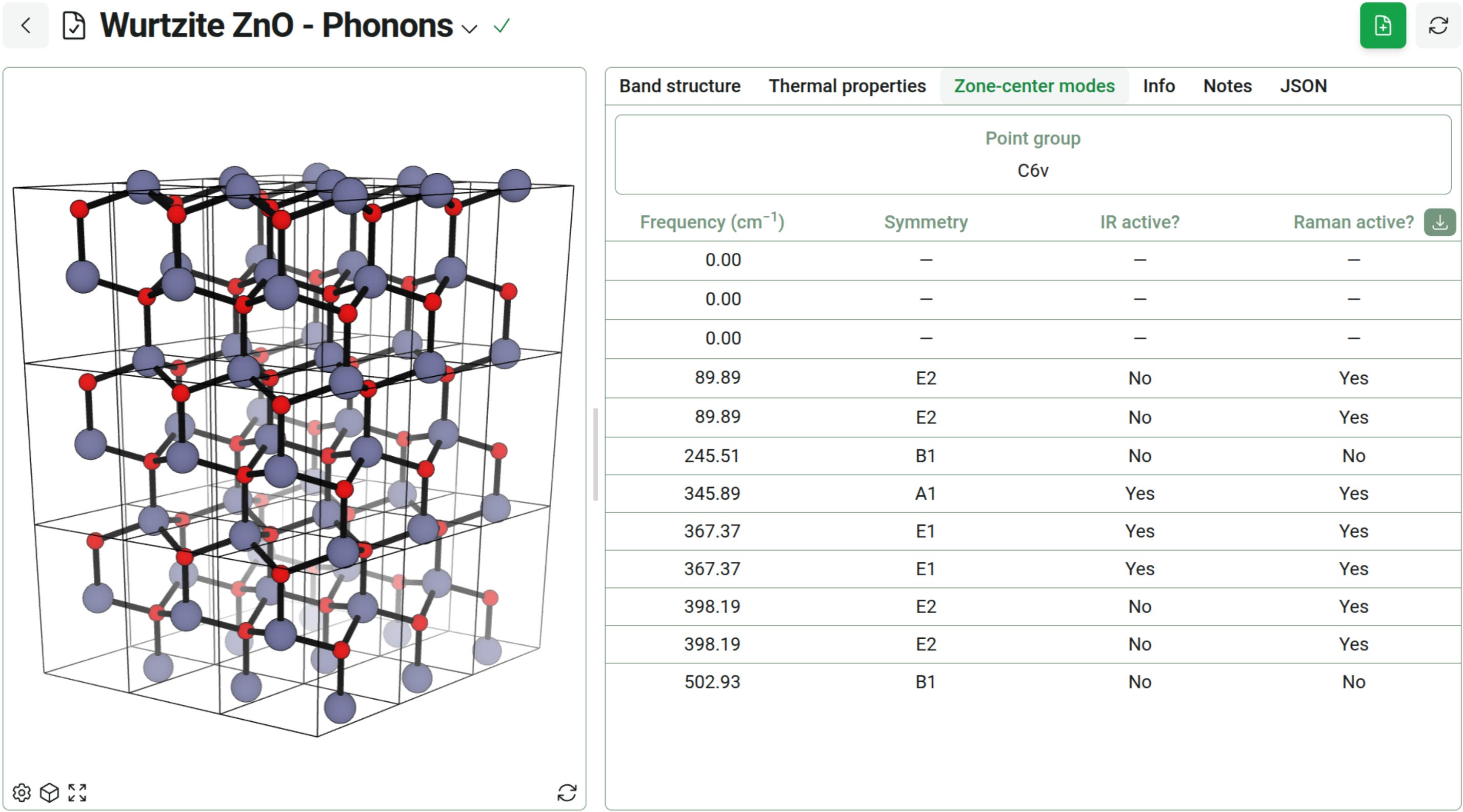
At Γ (the center of the Brillouin zone), phonons are referred to as zone-center modes (also called gamma-point phonons). While the acoustic modes are 0 at Γ, the optical modes have non-zero energies that arise from the out-of-phase motion of the atoms within the cell. These modes can be excited by light (typically infrared or visible), and the activity is similar to that seen in individual molecules. The modes can similarly be decomposed based on their point-group symmetry, providing an indication of whether they are active under the electric-dipole (IR) or electric-dipole–dipole-polarizability (Raman) approximations.
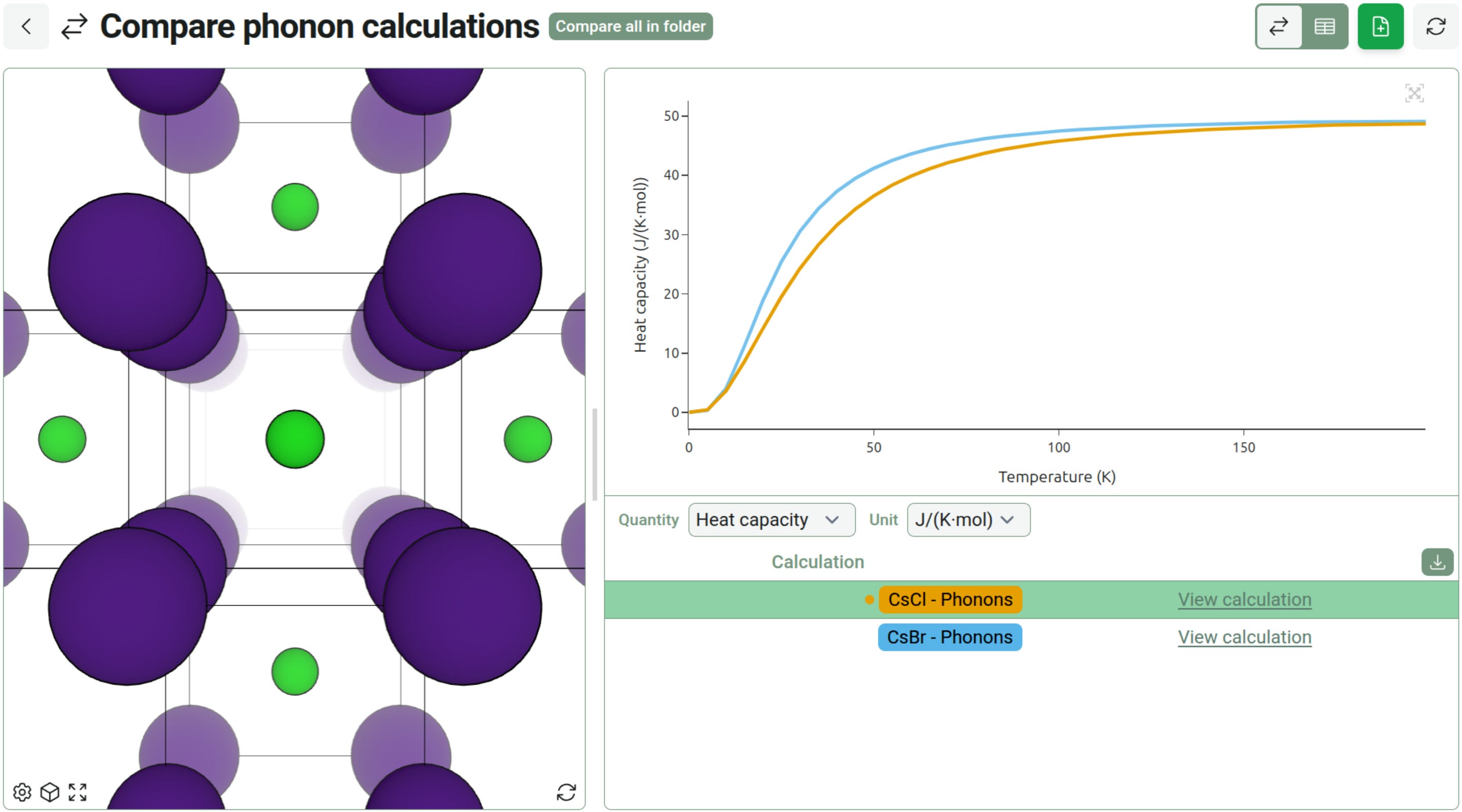
As the thermal energy rises above absolute zero, excited states of phonons are accessed. The available excited states generally increase with temperature, and thus the specific heat capacity (the amount of thermal energy absorbed per unit increase in temperature) increases. How fast a material approaches its classical heat capacity value depends on the frequencies of its lattice vibrations, which in turn depend on both lattice stiffness and atomic masses.
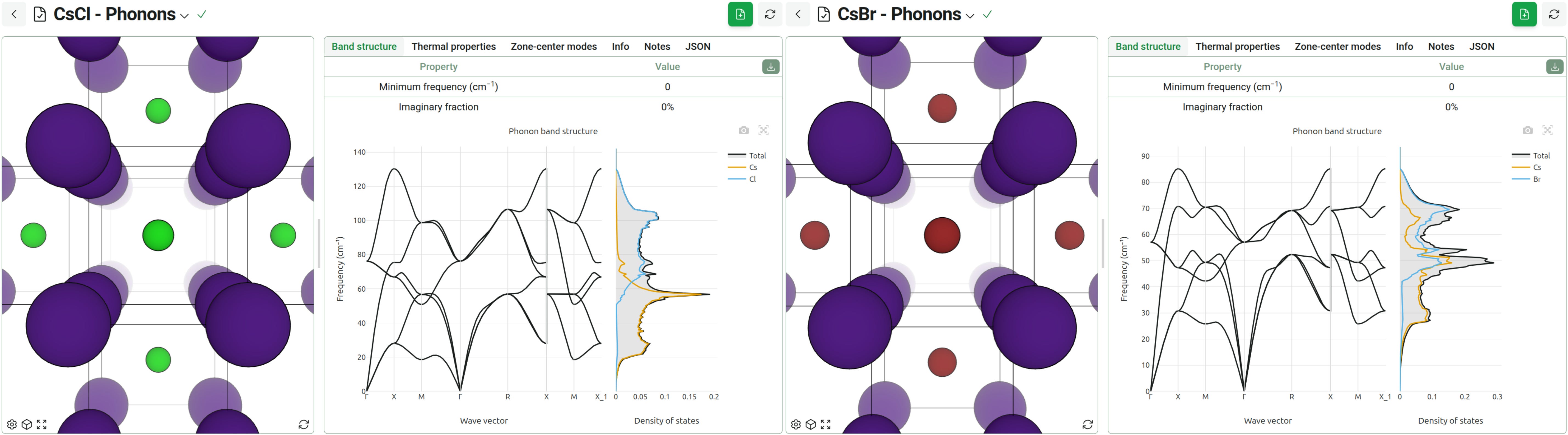
As a representative example, CsCl and CsBr are both in the 221 space group, with two atoms per primitive cell. The phonon spectra are similar in structure, but the CsBr frequencies are about two thirds of the CsCl frequencies across the whole spectrum due to the higher mass of Br. Due to the more thermally accessible modes, CsBr approaches the classical heat capacity limit more quickly than CsCl.
Apart from our phonon workflow, we’ve also put a lot of work into improving our periodic optimizer, including the addition of variable-cell TS search, improved constraint–cell coupling, and we derivation of the gradient from the step map instead of masked-strain filters. We’re excited to continue building to meet the needs of our materials science user base. We expect we’ll have more to share on this front soon!
No posts
Comments
Nothing yet. Say the first thing.
Sign in to join the conversation.