
Suppose there was a glitch in the Matrix that enough people could recognize all at once…
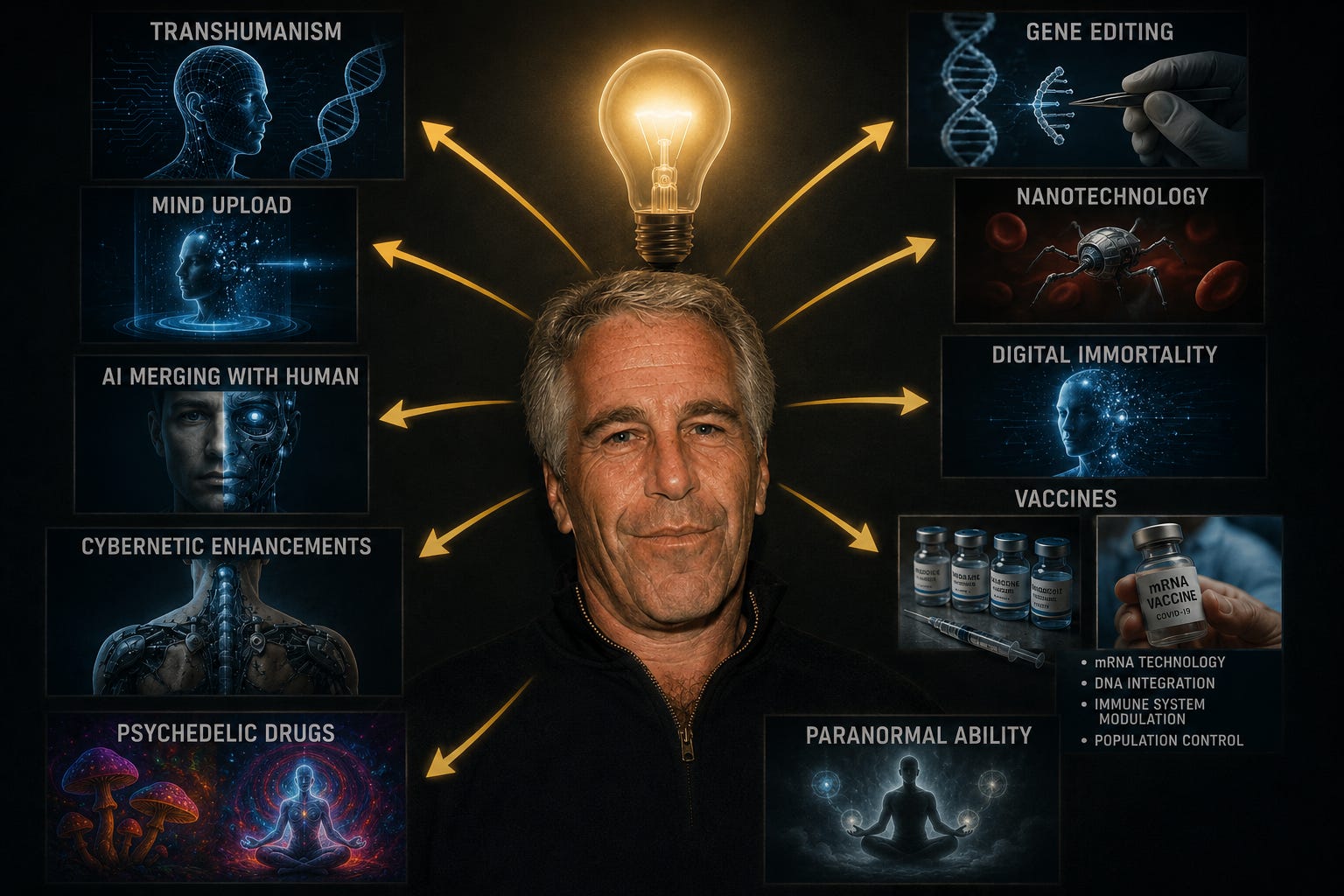
For several years I’ve had my finger on the button to publish a conclusion to an article series that I began 18 years ago (see here and here). Between my several past blogs, Facebook, and this Substack, I kept adding to the story, but there were always nagging details that made it feel incomplete. Then the Jeffrey Epstein story took a twist, entangling itself in this older story that I would never have imagined relevant. And yet, I think this may be a key, or even the key, to unlocking the door of understanding of the entire global network surrounding Jeffrey Epstein. This network incorporates government, technology, science, military, spycraft, and more.
What you’re currently getting from both the mainstream media and independent (or “independent”) pundits is largely no better than what you might expect from the National Enquirer. The Epstein story surrounds the current battlefield over the Venn intersections between artificial intelligence, genetic engineering, designer babies, supersoldiers, and mind control, including what I interpret as well-crafted illusions over your powerlessness to participate in the shaping of the future.
While I keep some of this story light, it gets really dark, so be warned. If I can do anything with this tale, it’s to open minds back to an orientation of productive participation in the unfolding of the future. I’m writing this for people who care about their children.
I include below an appropriately edited combination of my two 2022 articles linked above, which were originally published as part of my Science Wars article series. Before and after that text, and in additional articles that will follow, I explain relevant connections to Jeffrey Epstein, including the arm of his network that both tried to buy out my substack, and otherwise distracted me over the past few years. The bigger picture that finally came together with the partial release of Epstein’s emails startled me enough to motivate me out of retirement.
This is not going to be brief. Each article will be long, and I take some responsibility for not knowing how best to organize it all. It will take a few pages to get to the meat, but the up front context building is a necessary exercise. Between the articles and my graphs, there are thousands of links and citations. Take breaks.
How can I even begin? The modern propaganda industry is so vast and ubiquitous, spanning nearly every important topic, that few people seem to remain without crippling biases that make such serious discussions possible. It gets targeted at opposing sides of nearly every important debate, contributing to hypercharged culture wars. The lack of discussion turned soil to dust in the landscape of humanity, which often appears more like a reality TV show where people performatively signal virtue to disguise the fact that they’re always looking for another human to stab in the back, side, or heart. They’ll split the reward with the ruling class. 50/50, right? No, here’s a medal and a promotion. You don’t get to audit the books.
Culture war as a tool for social control enables all the preconditions for science and technology to become occulted asymmetric power tools. When nothing gets in the way, the result is true and complete totalitarianism that stretches the entrance to Plato’s cave into a labyrinth of illusion. Even the moment most people recognize this, they begin to collapse into fighting over whether to identify the problem as capitalism, socialism, communism, or some other -ism, which are all just branches of the maze. Bring it back and imagine the last innocent baby you held or petted. You have reasons to deflect the conditioning. If you cannot control your own mental disorder or disorientation, you cannot find a solution for anyone else’s.
Autism Spectrum Disorder (ASD) is very real, or at least mostly real. There are debates around the edges as to whether Asperger’s Syndrome belongs in the same category of mental disorders that often leave those afflicted entirely incapable of operating normally in society. And yet, because those who suffer the most extreme forms of ASD remain out of sight, most people interact more with those with Asperger’s Syndrome, creating a sort of illusion that these individuals, some of whom become quite successful, represent the sum total of the issue. When many people think of autism, they think of TV characters like Sheldon Cooper, scientists like Temple Grandin, or even the autism-coded portrayals of Sherlock Holmes. As you read this article, you may want to consider whether these fictional or exceptional images bend common understanding of autism. After all, upwards of a quarter of autistic individuals require lifelong intensive care, and the number who live fully independent lives from cradle to grave is vanishingly small. Some observers estimate that the cost of ASD to Americans alone will surpass a staggering trillion dollars annually sometime next decade.
Far murkier is the debate over potential causes of ASD. Daggers are quickly thrown over this turf. So, I would like to challenge the reader to steel themselves, and be ready to investigate the story that follows as if from the perspective of an impartial investigator.
While I did not devote myself to the Epstein emails [while recovering from the stress of the past few years], I paid some attention to those devoted to the digging. Some researchers focused on the interesting appearance of New Age guru Deepak Chopra. While that came as no surprise [to me], there was another name passed between Chopra and Epstein that caught my eye—a researcher whom Epstein funded—who surprisingly connects back to a story I first noticed and wrote about 18 years ago.
Telepathy?!
To be more clear, researchers at the University of California, San Diego wanted to study telepathy among autistic children.
I should stop here and note that Jeffrey Epstein expressed a dismissive skepticism toward supernatural claims in a general sort of way. That makes it all the more interesting that Epstein was involved with a wide array of woo-science guru types. This is our first clue that this story is not about actual science so much as it is about the engineering of perceptions about science.
The UCSD researchers Epstein funded were V. S. Ramachandran (whom we will talk much more about), Paul Mills, and Deepak Chopra himself, according to the San Diego Union-Tribune Article:
In 2017, Ramachandran and two other UCSD professors, Paul Mills and Deepak Chopra, the famous New Age author, were launching a study of autistic children thought to be savants. They had a particular interest in one provocative claim — that some might have telepathic abilities.
“I don’t have a problem with my lab being funded by Epstein,” Ramachandran wrote to Chopra in September 2017, in an email first reported by The Guardian, UCSD’s student newspaper.
The initial funding request and later discussions were revealed in emails that are among a tranche of millions of documents connected to Epstein that were released in January by the U.S. Department of Justice.
Among the files that have drawn attention are thousands of messages Epstein and Chopra exchanged, including ones discussing sex, “girls,” prior allegations that had been made against Epstein and his arrangements to bring “cheerleaders” to events Chopra was attending.
But their correspondence in the files also demonstrates how those two men coordinated some of Chopra’s work at UCSD, and pulled other UCSD scientists into Epstein’s orbit.
In a February social media post, Chopra, still an unpaid UCSD faculty member, characterized his relationship with Epstein as “limited and unrelated to abusive activity.”
Mills, a neuroscientist with post-doctoral work in the field of psychiatry, did his doctoral research work at Maharishi International University in Iowa. As the name suggests, this university was founded by Maharishi Mahesh Yogi, the billionaire “Rolls Royce Guru“ whom Chopra chose as a spiritual guide. The Maharishi was also accused of sexual assault by Mia Farrow, whose adopted daughter Soon Yi became the wife of her one-time boyfriend Woody Allen, another close friend of Epstein. The relationship between Allen and Soon Yi has been the subject of bitter controversy involving accusations of child sexual grooming.
The Maharishi chose his devotee Chopra to establish the Maharishi Ayurveda Health Center in Lancaster Massachusetts. The broader network of Maharishi Ayurvedic wellness centers now operates in several locations in the United States and Europe.
Guru wellness medicine aside, it was Ramachandran’s name that caught my eye. More than twenty years ago Ramachandran was at the center of a story surrounding a supposed autistic savant named Daniel Tammet. The two appeared in the British documentary, The Boy with the Incredible Brain. I watched the documentary in 2008 at the behest of friends who were aware of my extensive work with young math prodigies, several of whom are autistic. And while I can fully understand why the public at large might find the Tammet story charming and fascinating, my immediate opinion was that it was an orchestrated fraud. Much of this article will be devoted to my breakdown of this story, and why I call it an “Autism Science Illusion Tale”.
A fraud? For what purpose?
For what purpose, indeed. This is where the story I thought might simply be about a few research dollars gets quite dark. This is the reason why I decided to finish this story. The stakes are not measured in 5-digit research grants doled out by a manipulative broker. They’re measured in the trillions of dollars. Further, they’re measured in power over the human race, potentially including its controlled evolution.
Some readers may want to take a side journey into Courtenay Turner’s excellent investigative article connecting Dr. Gino Yu, who introduced Epstein to Chopra, to the Changing Images of Man blueprint authored at the Stanford Research Institute (SRI) in the early 70s. As I will explain more in a future article, it is no coincidence that such a blueprint was developed in the same time and at the same place as both ARPANET (the internet) and the Stargate Project.
Hat tip to my amazing friend Tonika Todorova for turning me on to the trainwreck that is the Telepathy Tapes podcast after reading the first draft of this article.
By 2024, after an insanely propagandized pandemic theater and rollout of mRNA genetic therapy platforms, a great many people were searching for answers. Unfortunately, many of them were too eager to believe that the enemy of their enemy was their friend, and ran into the open arms of several forms of controlled opposition. Some of them were screaming loudly, “This is all spiritual warfare,” which can be interpreted in numerous ways. But some spiritualist gurus are always there to pick off those who still haven’t read enough through the history of spiritualism to understand the past several centuries of frauds and cults built to take in frightened, confused, credulous people. Cue the Telepathy Tapes podcast.
The narrative presented in the Telepathy Tapes podcast is that science nerd skeptic Ky Dickens discusses claims by Dr. Diane Hennacy Powell that a whole bunch of autists are definitely telepathic. In a phenomenal twist, Powell breaks down her skeptical host. Dickens is then invited onto the Joe Rogan podcast and blasted into orbit with a much wider audience. A lot of these guests are then tossed to Lex “MiniJoe” Fridman who should probably rename his podcast MiniJoe’s Quantumish Experience, and not give people the chance to google his own name.
Around 18:30 into her JRE promotional appearance that looks like prime case fodder for a master class in neurolinguistic programming, Ky Dickens casually pushes the general claims being made from telepathy to the far more extravagant “merged consciousness” based on unevidenced just so stories. Just as you might expect from a skeptic?

Not so fast, bro!
Rogan has a history of providing energy to softball interviews of a large number of guests promoting topics within the techno-transhumanist agenda: paranormal claims, UFO/alien disclosure/claims, and general human potential unfalsifiable woo. He fully let Hal Putoff off the hook about his Scientology background. We’ll come back to all that later in this article series as it mirrors the goings on within the Epstein network. It’s all very quantum, bro. Call it…spooky action at a distance.
Before we move any further, I would like to point out that Ky Dickens did not exactly have the “science skeptic mom” background she represented in appearance on the JRE. Her background is as what IMDB calls “an award-winning filmmaker celebrated for her transformative documentaries that tackle complex issues…” A critic might say, “propaganda artist”, and if you can see her aura, it’s quite chameleon-like. When it’s important to be the girl boss, she dresses the part of the girl boss. When it’s important to support the LGBTQ+ community, she looks like a dorm room culture warrior. And when it’s time to sell telepathy observed in autists to millions of moms of autists taking pains to find answers for their beloved sons and daughters, she looks like a competent carpool mom.

Now, in order to keep this long form article from stretching out for another 50 pages, I point you to Professor Dave Explains who destroys the Telepathy Tapes narrative, and then some.
Apparently Ky Dickens had Dave’s video censored on YouTube.
I’d never seen any of his other work, but I’d buy Professor Dave a beer based on this episode alone. I would however hope we could have a good faith discussion with him about vaccines and autism, and how the CDC has had to come to admit that it was dishonest about its declarations that research showed that no vaccines contribute to autism. The CDC paper on which the claim is based leaves out a bunch of vaccines, and they never answered the question of why they left the other vaccines out, or whether they looked at the data prior to making that decision. I’ll talk about that more in a future article. Maybe he would convince me, but I personally believe that the story is more complicated in the Hegelian theater sense. The best psyops try to point you in two false directions at once while making the escape hatch as invisible as possible.
(Update: I’ve now watched enough of Professor Dave’s work to see some points of agreement, but I think he often does a poor job of differentiating between the sort of mathematics and science that is published with high fidelity, and less hard sciences that are certainly subject to dangerous politics, sometime fraud, and also bad actors seeking asymmetric powers. There certainly are conspiracies in this world. We are covering one of them now. I also take strong issue on his defense of the mRNA “vaccines”.)
Understand, I do not hold an opinion with high certainty about exactly what does cause or contribute to autism, but if I listed the adjuvants of all the vaccines alone, numerous of which are classified as poisons, and asked most people (heck, most biochemists, like the one I’m married to) to inject themselves or their babies with just those ingredients alone, I suspect few would be interested in the experiment.
But I love Dave’s work in this video, which fairly parallels the Telepathy Tapes podcast to the facilitated communication scam that most of us simply hoped would die. Apparently you just have to wait one generation to roll out most scams a second time. And if you need funding for the project, you might ask for an introduction to Uncle Jeffrey’s network.
Facilitated communication (FC), also called “supported typing”, is the now discredited puppeting of autists where the facilitator claimed to help autists type out what they were thinking. The discrediting process was simple. When an autistic individual was shown one image, and the facilitator was shown another, what got typed was the word related to the image that only the facilitator was shown. Every single time.
But the scam was far bigger and more dangerous than just selling false hope to parents of autistic children. FC elevated facilitators, who were average people who can make big mistakes when given control of magic wands, to the status of oracles. This resulted, for instance, in some families being torn apart by imagined or invented sexual abuse allegations.
This may be a moment to stop and consider the implications of Peter Thiel‘s precrime program. Just. Think. Slowly. And. Carefully. Who really controls the oracle?
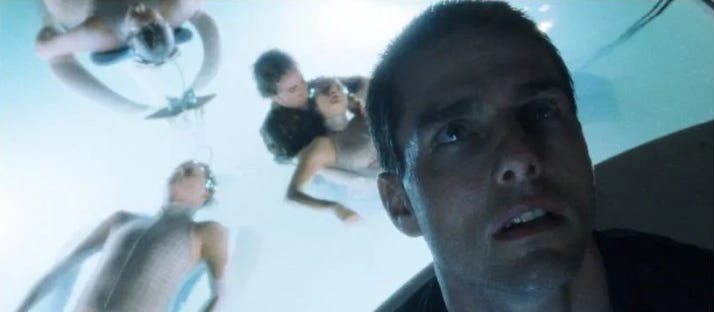
If you can stomach something even more gross (it’s okay to skip this part), consider the story of FC’s first advocate, Dr. Rosemary Crossley. In the course of defending FC, Crossley defended Rutgers University-Newark philosophy professor Majorie Anna Stubblefield who was accused of raping a man with severe cerebral palsy. Stubblefield claimed she believed the man gave consent through facilitated communication. She was convicted and sentenced to 12 years in prison.
Crossley was an academic from Melbourne, Australia, which many people point to as the Australian hub for MKULTRA-like experiments. This includes the several psychiatrists involved in Anne Hamilton-Byrne’s Neo-Theosophy cult.
Now, let’s get to the meat of this story: A documentary about a supposed autistic savant that includes one of the UCSD researchers funded by Epstein.
Forgive the wordiness of the “computational section” of this article. If you cannot follow the computations well enough, you are encouraged to email this article to your brainiest friend who can verify what I’m doing. While I make no firm declaration of fraud (though the presence of numerous forms of fraud is my firm standing opinion), I want to close as many loopholes as possible. After all, the public tends to go along with the appearance of consensus unless there is solid evidence to suggest an appropriate pause to consider the skeptical take.
Edward Bernays, who was often employed by John Davison Rockefeller, is considered the Father of Public Relations. He is often also called the Father of Modern Propaganda, where “public relations” is the personal and recursive touch applied to propaganda. Bernays’s great-nephew, Marc Randolph, was a co-founder of Netflix. High level propagandists understand well that the best propaganda is self-financing, if not wealth building. Such is the art of genius media magicians, which is likely a reason so many of those magicians centered around the Theosophical Society, and its offspring, like Scientology.
Humans have long been fascinated by genius, though most attempts to engineer it either fall flat, or are intentionally buried in bureaucracy. Genius resists engineering because the engineer cannot easily mold from the same clay more than they are---even if they were able to create people entirely from scratch, which they cannot. And if they did all that, I suspect the result would not often be desirable. Mary Shelly had some thoughts on that.
Personally, I suspect that the key to understanding genius is in understanding the joy of the human spirit and how it wraps itself with complexity, seemingly almost at random, around its environment. And the specialists, who are often secretly generalists with a vocation of obvious and well-appreciated arts, are dubbed “geniuses” in a blundering attempt to analyze, categorize, reproduce, and even to take ownership of their love and creativity. It may also be worth considering the possibility of make-believe genius.
During my career working as an educator specializing in the nurturing of genius among young people, friends often sent me stories about various prodigies. In early 2008, at the behest of several people, I watched a documentary called The Boy With the Incredible Brain. They wanted my take on the story of Daniel Tammet, as told in the well-produced documentary.
Given the buildup during which friends told me that Tammet is an autistic mathematical savant (a non-generalist genius without a well-appreciated art?), I was expecting to see something I’d never seen before. I wasn’t certain what that would be, but the first thing that I noticed was that Tammet’s primary talent on display struck me as nothing more than the practiced number sense that a subset of competition math students routinely learn and display.
Certainly Tammet is an outlier---somebody we sometimes call a “human calculator“ or “lightning calculator” to make it sound nifty and impressive. But the human calculators are a class of illusionists and entertainers, and while some mathematical or scientific geniuses have also been human calculators (or marathon runners or actors or hockey players), it takes no particular genius to learn to compute quickly. Just practice.
I can speak authoritatively on this topic because I am also one of the human calculators. I can usually still impress an audience, though I was much faster at many computations as a child. I found too many interests in adulthood to care about practicing, so I rarely display those talents, except as demonstrations to students about practical connections between algebra, geometric, and arithmetic (basic number theory). That said, my skill as a human calculator fully encompasses what I saw from Daniel, so the documentary that stemmed largely from this skill display startled me. Numerous supposedly high level researchers were taking Tammet’s performance at face-value, without appropriate inquiry and skepticism. Even worse, it appeared to me that they were participating in the illusion.
In the end, I wondered if there was a pile of grant money at the end of the rainbow. Unfortunately, I now think that this is the crafting of a spell—the production of the image of an autistic savant for the purpose of serving an agenda. This will take some time to explain, so let’s get started.
There is a principle of word and time economics in literature and drama known as “Chekhov’s gun” or “Chekhov’s rifle” that states that every element in a story must be necessary in the telling of the story. The implication is that any irrelevant elements should be removed.
Chekhov’s gun: Every element of a story must be necessary and irrelevant elements should be removed.
Before we dive into details about Tammet’s story, note that the documentary includes elements that fail a scientific analogy to Chekhov’s gun. These elements are more associated with infotainment than with science:
The relaxing, mystical music,
The blurry graphics that give the audience a mystical sense of something alien,
A narrator telling Tammet’s story exactly as you might imagine Tammet would want it told,
The humanization of Tammet using an innocent child actor on a playground,
The blended stories of various autistic savants, setting up the story that Tammet must also be an autistic savant in the same sense, and
Scientists displaying none of the skepticism that we will see later—both from myself and other critics who later, independently analyzed the Tammet story.
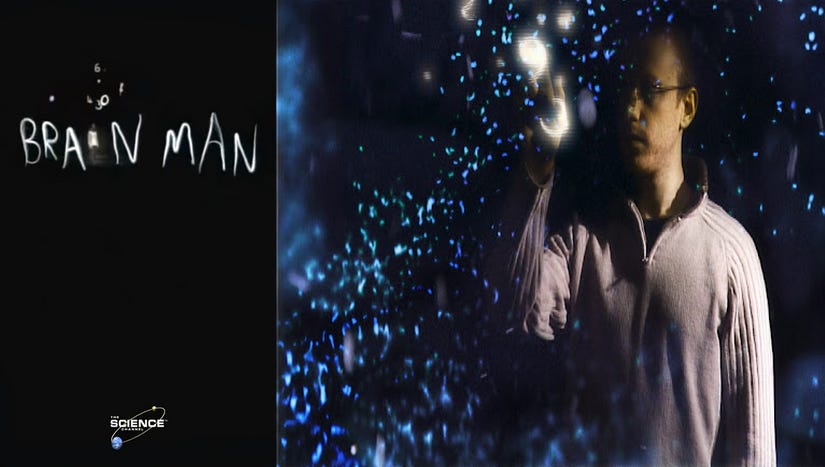
Is it still science if it’s fuzzy, unintelligible, or just made up by a production team?
There are also numerous hidden associations between the several researchers who appear in the documentary. These are associations that a critical audience would want to know about. We’ll discuss these as we go. First, let us take in the jaw-dropping rise in the frequency of autism in the United States:
Understand that I am currently undecided on the question of what all factors led to the explosion in autism. I have talked with enough doctors and teachers to know that “increased rates of diagnosis” does not come close to explaining the phenomenon, and the curve is too steep for me to buy any suggestion that it’s all genetic. Very few diseases or biological conditions are genetic, meaning associated entirely with genes. Nearly all diseases and biological conditions are either multi-genetic or epigenetic—meaning a combination of genetic and extrinsic factors—or simply the result of extrinsic factors, which may include any toxic or stressful conditions.
It does occur to me that the above explosive curve took off right around the time the Club of Rome published The Limits to Growth (1972) and David Rockefeller and his friends established the Trilateral Commission (1973; which Jeffrey Epstein was ushered into by Rockefeller in 1998). For the moment, I’ll just leave that here for readers to ponder on.
After a few minutes, I started to feel anger at what I was watching. Since that time my anger has fragmented into an array of more complex emotions, including anger, pity, and many other emotions I associate with various aspects of the plandemonium we’ve been living through since early 2020. Hopefully my explanations as to why the computations Daniel performs will be enough for many readers to understand why the problems selected are specifically conducive to computation that appears more amazing than it is difficult by the widest degree possible.
I will proceed with many direct quotes from the documentary, but first let us define two hypotheses:
H1 (the narrative hypothesis): Daniel Tammet is an autistic savant who performs fantastic numerical calculations in ways that he cannot explain, but that involve synaesthetic color vision that mysteriously just sort of works on its own within his brain [and that’s worth studying].
H2 (the Showman Hypothesis): Daniel Tammet learned some neat arithmetic tricks, then became famous being promoted as an autistic savant with synaesthetic attributes, and sold lots of books.
Now, let’s take a look at the balls pitched at Tammet.
“We first asked Daniel to multiply 37 by itself. Four times.”
The task is stated as dramatically as possible, but understand that learning the squares of the first 100 positive integers is not nearly as tall a task as it seems. There are many simple patterns, observations, and symmetries that appear.

The last two digits of each perfect square, going up and down the same amount from 50 (or indeed from any multiple of 25), will always be the same. Once you recognize such a pattern, you often leap past much of the computational process in calculations involving squaring numbers, which happen to be a lot of the computations Tammet performs—both in this documentary and in interviews. Here are some more:
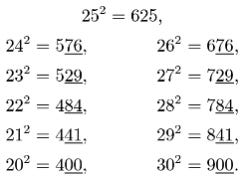
If you play with numbers enough, you notice all kinds of helpful facts. And the reasons behind those facts can be easily understood, though I won’t go through them here entirely.
The units digits of all (perfect) squares (like 132^2, which is 17,424) are among the digits 0, 1, 4, 5, 6, and 9.
The tens digits of squares are even unless the units digit is a 6. For instance, 43^2 is 1849 while 44^2 is 1936.
There are quartets of integers from 1 to 100 whose squares have the same last two digits. You may see that in the examples above where the general algebra depends on relating the integers to the nearest multiple of 50. For instance, the squares of 23, 27, 73, and 77 all have the same last two digits, and
27 = 50 - 23
73 = 50 + 23
77 = 100 - 23
Somebody who practices the computations might simply remember the squares of all the two-digit integers by heart, which is easier than you might think when you recognize the “terrain” of the integers, including the facts above and a few others. I got to know the squares of all the two-digit numbers as a kid by heart, and it happened somewhat accidentally after working out the roots (reasons behind) of the patterns I would notice.
“Yeah, but...the fourth power. Now that’s hard.”
A little, but not extremely. This one does separate the well-practiced experts from the novices, to be sure. We can assume that Daniel knows that 1369 is the square of 37 instantly. From there, most of the rest is a matter of managing addition of several digits.

The hardest part is squaring 137, but we’ve already square 37, so that’s not all that hard, either.

Finally,

Like I said, the addition step is the hardest part.
But the addition is just a matter of practice keeping track of the digit places. Sure, it’s impressive, but less so than it looks. And the repeated use of 37, scary-looking prime number though it may be, set my BS detector to alert mode. I’ve taught this level of mental computation to scores of students, many of whom could perform it faster than Daniel did. I’ve taught computations nearly this difficult to at least hundreds more. The novelty is in the will to practice keeping track of the digits. The rest is application of algebra (of a variety which is rarely taught to grade school students), and basic number theory facts.
This was Daniel’s most impressive moment during the first few minutes of the documentary because it’s the greatest amount of brute force necessary. The rest of the problems are far easier.
The next computation offered up to Daniel is dividing 13 by 97. The trick here is to understand infinite geometric series and their clever application:
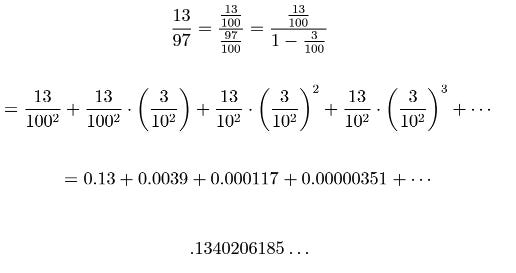
Take it slowly, step by step. Basically, we’re multiplying 13 by 3 over and over and moving the new result over two decimal places. That can seem challenging, but those who discover the technique know that the carrying that eventually occurs can just be sucked into the process:

13/97 = 0.(13)(40)(20)(61)(85)...
This trick of pairing two digits seems mystical at first, but is really just a result of the fact that 97 is so close to 10 to the power of two. We can describe the process algorithmically:
Multiply each pair of digits by 3,
drop any hundreds digit in the result, then
add an adjustment to get the next two digits in the repeating decimal form.
The adjustment comes from knowing the hundreds digit of the next calculation in the series, but that’s the same thing as saying “83 is beyond 2/3 of 97 (100 is the proxy handle in easy denominator cases), so add 2”.
Daniel’s body language and explanation strike me as performative. He speeds up after the first few digits—dramatic flare?
Whether he is doing brute force long division (which I doubt) or seeing synaesthetic shapes (as he claims) come together (why would that happen more rapidly after the start of the computations?!) or performing the computation as I did (almost certainly), the only expectation I would have is that the calculations don’t just suddenly become easier.
But it does sound more dramatic for him to say that he can spit out maybe sorta around 100 digits, and it keeps the cards hidden if you’re playing a game (Hypothesis 2). You can’t say you can spit out infinitely many digits, or somebody might catch on.
But here is the really dumb part...if you perform long division by dividing 97 into any integer, there are only 96 possible nonzero remainders (this decimal series is infinite because no power of 10 will ever be divisible by 97). This means that there are at most 96 distinct remainders in the long division before one repeats, which in turn means there are at most 96 digits in the repeating decimal form prior to repetition. Wouldn’t a number geek have at least stumbled upon the observation of such principles of repetition, even if they never learned a complete text on elementary number theory that would include Fermat’s Little Theorem? While we cannot reject H1 on this basis, we should have solid reason to prefer H2 at this point.
Next up: 27 to the power of 7? Since 27 is 3 cubed, that’s the same thing as 3 to the power of 21. I knew the powers of 3 by heart as a kid working contest problems. No big deal. While I don’t remember 3^21 by heart now, I’m confident I can compute it quickly for several reasons, the biggest being that I still remember 3^10, which is 59049. That’s an easy number to square for a practiced lightning calculator because it’s so close to a multiple of 1,000:

Multiplication by one more power of 3 is in fact the hardest part by far, but still not so bad. After all, we’re not all that impressed by people who can multiply by 3, even if it’s by ten digit numbers, right? I mean...it’s more than most people can do, but it’s not hard to imagine that a person can multiply numbers by 3 and keep track of the rounding so long as they can keep a running string of digits in their head.
Even if I didn’t recall that the tenth power of 3 is 59049, it’s not hard to get there quickly.

I could even just multiply by 9 several times over. After all, 9 = 10 - 1:

31 to the power of 6? Not that hard. 31 squared is 961. Now we can use binomial expansion on (100 - 39) to dramatically simplify the computation. The calculation is no harder than cubing 39, ultimately.
There might be methods for any of the above problems that I did not explore. However, each of these methods came to mind within the first fraction of a second that I heard each problem, which should display that they are just a matter of training. Just reflexes.
And those reflexes, which I’ve helped many others develop, don’t involve shapes and colors. There is nothing here at all that supports H1 over H2.
Note what the researchers do not do more than what they do. The interviewers never once asked Daniel to multiply 7139 times 41562.
Why did I pick a mundane multiplication exercise like that one? Because there’s very little that is special about the two numbers, except that they don’t contain the structural shortcuts inherent in every one of the problems Daniel worked over the course of the documentary. In other words, 7139 times 41562 would be a worthy test to distinguish H1 from H2. These numbers are not even particularly easy to factor (not even for a human calculator like me), so there’s no quick reconstruction to save the day as in some convenient pairs such as 369 and 1897:

If you’ve seen the product of 41 and 271, you have a nice handle to wrap the computational process around. The rest of the game is noticing that 36[9] and 189[7] are multiples of 9 and 7, respectively. That takes me all of three-ish seconds, but would have taken me a tenth that amount of time when I was young and in practice.
It seems to me that the most realistic reason not to test Daniel with such computations as for which there are not clever hacks is to actively avoid a test that would distinguish H1 from H2. This would mean that either the researchers conspired with Daniel to misrepresent what was going on, or allowed for him to lead them in the process, which introduces enormous bias into the “experiments” that should be acknowledged and should spur skepticism.
I also noticed that during the very first problem in the video, Daniel moves his fingers in what I perceive as a useful way. I don’t believe he’s “playing with shapes and colors” or something like that. I recognize those finger movements. We humans of limited short-term mental storage capacity often move our hands and fingers as we conduct thoughts that make our mental wheels spin—particularly when that spinning stretches our limited short-term mental storage capacity. I often “constructively fidget” in such ways when I perform mental arithmetic.
Computation spurs that. It’s a lot like what the Chinese kids working on the mental abacus do in the video (which is itself proof that even extreme brute force computation can be trained). Their fingers aid them to conduct a mental process of real calculation. To me, those finger movements are direct evidence of H2 over H1. Perhaps not alone, but along with everything I saw in that video, I concluded that Daniel’s explanation of “spontaneous computation” from “shapes and colors” is almost certainly a sham (H2).
Note that the hard-drilled Chinese children can multiply any two four-digit numbers. So why is Daniel hailed, at the end of the video, as “one of 50” such high level savants in the world—particularly after taking a bunch of softball problems? This stands out as an entirely rhetorical and unscientific preference for H1 without respect to H2. Linguistic sleight-of-hand.
Is all this production because somebody wants a research grant?
Or is there an even bigger prize at play?
Much of my adult life, and indeed my childhood, was spent trying to understand the sabotage of our educational system, and to correct it. When I was younger, more patient, and more energetic, I could sit down with most anyone and help them break down mental barriers, and realize that they could learn more than they believed they could. In 2019, after years of working with precocious youngsters from around the country and even around the world, I moved to Chattanooga, Tennessee to work with students from one of the poorest, most rundown, crime-ridden ghettos in the United States. That is me (in the hat, at bottom) playing chess at the park with several inner city kids upon the invitation of their chess coach. A newspaper photographer showed up to capture the moment.
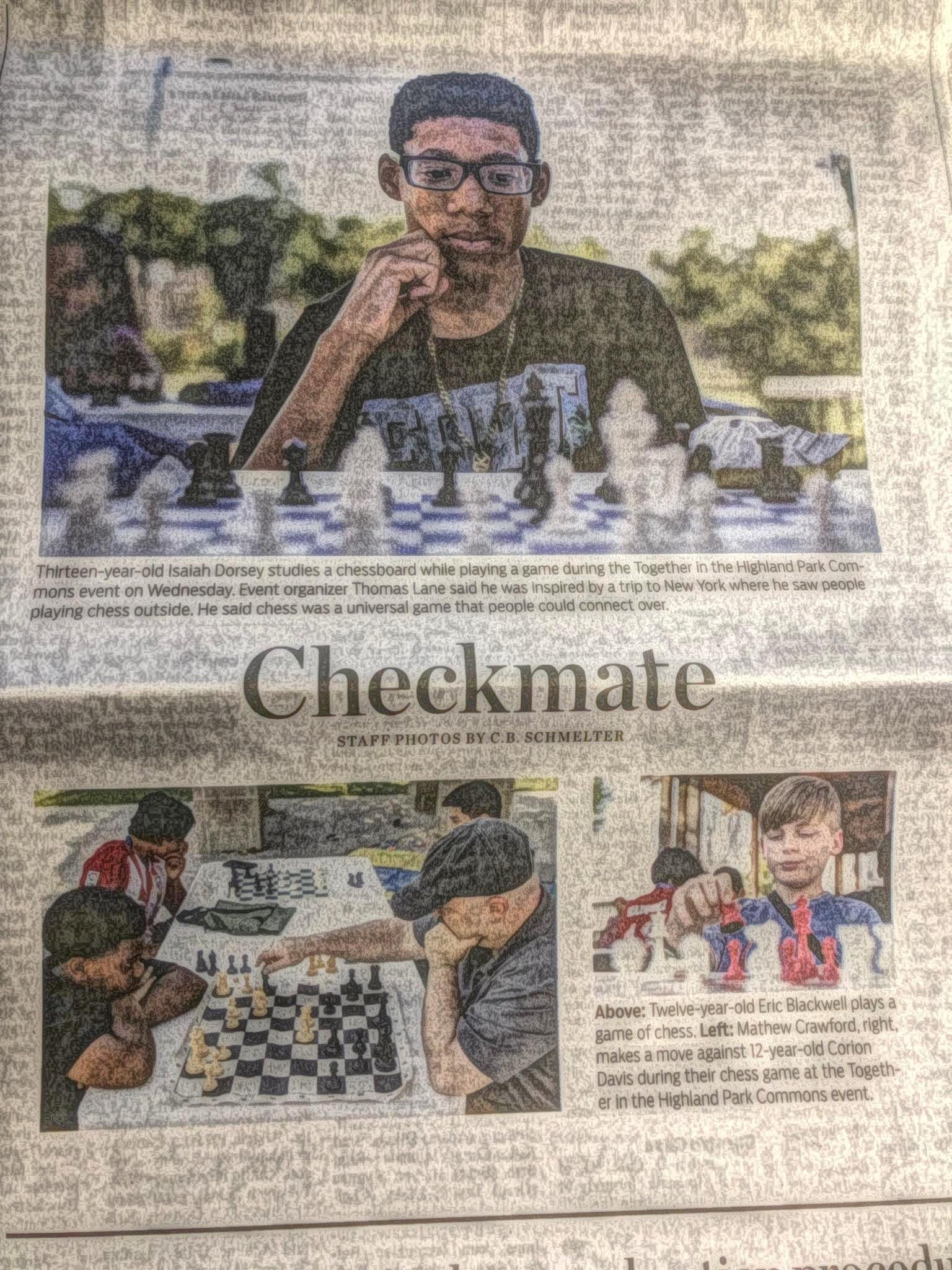
After two games with the rising sixth grader across the board from me, I asked if he would like to discuss math with me. Over the next 45 minutes I gave him the same interview that I’ve given to over a thousand, mostly rising sixth, seventh, and eighth graders of usually European or Asian descent. A brief summary of the interview goes like this,
Step 1: You have three blue shirts, four green shirts, and seven yellow shirts. How many shirts do you have? Most students of this age know instinctively to add three, four, and seven to get fourteen. We then discuss the concept of “addition as fast counting”, piggybacking off the child’s mastery of addition tables.
Step 2: You have three distinct shirts, four different pairs of pants, and five different pairs of matching socks. In how many ways can you select an outfit consisting of a shirt, a pair of pants, and one of the matching pairs of socks? We then discuss the concept of “multiplication as really fast counting” piggybacking off the concepts of “addition as fast counting” and “multiplication as fast addition”. We also build a tree diagram and discuss casework.
Step 3: I flip a coin with a head and a tail seven times, recording the results in succession. How many sequences of flips are possible? This time we get to identify “exponentiation as super fast multiplication”, but we often start small, with sequences of two flips, working up to seven. Most students get the idea before we count out the sequences of four flips.
Step 4 (permutation counting): You and five friends sit on a long couch to watch a movie. In how many orders, from left to right, can the six of you sit? I add that it’s rude to sit on your friends. A little humor goes a long way with kids. This is the problem that gets students to buy in. They’re thinking strategically, and recognize that they’ve just cleared a real hurdle when they get it. Once again we build from a simpler problem as in step 3, applying casework. One child has six options to sit. Two have six times five…nearly every child stops building the tree diagram on the second or third step and computes the final answer, which is “six factorial” or 720.
Just like the suburban kids from good schools with competitive math teams, this kid got it. He literally fell down on his butt on the sidewalk with his eyes wide when I told him that this is what advanced seventh grade math students spent a full week learning in pre-algebra class at excellent schools. While I was in Chattanooga, I interviewed seven or eight other rising sixth graders. They all got it. Every one of them.
Would I have taught these kids all the feats performed by Daniel Tammet? Mental tricks are not the focus of a quality math education, but I do throw such methods into the mix for different reasons. The best of those reasons is when building a short cut is the best method for explaining how a technique can be made applicable. Then again, it’s good for kids to understand a bit of sleight-of-hand. In absence of the demonstration, they might not learn the skepticism necessary to detect it.
While my plan was to build the state’s top math team out of a ragtag group of inner city kids, I was covertly run out of town by the builder of the charter school that had initially opened the door for me to work with those students. I was even warned by one of his colleagues prior to showing up that it might be best if I didn’t “succeed too quickly.” Even members of the Paypal mafia, who are aware of my work, have ignored it. YouTube deleted my only video recording an instance of the interview. Perhaps there are reasons why those with power want to silo any understanding of what people are truly capable of learning.
From a 2005 (The Guardian) article on Tammet,
Last year Tammet broke the European record for recalling pi, the mathematical constant, to the furthest decimal point. He found it easy, he says, because he didn’t even have to “think”. To him, pi isn’t an abstract set of digits; it’s a visual story, a film projected in front of his eyes. He learnt the number forwards and backwards and, last year, spent five hours recalling it in front of an adjudicator. He wanted to prove a point. “I memorised pi to 22,514 decimal places, and I am technically disabled. I just wanted to show people that disability needn’t get in the way.”
He’s saying that the reason he memorized a lot of digits of pi was to show that disability doesn’t have to get in the way [of what?], even though the narrative is that his memory is his superability? Or is quick computation his superability? Is memorizing the digits of pi considered “math”? Or is the association designed to blur the boundaries of completely different mental disciplines, each of which can be incorrectly identified as a superability?
So, the guy memorizes digits of pi. That’s just what he puts his mind to doing. Nobody is saying it’s effortless, but lots of people do it.
Memorize 7 digits a day, which is just a phone number, and in ten years you’ll know as many digits of pi as Tammet does—particularly if people pat you on the head a lot along the way. It is, after all, mostly a matter of motivation. Since more people started paying attention to the record (for memorization of digits of pi), that record has grown and grown very very quickly. In 2006, Akira Haraguchi hit 100,000 digits. Oddly, it’s a common obsession, and all kinds of people from around the world have shown an ability to memorize thousands of digits of pi. On Pi Day (3/14 each calendar year), there are many contests for recitation of the digits of pi.
I did find it impressive that he could learn a new language in a week, but it stands out as a poorly verified test. Who actually knows whether or not Tammet spent some time learning a bit of Icelandic prior to the challenge?
I remember studying for the first semester exam during my first year of German under a lazy, alcoholic teacher whose only difficult and motivating tests came at semester’s end. I thew myself into studying for that exam while learning hundreds of words in a couple of days, including verb conjugations and noun genders. German was the first language in which I learned a several hundred word vocabulary outside of English. I imagine that if I’d learned several languages, I would better be able to learn a new one quickly. Working with motivated students in schools I ran for nearly a decade, I had several with linguistic talents who would learn a language per year (in addition to learning math several years above grade level, dominating science fair or robotics competitions, playing a sport at a high level, etc.). One of my students from Alabama with such linguistic talents taught herself Klingon one school year. Why should I think this ability has anything more to do with synaesthesia or otherwise special brain wiring in an autistic savant (if we still want to use the word “savant” here)? And that his special brain powers (H1) lend themselves to multiple different disciplines that seem otherwise easily explained by work and effort erodes credulity. Advantage H2.
Also, 10 minutes to memorize a chess board?! That’s a whole lot of time, and something I can do quite easily. I bet I know plenty of other people who can. I’ll bet that I can do it without any more training than the six chess tournaments I competed at in my life. I bet when I was 12 I could do it in under a minute. I suspect I could have trained myself to do it in 10 seconds. The more context you develop within a system, the easier it is to establish the simplest code to help with the memorization process. Chess grandmasters often recall entire games with dozens of board positions decades after they’re played.
Warning: weird self-brag. One day during middle school, my neighbor and drama teacher, Mrs. McCord, asked everyone in class their birth date. When she was done, she asked everyone to name the birth date of the last person who spoke. Around half the class remembered the birth date of the person before them. When it came my turn, I recited all of them, which was 24 total birth dates. I encoded the dates into numbers, and used basic number patterns to relate them. The class exercise was presented as a memory game, so I converted all the birthdays to numbers and got lucky with some easy-to-spot patterns. All I can say is that you’d be motivated to show off, too if the girl who sat behind you and played with your hair randomly made out with you in the hall during an otherwise dull school day. Motivation begets results.
I can’t often perform that level of memory feat anymore, but I have plenty of witnesses to similar events. I think that the primary reason my memory no longer works that way is that I’ve trained myself to focus on other things (like other ordinary people with interests and families and all those really important things). As adults, we focus more on processing information, not storing it, and we even skip the processing that we can delegate to an electronic gadget or memo pad. That’s just the economics of cheap computing and information storage. But here is an example of a model simplification that I still use intuitively, at times:
While it is hard to memorize the digit string
101110011001,
It is not so hard to memorize,
5631.
These are the same number, if we think of the first as binary, and the second as octal (base 8).
101110011001
is
(101)|(110)|(011)|(001)
is

is 5631.
The conversion would take most people deliberate thought and time, but it’s all quick addition, and within a framework that I’m accustomed to operating in, so it only takes me about two seconds. And, of course, memorizing 5631 takes little effort—at least much less effort than memorizing a twelve-digit string!
I don’t think such feats of memorization are particularly spectacular. In 1999 I was one of eight players in a chess exhibition against International Master Vivek Rao in which he played us blindfolded and beat all of us. Most of us were pretty good players too (tournament players for at least brief periods, though not Master level serious). Granted, I told him several days beforehand what opening I planned to play, but the feat of beating eight of us at once blindfolded is still spectacular—and more impressive than anything I saw in this bizarre documentary. And if that sounds crazy, Grandmaster Miguel Najdorf played against 45 players simultaneously while blindfolded. The more you train at a feat, the better your brain organizes complex information into simpler representations.
People train their memories to their strengths, and contextual relationships enhance the process. People memorize sheet music and baseball box scores quite quickly if they spend enough time looking at them, and care enough about the meaning behind the numbers.
Now, before we turn the page, here are some interesting feats of memorization:
Mongolian Shijir-Erdene Bat-Enkh memorized a single deck of 52 playing cards in 12.74 seconds, with perfect recall.
Alex Mullen memorized 52 full decks of 52 cards each (2704 cards) in perfect order in a single hour, with perfect recall.
Weng Feng memorized the arrangement of a standard 8 x 8 chessboard in 16.22 seconds.
Marwin Wallonius memorized 5445 binary digits in a single hour. The NSA is getting nervous.
Katie Kermode memorized 630 random (unconnected) words in a single hour. I think she currently writes speeches for Kamala Harris?
Johannes Mallow memorized 187 names and faces in 15 minutes.
Mallow was then kidnapped by the CIA for use in operations. I’m just kidding about the last part. Most likely. Really, I hope I’m kidding.
I had to find this interview of Daniel Tammet using the wayback machine. Here are some interesting observations:
Once again Daniel computes 31 to the fourth power. That very same and suspiciously convenient computation, again. Huh.
The other impressive computational feat Tammet performs in the article is computing the day of the week of a calendar date (November 8, 1931).
In 1989 I won my first big math competition as a kid at the National MATHCOUNTS event. Some readers may recall the MATHCOUNTS competitions being aired on ESPN for a few years. I was this skinny long-haired kid from Alabama who figured out at some point that these academic games were my best escape from the Neo-Theosophy cult I grew up in. So, I spent time learning how to win those games. The Keynote Speaker at the event was a guy named Scott Flansburg, otherwise known as the Lightning Calculator. Here he is in a video impressing young women by telling them what day of the week they were born on.
If the scenery is always that good, it’s good work when you can find it, right?
Notice that Scott doesn’t pretend any special abilities in the video. He plays along with a bit of numerical mysticism, but ultimately refers to “patterns” and the tone of the entire video is appropriately that of a stage magician. Scott taught me the trick for computing the day of the week from the calendar date in about two minutes at the hotel bar after the competition. Within a few days, I was almost as fast as he was with the trick because (1) I was already in practice with numbers, and (2) I practiced that method just enough to make it fun. That’s all. I’ve taught it to hundreds of students since then as an aside to learning modular arithmetic.
But now I’m going to point out a striking similarity between Tammet’s performance and Scott’s: a convenient delay. The computation that translates a calendar date to a day of the week involves a bit of addition in a way that will take even most lightning calculators a couple of seconds to perform most of the time. Notice at 33 seconds into Scott’s video, he doesn’t tell the woman on the left, “Wednesday” immediately. He draws it out for just a single second with, “That was a Wednesday.” He’s buying time. He only needs to buy one single second in conversation while he manages the calculation. As somebody who worked from the same bag of magic tricks, I wager that Scott will be honest about buying that one second if you ask him.
So, what is Tammet doing here in the interview?
Which brings us to that other savant we mentioned: Daniel Tammet. He is an Englishman, who is a 27-year-old math and memory wizard.
“I was born November 8th, 1931,” Safer remarks.
“Uh-huh. That’s a prime number. 1931. And you were born on a Sunday. And this year, your birthday will be on a Wednesday. And you’ll be 75,” Tammet tells Safer.
He first buys several seconds with an unnecessary brag (there are 13 years in the 1900s that are prime, and if you really want to be a showman you’ll find something nifty about all the integers from 1900 to 1999, yawn), and tacks on the likely habitual, “you were born on a [X],” introduction to the answer.
Busted?
In the same interview, Tammet tells of his memorization of digits of pi:
“And I would sit and I would gorge on them. And I would just absorb hundreds and hundreds at a time,” he tells Safer.
This strikes me as a showman’s exaggeration. I seriously doubt he can “absorb hundreds and hundreds” of digits in any sense of memorizing them all at once. If he could do that, his 22k+ digit memorization display would be small change. If I’m wrong, wouldn’t he have demonstrated that far more general feat, instead? Why would he stop and allow somebody to get nearly 100k digits ahead of him? The constant sense of exaggeration in Daniel’s story favors H2 over H1.
And let’s be clear: that would be all well and good if this were a game or a show or a game show. But we’re being led down the path of (the beautiful beginning of) scientific rigor, or so we’re told.
Maybe in a few years you can take an mRNA injection to become enough like Daniel so that the robots can’t replace you at your job?
Eh…
That junk about blackjack is just obnoxious quackery. That’s an experiment that can be repeated over and over and he’ll lose with those split 7’s. I suspect that what happened is that he gave up on trying to count numbers. He hasn’t practiced, and the conditions are not ideal. So, he just starts bullshitting. And who will ever know what didn’t get filmed or didn’t make the final cut—particularly if the documentarians are aligned in their interest to promote H1.
I’ve known a couple of players from the old MIT blackjack teams. They had to work at what they did, and the discipline is different enough from the rest of these games that the Rain Man moment would remain just another film drama.
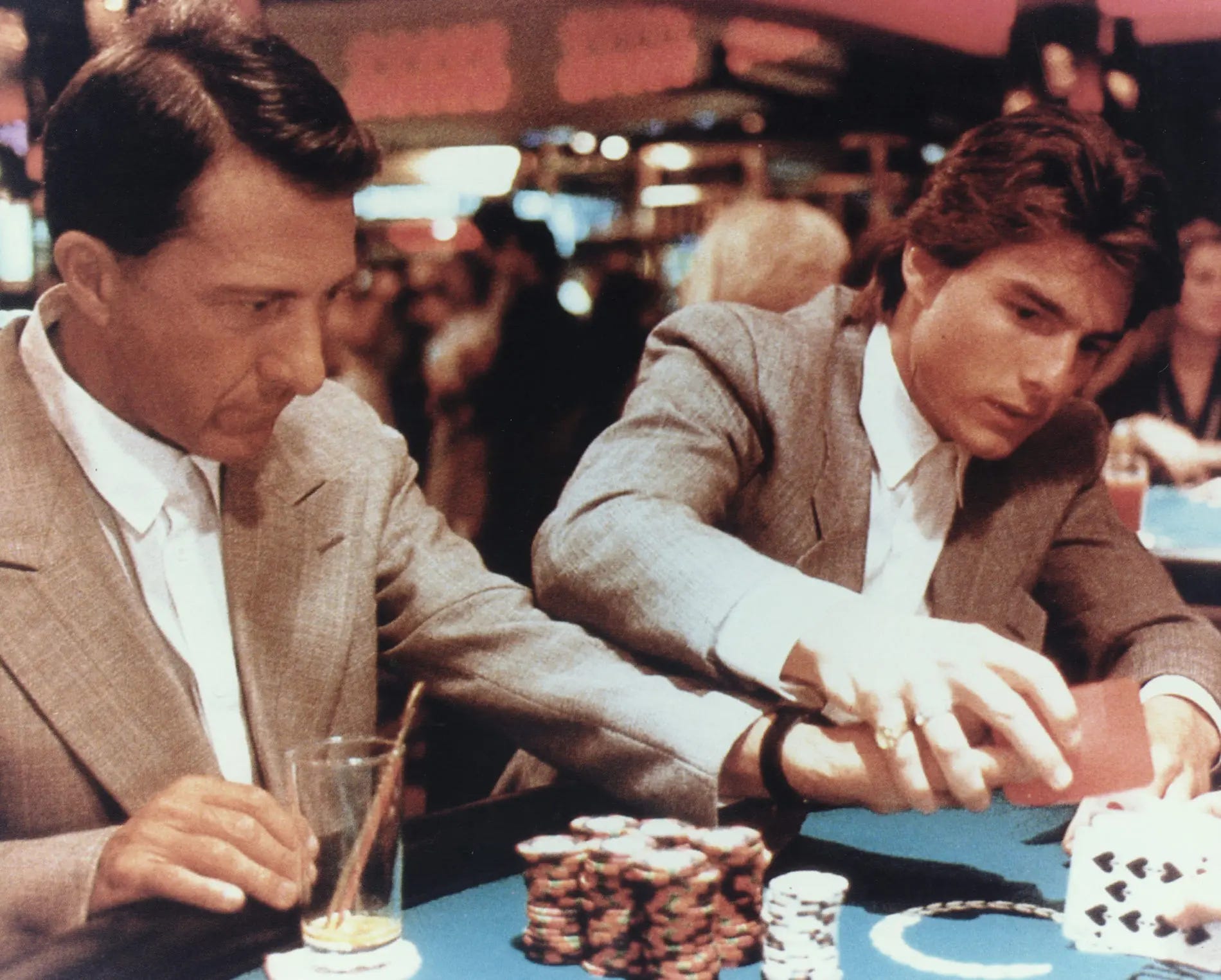
Restart the documentary at around 37:00 to find this part.
This is where I feel the story goes from silly to insulting my intelligence. There is nothing scientific about what’s going on in that test. Nothing about it differentiates H1 from H2. Daniel clearly has a good memory, that’s all. It’s insulting because they present this test as if it should be regarded as some kind of “final proof” of Daniel’s ability to see numbers as shapes and colors. We have no reason to believe Daniel hasn’t been memorizing the basic descriptions, and holding up two little dildo-looking sculptures from day 1 and day 2 is not anything like a “rigorous test” of anything.
Good grief.
Notice that Daniel never said, “Um, 242 isn’t just one color, and it’s cobalt blue, with streaks of silver and green polka dots.” Amazingly, all the numbers happen to be single colors that are all represented (at least to basic analog) in a standard play-doh kit.
Fascinating.
The Indian-American neuroscientist squishing play-doh with Tammet is Dr. Vilayanur Subramamian Ramachandran (one of the UCSD scientists funded by Epstein to test telepathy in autists), whom I will henceforth call “Rama” (he’s used to it). Rama is Cambridged-trained, and proposed one of the various theories of autism.
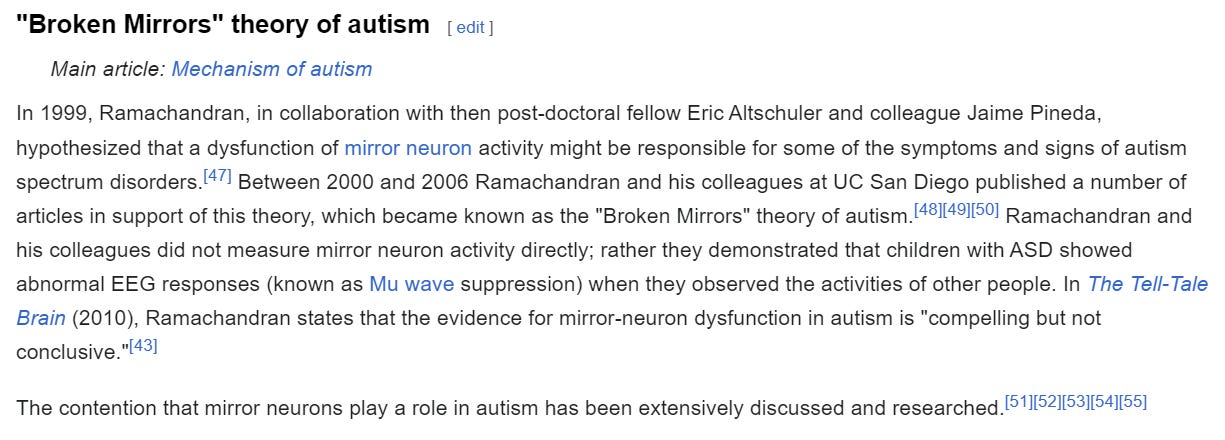
Well, now isn’t that interesting? File it away. We’ll revisit it in another article, but I’d like to briefly note that after a cursory review of his papers, I see no reason to dismiss the theory. It may be quite promising, whether as a small or large piece of the puzzle. If there is anything fraudulent about the Tammet story or the testing of supernatural abilities, as I suspect, it may be that the public more easily accepts the “results” of those experiments from a serious scientist.
Perhaps also interesting is that Rama’s father worked with the United Nations, and his grandfather, Sir Alladi Krishnaswamy Iyer, was a Tamil lawyer who helped draft India’s Constitution. That’s a story that intersects with both the British East India Company and the illusionists of the Theosophical Society in a moment I make no bones about referring to as, “the faked independence of India.” Iyer hailed from Madras, now Chennai, where the Theosophical Society planted its headquarters, most likely because the Madras Corporation governs that area of the Indian subcontinent.
What is the Madras Corporation?
Now called the Greater Chennai Corporation, it is the world’s second oldest corporation, established by an agent of the first (the British East India Co., of course). And now you know why the Theosophists probably settled in Adyar, Madras. Sir Iyer regularly broke bread with his numerous friends in the Theosophical Society, including its Fabian Malthusian leader Annie Besant.
Note also that Elihu Yale, who ran the Madras Corporation in the late 1600s, founded Yale University in 1701.
Finally, I’d like to point out that Rama’s uncle was the late Alladi Ramakrishnan, one of the most storied mathematicians (a mathematical physicist who worked with Bohr and Oppenheimer) in the whole history of India. This makes it all the more unforgivable that Rama sees absolutely nothing wrong with his “testing” of Tammet’s skills.
Now, I’m not going to say that the play-doh “experiment” is “an intentionally sham experiment designed to reach for research dollars or establish the illusion of advanced abilities (transhumanism) that can be achieved by tinkering with the brain or genome.” I won’t say it. It...just...might...be...that...God made the universe so that Daniel’s brain sees in play-doh-vision. But…do you understand why I developed a strong opinion by this point in the documentary?
Like Tammet, I memorize numbers well, but in a way that makes good use of context. If somebody gave me play-doh and told me to build numbers, I’d strategize. What comes to mind immediately would be to primarily use prime factorizations. For big prime numbers, maybe I’d have a fallback that wouldn’t require immense decoding, perhaps relying on the digits themselves. That way, you could ask me five years later, and I’d recall that method perfectly, giving you the same answer each time you asked the question. I might even have a standard way to break down a number like 432, which is 4 powers of 2 multiplied by 3 powers of 3, that stacked the colors in alternating order to look whizzy neato despite following a simple rule that I could easily repeat in all representations. Such a feat would not even be much of a memory feat, but the illusion of numerically-coded color construction would obscure that fact. My technique would allow me to readily give consistent answers in multiple inquiries.
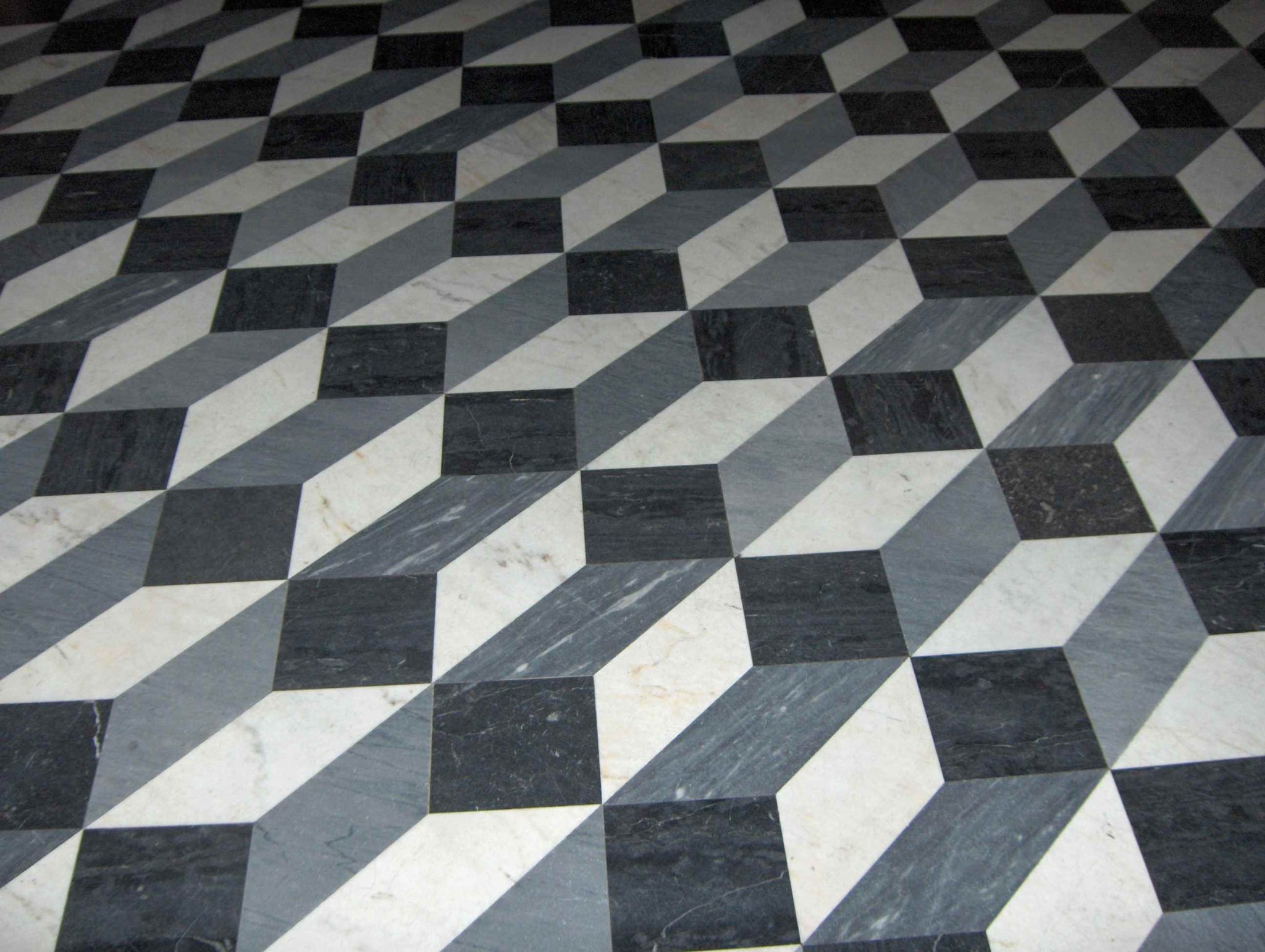
When colored this way, Penrose tiles can be viewed as three-dimensional in multiple ways.
But has Tammet always given consistent answers when confronted with the same questions? Well come back to that…
So what if Tammet has anxiety when shown a pattern that deviates from his familiar mental picture of pi? That’s not a “mean” test as some “scientist” puts it—it’s at best meaningless beyond the fact that Daniel has great [expressed] affinity for pi. At worst this is just a softball served up to make Daniel look really mathy in a sparkly mysterious kind of way. This feels un-science-y in that “unfalsifiable” sort of way. At best, it’s noninvestigatable like so many bottom-feeder episodes of true crime series or “documentaries” about aliens.
I’m going to need a $2 million grant and a massage to study that.
“I’m a savant. Or, more precisely, a high-functioning autistic savant. It’s a rare condition. Uh. And rarer still when accompanied, as in my case, by self-awareness and a mastery of language.“ -Daniel Tammet
Let’s take a look at a few choice quotes from the documentary.
“His childhood holds a dramatic clue.” (7:53)
I love this line. The drama is not the clue, esteemed Drs. of Sciency stuff. The drama strikes me as a form of hypnosis that primes the audience into buying into supposed implications that are not well supported by the predicates of the story. Tammet’s childhood betrays the attempt, logically speaking. A kid who focuses on numbers develops special abilities for working with them. That basic story rarely intersects with autistic savants.
That was in fact the premise of my career as a math teacher. It’s that simple. And being honest about it spurs greater and broader growth in human development. Making any form of excellence look like unattainable magic makes people quit working a little more often. It’s that simple, and the purpose of a system is what it does. So, our default assumption should be that the general sabotage of education is deliberate.
“By most measures, Daniel is autistic, but he’s also picked up enough social skills to blend in.” (14:41)
This quote really struck me. It’s true that Tammet is interesting (or “interesting”) in some regards. While I’ve bashed Tammet’s explanations for his computational abilities, that’s mostly because it appears to me to be a cheap grab at attention (for which I feel only pity, but I feel serious anger over what strikes me as manipulation of science). Tammet’s standard set of social skills are not horrible, but they’re certainly not par either. He’s somewhat weird, and clearly did not have great access to a dentist (oddly common in England). Most people are weird in one way or another. So what? Most people manage through more than a bit of weirdness.
But really, what “measures” of autism are we talking about? Just diagnose him and show us how it’s done and what that means. Or is the point to build mystique in place of understanding?
“One day you’ll be as great as I am.” (28:12)
Superb line! The director screams, “Cut!” and it’s a print.
That line probably helps with the charade that Tammet and Kim are alike in some especially peculiar way. But I don’t buy it at all.
You have to love Kim. He expresses kindness, seeking to endow what makes him special onto another man. You can see why Kim’s story inspired Rain Man. Tammet looks embarrassed by Kim’s tenderness, if anything.
The greatest similarity between Kim and Tammet is intense memory, if overbroadly defined. Kim’s memory is far more intense, and far from being explainable by ordinary memory building techniques. There is a difference by kind. He concentrates more wholly on his savant abilities. Of course, Tammet is more social, which may itself explain some of the difference. But overall, it’s not clear that Kim is even capable of less intensity.
Interestingly, and not included in the documentary, Kim’s father, Fran, questioned Tammet’s explanation of Tammet’s story, as have some people diagnosed with savant syndrome. Tammet’s undoing may have been talking with a guy who memorizes books by thumbing through them. Kim was probably highly familiar with the summary literature on savant syndrome.
Oops?
Here is a ten minute Ted Talk given by Tammet. You make the call.
Aside from the lisp, or in addition to it, Tammet presents as a typical geek cultivating an air of profundity by quoting literature rarely read by an audience of credulous college graduates, most of whom did the same thing concocting their college resumes. But as is typical of many a conman, he thrusts his terrible watercolor art at the audience. I wonder if he’s thought of NFTs yet?
It was interesting to experience the joke at around 7:50 (a good little joke!) that is the type of joke that strikes me as coming from a place of ordinary if well-observed human experience. Out of all the words he studied in Icelandic, he recognized the one around which he could build an entertaining moment in front of an audience that reads The Atlantic a little too seriously. Having worked closely with around a dozen autistic students (specifically as a specialist working with those who were gifted in mathematics), and less closely with numerous others, that strikes me as something I never once saw from any of them, despite patient encouragement. To be clear, I once in a while took the moment to point out humor or laughter, and the cognitive friction behind it, and asked autistic students I worked with what might make another person laugh. Never once did I see substantial recognition of the meaning of the exercise. While I’ve shared humor with a few of my autistic friends, I can’t ever recall one of them busting out with a joke that would fit well into a late night comedy routine.
”I’m very much a big skeptic of this.” (32:30)
Azoulai struck me as one of the least skeptical scientists I’ve ever witnessed. My opinion of his body language is of a person who wants to be impressed or at least express that reaction performatively. But truthfully, I’m taking a shot at him here because the tests I saw in this documentary were so flimsy that I simply cannot respect any of this as a scientific exercise. Nothing here elevates H1 over H2, and when this quote sits in a documentary near heavily-produced action shots of Daniel miming his play-doh-vision-arithmetic like Manga magic, I move a little closer to H2.

“It was something that you just can’t fake. These are the things specifically that are showing me that he’s not bullshitting and he’s not scamming. Even the mistakes that Daniel makes are the mistakes that are telling me ‘you know what? This is legit. A faker wouldn’t be doing this.’” (39:39)
A faker wouldn’t do this? That’s a scientific opinion? I thought science was about testing a hypothesis. I can test the hypothesis. I have. I’ve taught hundreds of neurotypical grade schoolers to do nearly all the “amazing” things Daniel did in the documentary.
Also, I’m fairly certain that I could fake all of it. Part of me wants to meet Penn & Teller, and see if I could pull it off. That few people have firm expectations of what any particular outlier personality looks like would make it easier than a typical acting job, not harder.
I have a strong opinion about this particular quote. I can’t prove it, but it strikes me as the kind of quote that comes out of somebody’s mouth exactly when they’re staging something, and they’re building on hypnotic suggestion. The whole video seems to have this defensive quality to it, presented with a tenor of scientific analysis. Nothing here elevates the narrative hypothesis (H1) over the showman hypothesis (H2).
“This could be the linchpin that spawns a whole new field of research. (40:56)
A whole new field. And that’s going to cost your government. That’s also why we’re raising tuition by 18.3% again next year. Suck it up, normie.
I find it utterly amazing that Daniel’s shapes weren’t put to any rigorous testing. I bet I could debunk them in 5 minutes, but don’t expect anyone to give me that opportunity. A researcher just says, “Wow, I’m blown away” as Daniel looks away, once again looking anxious. This line, with lack of all credible backing, does nothing but support my case. Nothing here distinguishes H1 from H2.
“The line between profound talent...and profound disability seems really a surprisingly thin one.” (46:18)
That sounds to me like something somebody might say if they’ve gone through life playing mental games, never doing anything productive, finally deciding to play their cards in a hoax, hoping for something good to happen. Hoping perhaps for a little fame? Some butter for the bread? Nothing here distinguishes H1 from H2.
The quote comes from the late Dr. Darold Treffert, a psychiatrist who made appearances on such scientific programs as Oprah, and the Phil Donahue show.
Has anyone ever noticed how many of Oprah’s guests are occultists like Ma Anand Sheela with hidden connections to the British Empire? Or how many turned out to be serial rapists, or at least ran programs where serial rapists seemed to congregate? Or future presidents? Never mind…
In 2010, Treffert published a book entitled Islands of Genius: The Bountiful Mind of the Autistic, Acquired, and Sudden Savant. Tammet is credited as authoring the Forward.
“The bigger question is whether we all have some of those abilities within us. And that is what I refer to as the little rainman within us.” (46:43)
Wow, that’s so warm and fuzzy. And fully loaded with a conclusion that hasn’t been subjected to basic skepticism, much less scientific testing. Is there an aphorism about Chekhov’s neurolinguistic programming?
There is an interesting question, but the answer is plain: there are far more than 50 people with the abilities described in the documentary. There are not a lot of people like Kim “the real rain man” Peek, but Daniel isn’t like that either, even if he wants to play the role. Daniel is just a guy with a fairly high IQ (but probably not too high if this is his shot in the world’s game of Who Wants to be a Millionaire?) who claims to accidentally squash shapes and sizes together to compute numbers—or that it just sort of happens with little or no effort—like hair growth or pooping.

While I brooded over whether I could maintain an erudite tone with this article, I can’t help but to make fun of the theater. Expeliarmus! Riddikulus!
“I’m an extreme example of this. My worlds of words and numbers blur with color, emotion, and personality.” -Daniel Tammet
When you’re trying to sell [a conclusion], it’s easier to just state the conclusion without ever mentioning competing hypotheses. If you pay close attention, this is how the media (and even most of the alt media) gets away with propagandizing large audiences who haven’t yet self-diagnosed their Gell-Mann amnesia. The tactic includes elements of neuro-linguistic programming, and adjectives like “extreme” that your English teacher begged you to avoid.
I would be interested in knowing how all these shapes and sizes mash together when Daniel divides one integer by another. Am I really the only person who imagined imposing the arithmetic operator under which the integers are not a closed set?! Why was the one and only division problem he was served up one that happens to have the most perfect setup for an easy-to-employ, but difficult-to-identify tool? (Put 13/98 into a calculator and look at the pairs of digits. Do you see the near-perfect doubling? Too many people would notice?)

Now try 13/998 and 13/9998. Now try 13/97, 13/997, and 13/999997. It’s hard to teach the whole method in this article, but I’m guessing you can see that there is a simple computing technique. It’s all just a joke.

These are all fractions that are easily converted to infinite geometric series:

Does it strike nobody else at all that it is implausible that some brain abnormality results in both a rare and arithmetically effective form of synaesthesia and exceptional memory capacity—each enough to impress the gods on Mount Olympus? And is coupled with the ability to learn languages and write annoyingly mediocre poetry?
“So, Bob, when I hit you in the head at that one particular location, it caused you to be able to pick stocks better than Wall Street, you grew muscles in your sleep, and your cock grew three inches. Go ahead, hit me in that spot. Let’s hit my kid there, too. Then the neighbors. They’ll thank us.”
Do it for science. Do it for your government. Also, take this genetic therapeutic injection designed by artificial intelligence to become telepathic?
If Daniel’s abilities are so abnormal—if he uses shapes and sizes to compute in ways he can’t explain...why was his primary profession before all the hooplah began…as a tutor? Did he go out of his way to learn mathematical methods he doesn’t actually need to use himself in order to teach the basics to children? Tutoring (well, professionally) means making connections with people and understanding where they are and how they can move forward. Not many people hire an autistic Olympic medalist in fencing to coach offensive linemen in football.
In the Wikipedia article on Daniel Tammet, his synaesthesia is explained as such:
In his mind, Tammet says, each positive integer up to 10,000 has its own unique shape, colour, texture and feel. He has described his visual image of 289 as particularly ugly, 333 as particularly attractive, and pi, though not an integer, as beautiful. The number 6 apparently has no distinct image yet what he describes as an almost small nothingness, opposite to the number 9, which he says is large, towering, and quite intimidating. He describes the number 117 as “a handsome number. It’s tall, it’s a lanky number, a little bit wobbly.”
As Mathew’s first law would predict, there is no section on that Wikipedia page for “Controversy”, despite his being flayed in a best-selling book by a well-known journalist. We’ll get to that. It is also interesting to see the British-English spelling of “colour” six times on Tammet’s Wikipedia article, which seems to have been largely written in 2012—largely by editors with little or no other editorial history in the wiki. Hello, Q? Shall we discuss this over biscuits and a spot of tea?
Back to the arithmetic…
If you’re doing mental computation, 17 is an ugly number to work with. Unless you couple it with another number, like 6 (to make 6*17 = 102), it’s hard to find a nice way to multiply by 17. 17 squared is 289. Now, when doing large computations, you have to pair 17 with “nice” numbers twice to perform well. So, if 289 is involved, the computations are “ugly” to try to do mentally. It makes for a nice excuse if you miss those problems: “The squiggles in my head were ugly this time—hard to read.”
On the other hand, multiplication by 333 is extraordinarily easy because,

Powers of 10 are, as I have alluded to already, the key to quick mental computation. It strikes me as convenient for Daniel to have picked a power of 10 to stop at for “seeing” numbers as shapes, colors, and textures. If I wanted to script a story like his, that’s exactly what I would do. It would make all the crap I made up for that task easier to remember anyway.
Perhaps the story of Daniel Tammet is not simply an elaborate fairy tale for profit and the promotion of the idea that the human brain might be sculpted to help people unlock godly talents. Perhaps a very basic look into the investigators promoting Tammet as a unique autistic savant might help us better distinguish between our two primary hypotheses:
H1 (the narrative hypothesis): Daniel Tammet is an autistic savant who performs fantastic numerical calculations in ways that he cannot explain, but that involve synaesthetic color vision that mysteriously just sort of works on its own within his brain [and that’s worth studying].
H2 (the showman hypothesis): Daniel Tammet learned some neat arithmetic tricks, then became famous being promoted as an autistic savant with synaesthetic attributes, and sold lots of books.
The most obvious connection is that several of the researchers associated with Tammet promote various theories of autism—not a single one of which directly grapples with the world of toxic chemicals that we humans are now exposed to (including some from vaccines):
Simon Baron-Cohen: Mindblindness Theory of Autism
Simon Baron-Cohen: Prenatal Sex Steroid Theory of Autism
V. S. Ramachandran: Broken Mirrors Theory of Autism
On a side note, the prenatal sex steroid theory of autism has an interesting connection back to Jeffrey Epstein. One of Ghislaine Maxwell’s sisters, Isabel, married Dale Djerassi. Dale was the son of Carl Djerassi, co-inventor of the birth control pill. Isabel’s twin sister Christine married Roger Malina. Roger’s father Frank was mentor to Jack Parsons. Parsons founded the Jet Propulsion Laboratory and was involved with Scientology founder L Ron Hubbard, performing sex magick rituals together inside of Aleister Crowley’s Ordo Templi Orientis.
Treffort and others in the near orbit of this story are also responsible for research and theories surrounding autistic savants. There is a lot of opportunity here to corrupt and steer the direction of science as it pertains to autism and public perception of transhumanist studies.
Simon Baron-Cohen was an author on a genetic study of autism correlations (Baron-Cohen et al, 2021) that made use of the 23andMe database. In 2021, 23andMe merged with Sir Richard Branson’s VG Acquisition Corp, and the combined entity’s stock quickly began to crash, losing nearly all of its value over the past few years.
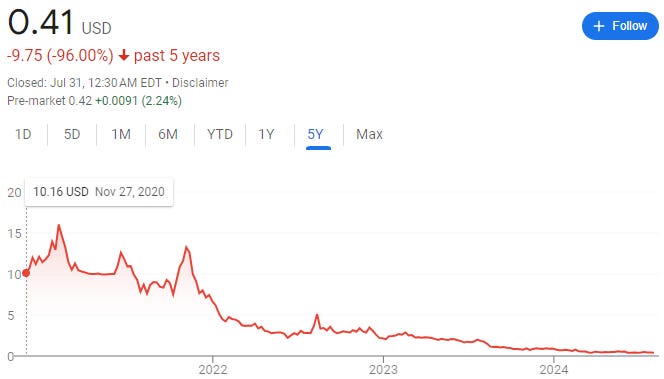
Branson, another associate of Epstein’s, is a member of the board of the Centre for the Mind, an organization founded in Australia by savant researcher Allan Snyder. Snyder has promoted Tammet numerous times, including with this dramatic quote,
Savants can’t usually tell us how they do what they do. It just comes to them. Daniel can describe what he sees in his head. That’s why he’s exciting. He could be the Rosetta Stone.
The Rosetta Stone for unique savants? Or for some sort of [transhumanist] change that might be induced in human beings?
Snyder published a paper (Snyder et al, 2006) claiming to have “temporarily” induced historically specific savant-like skills after subjecting 12 subjects to magnetic pulses to their brains.
The Centre for the Mind awarded Ramachandran with a Distinguished medal.
This brings me to the Cambridge University connection:
V. S. Ramachandran (documentary)
Simon Baron-Cohen (documentary; brain scan of Tammet)
Daniel Bor (brain scan of Tammet)
Julian Asher (documentary)
Allan Snyder (Centre for the Mind founder)
Peter Karmel (Centre for the Mind board)
None of these facts and associations prove anything definitively, of course. They are circumstantial evidence that we may each interpret as we like in conjunction with all other facts that help us sort between H1 and H2, not to mention the goals of Epstein’s network. But it must be noted that it would be easier to pull off something like the building up of Tammet into a faux-scientific construct if the participants were part of something like a small, tight, niche scientific community. Maybe easier of that community is funded by a pedophile with connections to all the most powerful intelligence agencies?
If H2 is correct, can we identify a motive—specifically Tammet’s motive?
Why LARP as a lab rat?
Maybe Tammet is perfectly happy to give up some of his prime years of productivity for the sake of The Science? Having one’s ego stroked is nice, but too much of it makes one a target, so I’ll say “possible, but unlikely.” Speaking as a former almost-30-year-old man, I think that making a good living fits as a better motivation. I’m told privately that Daniel has sold well over a million books, so I assume he has earned several million euros in royalties. The Boy with the Incredible Brain came out in 2005. Two years to the day later, Tammet published the first and most successful of his several books since. It spent months on the NYT best seller list.
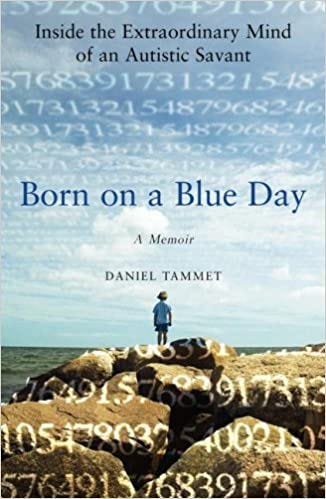
After the Boy with the Incredible Brain came out, Tammet went on a bit of a media tour, including an appearance on David Letterman’s Late Night program:
Tammet also appeared on 60 Minutes, which includes the 31^4 question which I noted as a repetition of computation from The Boy with the Incredible Brain. That’s fine. Maybe Daniel has a poor memory…wait a minute…
Tammet also ran an education company, and the publicity surely buoyed that project.
Toward the end of the 60 Minutes video, it is mentioned that Tammet sometimes gives talks to parents of autistic children. Discovering that gave me a bit of a chill. Tammet may have been raised up as a patsy for the transhumanist industry, handled by academic intermediaries. Being love bombed as he was, he may simply have felt that he fooled everyone—or maybe that he really is that special.
And, all in all, becoming a cult hero with a career in publishing books beats vying for prizes in memory competitions and answering phones for a psychic hotline (we’ll get to that last part).
“When he was writing the plays and the short stories that would make his name, Anton Chekhov kept a notebook in which he noted down his observations of the world around him—little details that other people seem to miss. Every time I read Chekhov—and his unique vision of human life—I’m reminded of why I too became a writer.” -Daniel Tammet
Three years after my original critique of the Tammet story, journalist Joshua Foer published Moonwalking with Einstein, which debuted at number 3 on the NYT bestseller list. I own a copy and recommend it as a unique and exceptional piece of participatory journalism.

Foer’s journey begins as an exploration of advanced or enhanced memory. His explorations took him to the 2005 U.S. Memory Championship where his mind was blown to find out that the participants did not think of themselves as savants. Participants explained to Foer the use of both short- and long-term memory enhancement that have been used for as many as 2,500 years (often refined for modern use or competition). He gives an excellent 20 minute TED Talk about some of what he learned.
Foer did not just learn about the techniques. He put in the work to learn them himself at an expert level. In fact, he learned them so well that he participated in and won the competition the very next year. Foer spent a year’s worth of dedicated time proving to himself and the whole world that [what most people can be convinced are] savant-level achievements can be the result of medium-term dedication to skill development. And it doesn’t require any kind of elite conceit that could otherwise trap somebody (particularly a young person without the wisdom of a good guide) in a false reality of feeling or performatively behaving differently.
Chapter 10 of Foer’s work includes a perspective on Daniel Tammet and the documentary that thrust him into the dazzling world of celebrity savants. You can read that chapter here. All quotes are from the first page of that chapter (emphasis mine),
One day, after memorizing 138 digits in one of my five-minute practice sessions, I was sitting in front of the television, rifling through a deck of cards, as I often did to pass the time. I was looking at the queen of clubs, thinking about Roseanne Barr, about to form a disgusting memory, when I caught a trailer for a new documentary called Brainman about one of those rare prodigies. The subject of the film, which aired on the Science Channel, was a twenty-six-year-old British savant named Daniel Tammet, whose brain had been altered by an epileptic seizure he suffered as a toddler. Daniel could perform complex multiplication and division in his head, seemingly effortlessly. He could tell you if any number up to ten thousand was a prime. Most savants have just a single claim to exceptionality, a lone “island of genius,” but Daniel had a veritable archipelago. In addition to his lightning calculations, he was also a hyperpolyglot - a term used to describe the small number of people who can speak more than six languages. Daniel claimed to speak ten, and he said he learned Spanish in a single weekend. He’d even invented a language of his own called Mänti. To test his linguistic skills, the producers of Brainman flew Daniel to Iceland, and gave him one week to become conversational in Icelandic, one of the world’s most notoriously difficult languages. The talk-show host who tested him on national television at the end of the week pronounced himself “amazed.” Daniel’s tutor for the week called him a “genius” and “not human.”
Reading this, I felt that Foer had a similar reaction that I did, but with less background knowledge by which to judge Tammet’s calculation methods. Having just spent time learning to perform a breadth of impressive memory feats, Foer found himself skeptical enough with Tammet’s story that he sought Tammet out to observe him. Upon meeting Tammet, Foer remarked, “I was taken aback by how surprisingly ordinary Daniel seemed,” after sharing food, drink, and a bit of conversation with Daniel and his partner.
Who could meet an autistic savant and be taken aback at how “ordinary” they seem? Has any other autistic savant stuck any other human being as ordinary?!
Foer points out that Tammet changed his name at some point. The so-called “savant” Daniel Tammet was born Daniel Corney.
Huh.
Would an autist think up changing their name so that their story isn’t branded as “corny” by some audience? Would propagandists working with a subject such as Tammet be more likely to suggest the rebranding?
Foer talked about Tammet with other mental athletes whom he had gotten to know, and quite a number of them were skeptical about Tammet’s story. “Any of us could do what he’s done,” remarked one of them. Foer researched Tammet by searching his former name, Daniel Corney to discover that Tammet was himself a competitor in the World Memory Championship, placing fourth in 2000, but had his name legally changed in 2001. That seems to be shortly after advertising his own memory program:
I was especially surprised by one of Daniel’s posts to the WWBC. It was an ad from the year 2001 in which he offered to reveal the “secrets of his ‘Mindpower formula’ in his unique ‘Mindpower and Advanced Memory skills e-mail course.’ ” What secrets were those? I wondered. And why hadn’t he shared them with me when we met?
Does Daniel believe his abilities are teachable, or as the claim goes, the result of the damage of autism and childhood epilepsy coming together in a seemingly magical recipe that involves plah-do-vision, and enhances mathematical, mnemonic, and linguistic ability all at the same time?
Though I asked him repeatedly on several occasions, Daniel refused to perform even a single mental calculation for me.
Daniel says that he doesn’t want a life of performing like a trained seal, but shying away from one single computation that would not come from somebody vested in his story does not demonstrate any of that much-needed veracity for Hypothesis 1.
“There are a lot of people in the world who can do those kinds of things, but they’re still pretty impressive,” Ben Pridmore told me. In addition to competing on the memory circuit, Ben also competes in the Mental Calculation World Cup, a biennial contest in which participants carry out mental calculations far more extreme than Daniel’s, including multiplying eight-digit numbers without pencil or paper. None of these top calculators make any claims about seeing numerical shapes that fuse and divide in their minds’ eyes. They all readily admit to using techniques detailed in countless books and Web sites. I asked Ronald Doerfler, author of one of those books, Dead Reckoning: Calculating Without Instruments, to watch Brainman and tell me what he thought. “I’m not fantastically impressed with any of that,” he said of Daniel’s mathematical talents, and added, “The lore of mental calculators is rife with misdirection.”
Having grown bored of math contests early in high school, I don’t bother with mental calculation events. But I know a few people who have participated in such events since writing my 2008 article in 2008. The opinions of Pridmore and Doerfler are absolutely the norm. Having spent fourteen years teaching techniques of mental calculation to thousands of students, I view the set of problems Tammet answered in the documentary as little different from Foer’s quest that led him to a national memory championship title.
Now, here is a paragraph from Foer’s chapter that requires special attention at the Big Picture level of The Science itself.
“You don’t use memory techniques?” I asked him. “No,” he assured me. If Daniel had concocted his story of being a natural savant, it would have required a degree of mendacity that I couldn’t quite bring myself to believe he possessed. If he was merely a trained mnemonist trying to cloak himself in the garb of a savant, why would he so willingly subject himself to scientific testing?
After working for a summer (1995) at the statistical hub of the Human Genome Project at Washington University in St. Louis, I found myself heavily recruited by the biologists and geneticists, but my intention was to study Mathematics at the university level, whatever else I might do thereafter. I spent time poking around various corners of science during my freshman year and for reasons I may explain in other articles, came away with the impression that a great deal of The Science was fake. In particular, what I saw in the field of Psychology made me cringe, including all manner of methodological posing, posturing, and p-hacking that struck me as narcissistic, performative “science”. But I suspect that the firehose of money in corners of every field ensures less than honest cash grabs. My strong opinion is that somewhere in the Tammet story is an intersection with that observation.
The researcher who diagnosed Tammet with Asperger syndrome is clinical psychologist and development pathologist Simon Baron-Cohen, cousin of comedic character creator Sacha Baron-Cohen. This coincidence somehow always remains in the back of my mind. Simon Baron-Cohen is also responsible for the mind-blindness theory of autism, which suggests a link between autism and an inability to formulate a theory of mind as a construct for personal recognition (as in relationships). I have to stop and ask: Can you participate in mental telepathy without a theory of mind?
If there is a motive to this story that could reach beyond establishing an upper-middle class living standard for a guy who was good at contests of mental feats, could it be the very story of autism itself?

Reminder:
H1: Daniel Tammet is an autistic savant who performs fantastic numerical calculations in ways that he cannot explain, but that involve synaesthetic color vision that mysteriously just sort of works on its own within his brain [and that’s worth studying].
H2: Daniel Tammet learned some neat arithmetic tricks, then became famous being promoted as an autistic savant with synaesthetic attributes, and sold lots of books.
The following paragraphs from Foer’s book strikes me as uniquely important in distinguishing between H1 and H2:
Earlier, I had also found something else, a series of messages posted several years ago from the same e-mail address used by Daniel Corney, but sent by someone named Daniel Andersson, who claimed to be “a well-respected and gifted psychic with more than 20 years of experience helping and empowering others.” The messages explained that Daniel Andersson had received his psychic powers during a series of childhood seizures. There was a link to a Web site where you could arrange a phone reading with Daniel for “advice on all manner of topics, including relationship problems, health and financial matters, lost love and contacting those who have passed over.”
I asked Daniel what I was supposed to make of those e-mails. Six years ago he was claiming that his epileptic seizures gave him psychic powers. Now he was claiming that they’d made him a savant. “Do you see why someone might be suspicious?” I asked.
He paused to collect himself. “God this is embarrassing,” he said. “After I offered myself as a tutor and that wasn’t successful, I read an ad for someone who could do psychic readings. You could work from home and use the telephone. That was ideal for me. I wasn’t a psychic. I did it for about a year because I had no income otherwise. I was regularly told off, because I wasn’t giving advice. I was mostly just listening. I treated it, start to finish, only as an opportunity to listen to people. With hindsight, I wish I hadn’t done that work. But I was desperate. Look, life is complex. I never thought I would come into the public eye. I promise you that I’ve done tests for consistency with scientists who are well placed to determine whether I’m putting it on, and they’re opinion—not just one scientist’s opinion, crucially—is that I’m for real.”
Yes, this certainly is quite embarrassing—most of all because it reveals Tammet as (forgive the judgmental sound of this) something of a loser, and a showman with loose ethics. These aspects of Tammet’s state of mind as a young man provide all the preconditions for H2.
In 2005, the aforementioned Baron-Cohen took scans of Tammet’s brain.
Scans of the brains of autistic savants suggest that the right hemisphere might be compensating for damage in the left hemisphere. While many savants struggle with language and comprehension (skills associated primarily with the left hemisphere), they often have amazing skills in mathematics and memory (primarily right hemisphere skills). Typically, savants have a limited vocabulary, but there is nothing limited about Tammet’s vocabulary.
Again and again we see evidence that Tammet is unique among those who usually fit into the categories of both autistic and also savant. And yet, the abstract of the paper published in 2007 by Baron-Cohen, Bor, and Jac Billington begins by declaring Tammet to have synaesthesia [from which his superabilities emerge]:
Single case: DT is a savant with exceptional abilities in numerical memory and mathematical calculations. DT also has an elaborate form of synaesthesia for visually presented digits. Further more, DT also has Asperger syndrome (AS). We carried out two preliminary investigations to establish whether these conditions may contribute to his savant abilities.
However,
Finally, DT did not activate extra-striate regions normally associated with synaesthesia, suggesting that he has an unusual and more abstract and conceptual form of synaesthesia.
Instead of concluding that Tammet most likely does not have synaesthesia, the researchers simply decide that he has his own unique form of synaesthesia. Voila!
Bor later wrote an article in which it is claimed that a second such synaesthetic has been discovered and studied, but is unnamed and apparently hasn’t achieved any fame. This is despite having a highly overlapping set of abilities with Tammet, minus language learning skills, but with musical mastery added.
At the time, I was concerned that Tammet was only a single case study, and hence it was difficult to draw too many conclusions from him. But more recently another research group has studied a second person with surprisingly similar features. FC, as he is known in the literature, has various abilities, including perfect pitch, powerful calculation skills, and an exceptional memory for certain topics. He is a talented pianist, with superior memory for melodies. He can tell you what day of the week corresponds to a particular date, and is rapidly able to multiply four digit numbers together. At least some of these impressive skills are underpinned by his synaesthesia. For instance, he links the seven white keys within an octave on the piano with the days of the week, and the 12 black and white keys of a full piano octave with the months of the year. His mental arithmetic also follows a similarly circuitous route, as he converts all numbers into times (hours, minutes, seconds) to work on the calculation that way, and then back to normal numbers again to give the answer. With both Tammet and FC, it might seem that this conversion process is a wholly inefficient way of trying to remember or manipulate numbers. However, just as with my volunteers turning sequences of locations into regular shapes, what matters here is that we start with something abstract and somewhat arbitrary, and it helps enormously to impose some mental structure on these stimuli. That’s often the best route to memorisation and expertise.
Part of the discussion of the emergence of savant-like talents focuses on a common thread of brain damage among the majority of those savants studied. The phenomenon is called “acquired savant syndrome.” It is observed that when one area of the brain compensates for others, strange things do seem to take place.
In 2002, Tacoma, Washington resident Scott Padgett was mugged at a karaoke bar. The 31-year-old suddenly became obsessed with math and physics. From a DailyMail article about his transformation,
The next morning, Padgett woke up and found that his vision had changed to include details he never noticed before.
He started the tap in his bathroom and noticed ‘lines emanating out perpendicularly from the flow.’
‘At first, I was startled and worried for myself, but it was so beautiful that I just stood in my slippers and stared,’ Padgett told the New York Post.
Padgett stopped going to work and spent all of his time studying math and physics, focusing on fractals, which are repeated geometric patterns.
Even though he showed no talent for art before, he started drawing fractals in extreme detail - sometimes taking weeks to finish the work.
But there was also a downside to his new talents. While he was once outgoing, Padgett turned introverted and started to spend all of his time at home, covering up his windows with blankets and refusing visitors.
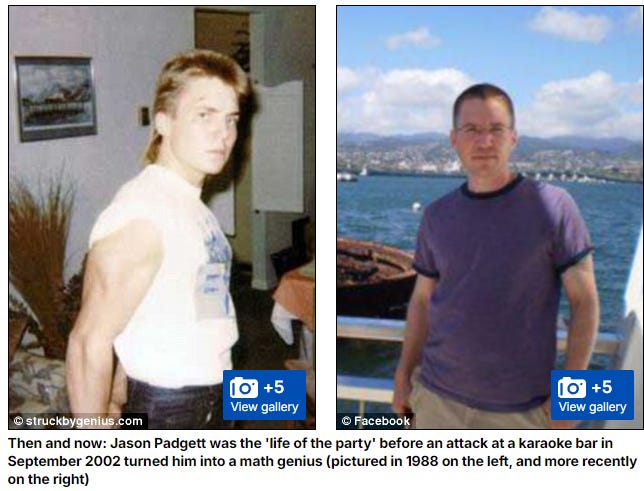
Padgett underwent an fMRI. Researchers found what they expected,
Dr Brogaard used fMRI machines to survey Padgett’s brain and found that the left side was more activated, especially in the left parietal love where ‘math lives’.
It seems that after the injury, neurotransmitters flooded the left side of Padgett’s brain and ultimately changed the structure making him hyper-specialized.
An fMRI showed that Scott Flansburg’s brain region 44 is quadruple the size of most people’s, possibly indicating that brain regions grow according to frequency of exercise. This makes sense on an intuitive level, as does the fact that he made a good living teaching his methods to students. Because people can learn to do things—even things that at first appear unusual. Humans are cool like that.
In the meantime, what I’d like to know is why nobody runs before and after brain scans on somebody such as Daniel Foer as they begin to study for the Memory Championships, and later when they’ve practiced the many well-known techniques. Would it be too inconvenient to maybe control for a variable once in a while as we propose dramatic new theories in the face of highly questionable evidence?
On May 31, 2017, celebrated Argentinian physicist and neuroscientist Andres Rieznik and colleagues published an article in Frontiers of Human Neuroscience (Rieznik et al, 2017) imploring reasonable understanding and skepticism by members of the scientific community when examining “mental athletes” (MAs) and prodigies.
The paper focuses a great deal of attention on Daniel Tammet’s story in particular. I corrected three small typographical errors, but this quote is otherwise verbatim from the paper:
Currently, there are several famous MAs who are candidates for scientific scrutiny. Daniel Tammet is famous because of his extraordinary calculation abilities. He attributes his skills to an epileptic attack at his infancy (Bor et al., 2008). Although the connection between epileptic attacks and mental abilities could be of interest, several skepticism has been raised concerning Tammet’s case (Doerfler, 2008; Foer, 2011). In his best-selling book “Moonwalking with Einstein,” Joshua Foer suggested that Tammet’s achievements could be the result of extensive deliberate practice rather than a feature of his exceptional mind. Curiously, The New York Times review of Foer’s book (Horowitz, 2011), raised a criticism because “Foer inexplicably devotes space to attempting to convince the reader that Daniel Tammet, a renowned savant who memorized 22,514 digits of pi, may not actually be doing it naturally.” We certainly disagree with this criticism and argue that an examination of mental strategy should be the crucial issue in cognitive studies of MAs. The entire point of investigating prodigies is to decipher the cognitive mechanisms by which they perform their feats. If the magic tricks remain hidden there is very little that can be done about such cases scientifically.
In Tammet’s case, evidence of a memorization strategy has been obtained by Ronald Doerfler who investigated Tammet’s response times while mentally dividing 13 by 97 (Doerfler, 2008). This particular operation is well-known to MAs because dividing by 97 results in a repetition of shifted patterns of 96 digits and hence can be remembered. The hypothesis that a MA uses this algorithm has a concrete prediction: he should slow down during the transitions between these remembered chunks. This is exactly what Doerfler observed when measuring the speed of recitation in Tammet’s calculation. Doerfler concluded that a classic mnemonic technique was much more likely than more glamorous explanations such as the formation of synesthetic landscapes for the representation of numbers (Doerfler, 2008).
Notably, both Doerfler and Foer are MAs themselves, so they have a good understanding of the conjuring that tricks the audience, including the scientists investigating MAs.
Several myths about autistic savant calendrical calculators have been debunked by Cowan and Frith (2009). Calendrical calculation is a paradigmatic example of mentalist demonstration because it has the virtue to appear much more difficult than it really is (Benjamin and Shermer, 2008).
Rieznik’s critique and my own have substantial overlap, but we each recognized some unique details. Rieznik is himself a mathemagician in addition to being a well-published physicist. He also has his own television program in Argentina. His talent set enables him to be instinctually aware of subtleties in the behavior of a performance. You can see him entertaining with his talents here, minus the flock of neuroscientists:
A few weeks after Rieznik’s article was published, Rieznik found my original critique from 2008 of the documentary about Tammet. He emailed me shortly afterward. We compared notes on Tammet, and a couple of the scientists promoting his story. Rieznik explained that he was preparing a larger, more thorough publication.
After a few weeks of communication, Rieznik went silent for a stretch. After an extended pause in correspondence, I received an alarming email. He had taken his family into hiding after receiving threatening phone calls from what he suspected was a Colombian mafia associate (based on the accent). Somebody wanted Rieznik’s work to stop.
Though his feeling of safety grew back, and Rieznik returned home, he stepped away from completing the larger study. He asked if I would take up the work myself, but I did not have the time to commit. While he told me that his Russian coauthor, Mikhail Lebedev planned to move forward with the publication, that apparently never happened.
Rieznik’s scientific publication record seems to cease around that time. While he has since written a couple of books, it seems that since the threat was delivered, he is no longer a publishing scientist.
It is worth pausing at this moment and asking what sort of network would have the power and resources to summon the Columbian mafia, and has such interest in illusions of autistic superpowers, to threaten a popular national science treasure such as Rieznik. Further articles will explore that question, but Jeffrey Epstein was certainly a power broker in such a network.
Since our last correspondence in 2017, Rieznik appears to have completely shifted his focus from publishing scientific studies to teaching and hosting television programs such as La Liga de la Ciencia, which airs on Argentine Public Television. As an educator, he challenges his audience to understand how “neuromagic” can hack the human mind.
Indeed, we all need to up our game in order to recognize all the illusions.
In 2020, while I was leading a Math Club for Adults with the goal of helping parents get acquainted with topics that might help them teach and inspire their own children. During one episode, I talked through some of Tammet’s story and techniques of number sense in a video that YouTube quickly demonetized. I sent a message through the YouTube system with the reasonable observation that the use of a few clips in my video was clearly fair use, but YouTube never responded.
While it does not otherwise pertain to this story, here is that video:
Since then, YouTube also completely nuked my other channel, which included the only recorded video of the interview I described giving a student in Chattanooga, and many other young students.
Have we sufficiently unraveled an autism illusion tale?
Can we pierce the fog to obtain a clear view of the bigger picture?
The story of Epstein will continue in further articles. Believe it or not, it gets deeper, and it may challenge your models of how the world works. I hope that readers can already see how they may have been misled about the bigger picture. Perhaps we can remedy that.
Thank you for reading this far. Your support is appreciated.
No posts
Comments
Nothing yet. Say the first thing.
Sign in to join the conversation.