
It’s been almost a year since the fashion and lifestyle content creator Scottie Butler posted his first ring camera portrait on Instagram. His look is strategically casual, two degrees away from disheveled: Butler is shutting the door while looking directly into the camera in the first image, bangs slightly messy. In the second he’s wearing sunglasses and holding an umbrella, ready to go. The caption reads “First door cam on main for Demna #gucci,” accompanying a slim-cut tight leather jacket, and a low-cut black bottom. It feels like a campaign built around lo-fi vibe and a candid look; a snap caught on the way out, offhandedly. An adequate replacement for decades of selfies shot in bathroom mirrors and elevators, perhaps. But as the high-fashion brand mentioned in the caption suggests, something else was happening here: an intersection of photographic monitoring gear with desirable bodies and fashion — an extension of voyeurism that fits this day and age. Now, as the first anniversary of CCTV Chic is nearly upon us, it seems fitting to put it into focus (yes, I did that).
Butler continued sporting branded outfits for the ring cam, perfecting the I-just-happened-to-be-caught-spontaneously-exiting-the-house look. In a more recent post, he’s looking at the camera wearing a deep blue almost-crop top and yellow shorts by Lui. In these four frames he turns his back to the camera, providing a better look at his, well, behind. It’s a performative display of a highly choreographed spontaneous ring cam look—a pageant of surveillance masked as a trendy accessory and a point of view. Lo-fi entangled with advanced tech, a photo dump married with intention, chic interwoven with everyday actions. The viewers are left on the doorstep, never really invited in, looking at Butler through the surveillance apparatus, invited to inspect him from all sides, seemingly almost able to click their Google Home app and speak to him directly.
Earlier this summer, Alexa Chung, the British style icon and TV host, posted a ring cam outfit dump of her own, which she captioned as “Outfitcam.” In each of those frames, she is seen wearing a different outfit, handling her key at the door. Chung is either stepping out or stepping in, wearing a t-shirt and a lime green sweatshirt tied to her waist above a midi skirt, holding a Gucci handbag and sunglasses, or Oxford shoes, sweater and denim, all in blue, or a striped oversized shirt over a white shirt. The vibe is elegant and casual, self-conscious but effortless. In all of these images the viewers are meant to feel like they are getting a glimpse of the everyday, of a behind-the-scenes glimpse into the wardrobe of an influencer, or of a secret Chung shares with her onlookers through a camera whose images are not meant for them.
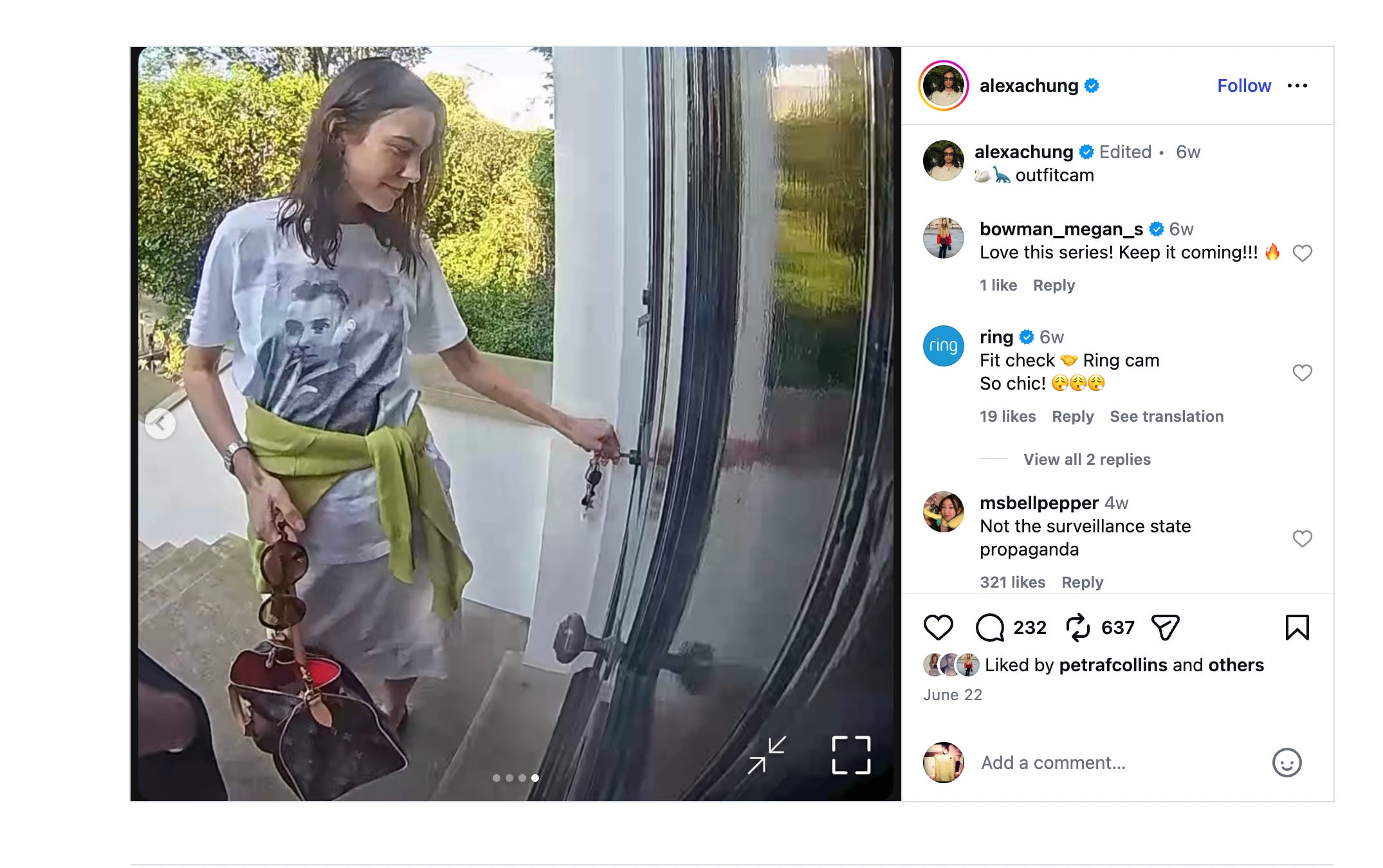
The viewers occupy two conflicted positions here, both mediated through camera-based technologies (ring cams and social media): invading the privacy of people who seem to be sharing it freely, while never quite knowing where they are or how much preparation went into these images. It’s a playful strut between staging oneself for the camera and being caught in a passing moment, between performing and existing. This “surveillance aesthetics,” as it is also called, reflects the zeitgeist of this moment, in which images capture existence as a state of constant surveillance, where selective self-disclosure becomes a means of protecting privacy.
And yes, this element of CCTV Chic, or such conscious use of invasive photographic technologies, is nothing new. As early as 2014, Amalia Ulman declared that TMI is the only way to maintain privacy, and created a weekslong performance on Instagram based on extreme makeover TV shows. I wrote about it here. In 2016, K8 Hardy released the work Outfitumentary, documenting a decade of self-portraits that chronicled what she wore each day pre-Instagram. This diaristic and expanded self-portrait heralded the age of self-presentation on social media, in its DIY aesthetic perception, collage sensibility and coming-of-age drive. In 2020, Paolo Cirio used AI facial recognition to turn the institutional camera back on itself, using it to identify faces of police officers in protests and demonstrations in France, plastering their faces in the streets, and creating a massive collage of portraits he presented under the name Capture.
But whereas artists like Ulman, not to mention a generation of artists who responded to life online with online tools, critiqued institutional monitoring and turned social media and digital spaces into self-reflexive creative spaces, this latest stream of CCTV aesthetics adoption seems much more complicit.
Now, when corporations like Meta, Snap or Alphabet join forces with Ray-Ban or Gucci around wearable AI-assisted technology, they also re-define these items as a desirable commodity, specifically by employing a performative lo-fi look and establishing presence on influencers’ feeds on social media, be it the ring cam itself or what people wear in front of it. While Gen Z has been pushing toward authenticity, Meta opened a New York flagship store next to Prada and Louis Vuitton, and is seeking to take some cues from the fashion playbook. Surveillance aesthetics cuts deep into the hold that advanced visualization technology has over any dividing lines still remaining between private and public spaces, anonymity and identification, spontaneous proximity and the distance of surveillance cameras. We’ve reached the immersive phase of integration, in which we begin to think, hey, these glasses look kind of cool. And hey, can I also post a stylized self-portrait from my ring cam? Once the brands ingest and digest such creative experimentation — once they’ve become trends — global culture tends to brush away concerns about privacy, eroding visual norms even further.
While popular culture finds new registers to surrender itself to the surveillance apparatus, we should take note of those undercurrents that move in a different direction - further away toward objects, ideas and aesthetics that distance from slop. All of this cannot be divorced from other trends, namely, a return to analog technologies, the emergence of parties with no photography allowed, and a collective search for third places away from the presence of the interconnected camera, which feels invasive and punitive. The deeper we dive into wearable technology and AI at the tip of our noses, the deeper this search will become.
No posts
Comments
Nothing yet. Say the first thing.
Sign in to join the conversation.