
A PERSONAL DOXOGRAPHY
It was left to Plato’s philosophical heirs to decide what, from his suggestive, yet highly and intentionally ambiguous written corpus, to his unwritten ‘esoteric’ doctrines, constituted the essence of the master’s teachings. Had he have claimed an oracular authority, or Hebrew style “revelation”, it would have been relatively simple.
There were, after all, numerous prophets and oracles; those of Egypt, West Asia and indeed western and northern Europe, from the priesthoods of Memphis and Sais, to the druids and Germanic seers, from Iberian prophets, to the Persian magi, and even the distant Brahmins and sramanas who occasionally made their way westward. There were also the Greek oracles, such as the one at Delphi, which Socrates himself, or through a friend, consulted. But, as was known to the Vedic sages, the gods like to communicate in obscurities, and leave it to the divine in man, the rational part of the soul, to decipher and interpret. So, mirroring below what seemed to come from above, Plato obscured his wisdom in writing.
Along with the various interpretations of Plato, each legitimate given his own insistence on the inadvisability of taking his “dialogues’ literally, is that of his secretary, Philip of Opus, who arranged and published his last and unfinished dialogue, “Laws”. Of Philip’s position, Irish Platonist scholar John Dillon says –
“Philip, in the “Epinomis”, comes out unequivocally in support of the position that the supreme principle is a rational World-Soul immanent in the cosmos, and indeed that the study of astronomy (rather than dialectic) is the highest science, since one is in fact studying the motions of the divine mind”1
And that is what “philosophical” revelation is; the activity of the rational principle immanent in the human being. After all, we find ourselves in this condition; whatever it may be, it is not our conscious fabrication, at least, not in any sense that would compare to say, the making of a movie, a painting, farming machinery, or other implements. The principle of being, the World-Soul, manifests and rises into human form, and it is only with our self-consciousness that the world seems so irreconcilably fractured into selves, things, places, and times.
It was Kant that first (in the west at least) identified structures inherent to the mind, and bound up in the human condition, which account for what seems the given state of the world, the arrangement of the things we perceive in space and time. Going a step further, Arthur Schopenhauer showed that the very duality of the world and the self, of object and subject, is itself a form of perception, inherent in consciousness, and not an absolute constituent of reality, or Being-in-itself.
That perception of fracture, and of consequent alienation, has been, on personal level, the single greatest source of spiritual pain in my own life. The sense of being self-enclosed, removed from the world and others, unable to connect in any easy, or chemical-free way, and yet to possess as a memory from childhood, the natural sense of integration into the whole of the world. It has only been through philosophy, and in recent years, finding a true teacher, that any real sense of reconnection has been afforded me. It is from this place, struggling to approach reintegration with the world, and with humanity, from the hinterland of (undesired) isolation that I can say with a sense of authority, that empathy is not a weakness.
Empathy is not a weakness, but a natural, authentic characteristic, given before the often miasmic productions of the discursive and self-conscious human mind.
There is a rather ridiculous agenda, if no less harmful for that, to promote a decoupling of maybe the chief, or only virtue of globalised Abrahamic religion in it’s western guise, from that religion, in other words; taking the compassion part out of Christianity. It has been that way for a considerable time in ‘American’ Christianity (an oxymoron, given that Christianity is essentially a globalist creed)
But the effort is now being exported through the activities of noxious think-tanks and policy-influencing NGOs, funded by globalists and oligarchs, trading under a ‘traditional values” label. Apart from the simple fact that Christianity, no less than Judaism and Islam, could only be regarded as traditional, that is, native to the Semitic peoples of West Asia and Arabia, there is also the obscenity of trying to squeeze this ancient Abrahamic religion into the very modern, but also in it’s way descended from the Abrahamics, economic ideology of Randian-libertarianism. It seems that the globalists think lightly if at all of the fact that this mongrel ideology is a blend of the worst of both iterations. Then again, what else could we expect from a genocide-positive caste of tyrants? The very anathema to what is needed.
Western societies today, if a descent into civilizational collapse and bestial savagery is to be avoided, are in need of a rebalancing distribution of wealth and power- as a return to a more natural, healthier paradigm. Whether that occurs or not will not be the outcome of some teleological force or eschatological dialectic. It will be the result of present effort for present.
In any case, fundamentally I favour a cyclical view of change over a linear one. As Arthur Schopenhauer wrote -
“The genuine symbol of nature is universally and everywhere the circle, because it is the schema or form of recurrence; in fact, this is the most general form in nature. It is carried through in everything from the course of constellations down to the death and birth of organic beings. In this way alone, in the restless dream of time and content, a continued existence, i.e. nature, becomes possible”2
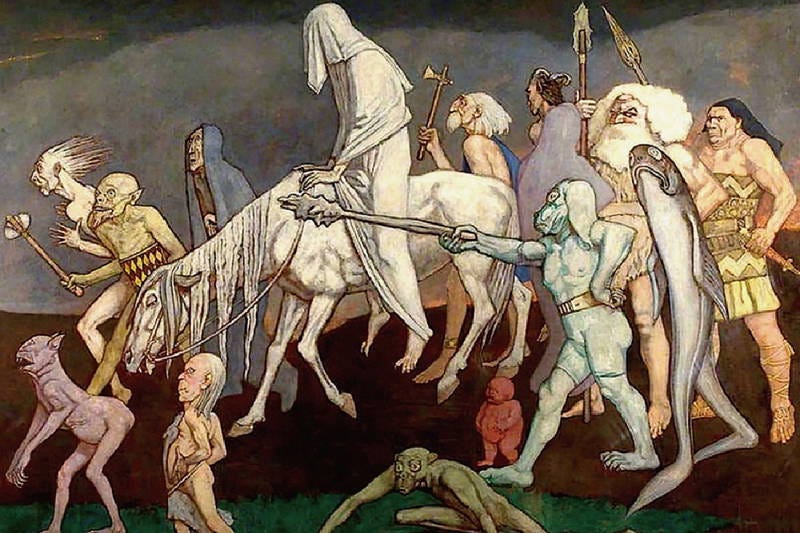
MEDBH’S ENCHANTMENT
‘Tarmac, and the tarnished quilt,
ash, and aching of the spine,
the world of ours, on passion built,
and fashioned, fake as faery wine
***
Light to eye, and firm to skin-
but only if there open lies
unseen, a porch to night within,
aware, it gropes to synthesise
***
And render thus a plain to sight,
unfurling stories, bred by need
with pain, a world of men and wights,
that lured to breed, tread war again”
Dillon, John, “The Roots of Platonism”
Schopenhauer, Arthur, “On the Suffering of the World”
No posts
Comments
Nothing yet. Say the first thing.
Sign in to join the conversation.