
In 2024, a new open-source repository typically took around 800 days to grow from 100 to 1,000 GitHub stars. By Q1 2026, the median time has dropped to 92 days, with a quarter of projects reaching that milestone in under two weeks.
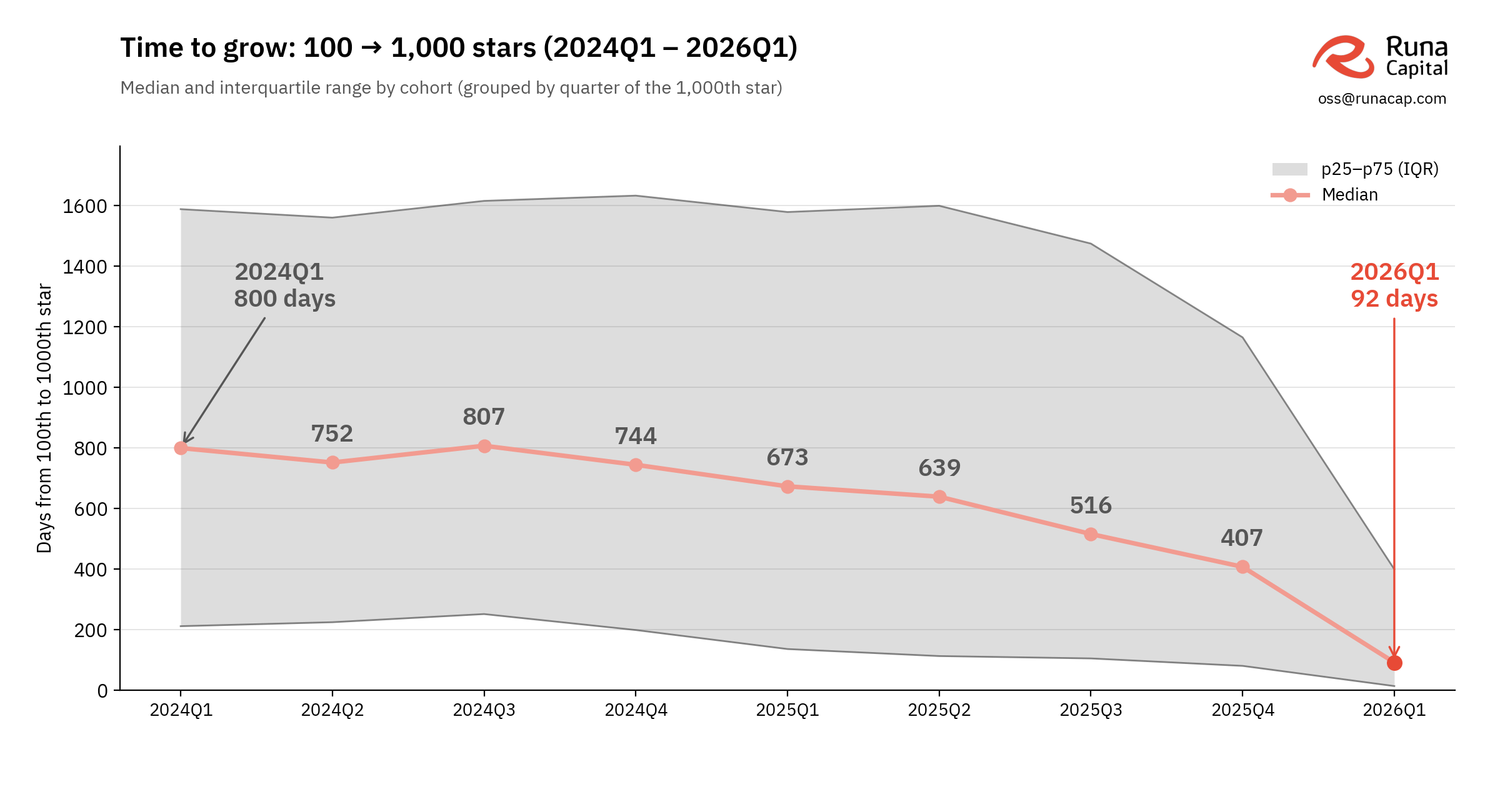
From 2020 through 2024, the curve barely moves. A flat line around 800 days. Then it bends, and in a single quarter falls off a cliff. If you’ve been joking about the Kurzweil singularity at dinner parties, well, here’s your chart.
This edition of the ROSS Index is different from previous ones. Before we get to the rankings, we want to walk through what changed, because the changes were big enough that we had to update our methodology to keep up.
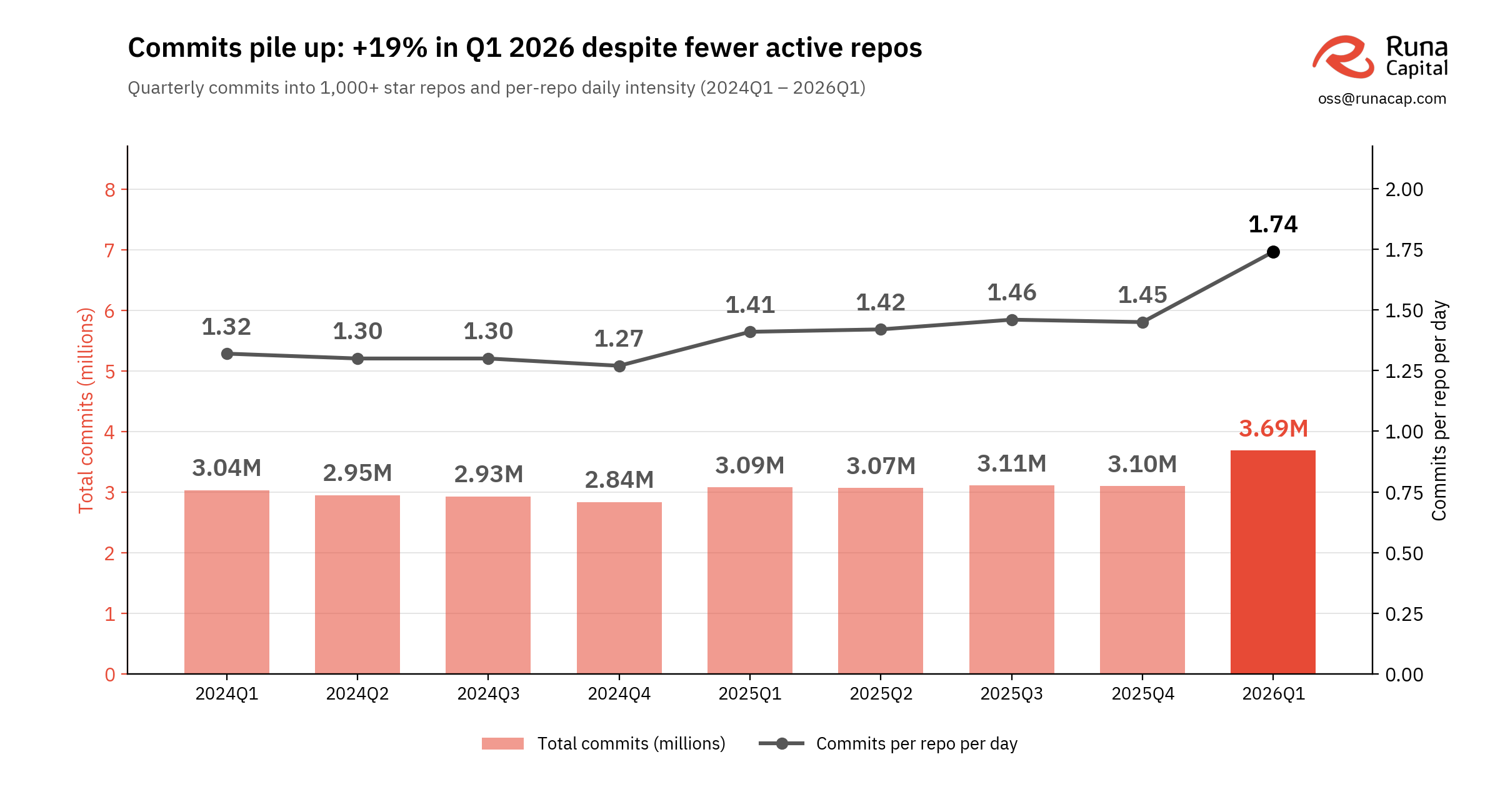
Code is shipping faster. Total commits into repos with 1,000+ stars jumped to 3.69 million in Q1 2026, up 19% from the 2025 plateau of ~3.1 million. The number of active repos barely changed. This is more code per project, not more projects. Commits per repo per day hit 1.74, up from 1.27–1.45 across 2024–2025. Two years of flat activity, then a spike.
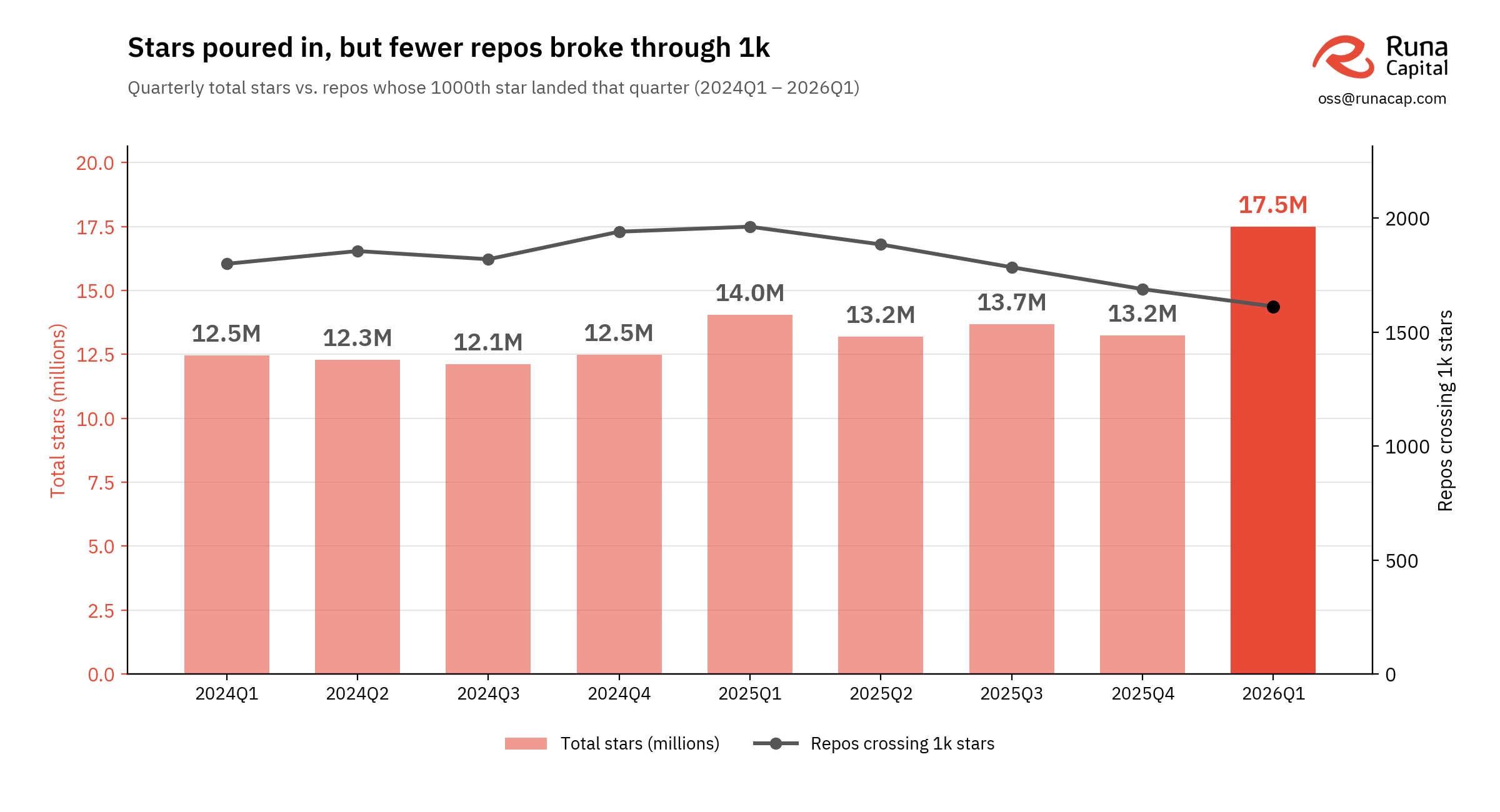
Stars tell a similar but stranger story. Total stars on repos with 1,000+ stars hit 17.5 million, up 25% from the 2025 average. New users starring repos jumped 31%, an all-time high.
But all that attention isn’t spreading across more projects. It’s concentrating. The number of repos crossing the 1,000-star mark declined for the fourth straight quarter. Fewer winners, each growing much faster. The ones that do break through reach 10,000 stars 10× faster than 2020–2024 cohorts.
This forced a rule change in the ROSS Index. We used to require 1,000 stars at the start of a quarter to be eligible, which made sense when getting there took years. Now repos can qualify even if they were created mid-quarter. We normalize their growth to a 90-day baseline so they’re comparable with established projects.
No project moved faster than OpenClaw.
Peter Steinberger built it as a weekend hack in November 2025: a personal AI agent you could text to actually do things on your behalf. It went viral in late January 2026, hit 100,000 stars in about two days, passed React (250,000 stars, a decade in the making) by March 3, and sits at 341.8K stars with 3.2 million active users by the end of March.
Those numbers are wild on their own, but what happened around OpenClaw matters more. “Claw” became a verb, a suffix, and a whole ecosystem. Within weeks, dozens of derivatives appeared: an ultra-minimal Python version from the University of Hong Kong (Nanobot, 37.1K stars), a Rust rewrite from Harvard/MIT students (ZeroClaw, 29.1K stars, a Go build for $10 embedded hardware (PicoClaw, 26.8K stars), a container-first security fork (NanoClaw, 26.0K stars), an enterprise reference stack from NVIDIA (NemoClaw, 17.8K stars), and a hardware-security-backed variant (IronClaw, 11.2K stars).
Projects built on the same principle (autonomous agents that act for you) took off alongside it: Agency Agents (66.5K stars), GSD (45.4K stars), Oh My OpenAgent (45.0K stars, 40.5x growth), Paperclip (41.1K stars).
All of these agentic systems run on the same structure: a powerful LLM, triggers that let it act on behalf of the user, and instructions that tell it what to do. That last piece is almost always just markdown files. A folder with a SKILL.md containing human-readable instructions, sometimes with small code snippets in Python or bash for running a specific task. Where you used to expect a Docker container, a pip package, or a full application to deploy, now it’s a markdown file with instructions and miniature scripts aimed at one specific job.
And people are building companies around collections of these files.
Among the fastest-growing repos this quarter, several are pure skill collections: Anthropic’s official skill repository (anthropics/skills, 106.6K stars, 40.7x growth), Garry Tan’s gstack (57.8K stars), a set of opinionated Claude Code skills from the CEO of Y Combinator, Composio’s Claude skill collection that doubles as their product’s growth engine (awesome-claude-skills, 49.5K stars, 32.7x growth), and VoltAgent’s curated directory of 5,400+ OpenClaw skills (awesome-openclaw-skills, 43.2K stars).
SKILL.md is one of the new formats for sharing knowledge as code. It doesn’t replace traditional open-source projects with their Docker containers, Python packages, and compiled binaries. But it’s growing alongside them, fast. Source code packages a tool. Skill files package expertise: how to approach a task, what to watch out for, what scripts to run. The wrapper is a markdown file instead of a repository full of source.
Starting with this edition, the ROSS Index recognizes skill-only repositories as eligible.
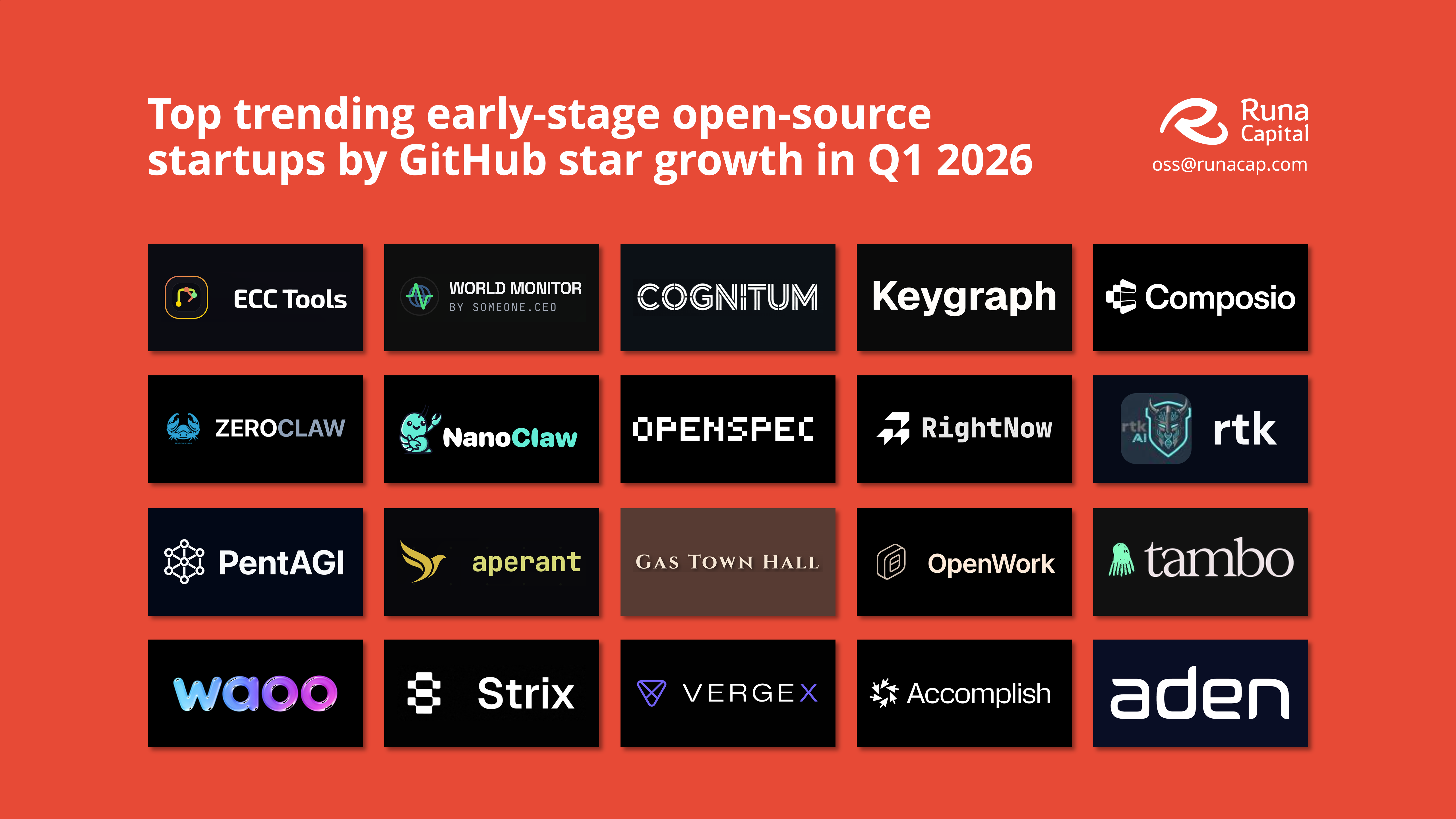
With the updated methodology (new repos eligible mid-quarter, skill-only repositories included), here is the Q1 2026 ROSS Index — top 10:
🇺🇸 ECC Tools (affaan-m/everything-claude-code 119.8K stars, 119.8x growth) is an agent harness system with skills, agents, and security scanning. Founded in 2026 in San Francisco.
🇦🇪 World Monitor (koala73/worldmonitor 45.5K stars, 45.5x growth) is a real-time global intelligence dashboard with AI-powered news aggregation and geopolitical monitoring. Founded in 2026 in Abu Dhabi.
🇨🇦 Cognitum (ruvnet/RuView 44.7K stars, 41.3x growth) builds RuView, a WiFi DensePose system that turns commodity WiFi signals into real-time human pose estimation without video. Founded in 2026 in Toronto.
🇺🇸 Keygraph (KeygraphHQ/shannon 34.9K stars, 33.5x growth) builds Shannon, an autonomous AI pentester for web apps and APIs. Founded in 2024 in San Francisco. Raised an undisclosed amount from Depth, Urban Innovation.
🇺🇸 Composio (ComposioHQ/awesome-claude-skills 49.5K stars, 32.7x growth) builds tools for AI agents; published awesome-claude-skills, a curated Claude Skills collection. Founded in 2023 in San Francisco. Raised $29M from Lightspeed, Elevation, Together, SV Angel, Blitzscaling, Operator.
🇺🇸 ZeroClaw Labs (zeroclaw-labs/zeroclaw 29.1K stars, 29.1x growth) is a private AI personal assistant that runs on-device and connects to 20+ messaging apps. Founded in 2026 in Cambridge, MA.
🇮🇱 NanoCo (qwibitai/nanoclaw 26.0K stars, 26.0x growth) builds NanoClaw, a lightweight personal AI agent running in containers, connecting to messaging apps. Founded in 2026 in Tel Aviv.
🇦🇺 OpenSpec (Fission-AI/OpenSpec 35.7K stars, 18.5x growth) is a spec-driven development framework for AI coding assistants. Founded in 2025 in Sydney. Raised an undisclosed amount from Y Combinator.
🇯🇴 RightNow AI (RightNow-AI/openfang 15.9K stars, 15.9x growth) builds OpenFang, an open-source agent operating system. Founded in 2025 in Amman.
🇫🇷 rtk (rtk-ai/rtk 15.7K stars, 15.7x growth) is a CLI proxy that reduces LLM token consumption on common dev commands. Founded in 2026 in Lyon.
The full top-20 list and detailed methodology are available at https://runacap.com/ross-index/q1-2026/
Comments
Nothing yet. Say the first thing.
Sign in to join the conversation.