
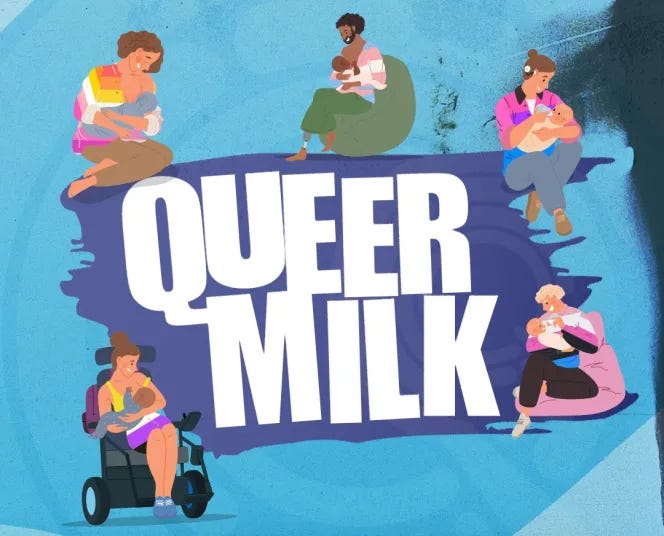
Every now and then I come across a story that makes me instantly recoil. And so it was when I read about a charity that helps biological men ‘chest feed’ their babies.
Funded by the Scottish government, LGBT Health and Wellbeing holds weekly sessions to support those giving human milk to babies, no matter what their ‘feeding journey looks like’.
My stomach turned over as I read about the drugs needed to promote ‘lactation’, but I’ve learned over the years to be a bit wary of completely trusting gut instinct, because sometimes disgust can be triggered by the unfamiliar, or simple ignorance, or misplaced moral outrage.
So whenever I feel that visceral reaction, I try to pause and work out exactly what my conscience is trying to tell me.
I’m a “live and let live” kind of person. I wish only kindness for others, (mostly, there are exceptions - mainly child abusers), especially those struggling with identity issues. As an adopter, I know how painful that struggle can be. But I get uncomfortable when the rights of one group begin to erase the rights of another, especially when those, like rights for women and children, have been hard fought for, over centuries.
At first, I wondered whether my reaction was about the artificial production of milk. But I remember reading years ago that a small number of adoptive mothers take medication to induce lactation as a way of bonding with their babies, and that didn’t trigger the same stomach churning reaction in me.
Although since then I’ve read that there has been very little research done on whether the drugs given to induce lactation reach the baby, and what the impact might be on their health if it does. That seems like more than enough reason to be concerned about ‘chestfeeding’.
And then there’s the attempt to write mothers out of the story of what the female body can do. In the UK, reforms to make intended surrogate parents official right from birth have been proposed, an attempt to airbrush mothers off the birth record entirely, not for any benefit for the child, but to spare adult feelings, and the inconvenience of extra paperwork.
But it was she who carried the baby. It was she who gave birth. However uncomfortable or unwelcome the facts, she is the first mother.
A legal ‘add-on’ further down the line to encompass a new family, as happens in adoption, makes room for a new story, but rewriting the history of how a child entered the world by falsifying their origin story, just to satisfy adult desires, seems wrong.
It’s not like we haven’t done this kind of thing before, and seen the consequences. For decades, society thought it was okay to erase the truth of adoption, shipping children across borders, or hiding their origins from them completely.
Ask any adult who discovered late in life that they were adopted, and they’ll tell you that tampering with the truth of their beginning rocked them to their core, so much so that they found it difficult to trust anyone again, even those closest to them.
As an adopter, I’ve had to accept uncomfortable truths - the question my 14-year-old daughter ponders often is “Who gave birth to me?”, not “Who is my legal parent for administrative purposes?” For a child exploring their identity, those are two very different questions, and only one is something they care deeply about.
The erasure of biological women is spreading throughout society, with even the NHS embracing language like “birthing parent’ instead of ‘mother’, and ‘chestfeeding’ instead of ‘breastfeeding’.
I was fascinated to read recently in Milli Hill’s The Body Myth, that breastmilk is an extraordinary, evolving substance, the composition of it changing in response to a baby’s biological needs.
Breastfeeding involves big effort for a tiny baby. Expecting them to work hard at the ‘chest’ for an insufficient amount of a drug-induced liquid, doesn’t seem to be prioritising their needs over the adults.
And you don’t need to breastfeed to bond with a baby. Millions of mothers in the UK go straight to the option of using formula milk.
I haven’t breastfed the babies I’ve fostered, but I would still walk through fire to protect them. I’ve learned, over twenty years of fostering, that deep and lasting love for a child can grow whether you gave birth to them or not, and whether you fed them from your body or not.
I think the biggest concern is the fact that a baby cannot consent to any of this. They can’t weigh the benefits of ‘chestfeeding’ against the risks of ingesting drugs that were never intended for a baby, and so if there is even the slightest doubt, surely we should always opt to do no harm.
A baby fed on experimental, hormone induced ‘milk’ will eventually grow up, and then they might start asking some difficult questions about why those who should have prioritised their needs above all else, were willing to take a risk, however small, with their physical and emotional health.
Many of the children I look after have parents who aren’t able to prioritise their child’s needs over their own. When society nods along and allows adults to fulfil or validate their own needs, it’s children who pay the price.
What are your thoughts? As technology improves exponentially and pushes the boundaries of what is medically possibly, these ethical dilemmas are set to explode. I’m all for using technology to ease human suffering, but should it be used to validate and affirm adult desires over and above the rights and dignity of the child? Where should we draw the line? I’d love to hear your perspectives in the comments.
Comments
Nothing yet. Say the first thing.
Sign in to join the conversation.