
Hi there,
I’m going to try something new and just tell you about my month, and maybe share some interesting tools for the writers who read these updates (there are a ton of you!). I opened the brewing outlines for research-and-commentary type newsletters I have cooking1 and just felt so exhausted at the thought of reading everything that’s happened, updating information from the month or so since the outlines were generated. Almost everyone I’ve talked to lately is suffering from something beyond “news fatigue”—a term too quaint to describe the pervasive aura of guilt, paralysis and avoidance that now feels both endemic and shameful—and we’re all living in the chronic discomfort of this loud silence.
Maybe people are talking about it on social media, where I’m not anymore. Maybe there are a thousand beautiful infographics about why you should feel bad about numbing out from the news and a thousand more about why you shouldn’t feel bad about anything, ever. But I, friends, am living free from infographics and largely free from discourse2 in general. And yet, the guilt, paralysis and avoidance do persist. Maybe scrolling is the silent scream at the other end of the loud silence.
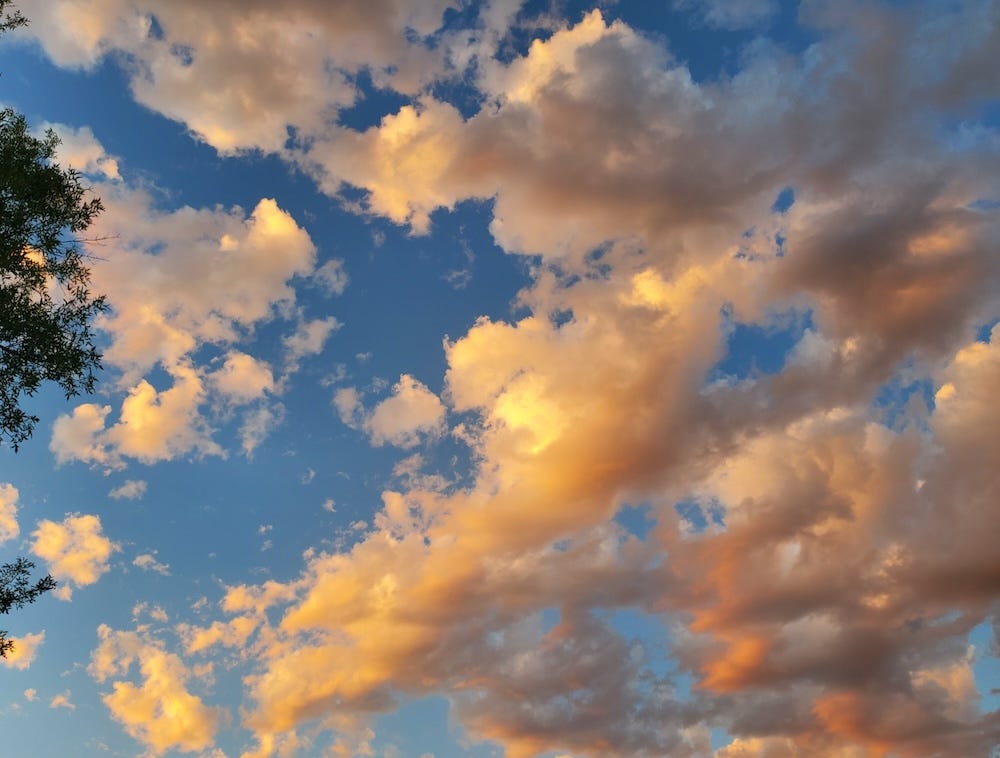
I’m not here to add to the chorus of “what are we supposed to be doing right now” essays (mostly because I don’t think that there is a particular solution set that can be applied wholesale during the deep, un-graspable instability of multi-systemic collapse), but I can tell you what I’ve been trying to do and how it’s working. I can also share some of the sort of life updates that I miss placing cryptically on Instagram (mostly clouds, I’ve been looking at a lot of clouds and cool old papers and cats). So here’s a speed run of that. If you’re here for something else…well, shoot, that’ll probably be back soon as I continue to re-imagine this particular digital public notepad.
Some of you3 helped me to attend a really wonderful writing workshop in August, and I would love to thank you again for that assistance. I was able to work for a week with Deborah Miranda (a huge deal for me because reading her memoir Bad Indians basically broke open my idea of what a multi-generational sprawling family-and-more-than-family memoir could be) and have great conversations with other incredible writers I admire. This was the first time I attended this workshop (or any like it, outside of school), and also the first time that Elk River Writers Workshop hosted an all-Indigenous faculty for workshops, panels, and performances. This was the first time I had been in a space where Native people set the tone and led the space for an entire day, let alone a whole week. That leadership allowed for many special things to happen and I felt honored to be invited in to participate alongside in such a space.
I received the permission I think I’ve been needing to dive in to the messy stories of my ancestors’ (direct lineage and broader cultural inheritance, alike) impact on this place and its people. Debra Magpie Earling told me, in response to a stumbling question about my limited perspective, “Just tell it raw, the way it is. Open honesty is the apology.” This reinforced my working theory that the best way to write a topic that you fear you’ll get wrong is to write your fear into the narrative, to name it and investigate it and, of course, to do your due diligence and tell it the very best you can based on the best sources you can find. And, crucially, to stop and point readers in a more qualified direction when you know you’re in the really deep water.
Writing about place so much—it’s really, I realize after thinking about it for a few years, the only thing I write about—has enriched my awareness of my attunement to the landscapes I know best. One of these is Central Montana. It’s where the line of my family I’m writing about now came in the 1800s and where I’ve traveled to connect to their story these past years. I love to visit, but I don’t think I could live there. It’s almost too beautiful. Visiting this time and befriending people who came from all across the country to write together put the beauty and special way of being that’s possible here into perspective.
The places I grew up hiking and driving around and the places I explore now are close cousins to this ecosystem. I take for granted that I know some of the plants and animals and what to expect from the clouds and light. On a hike with some of the people I met, another Northwest local (whose ancestors settled in the same valley as my own) and I pointed out ripe, delicious thimbleberries all along the trail to our waterfall destination. Then there were chokecherries. Less sweet, but edible and unique. Too late for wild strawberries, huckleberries sparse and not yet ready. I kept an eye out for mushrooms, but saw few. Rattling off the possible menu to my hiking partners, who were impressed at how much we two knew, made me feel good, reminded me that I have a real connection to these landscapes—the seeds of a deeper relationship.
Even though the news leaking into our idyllic week was particularly upsetting (the deployment of National Guard and checkpoints across Washington D.C., where one of my fellow students prepared to return at the end of the week), I felt grounded. My culture of origin, emerging from the (to us) invisible structures of whiteness, is obsessed with management, urgency, and certainty, and this leads well-meaning people horrified by the ever more visible fascistic elements of our (yes, our) culture to seek the One Correct Response or, sometimes, a savior figure. Maybe what felt grounding was being in an atmosphere where the louder and more elevated voices didn’t hand-wring or panic, but talked instead about relationships, care, and continuity. Not make this stop so we can return to Normal, but what do we build/maintain together that can withstand horrors and last to the other side?

My Montana trip fell in the center of a monthlong residency in an environment starkly opposite to that waterfall hike, of one of the concrete cubes of The Hive at Spokane Public Library. In its own way, the blank slate of that space gave me an opportunity to lay out everything I had and visualize the stories I’ve been trying to tell in my (slow) book project for the past few years. I literally laid some of it out in the form of printed pages from my scanned family documents and historical photos I’ve been leaning on for inspiration and found it heartening and interesting to observe what people—fellow artists-in-residence, library workers, and passersby (especially the line of children and parents adorably having their school photos taken one day in the adjacent studio)—had to say or ask about the low-key collage on display.
I dove in to the archives at the Inland Northwest Special Collections, first to search out some examples of ephemera to share with my workshop participants, but also for my own research purposes. I found myself in folders of old recruitment materials from Spokane’s heyday, copy of the “come out and live in a technologically advanced heaven on earth!” variety that, frankly, hasn’t disappeared today as much as mutated.4 These boasted incredible fonts, nostalgic images of neighborhoods where I’d live a century later, and raw, primary examples of the mentality of the era’s dominant culture. Descriptors of “a people at work building in the richest empire in our country, an empire passing the pioneer days and beginning the swing toward the richness of full development…” illustrate that industrial culture of extraction at work better than a historian might summarize.
Thumbing through these folders sort of at random, whether in person or in another library’s digital collection, has made up the most useful portion of my intensive research on the times and places where I’m focused. It’s a “vibes” sort of research, which I can’t recommend enough to anyone writing historical fiction (any fiction that doesn’t take place in your exact time and place, really, and even speculative work can benefit from thinking through what kind of forms culture perpetuates and normalizes) or non-fiction. Poets sure to enjoy a thrilling afternoon, too.
I had concerns about the workshop that I’d pitched many months before my stint at The Hive. Partially because I had never offered something like it before and partially because I didn’t know if some of the “vibes-based” or imaginative ways that I’ve been engaging with artifacts from the past in my work would resonate with other writers. But the first workshop put me at ease because people seemed to really get into the process, choosing an object (mostly photographs, some ephemera) from the items I’d pulled or engaging with something brought from their own lives, being open to conjuring characters, events, and details from the very limited material within the frame. I had fun and remembered that I do enjoy some kinds of teaching, especially learning in community outside of formal institutions. Also, because I needed to make many examples of “artifacts” generated from writing back into object for the second half, I made myself let loose a bit in terms of just making shit without judgment.
Would any folks here be interested in doing a virtual version of a generative workshop like this? Or a different sort of virtual-communal writing space? Message me! I’d like to gauge if there’s enough interest to get something going. I’m also happy to share some of the prompts and exercises we did if you want to experiment on your own.
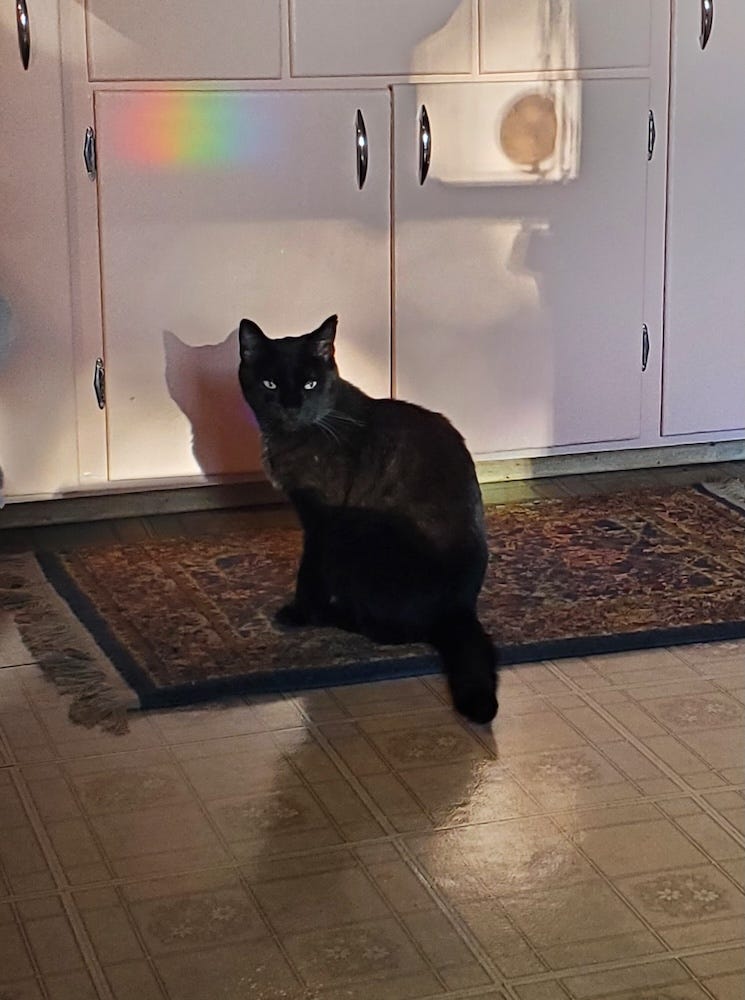
The main takeaway from this month and a half of travel and, yes, lovely experiences and new people? I WANT TO STAY HOME. Good lord.
All I’m longing for now is just a boring, predictable routine. And practice incorporating creative practice in among the dishes and watering schedule and home renovations5 and response to the news and being in love and cultivating community and making my cat like me again, so that he will stop pissing on things.
How is your routine? Do you have “balance”? Should I keep applying to a million things in remembrance of the fact that I also go mad if I’m cooped up at home in my little routine for too long? Honestly, weigh in if you have thoughts and advice because this is something I’m trying to get serious about this year without devolving into a self-optimization spiral (doomed to fail).
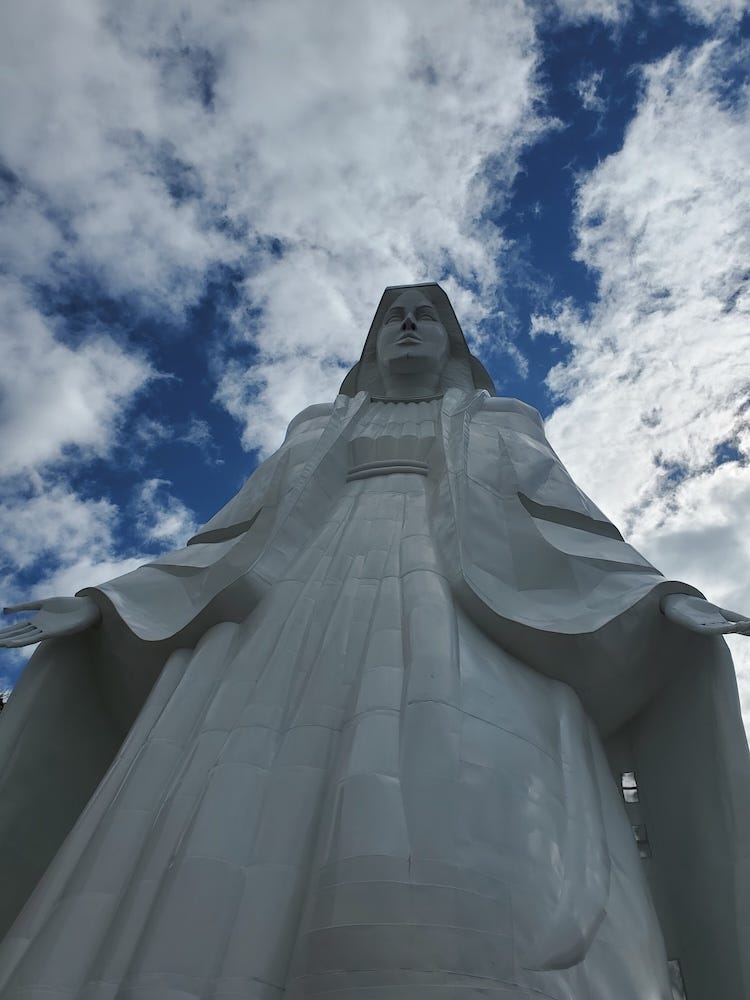
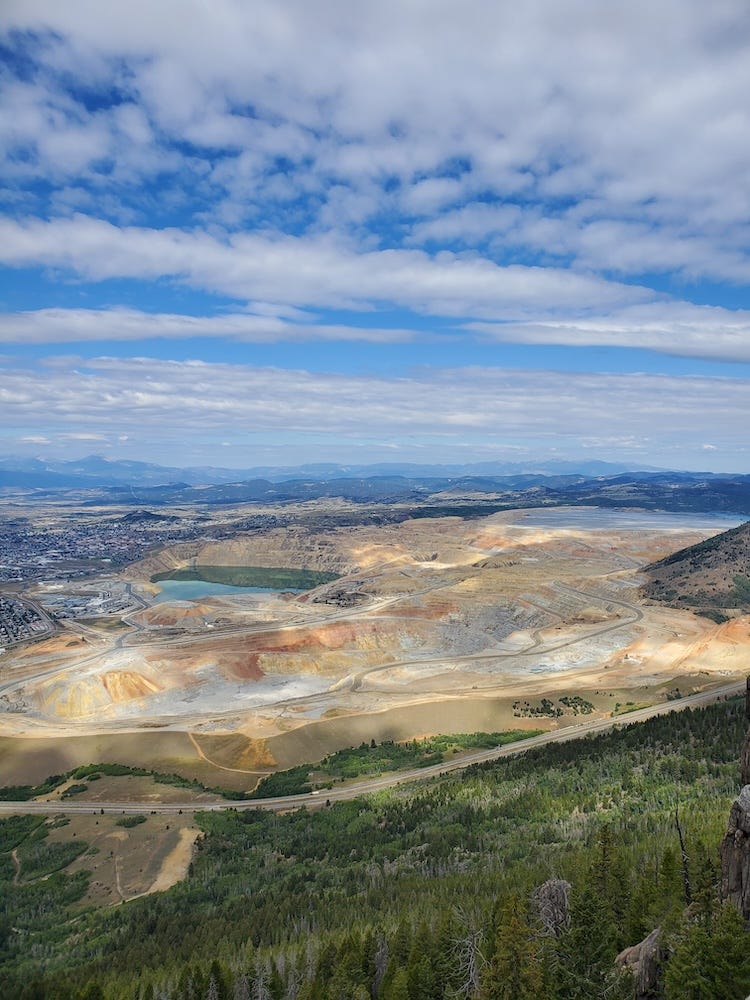
On a final note, because I don’t have an Instagram to post this to, I finally made it to a Montana bucket list location of mine: Our Lady of the Rockies. She is truly as weird, wild, and oddly moving as I thought she would be when I first learned that one of the largest statues in the United States was on top of the Continental Divide, at the top of a road accessible only by hikers or paying tourists who’ll brave a sketchy ride in a fifteen passenger van (I was in the latter group), overlooking the one and only Butte, Montana and its famous, distressing, eerily beautiful (?) open pit mine. Worth the $28 ticket that was never checked for. “Just pile in that van, young lady.”
Thanks, as always, for reading my long little letters. Sending love, creative discipline/freedom and moments of domestic relaxation to you all,
TRW
Yes, still the one I keep teasing about social media and AI slop and the compulsion to look at/away from AND another about Andor, because I’m late to the party, but very much at the party and I have very specific thoughts about Kleya and communications and surveillance and I hope some of you are nerds because I’m probably going to spend way too much time on that one.
Credit to Margaret Killjoy for planting a new version of Dune’s Litany Against Fear, “Discourse is the mind-killer/ Discourse is the little-death that brings total obliteration…” in my mind, probably on an episode of Cool People Who Did Cool Stuff, but I honestly don’t remember where, sorry. Murmuring this to myself actually helps me talk about this problem in my own mind, to my friends, and to you, here, right now.
If you’re a paying subscriber, that also means you. <3
I’m so petty, but I still think about this awful campaign from years ago that the city of Spokane poured half a million of public funds into, lol.
Mentioning home renovations made me want to share the latest episode of In Bed With The Right’s latest installment of their Project 1933 series, which focused on the way that summer doldrums and the normal demands of life slotted in alongside the rise of Nazi terror in Germany in another August in Germany.
Comments
Nothing yet. Say the first thing.
Sign in to join the conversation.