
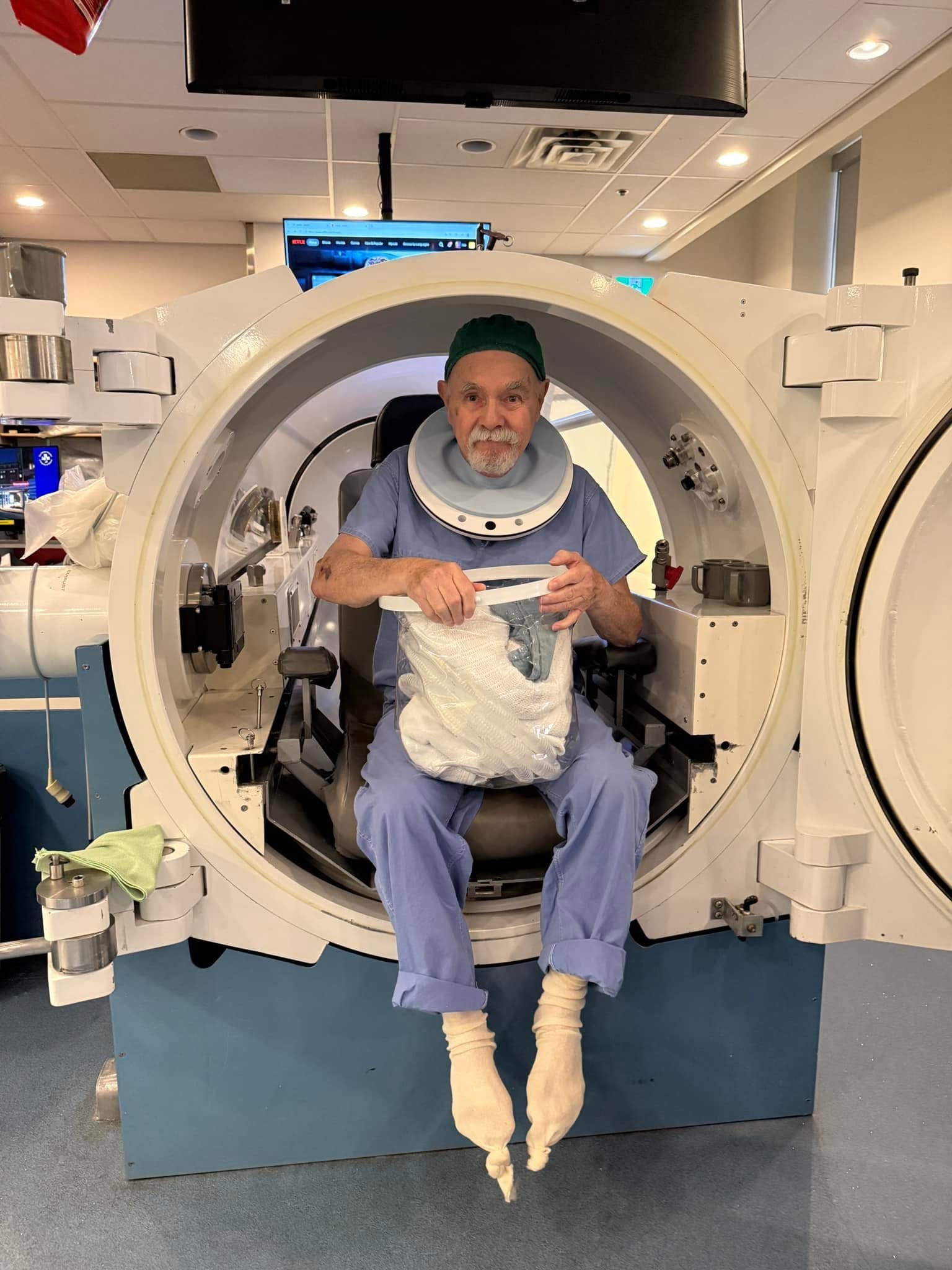
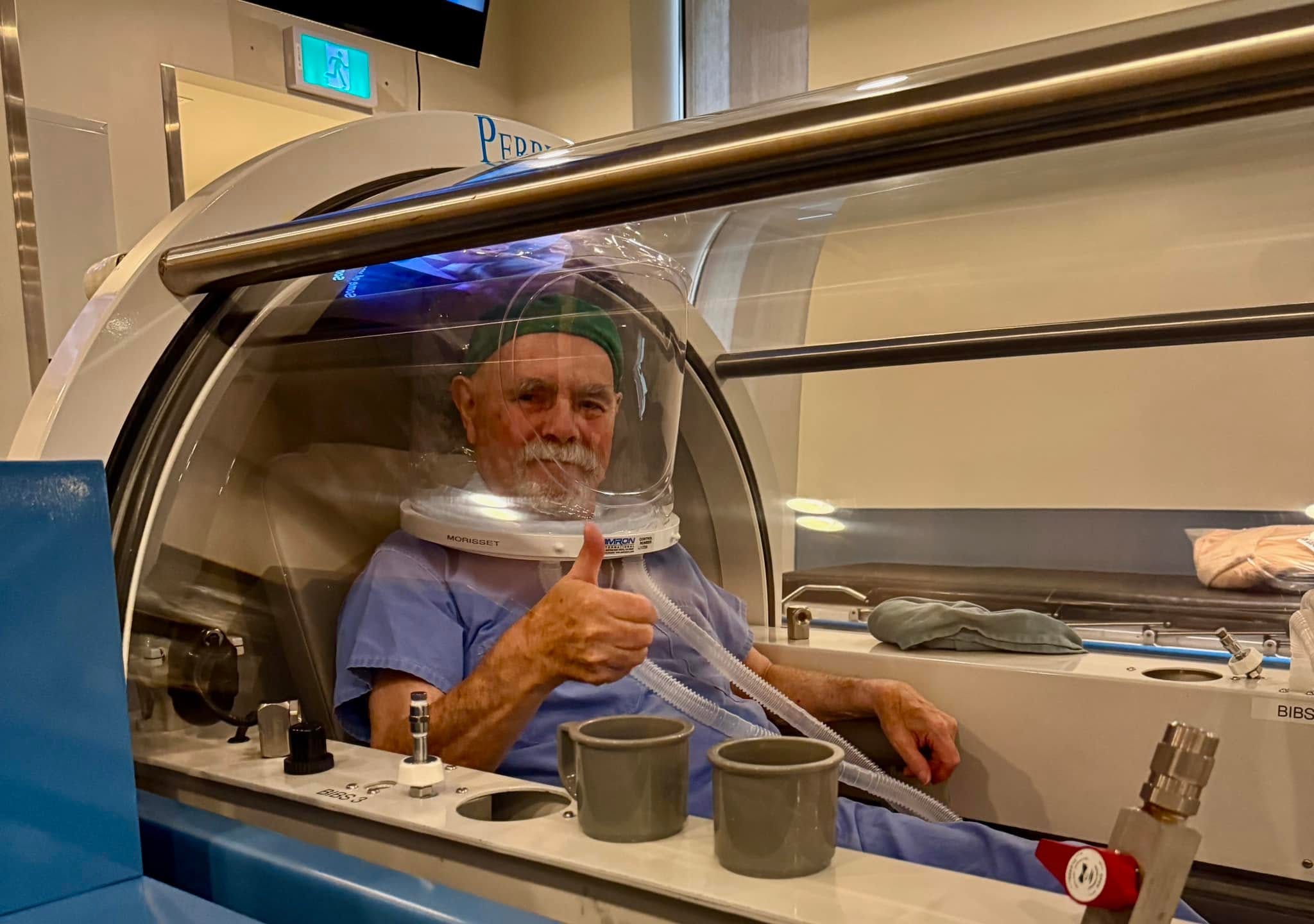
When Scott was in the Ottawa Hospital Rehabilitation Centre, his old friend Paul Morisset stopped by after his regular visit for a hyperbaric oxygen therapy session (HOBT).
Paul had been receiving HBOT since the spring to treat bleeding caused by the radiation used to treat his colorectal cancer. After 20 plus treatments, the bleeding stopped. He’d heard that some ALS patients are being treated with HOBT, and while the research is in the early stages, Paul told Scott that it does show promise.
HBOT involves breathing 100 percent oxygen under increased air pressure to support healing and complement other treatments like surgery and antibiotics.
Paul said he was amazed at the healing power of HBOT, which is now used across the world to treat everything from PTSD to knee and skin issues. In Paul’s case, it was used to help to heal the bleeding that seemed impossible to stop.
According to Paul, HBOT is the unsung hero of the Ottawa Hospital. Patients have difficulty getting treatment, often waiting months for an appointment. Part of the reason is that OHIP only pays for 14 specific indications like carbon monoxide poisoning, decompression sickness, severe non-healing diabetic and radiation wounds, and acute crush injuries. Yet, in other countries, like Israel, more than 200 patients a day use the service for myriad conditions including soldiers and citizens traumatized by war.
The good news, I suppose, is that HBOT is available on your own dime in Ottawa though it can cost between $150 to $400 per session.
Paul wonders why the HBOT isn’t offered to more patients who are eligible, and says the new Ottawa Civic Hospital doesn’t appear to be including the therapy in its new build. He warns that not all doctors are onboard with the treatment. Even his own radiologist thought it was a bad idea. I pointed out that specialists are sometimes best to stay to their own lane especially when dealing with patients who are seriously ill, and have little to lose.
If you think HBOT might benefit you or a loved one, the process is simple with a referral from a physician. More information is available here.
Conditions Treated by HBOT:
Acute & Emergency
Air or Gas Embolism: Bubbles blocking the bloodstream.
Carbon Monoxide Poisoning: Smoke or exhaust inhalation, including cyanide poisoning.
Decompression Sickness: Often known as “the bends” from diving.
Gas Gangrene: Clostridial myositis and myonecrosis.
Crush Injuries & Compartment Syndrome: Acute traumatic ischemia.
Necrotizing Soft Tissue Infections: Severe “flesh-eating” bacterial infections.
Exceptional Blood Loss: Severe anemia where blood transfusions are impossible. [
Chronic, Delayed & Recovery Indications
Severe Non-Healing Wounds: Specifically diabetic foot ulcers that fail to heal with standard care.
Delayed Radiation Injury: Damage to tissues, bone (osteoradionecrosis), or organs following cancer radiation therapy.
Compromised Skin Grafts & Flaps: Grafting areas failing due to poor blood flow.
Refractory Osteomyelitis: Chronic bone infections that do not respond to standard antibiotics.
Intracranial Abscess: Severe infections in the brain.
Idiopathic Sudden Sensorineural Hearing Loss: Sudden, unexplained hearing loss.
Thermal Burns: Severe, acute heat or fire burns.
Paul wanted to spread the word so more patients were aware of this important treatment.
No posts
Comments
Nothing yet. Say the first thing.
Sign in to join the conversation.