
Two summers ago I wrote about a book called The Fire and the Rose are One by Benedictine monk Dom Sebastian Moore. I wrote it when I was just out of the psychiatric ward, having had what the Italian doctors called ‘un episodio affettivo di tipo misto con caratteristiche psicotiche’—not what you want to hear. Reading that “essay” back, their diagnosis makes more sense. It’s mostly nonsense and riddled with spelling mistakes (which I attribute to a dose of delorazepam which would never have been prescribed in the Anglosphere.) Beneath those superficial elements, its logic bears the stamp of a mind in mania: associative, fiercely convinced of its own truth and importance, the hands trying to keep pace with a series of mental breakthroughs occurring faster than they can be recorded.
I can’t remember what that state felt like back then, can’t remember writing that piece (again, fault of the benzos), but I do remember how it was a few weeks ago, when I sat in the airport in Geneva and wrote 6,000 words on Jung and magic.1 I arrived in London that evening full of rage, the creative flight having tipped into its shadow side where mind’s energy is waning but the ideas are still coming and you can’t quite get a handle on them anymore; they come three at once and then disappear before you can even sketch their outlines in your Notes app. Irritation itches at the skin and the body, as if animated by a possessing spirit, seethes and, restless, looks for a fight.
Oddly, that line—the fire and the rose are one—had recently recurred. I read it in a book called Owning Your Own Shadow by Jungian psychologist Robert A. Johnson. I’d felt drawn to this book, and another titled Ecstasy by the same author, on the secondhand shelves at Treadwell’s, where I’d gone to pursue some esoteric threads that had been suggesting themselves. My approach to reading always tends towards the providential—I think books, authors or subjects suggest themselves to you when you’re ready to receive them—but in these periods the whole thing gets amped up and I feel like I’m being actively guided along a pre-ordained intellectual path. Each idea slots into place as if divinely revealed. Ideas develop at breakneck speed until I reach the state of physical exhaustion that I hit the night I returned to London. Before then, I was reading several books a day, writing thousands of words, filling my notebook with ten pages at a time, waking each day excited to see the various threads fused together as sense appeared out of the signs and messages I’d been receiving.
When I read that phrase, I underlined it and put an exclamation mark in the margin. I knew that I was reading the right book.
Now, I’ve spent a week resting in Wales and the pace has slowed. I no longer feel like entities of unclear allegiance are guiding me through a period of initiation. The analytic muscle is able to work again to supplement what is understood by intuition. I can ask ‘what is the evidence for this?’ and can bring to bear the skills of a historian, who is always sceptical and prefers to admit ignorance than make grand, sweeping judgements. Those two elements of my intellect are, I think, important counterweights. I’ve had periods of suppressing the intuitive sense of understanding, going only by what I can understand through reason just as I’ve periods of suspending reason altogether and going on a joyous flight of intuition. Neither extreme allows me to work at my best. Even in this calmer state, I can’t bring myself to write off the realisations that came to me in those few weeks of heightened intensity. I do believe, even on rational grounds, that God and whoever else speaks more easily during altered states—through dreams in sleep or visions in madness, when the mind’s defences are down and the subject is more willing to hear what is being said.
‘The fire and the rose are one’ is the last line of T.S. Eliot’s Little Gidding, the last in the series of poems collected as the Four Quartets. These are among my favourite poems in the world. I took that collection on my walk to Iona, reading it by firelight as I camped through the Highlands. The phrase indicates the union of two aspects of the spiritual path: desolation and consolation, affliction and grace, purgation and love. So tightly woven are these poles that neither can exist without the other, but the duality has to remain. They have to be experienced as if they were isolates even though they aren’t.
In Owning Your Own Shadow, Johnson uses the phrase in reference to the communication between the ego and the shadow and specifically in reference to the mandorla, an almond shape that can be understood as the overlapping segment in a Venn diagram. Christ and Mary are frequently depicted within this shape in medieval art, which for Johnson coheres with their roles as mediators between the otherwise dirempt parts of the soul or of human life. He writes: ‘the mandorla binds together that which was torn apart and made unwhole—unholy. It is the most profound religious experience we can have in life.’ The shape of the mandorla is also associated with Christ’s side wound, one of the Five Holy Wounds of medieval devotion, and with Mary as the gate through which Jesus entered the world. There’s a rich symbolic register here:
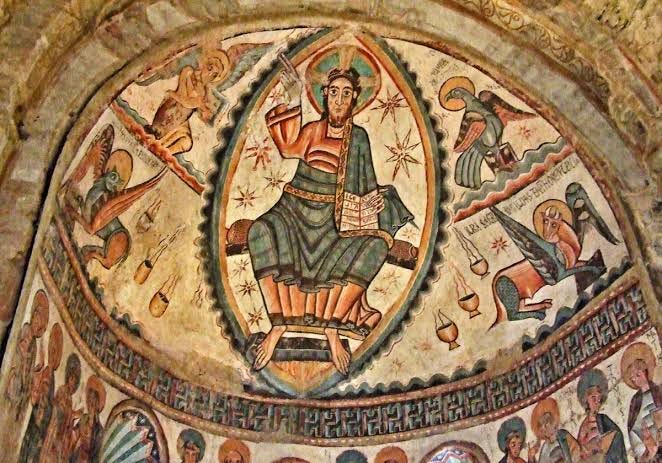
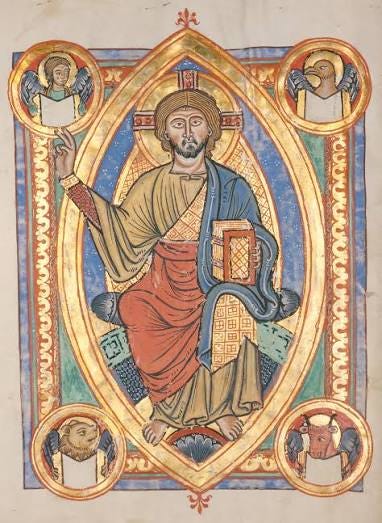
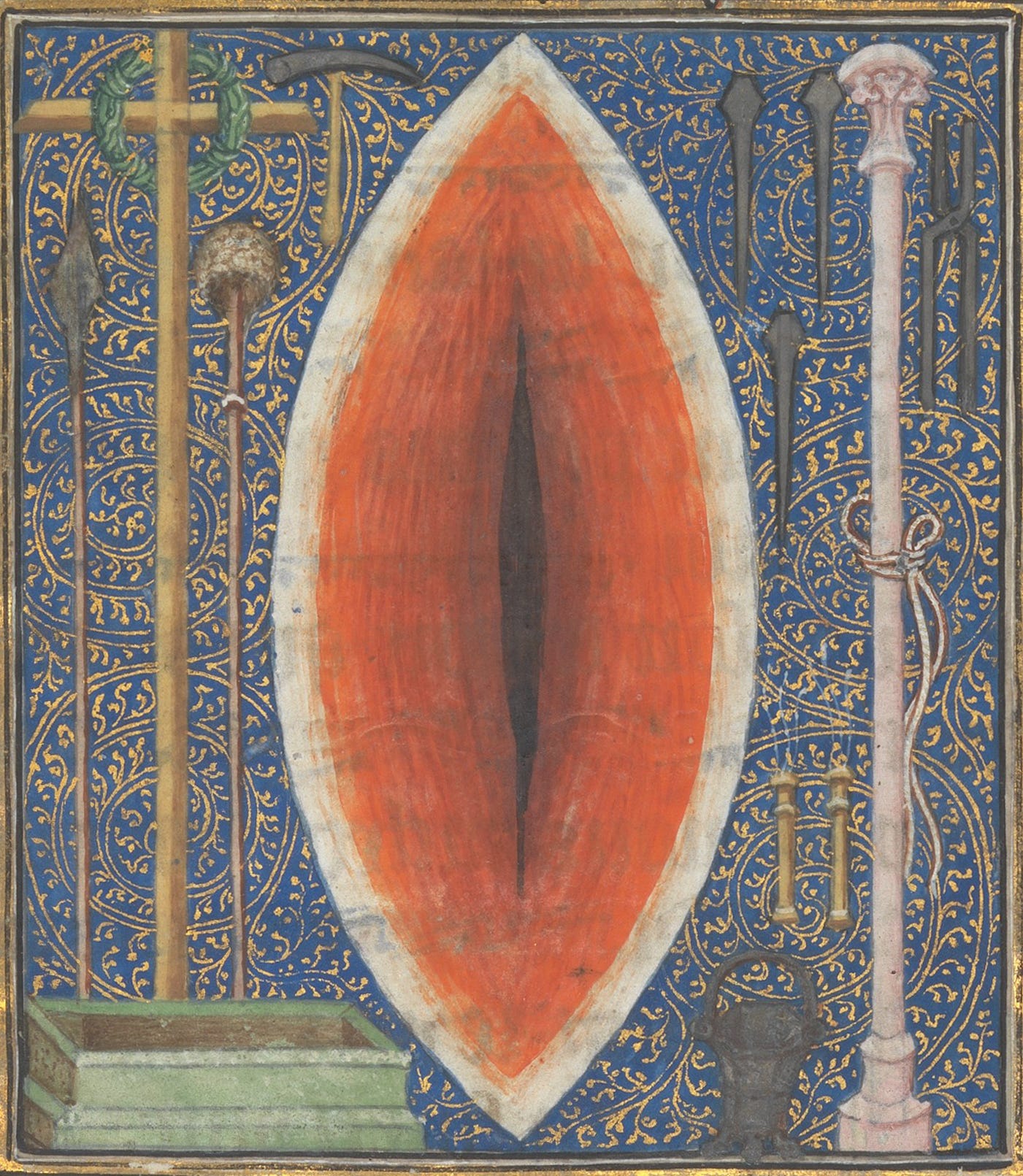

Jungian psychology is fertile ground for the manic mind which naturally thinks in archetypes and correspondences. It’s also exactly what I needed to encounter at this point in my life (I have a vague suspicion that these episodes are given to me when I’ve been stuck for too long and need to be shoved by force into a new way of thinking.) For a long time, I’ve lurched violently between extremes of overcontrol and undercontrol. I’ve become intensely religious, withdrawn, restrictive in appetites and then swung to the other pole of extravagance, excess, lust, irresponsibility and intoxication. My attempts to find somewhere to live in the middle have only created tension and a feeling of intense overexertion.
Johnson explains that ‘the refused and unacceptable characteristics do not go away; they only collect in the dark corners of our personality. When they have been hidden long enough, they take on a life of their own.’ He also explains that the shadow is a great reservoir of energy; when the ego has exhausted its reserves and become intellectually and creatively dry, the shadow is a deep well which can be drawn on. I’ve experienced this—like with the relationship I fell into in February where suddenly I was alive, thinking, writing and excited again. But I’ve always tended to project my shadow onto other people, usually men. These people, when they come along, enliven me. They let me live out a part of myself that I usually keep locked down. But it’s too extreme and it’s too much responsibility for them to bear. It wasn’t until reading this book that I realised what I was doing and that there’s a more efficient means of achieving the same result. The characteristics which enliven me when I encounter them in others are characteristics I possess within myself, only stuffed deep down and denied.
I also found Johnson’s discussion of the ‘golden shadow’ extremely useful. By this, he means the noble or positive parts of ourselves that we have repressed—either because they are connected to more ambiguous or dangerous traits or because we fear them for themselves. He writes:
‘The gold is related to our higher calling, and this can be hard to accept at certain stages of life. Ignoring the gold can be as damaging as ignoring the dark side of the psyche, and some people may suffer a severe shock or illness before they learn how to let the gold out. Indeed, this kind of intense experience may be necessary to show us that an important part of us is lying dormant or unused. In tribal cultures, shamans or healers often experience an illness that gives them the insight they need to heal themselves and then bring wisdom to their people. This is often the case for us today. We are still operating with the archetype of the wounded healer who has learned to cure himself and find the gold in his experience.’
I realised that, in every instance of intense attraction I’ve experienced as an adult, the man in question has demonstrated aspects of my shadow which I’m unconsciously trying to inhabit. They are cruel, apparently strong, unaffected by others’ feelings, decisive, impulsive, confident. There is a part of me that can be this way but I’m afraid of inhabiting her directly. It’s easier to bask in the glow of someone else’s gold, taking on only a little of it and without the responsibility of it being yours.
The men I’ve been attracted to have also been criminals, extremists, con-men, alcoholics and addicts. I envied how they could spin their double lives with apparent ease, knowing that attempting anything similar would break me. I didn’t see that it was also breaking them but in a steadier, less dramatic way. The down-side of projecting your shadow means that you never actually see the person in front of you, who is different and often lesser than your projections. Several times, I’ve had the experience of snapping out of an attachment and realising that a man isn’t some strong leader warrior type at all, only a scared child living in his parents’ house and punishing everyone around him.
‘Two things go wrong if we project our shadow: First, we do damage to another by burdening him with our darkness—or light, for it is as heavy a burden to make someone play hero for us. Second, we sterilize ourselves by casting off our shadow. We then lose a chance to change and miss the fulcrum point, the ecstatic dimension of our own lives.’
Johnson also explains the value of consciously carrying someone else’s shadow—or the collective shadow of a group. He tells a story about a Japanese priest who had been accused by a young woman of getting her pregnant. The villagers confronted him and he replied only, ‘Ah so.’ Though he was ostracised, he maintained his silence until a young man returned to the village and proposed marriage to the young woman, confessing to being the father of her child. The villagers went to apologise to the priest and he said, again, ‘Ah so.’ Johnson says that ‘this story shows the power of waiting while others do their shadow work. The priest did the villagers a great service by his silence; by not protesting or denying the situation, he left enough room for the people to work the problem out among themselves.’
Last year, when another writer accused me of secretly being a prostitute—claiming that I couldn’t possibly be supporting myself as a writer and PhD student without a day job—I was angry. It really bothered me. I went so far as to post my Substack income stats on Twitter. I told myself that this had a political basis—that I was angry because a male writer or a woman from a middle class or wealthy background would never have attracted this accusation, and because the person making the accusation was a supposed leftist. As I think about it now, though, this seems insufficient. It bothered me on a more fundamental level because it touched an archetype that I kept locked in my shadow.
Recently, I had a go at reframing the problem. Instead of trying to justify myself and prove the facts, I asked: what role am I playing in the psychic landscape of others to generate this accusation repeatedly? Why are people so certain of it despite lacking any evidence? At this, things began to fall into place. I could connect it with a recurrent problem I’ve had, which is that my freedom and the joy I take in my sexuality really bothers people. It’s because I function as a projection of their shadow. It’s not surprising that these people tend to be alienated from their own sexuality or tend to experience it in corrupted and commodified ways. My persistence in clinging to spirituality alongside sex puts me in ‘sacred whore’ territory; whether I’ve ever traded money for sex, then, isn’t really what people are interested in. I realised that I’d been wasting my breath trying to counter the rumour. Instead, I needed to see it as an opportunity to open a conversation with that archetype. Here was a precious chance to find that mandorla, the holy space between two seemingly incompatible extremes.
The next question, then, was how to open this conversation without letting the archetype run wild, which wasn’t something I wanted to risk. There are several options in the Jungian wheelhouse: active imagination (similar to Ignatian contemplation), circumambulation (mapping/writing the self) and ceremony. Johnson recommends active imagination but I haven’t gone that far yet. I was interested by what he had to say about ceremony. In particular, he suggested that any creative act required an equal and opposite destructive act to balance it out. Anything good done by the ego would be paid in kind by the shadow. He writes:
‘Does this mean that I have to be as destructive as I am creative, as dark as I am light? Yes, but I have some control over how or where I will pay the dark price. I can make a ceremony or ritual soon after doing some creative work and restore my balance in that way. […]
In this ritual you must find one of the left-hand contents of your personality and give it exporession in some way that satisfies it but does not do damage to anything in the right-hand personality. You can draw it, sculpt it, write a vivid story about it, dance it, burn something, or bury it—anything that gives expression to that material without doing damage… Remember, a symbolic or ceremonial experience is real and affects one as much as an actual event.
The psyche is unaware of the difference between an outer act and an interior one. Our shadow qualities are lived out equally well—from the viewpoint of Self—either way. Culture can only function if we live out the unwanted elements symbolically.’
This was lightning for me. I had never considered that I could make my own rituals. My dullness at Mass need not signal the end of my ceremonial life. My friend Nina had recently done a Thoth tarot reading for me and among the cards were the Devil and Lust, a card which features the Whore of Babylon, or Babalon as she is known in Thelema. She told me to look into that figure, correctly appraising that she was who I needed to integrate. The associations of evil and the demonic intimidated me—but I realised that this was part of the task, like how saying provocative things is a gatekeeping mechanism which only discloses what lies beyond to people capable of putting their sensitivities aside. I didn’t need to embrace evil to temporarily, for this particular task, lay aside good and evil as a strict dichotomy—or, at least, as a dichotomy which led to the suppression of one half of myself and the corruption of the other half into a false persona. Wholeness would require breaking down that particular mental trap.
In her book The Sacred Prositute: Eternal Aspect of the Feminine, Nancy Qualls-Corbett writes:
‘It is this moving, changing, transformative aspect of the feminine that is associated with the goddess of love and with which the sacred prostitute is identified. When it is active, we view the world and ourselves in a different light. Creative juices are stimulated, and rational boundaries or limitations push into the realm of the unconventional and irrational. New attitudes usher in a certain excitement and life itself takes on new meaning. Welcome change proceeds hand-in-hand with creative risk taking.’
I’ve often lamented that the creative and sexual drives are tied together. When I’ve attempted periods of chastity, I’ve experienced concurrent creative drought. But with that stimulation comes danger; Qualls-Corbett notes that, as a moon goddess, the archetype of the sacred prostitute also entailed lunacy. The dark side of her unrestricted freedom was ‘boundless rage and ruthless destruction… As the moon, she was cyclic, following a rhythm of constant change.’ As such, this is not an archetype compatible with close human relationships, with romance or family. She is necessarily unmarried and alone, set apart in a temple context. These aspects of the archetype seem coherent with Aleister Crowley’s warning for the Scarlet Woman, an office in his system of ceremonial magick whereby a living woman functioned as an avatar of the goddess Babalon:
Let the Scarlet Woman beware! If pity and compassion and tenderness visit her heart; if she leave my work to toy with old sweetnesses; then shall my vengeance be known. I will slay me her child: I will alienate her heart: I will cast her out from men: as a shrinking and despised harlot shall she crawl through dusk wet streets, and die cold and an-hungered. But let her raise herself in pride! Let her follow me in my way! Let her work the work of wickedness! Let her kill her heart! Let her be loud and adulterous! Let her be covered with jewels, and rich garments, and let her be shameless before all men!
As it’s Crowley, this advice is framed in the darkest register. His approach is to be shocking because he is elaborating a difficult requirement, one which means going against our instincts and social codes. Qualls-Corbett explains this aspect of the archtype in a different way:
‘When there is a breakup of a relationship, if one attempts to replace the deep pain of mourning with fantasties of the partner’s return, then life comes to a standstill… The strength of the goddess lies in the capacity to give up that which is most precious, in order to ensure growth and regeneration; transformation can only take place when old attitudes and values give way to new ones. Hers is not a cold, calculating strength, denying all emotion; on the contrary, she feels the deepest emotions and does not restrict her mourning. This is perhaps the most difficult aspect of the goddess to comprehend and certainly to integrate, for it goes against our cultural teachings.’
Especially in a culture where casual sex means disposability, it’s easy to misunderstand what is being said here. This archetype doesn’t mean using and disposing of people like objects. But it does mean standing alone, refusing the attachments that carry a woman from this archetype into that of the mother. Of course, this isn’t a permanent rejection of one in favour of another; both have to be integrated, just at different points in the life cycle. It’s this association of the archetype with transformation, renunciation and constant change that underlies the connection between the sexual and creative drives. Neither are domestic or able to be domesticated. Both carry a destructive aspect which must be discharged.2
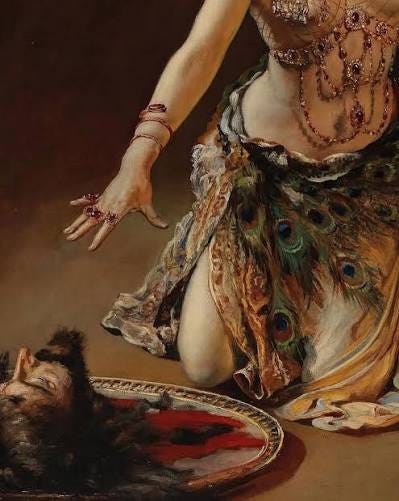
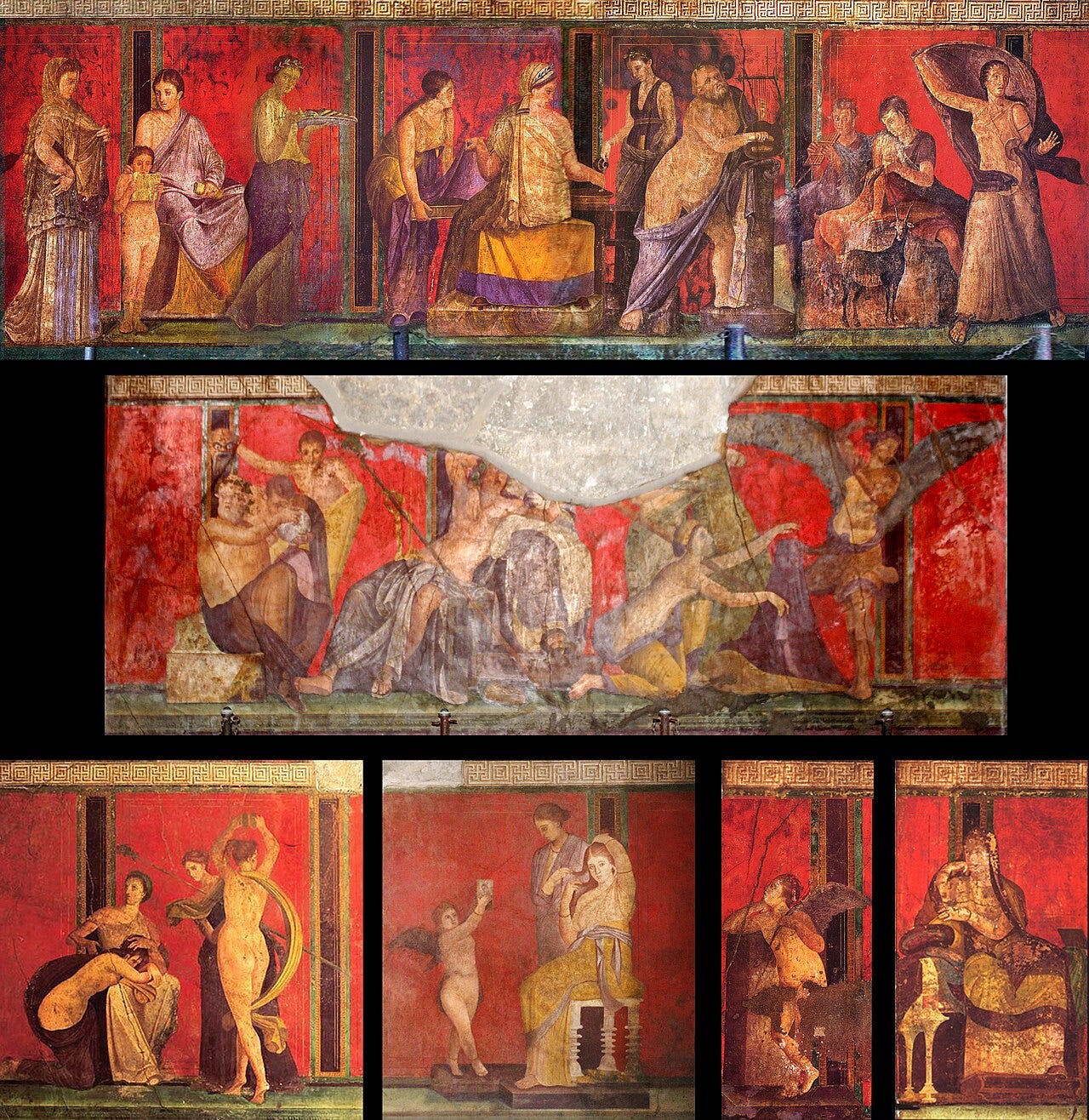
Discussing the psychological function of this archetype, Qualls-Corbett uses the myth of Ariadne and Theseus, in which the Cretan princess, abandoned by her lover on the island of Naxos, is joined to Dionysius in hieros gamos. She is depicted leading maenads in an ecstatic dance, demonstrating her transition from the Apollonian to the Dionysian principle. In a frieze in the Villa of Mysteries in Pompeii, this process is shown as a multi-stage initiation in which she is undressed and flayed before putting on new garments and emerging groomed and fully realised. This represents a kind of rite of passage: a divestment from patriarchal attachment as a preliminary to what Jung called individuation, where the shadow is joined to the ego in full realisation of the Self. Qualls-Corbett writes:
‘A maiden of any age regularly projects her creative abilities onto a man, seeing herself only as reflected in her love’s eyes and accomplishments. She falls in love with the hero, embodiment of her own unconscious potential, and the man fights her battles, carries out her wishes or takes her out of an undesirable situation.
Falling in love is always a result of projection; it is not a mature feeling of respect and appreciation for the other; rather one loves an aspect of oneself. When the partner does not live up to the demands of the projection (and no human possibly can), the projection cannot be sustainedl the reality of the person is seen and one wonders, “What did I ever see in him (or her)?”
For the woman to become more than just a reflection of her lover, the projection must be consciously withdrawn—abandoned or sacrificed. She must come to realize that the qualities she sees in him are actually inside herself. At that point she can also begin to appreciate the mature strength of the masculine, the god within, without losing the connection with her feminine nature. In the joining of opposite principles, the mature woman experiences the fertilization of her own creative energy.’
Another of the polarities I’ve vacilliated between is rejection or embrace of men. Part of my difficulty with this archetype is that I’ve misunderstood it as male-centred; in my periods of letting the whore run riot, I’ve also tended to elevate men and masculinity and to tolerate or concur with misogyny. I’ve seen my own femininity as something which needed to be corrected by a masculine power, and which ought to tolerate humiliation in the process of being humbled. This was a great mistake on my part. When I could stand it no more, I ran to the opposite extreme, rejecting men entirely, reflexively hating them. The archetype of the sacred prostitute doesn’t operate under the male gaze; her dancing is not a performance for men. Rather, she is the principle of change complementing the principle of upright stability. Her gift is that of wholeness; she can give without loss or diminishment.
Contemporary culture has little space for female sexuality which allows for male enjoyment but isn’t defined or ruled by men. The default interpretation of such a woman is that she is a whore, implying that she does what she does under duress, out of necessity, that she takes no enjoyment in it, that it is an inherently self-destructive rather than creative act. The woman herself is encouraged to see her own sexuality in these terms—as something aberrant and pathological, needing to be reined in. I have stayed in relationships for far too long because I feared what my sexuality would do unchained from a monogamous relationship. One ex, after ending our relationship, told me that we could keep sleeping together to save me from self-destructive acts. Certainly, I’ve also played into this narrative, casting myself as a damsel in need of rescuing and returning to the good, meaningful sex of the relationship. All of this is diagnostic of the archetype’s repression, both at the level of culture and individual psychology. The result of its loss is listlessness and lethargy punctuated by bursts of unrestrained sexuality which, because of being suppressed, does express itself in potentially dangerous and destructive ways.
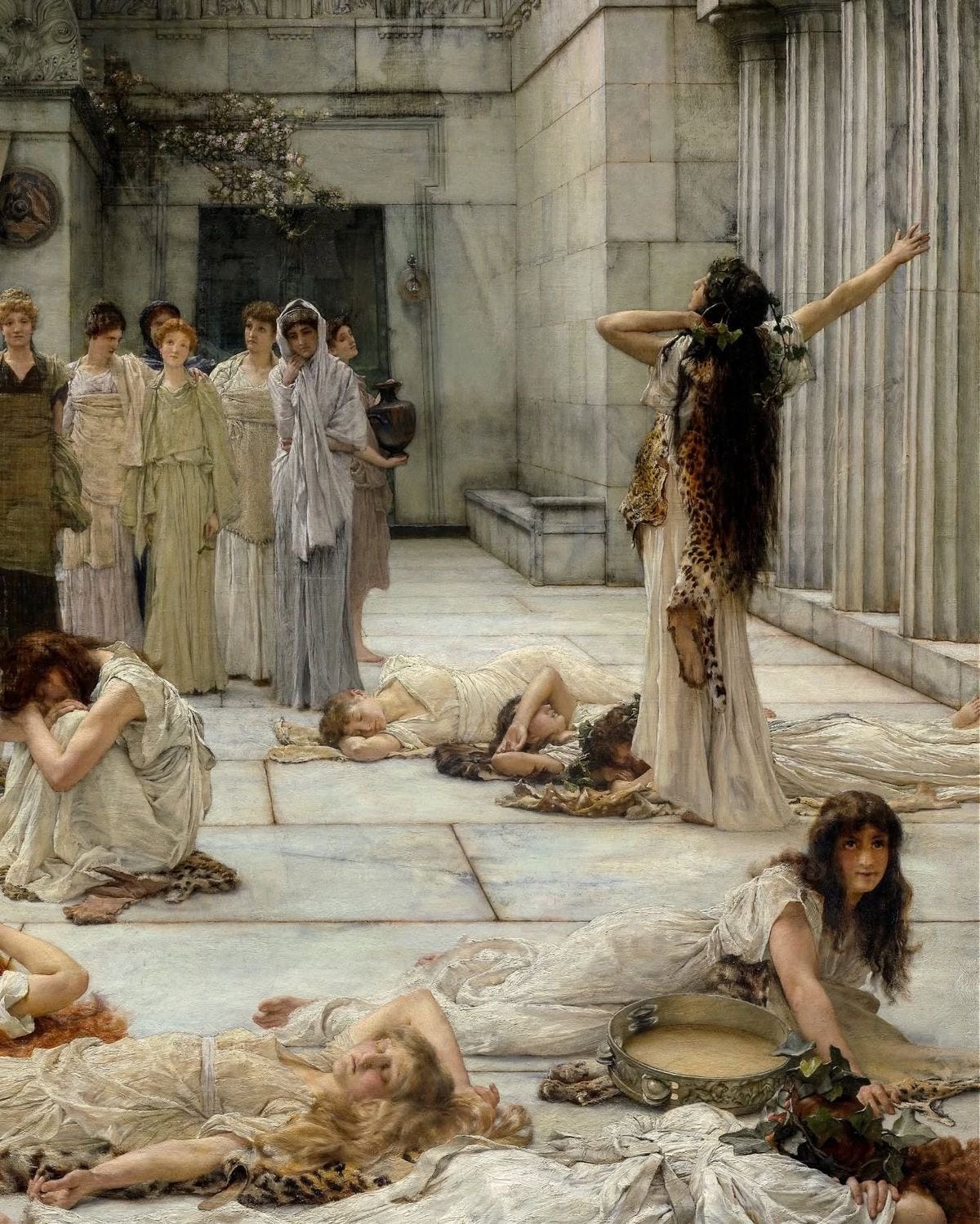
In the ecstatic dance of the maenads, we loop around to where we began: mania. In his book Ecstasy, Robert A. Johnson laments that almost all contemporary examples of the Dionysian principle are in fact examples of inflation rather than enthusiasm. While the former means to be puffed up, the latter means ‘to be filled with God.’ Inflation leads easily to mania and madness. On the other hand, ‘enthuasiasm annuls the distance between pairs of opposites, and this brings ecstatic joy. A visitation of God, which enthusasism gives, transcends the duality of one’s live—the either/or—and brings them into a synthesis… Then, for a short time—because this is all that we can stand—the opposites cease torturing us. When we transcend the cross of opposites, we will find ecstatic joy.’
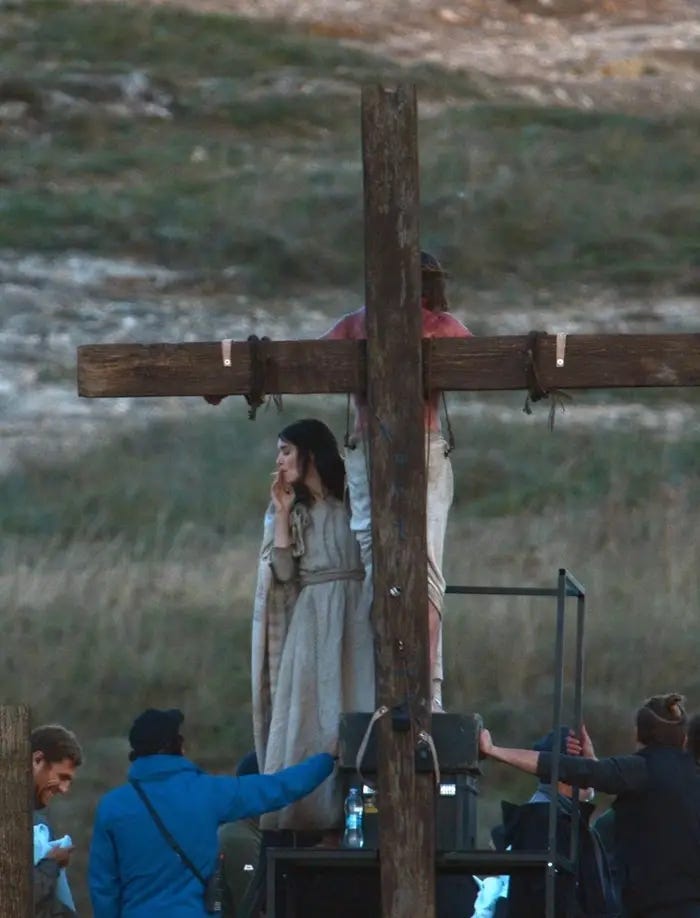
This, in fact, is the crucifixion: the still point at the centre of the universe, the meeting point of gravity and grace. The Christian tradition, though shorn of its medieval excess, has always carried this ecstatic principle at its centre—in the mandorla, where the furthest extremes of human life are, for a moment, joined.
I will publish this but it needs to be reined in a little.
I will write about my recent experiments with ceremony and ritual in another piece.
No posts
Comments
Nothing yet. Say the first thing.
Sign in to join the conversation.