
roseandscroll.com | support@roseandscroll.com | (980) 428-9647
Facebook | Instagram | YouTube | Spotify | R&S Store


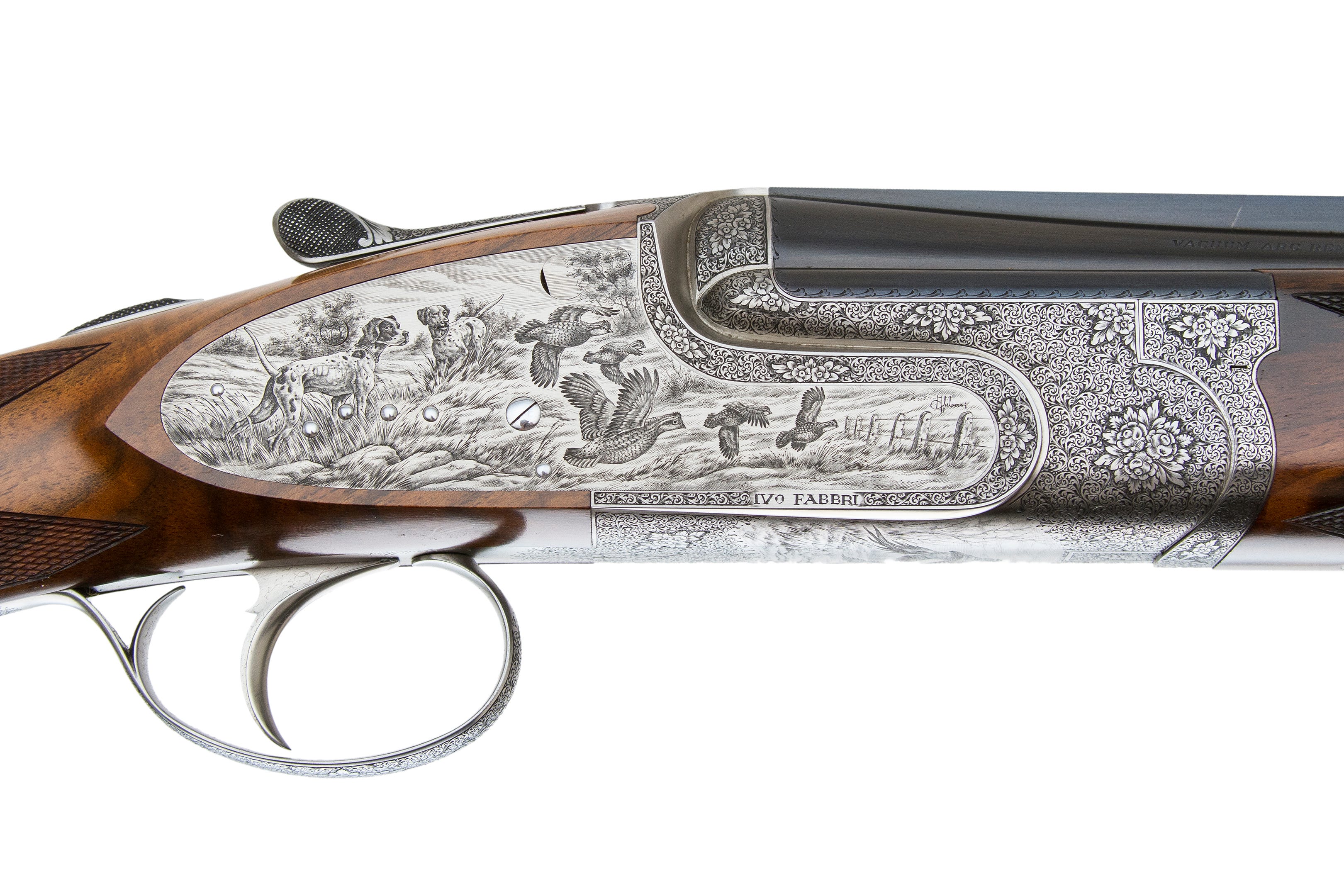
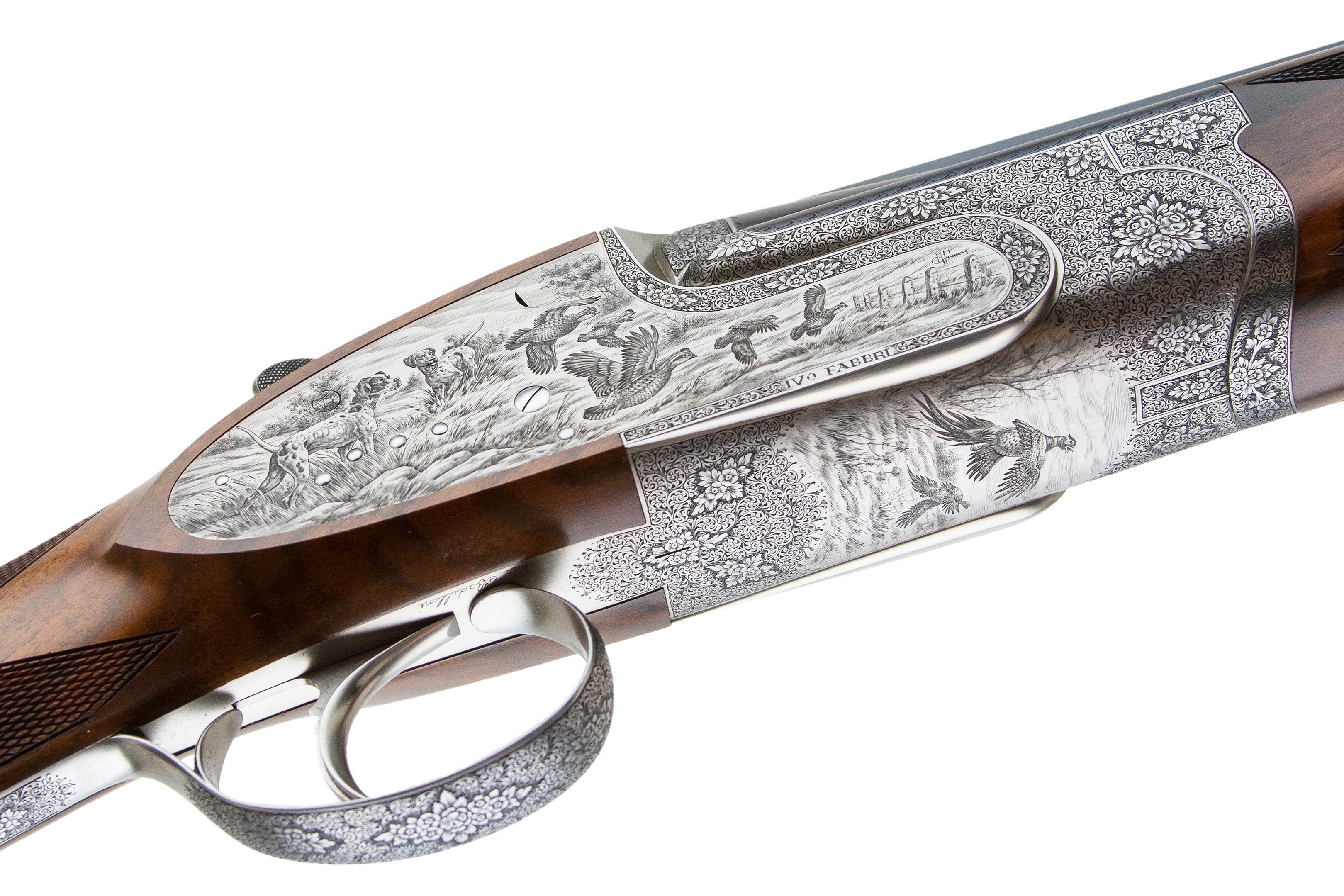
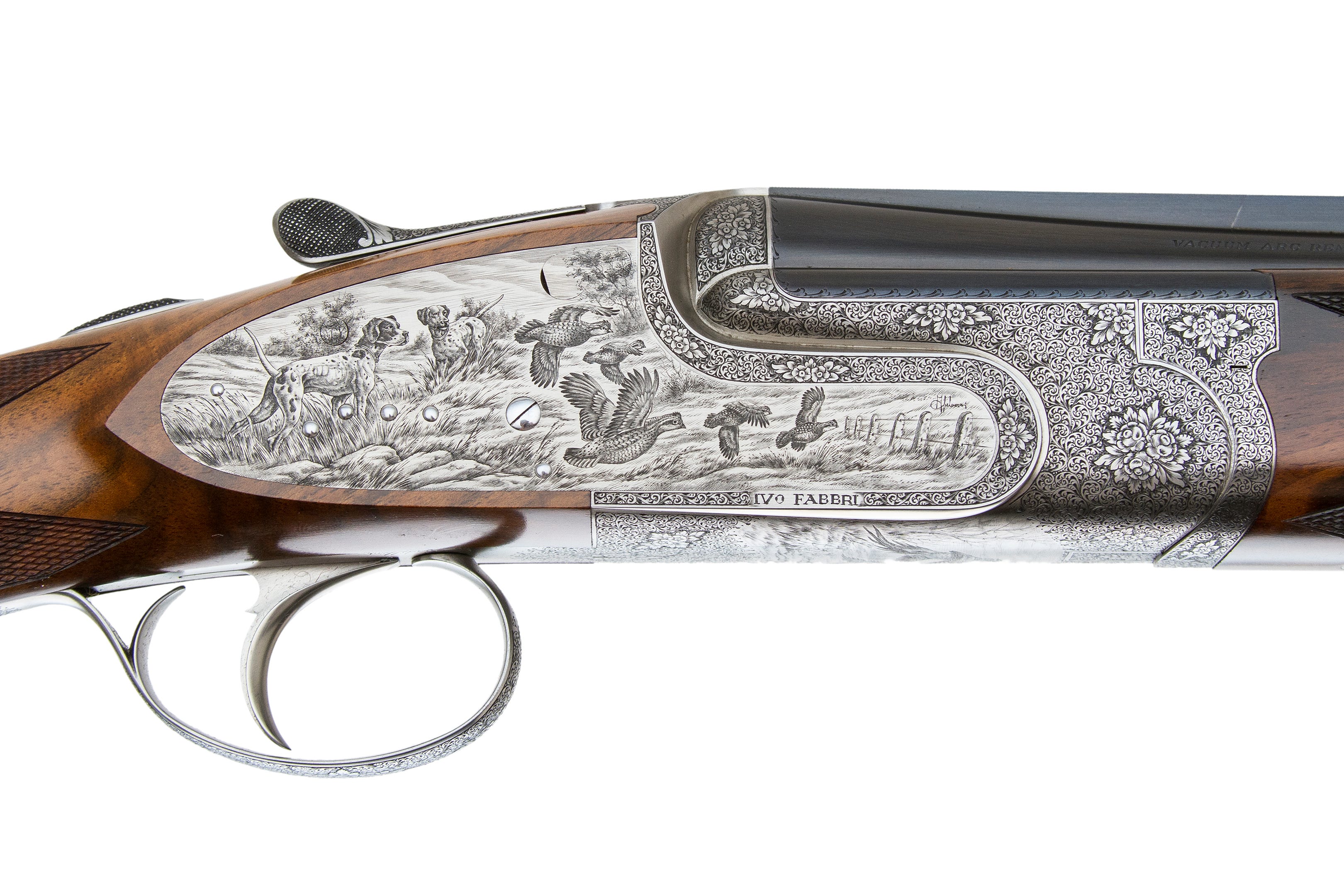
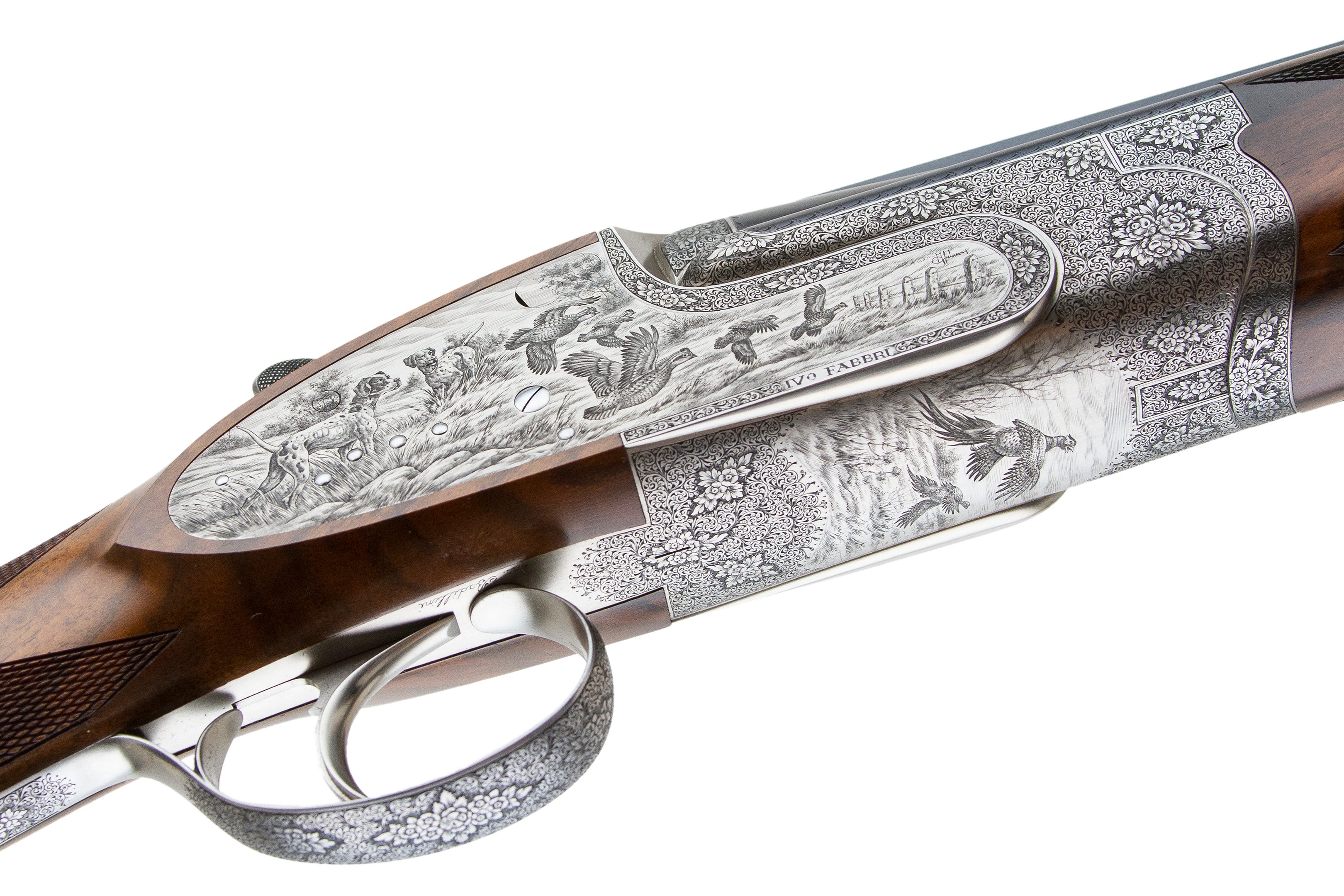
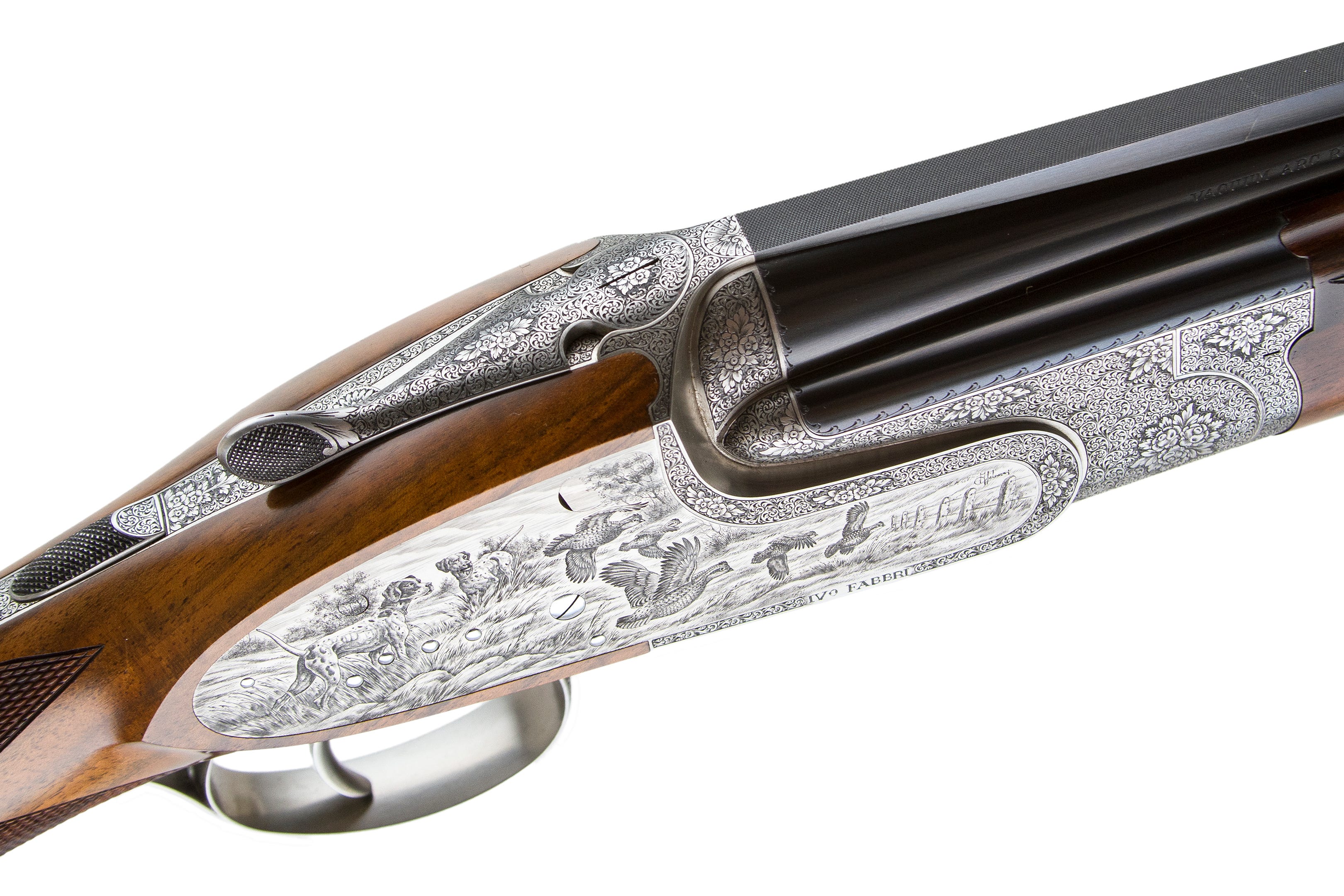
Nothing in the cover is moving. Two dogs have gone to stone at the edge of the long grass, one spotted, one dark, both reading the same few feet of ground along a line of fence posts. They have been on point for decades. Nothing about them will ever move, and the covey they are holding will never quite finish rising. It hangs there, spread low and wide against the sky, every bird caught at the exact instant of the flush.
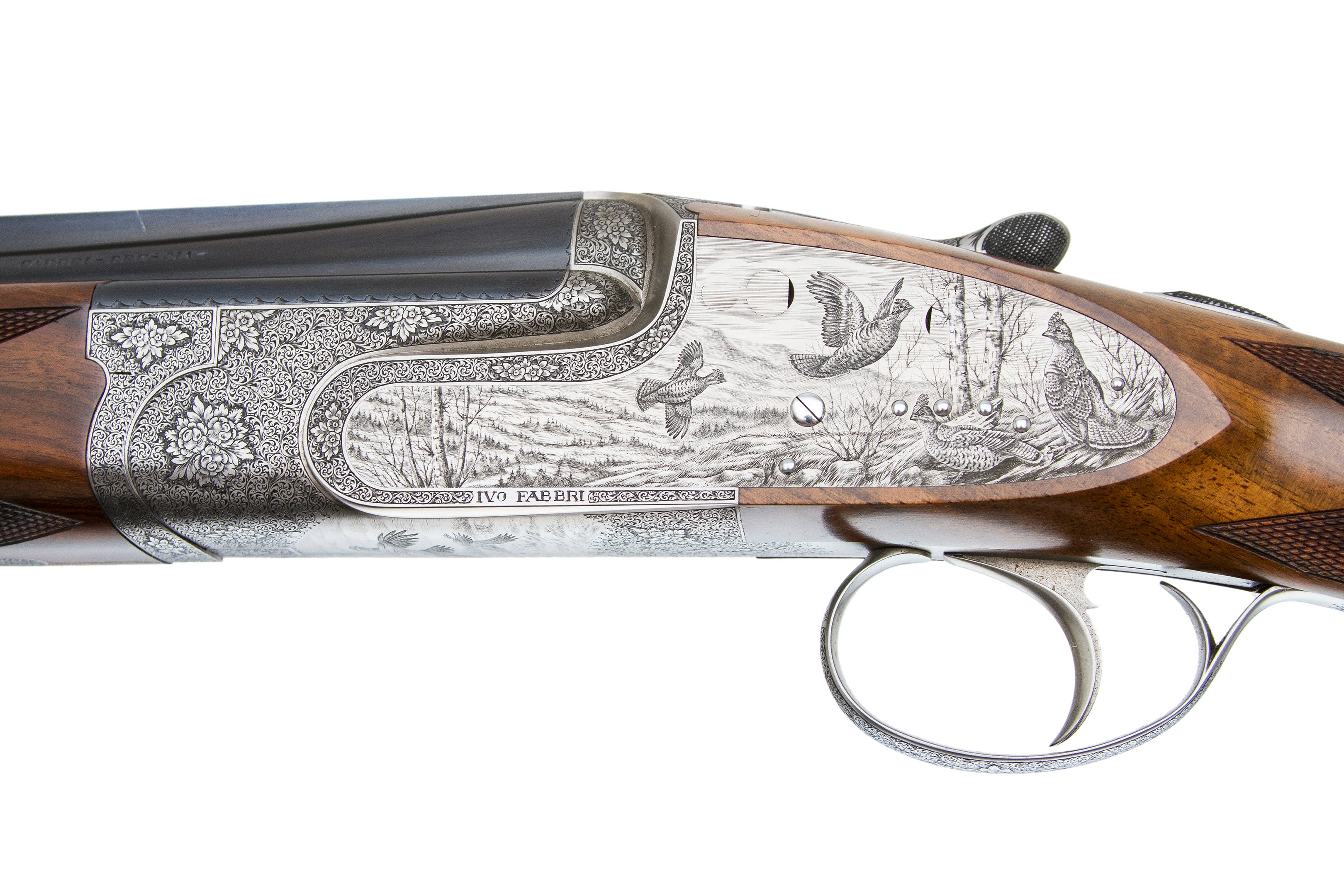
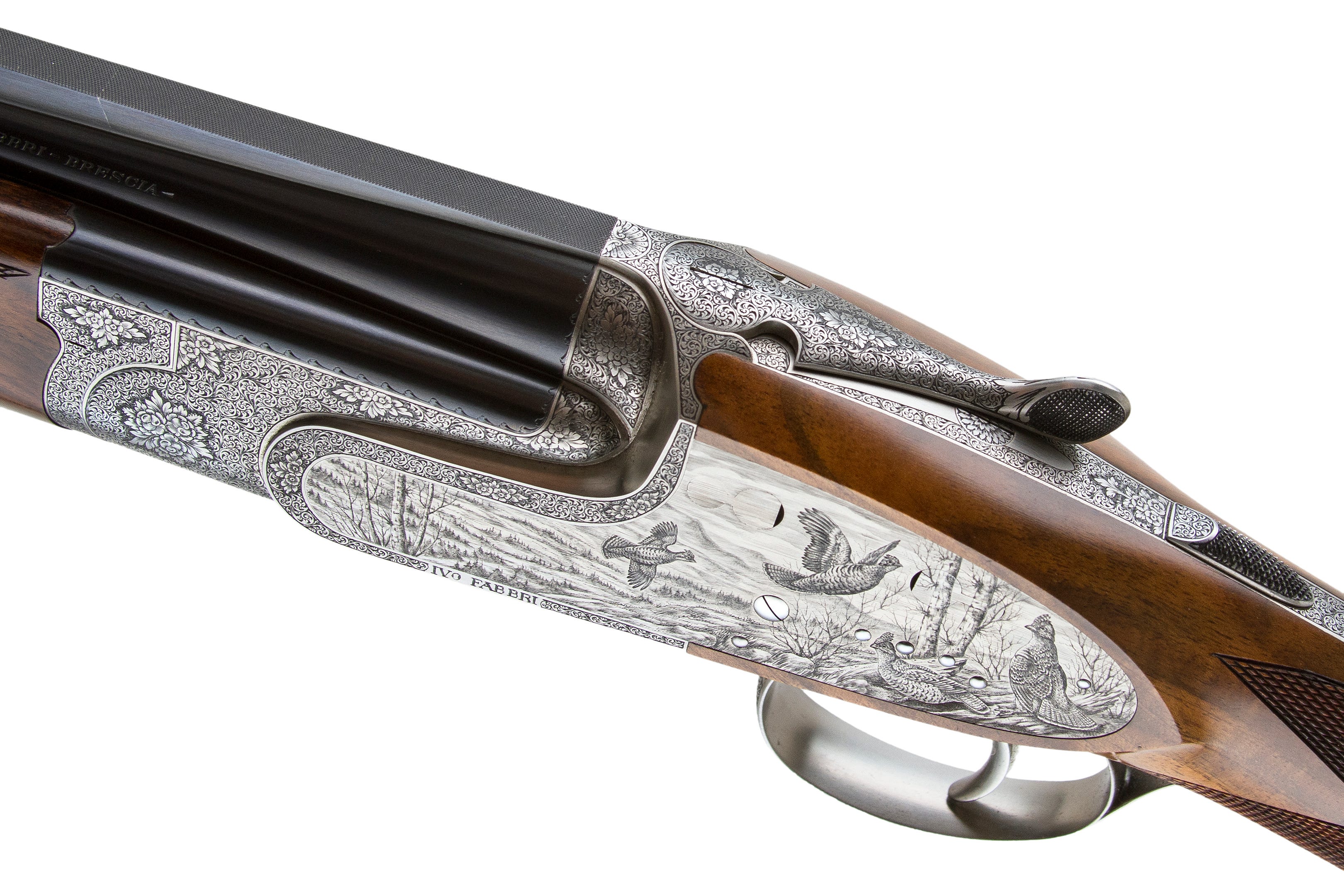
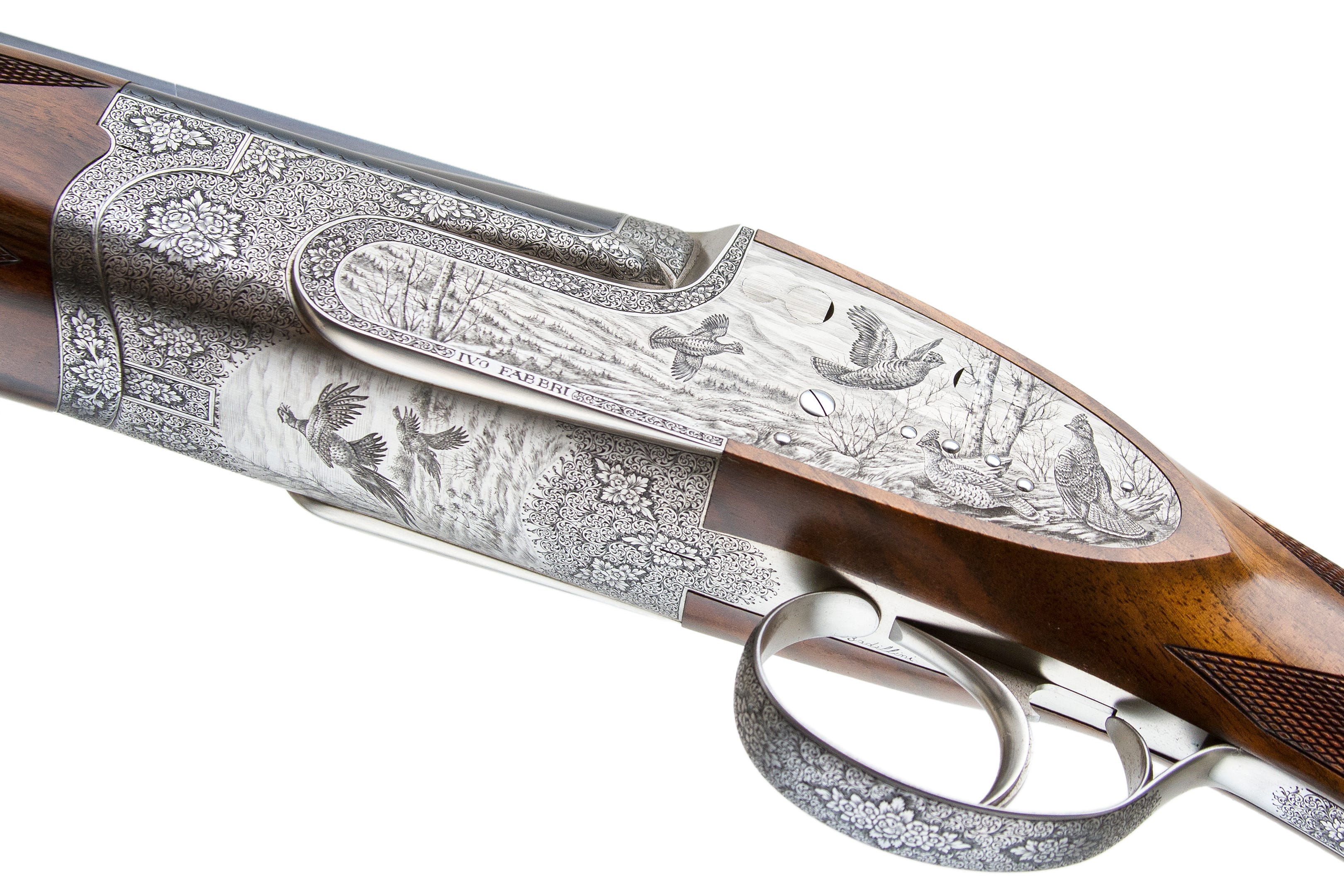
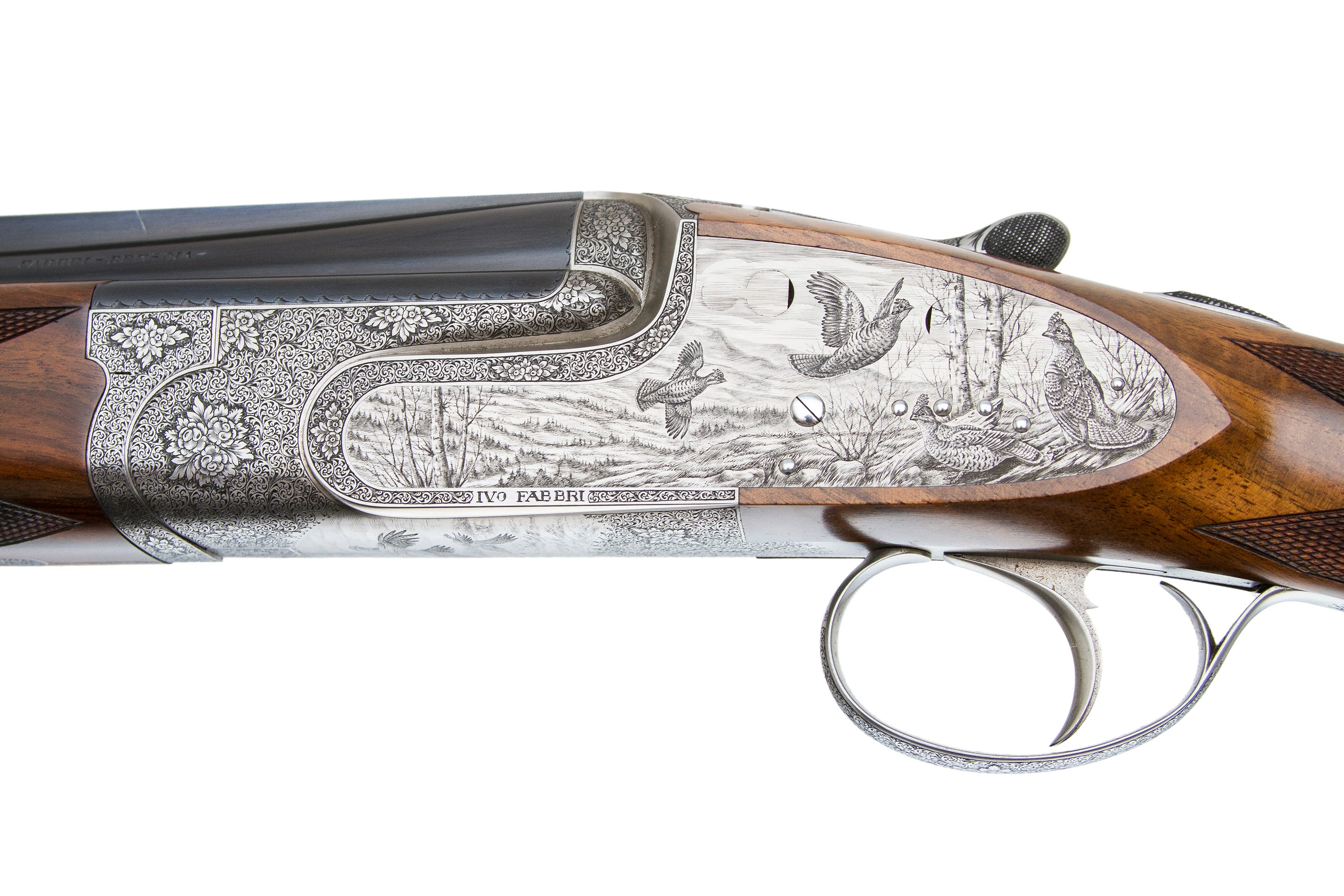
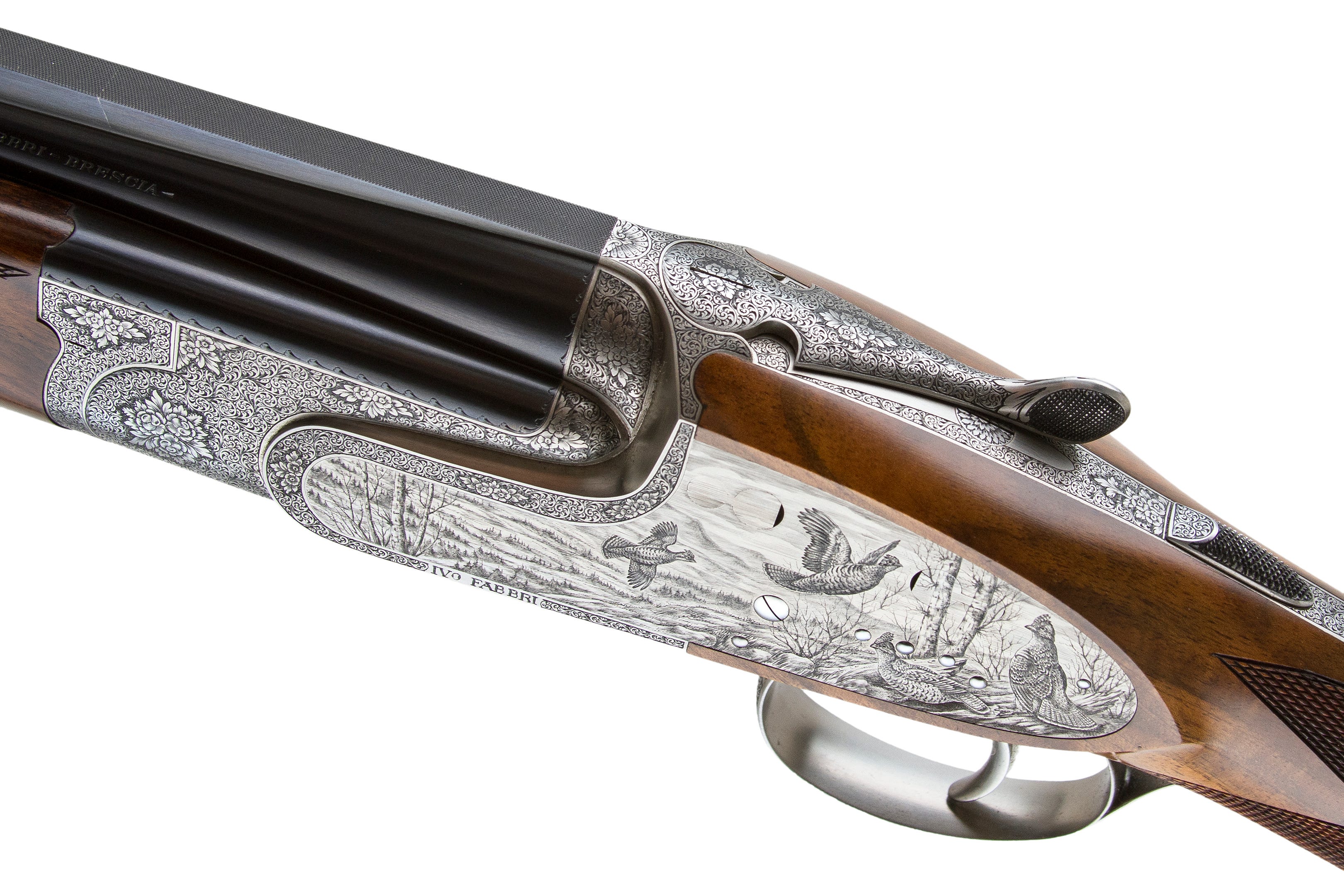
Another cover, and this one is birch country: white trunks in a loose colonnade, a pair of grouse tipping through them, a long valley of conifers rolling away beyond. Two more wait on the ground among the low growth at the foot of the trees, heads up, one beat from breaking.
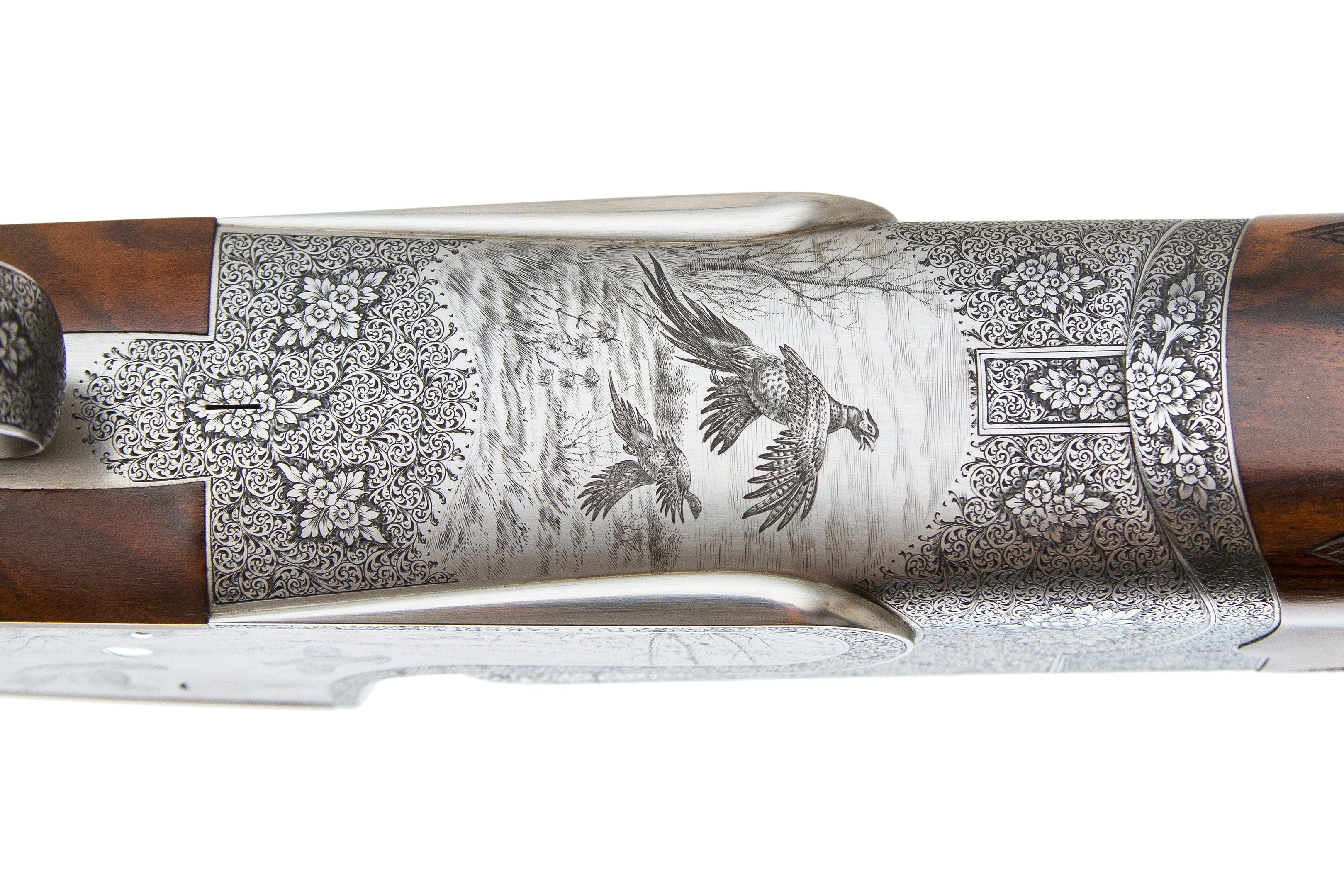
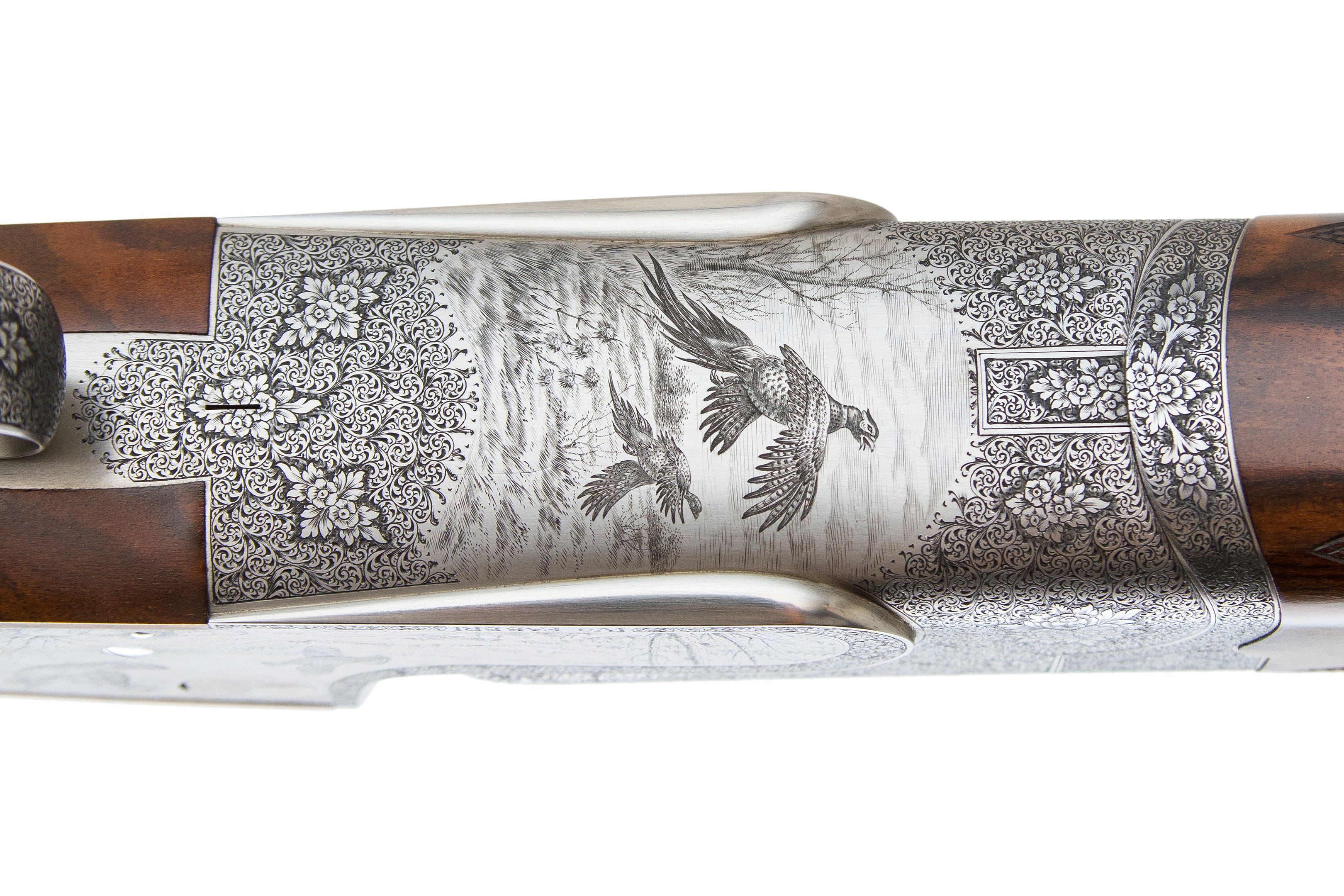
In a third the country runs open. A cock pheasant climbs at full stretch out of the rough grass, beak open, tail pulling behind him like ribbon, his hen a wingbeat behind — and away to their left a knot of distant birds hangs against a sky of fine ruled strokes.
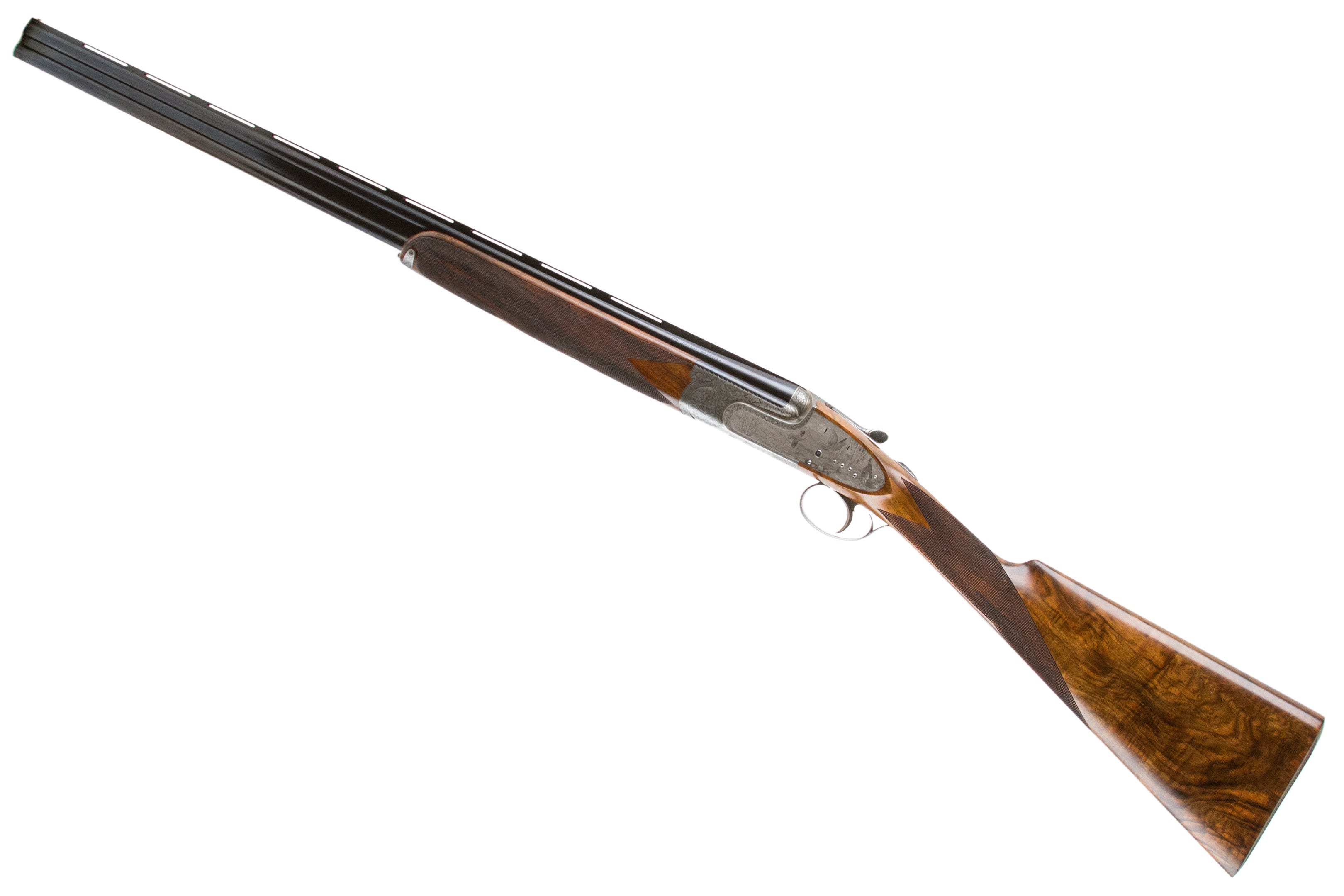
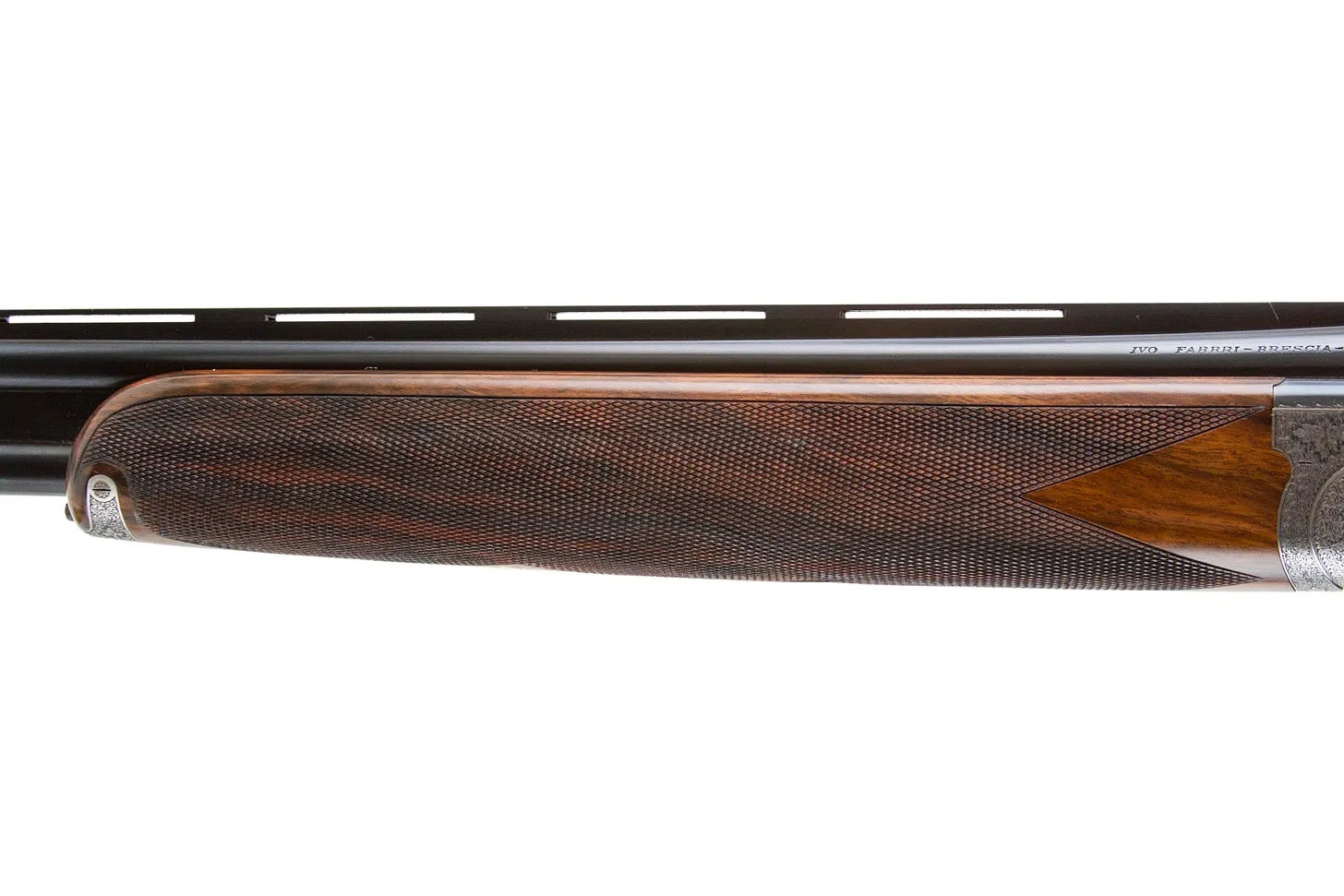
Three hunts. Three covers. One sky. And the sky, in all three, is silver. Each of these scenes is smaller than a playing card. The long grass is graver work under magnification. The birches are hairlines in steel. The open ground of the third is a few thousand cuts of a hand tool in polished metal. The scenes live on the lockplates and belly of a single gun, a .410-bore over-and-under weighing six pounds, four ounces, built in Brescia by a house that many in the trade, when nobody is quoting them, call the best gunmaker in the world. The banner on its action reads IVO FABBRI.
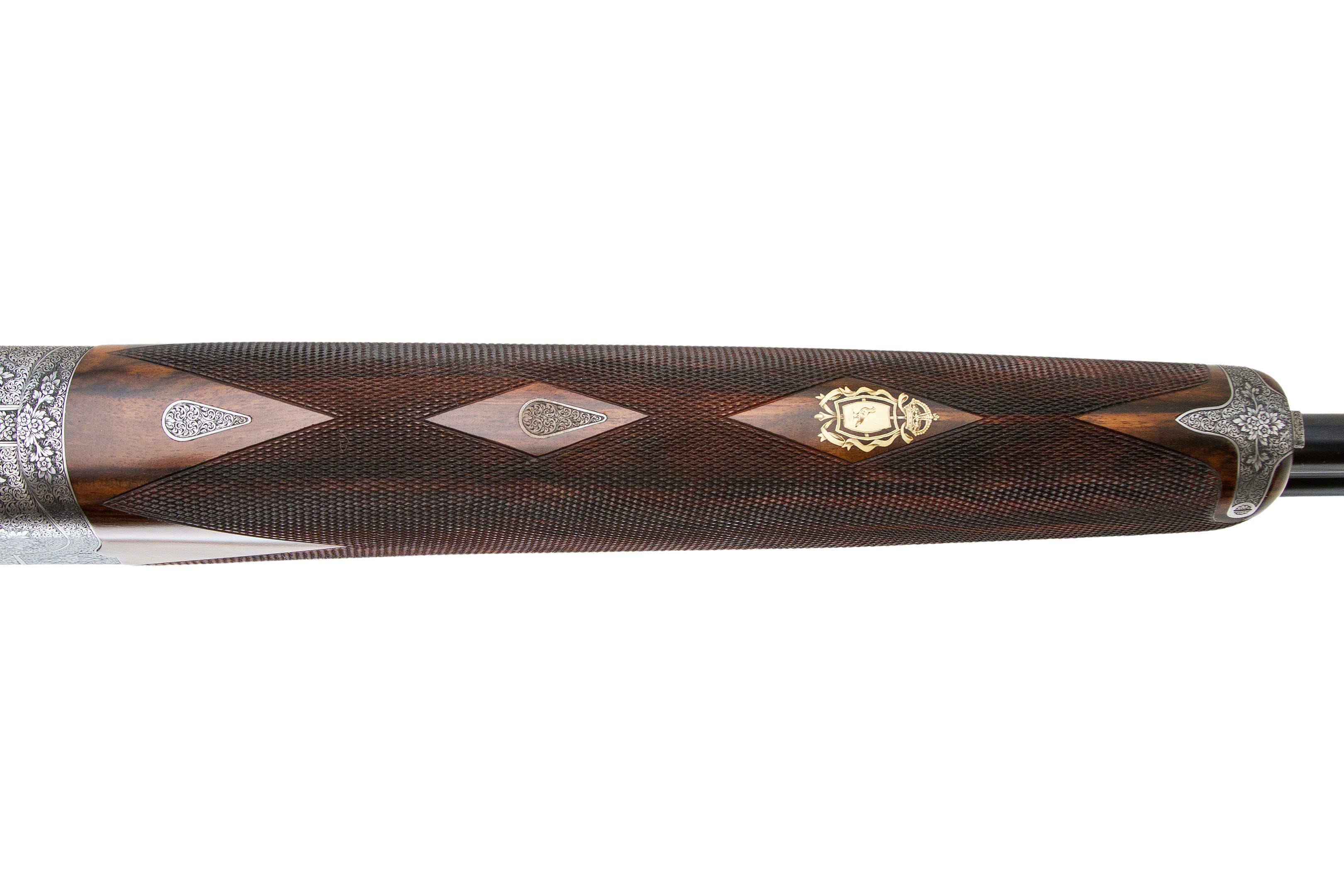
There is one more thing, set in gold in the wood of the forend: a shield with a lone bird standing in it, ribbons about it, and above them a crown that nobody has put a name to. We will get to the crown. First, the gun — because these three covers are exactly what they look like, and this is a gun engraved with the journey it was built to make; everything about it, from the steel of its barrels to the half ounce of shot it throws, says so.
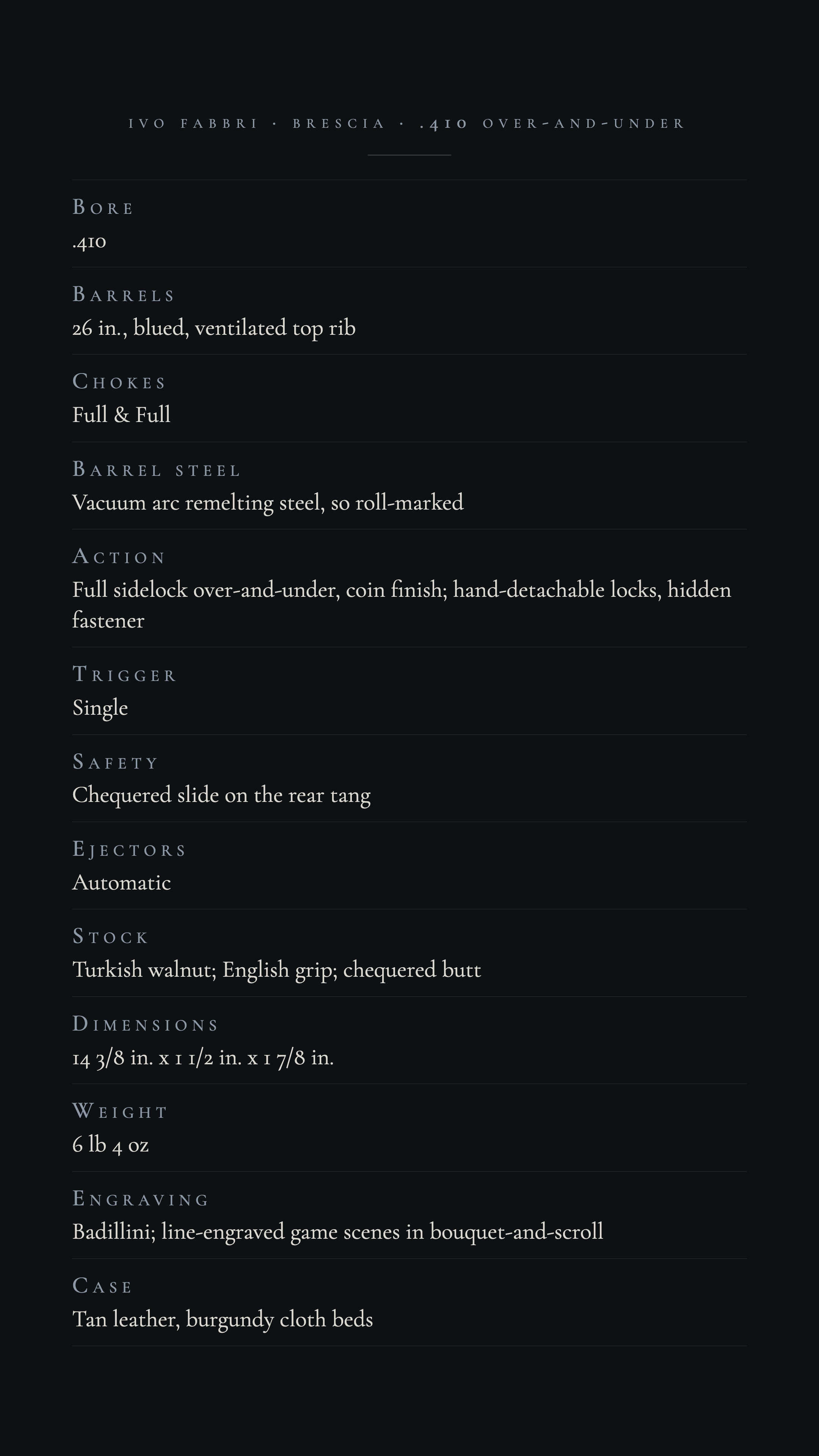
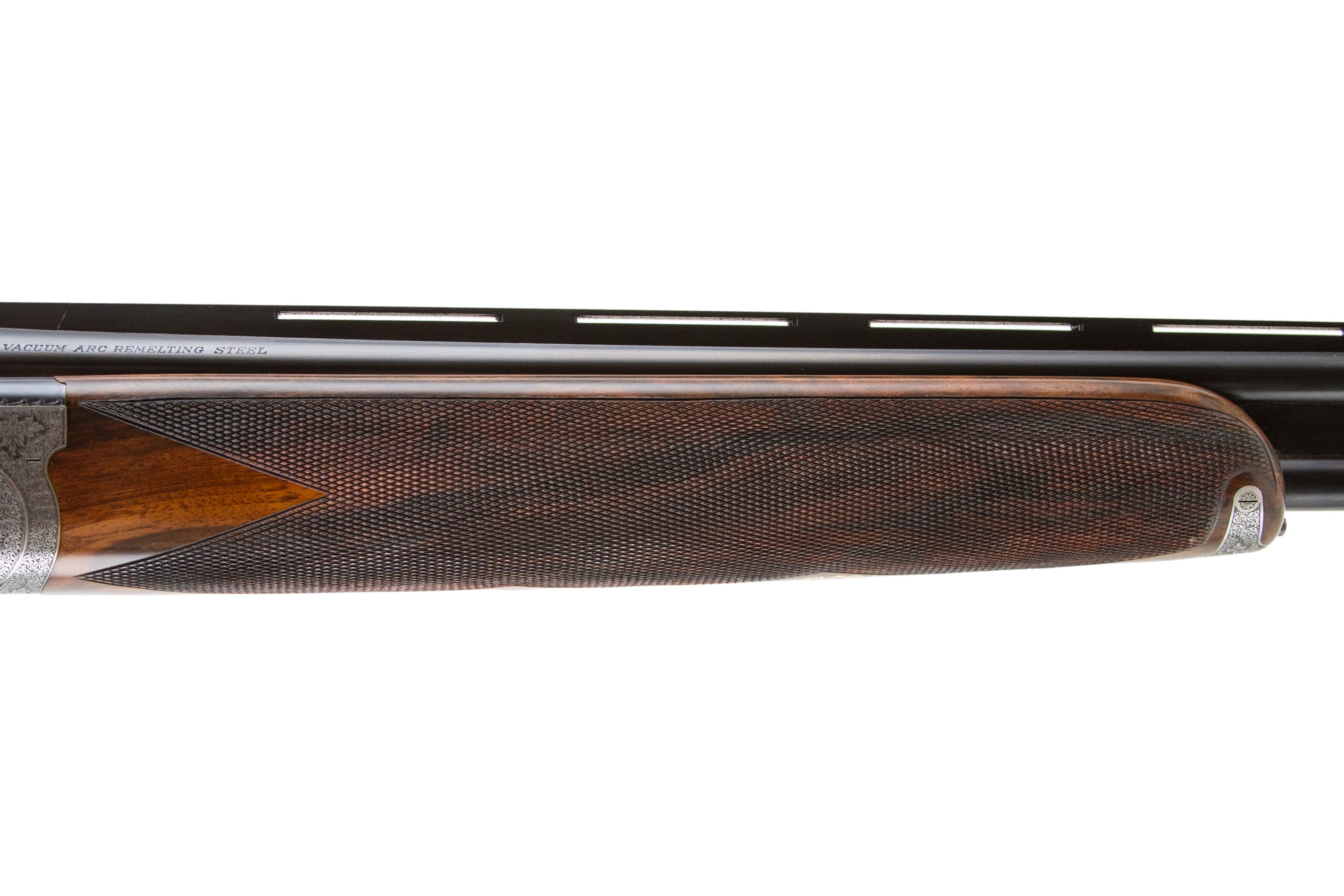
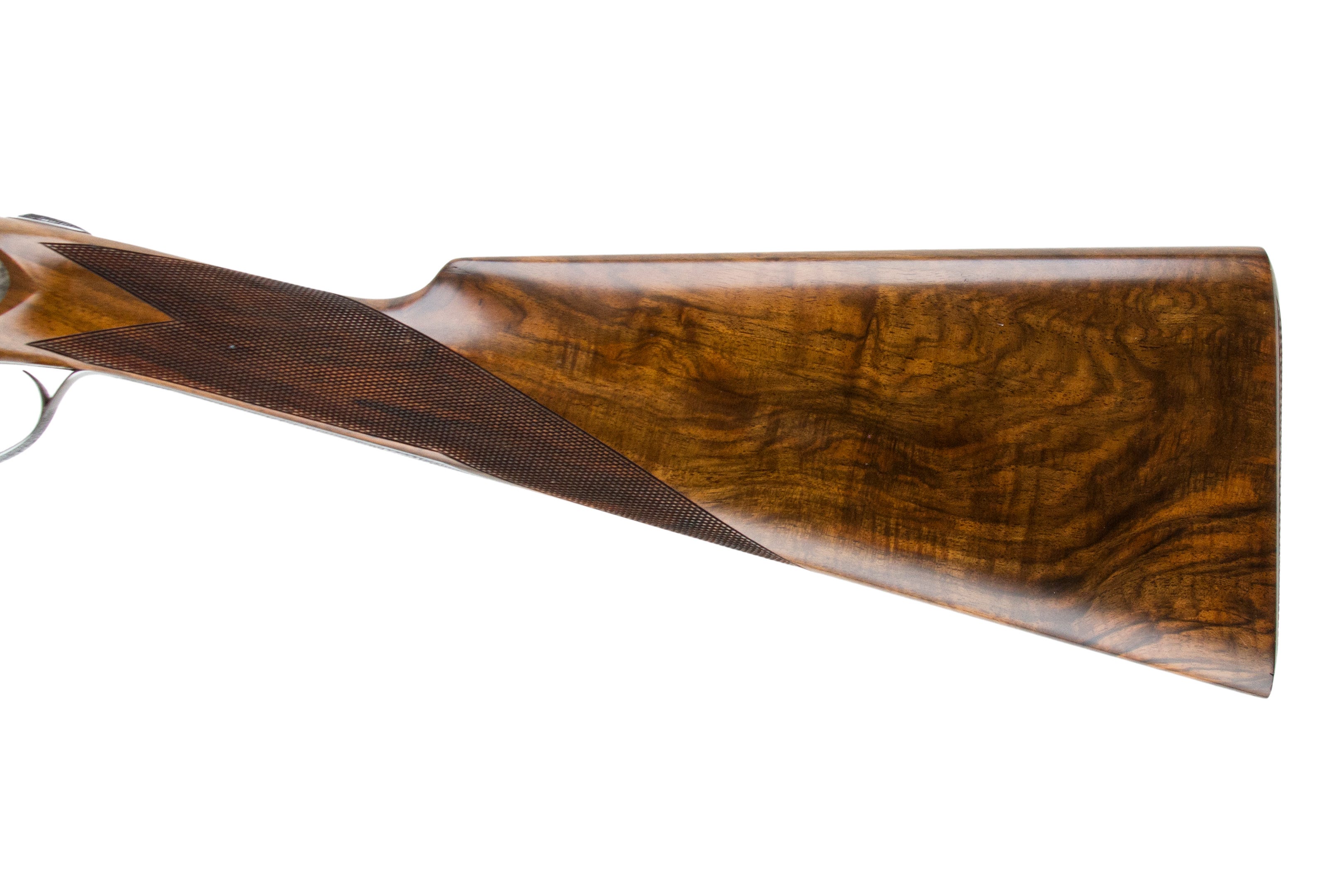
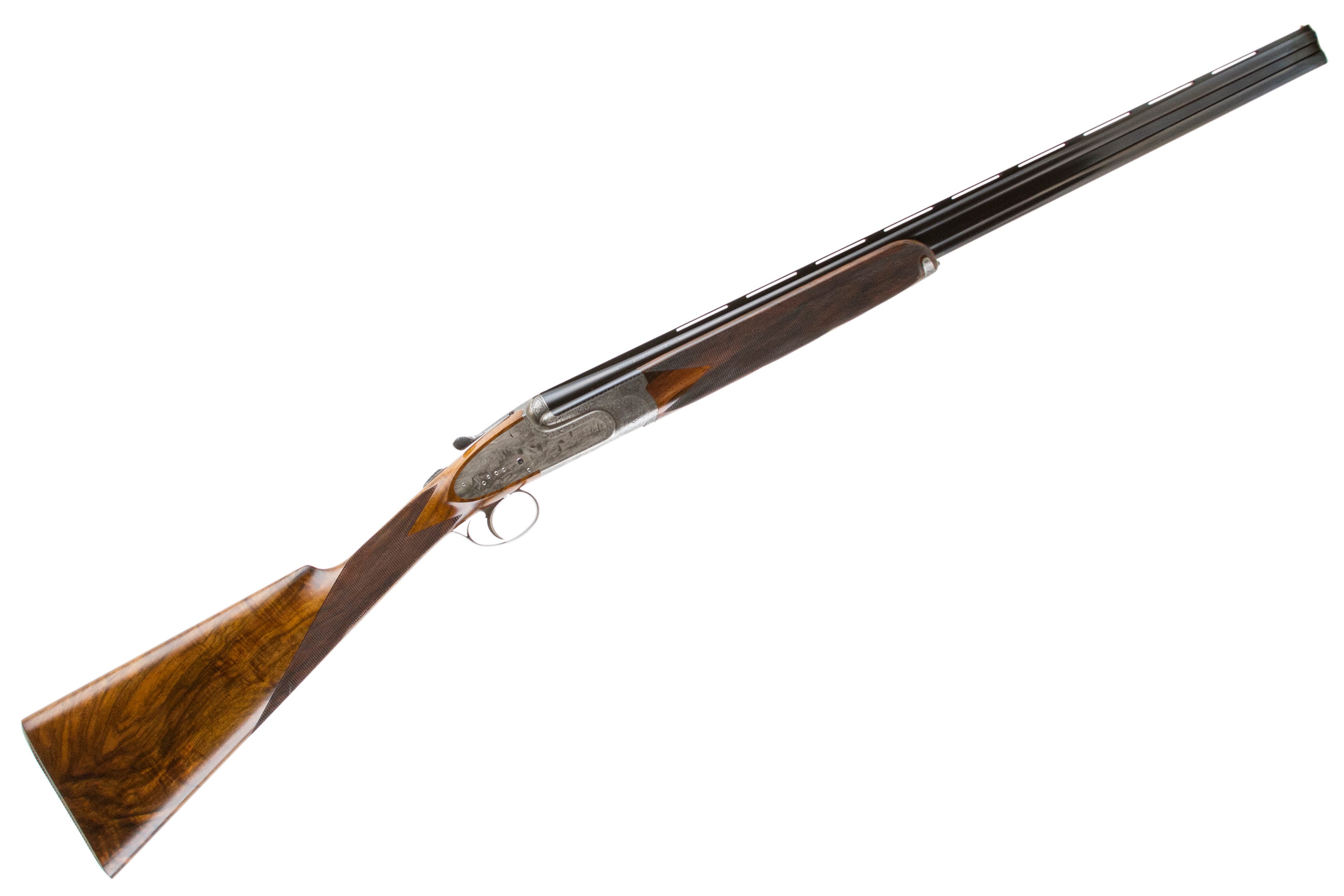
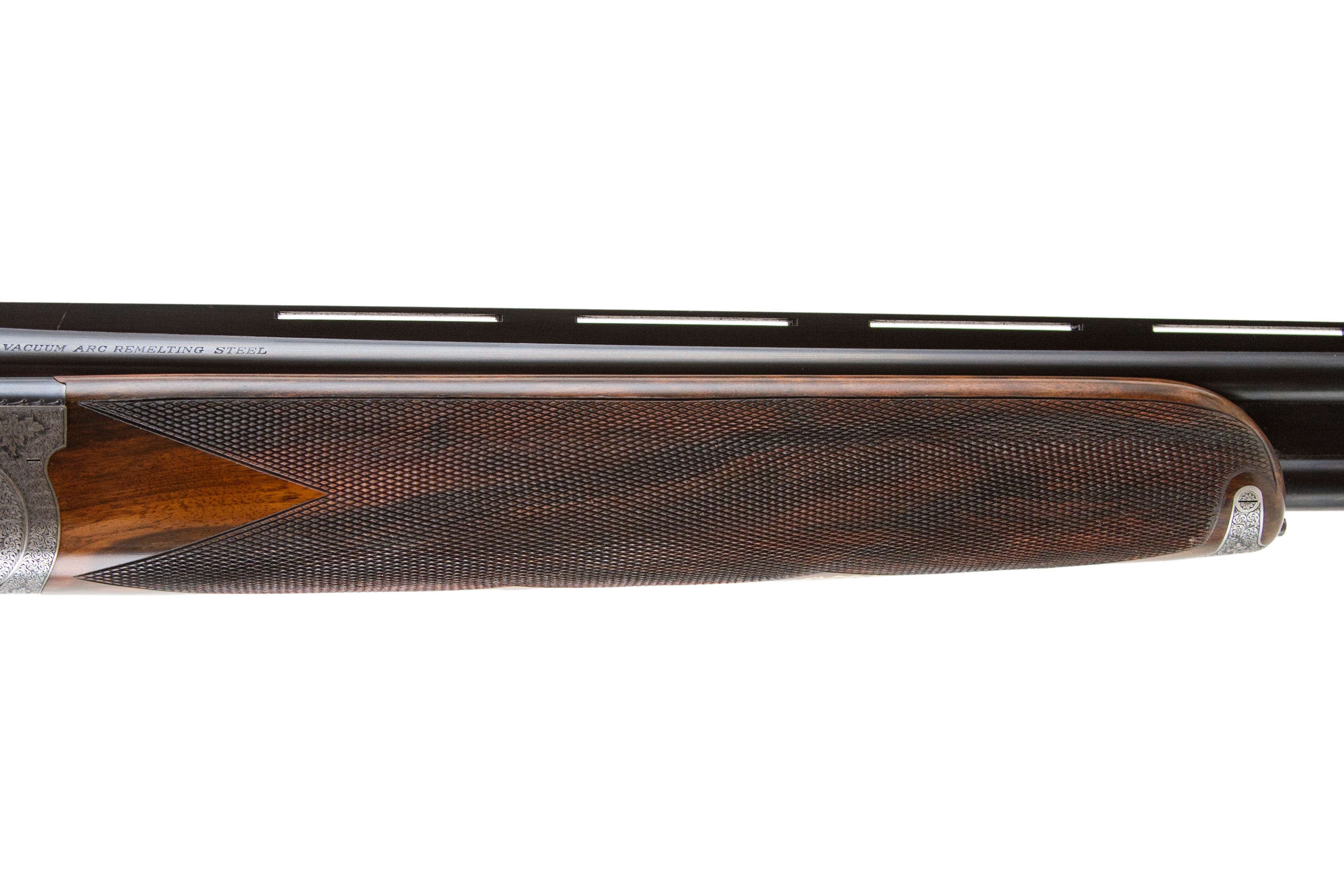
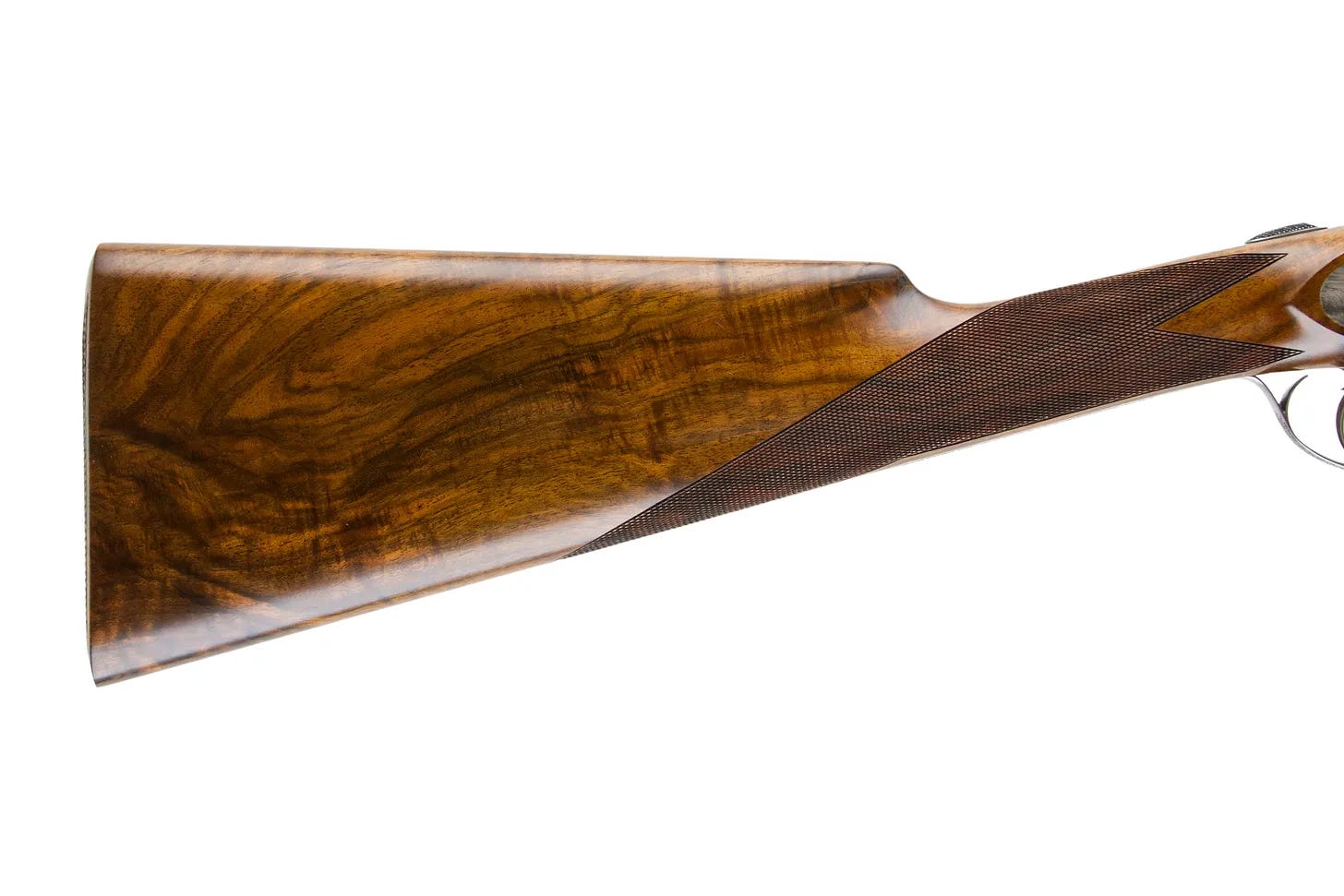
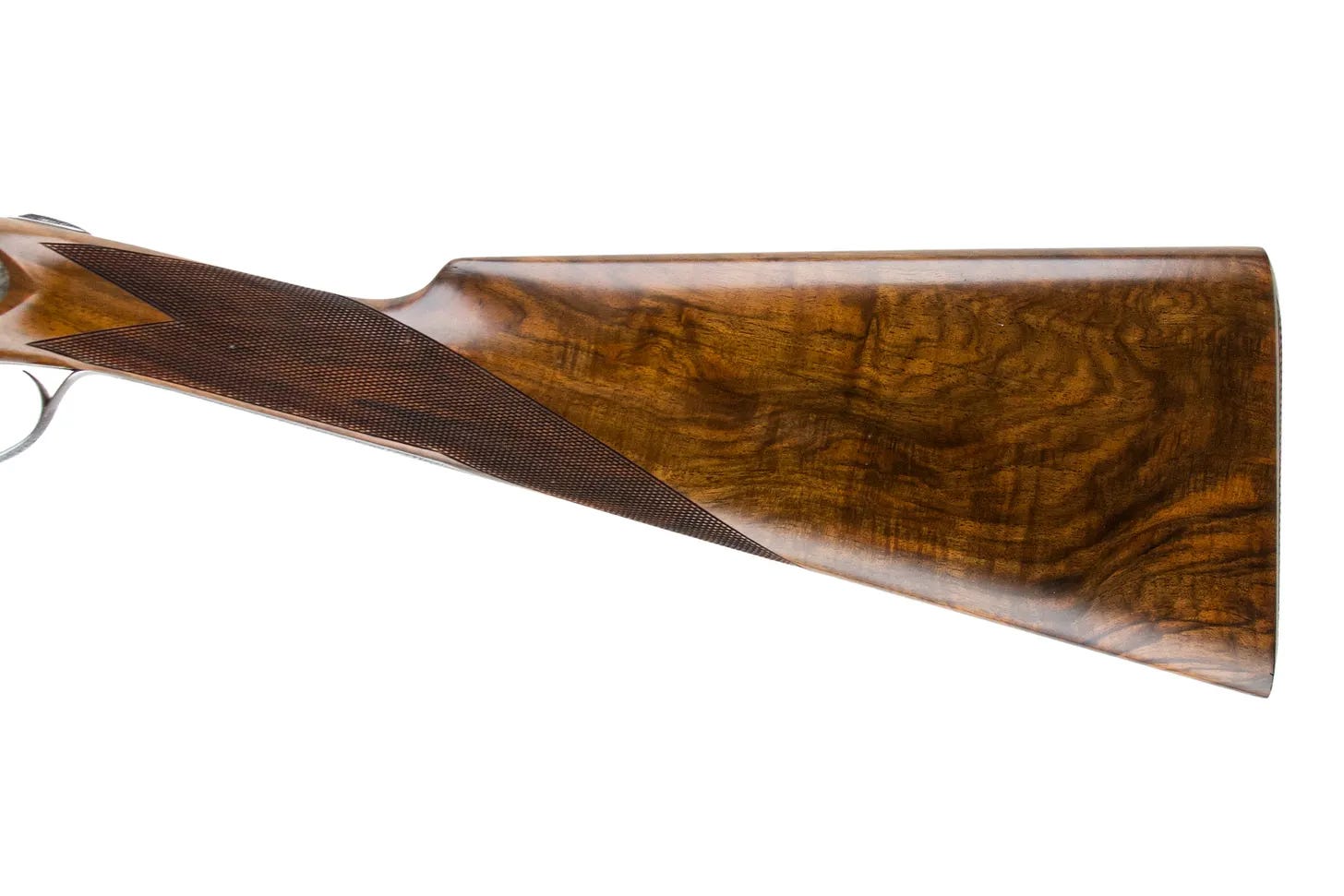
The specification reads quickly and means a great deal. Twenty-six-inch barrels, choked full in both, under a ventilated top rib. A single trigger. Automatic ejectors. A chequered safety slide on the tang. A full sidelock action whose locks come away by hand. A stock of deeply figured Turkish walnut, cut to a straight English grip and finished with a chequered butt — bare wood at the shoulder, no pad, the oldest signal in the trade that a gun was built for game and meant to be mounted often. At the head of the stock the chequering parts around a smooth spear-shaped reserve of figure. The dimensions are classic game dimensions.
Full and full sounds severe until you remember what a .410 is asked to do. The shell carries half an ounce of shot. Pattern is the whole problem, and choke is the only answer. A maker who chokes a .410 tight is being honest about the work the little shell has in front of it. And then there is the weight.
Six pounds, four ounces is heavy for a .410 sidelock by London habit. The classic English .410 over-and-under is a wand, often a full pound lighter. Fabbri’s answer sits at the other end of the argument. Its sub-gauge guns weigh what their barrels weigh — the house will not thin a wall to flatter a scale — and those barrels are machined to its own standard from steel it refuses to compromise on. The result handles like a gun rather than a conjuring trick: steady on a crossing bird, unhurried on the second shot, built to be shot in volume rather than admired at the rack. There is no apology in it anywhere.
Ivo Fabbri came to gunmaking from engineering, and he came armed. He had worked for Fiat. He thought in tolerances. When he and Daniele Perazzi joined forces in Brescia at the start of the 1960s, the partnership announced itself at the top of the sport almost immediately: at the Tokyo Olympics of 1964, Ennio Mattarelli took the gold medal in trap with an Olympic-record 198 of 200, shooting a gun from the young partnership’s bench.
Then the two men chose different roads. Perazzi built for champions, in numbers, and became one of the great competition houses of the world. Fabbri went the other way entirely, toward the fewest possible guns built to the highest possible standard, and by the end of the decade the firm carried his name alone.
The heresy, in London terms, was his conviction that machines could out-finish the file. Fabbri believed that measurement, repeatability, and aerospace-grade tolerances would produce a truer gun than the most gifted hand working by eye, and he spent the rest of a long life proving it. Everything is made under the firm’s own roof, down to the screws. Visitors to the factory have reported fit between barrels and breech face so exact that a single sheet of paper stops the gun from closing. And the output has stayed almost unbelievably small: two or three dozen guns a year, ever, for the whole world.
A best gun’s barrels will tell you who made it and where. This gun’s barrels also tell you what they are made of. Along one flank, in small roll-marked capitals: VACUUM ARC REMELTING STEEL. It may be the most honest sentence in gunmaking.
Vacuum arc remelting is a refining process, and an extravagant one. Steel that has already been made once is remelted by an electric arc inside a vacuum chamber and allowed to solidify again, slowly, into a new ingot. The vacuum strips out dissolved gases. The controlled second freeze sweeps the metal of the microscopic inclusions and hidden porosity that ordinary steel lives with. What comes out is among the cleanest steel human beings know how to make, and it is specified for the places where a hidden flaw is the one failure that cannot be allowed: the rotating heart of a jet engine, the implant that goes inside a human body. Fabbri put it in shotgun barrels, and then engraved the fact on the outside, where anyone could read it.
That inscription also tells us roughly when this gun was born. The vacuum-arc marking belongs to Fabbri’s work of the 1980s and into the early nineties, and the few sub-gauge Fabbris that surface cluster at the end of the eighties. The Italian proof house stamps a small date code on the barrel flats of every gun it passes, so the year is sitting under the forend, waiting to be read. Until then, the honest answer is: almost certainly the later 1980s, when Ivo Fabbri himself was mid-stride.
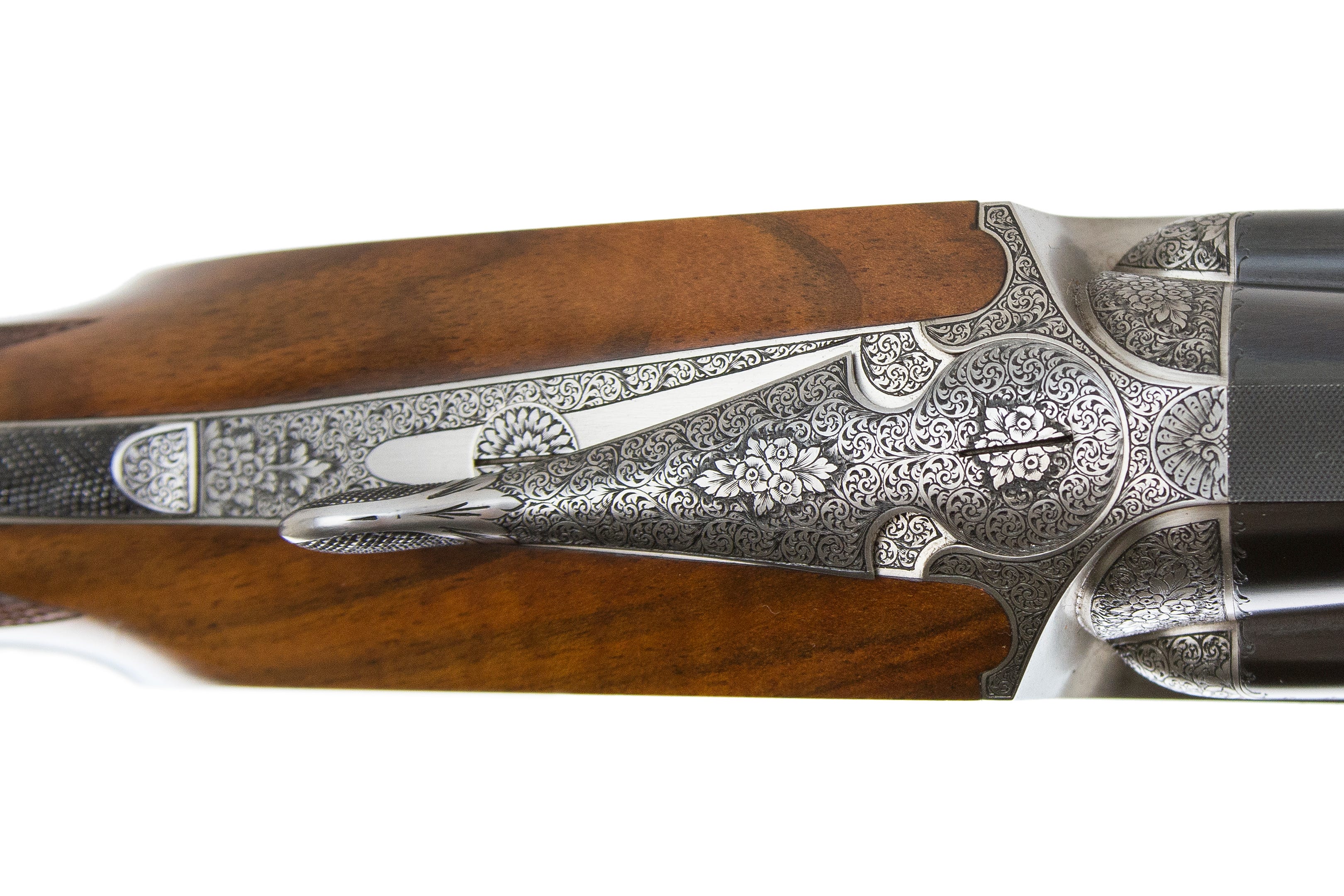
The locks are the quiet astonishment of the gun. This is a full sidelock, and the locks come away by hand, a tradition with real logic behind it: a lock you can remove in the field is a lock you can dry, clean, and trust. The famous English version announces itself with a small crank-handled screw standing proud of the plate. Here nothing stands proud. The fastening that frees the locks is hidden, and you could own the gun for years without finding it.
The reason is standing right there in the engraving. On a gun conceived as a canvas, hardware is intrusion, and Fabbri engineered the intrusion away. The only metalwork the eye finds on the plates is the polished heads of the lock pins and screws, left bright inside the scenes, treated by the engraver as part of the composition — one of them hangs in the right plate’s sky like a small steel moon. How the locks actually release is the gun’s own business. The maker left no visible instruction, and that was the point.
The cursive signature set into the right plate, near the fence posts and small enough to miss, is Badillini’s — Gianfranco Badillini, born in Brescia in 1942, named on the province’s own roll of its renowned arms engravers alongside the masters of its great postwar generation. The auction trade, which prizes his signed guns, has never quite settled the spelling of his first name; the Brescian record has, and it says Gianfranco.
The work is where to read him, and the work draws a clear map. Signed Badillini engraving appears on a Fabbri sidelock of exactly this era. It appears on Perazzi game guns cut in exactly this genre: coveys breaking, dogs on point, the same unhurried portraiture. It appears on masterwork for Krieghoff. And on at least one other maker’s gun, a crest inlaid in gold carries his signature. Hold that detail.
Go back to the quail, slowly this time. The right plate is staged in depth: the dogs anchor the foreground, the covey scatters across the middle distance, every bird at its own attitude, and the fence line carries the eye clean out of the frame past standing timber and a shoulder of rock, as if the birds were headed somewhere beyond the steel. The engraver’s cursive sits inside the scene, near the fence posts, faint as a watermark.
The left plate works the vertical. Birch trunks set the rhythm, the conifer valley rolls away behind them in strokes fine as etching, and the two grounded birds — one crested and fanned atop a deadfall — weight the composition the way a bass line weights a song. The belly of the action, the least visible surface on the gun, received the densest work of all: the cock and his hen climbing off the thistled ground.
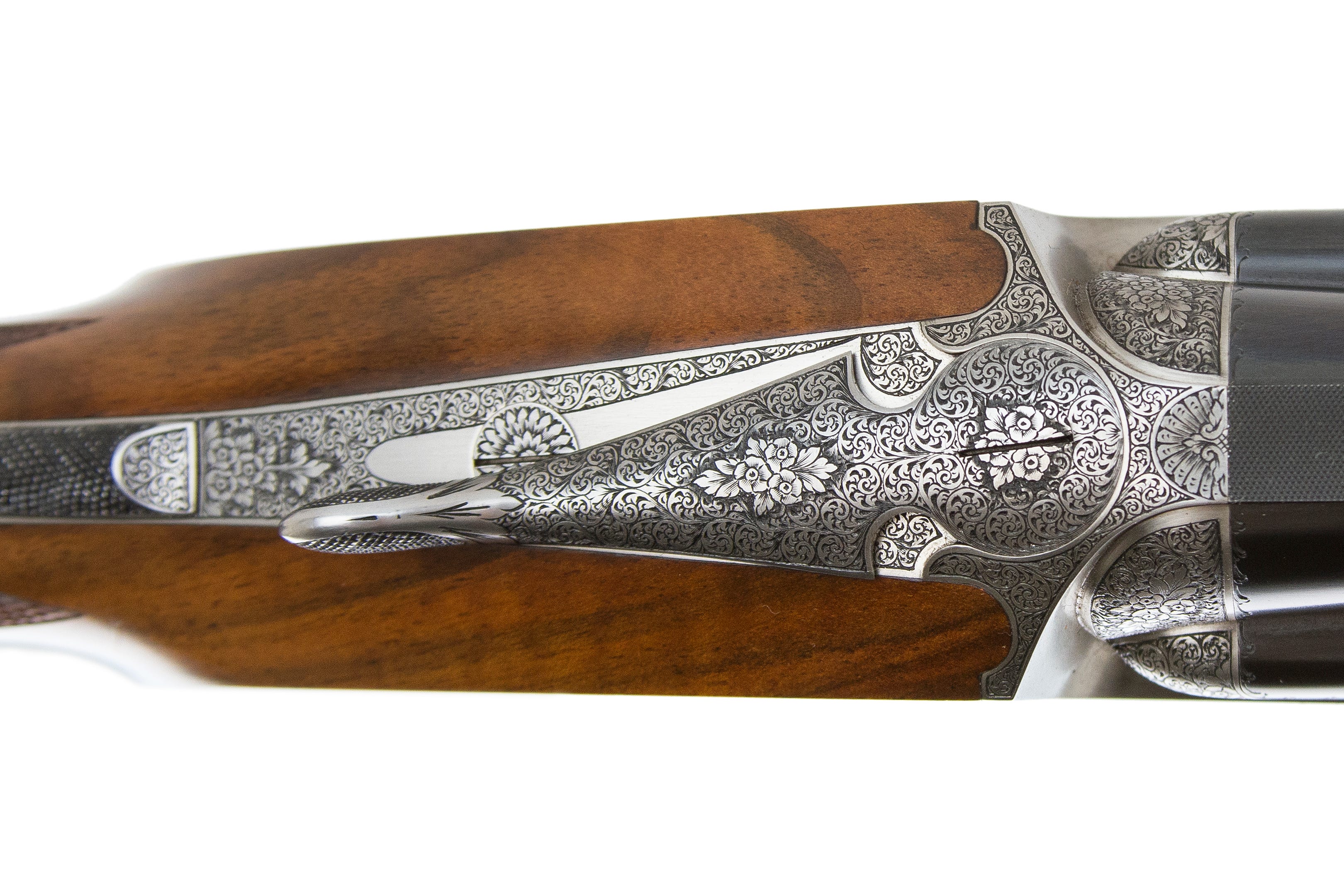
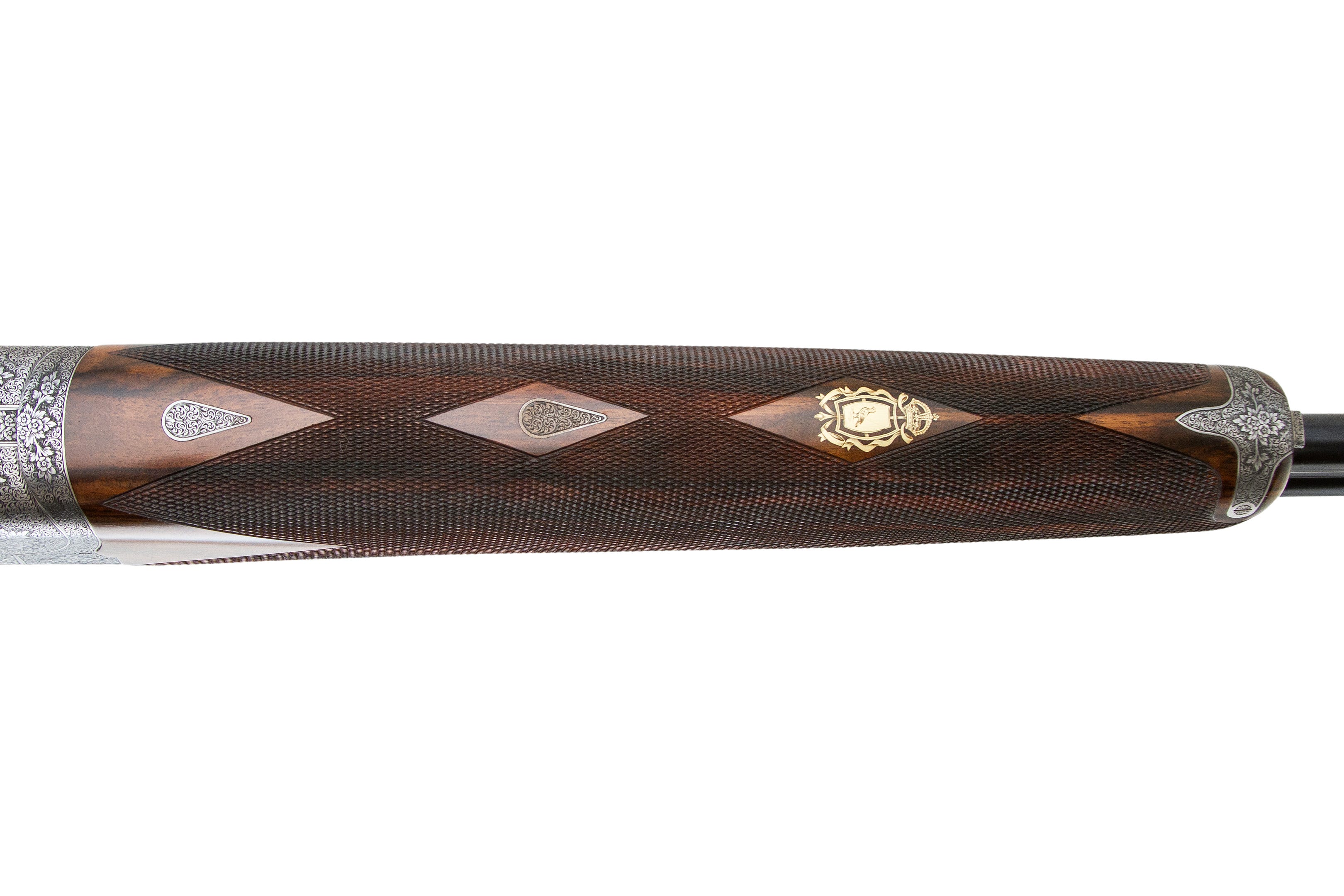
Around the scenes runs the grammar of the best-gun trade: bouquet-and-scroll borders, the long S-curve of the sideplates, fine scroll carried onto the trigger guard, up the top lever to its chequered thumbpiece, across the fences — where a small fan of ornament opens just behind the rib — and onto the scrolled nose cap with its bright push button, down to the two silver teardrops let into the wood itself. All of it is fine line engraving, a hand graver drawn through polished steel, tone built stroke by stroke — hatched, crossed, deepened — the way an etcher builds a plate, thousands of decisions in a medium that keeps every one forever, including the wrong ones. There are no wrong ones here.
And notice what the scenes are. Quail over pointing dogs. Grouse in birch cover. Pheasants climbing hard off open country. Three subjects from the American uplands, on a gun from Brescia, in the bore Americans turned into a test of skill. Together they read less like decoration than like an itinerary — a commission with a destination in mind. That is an inference; the order book that could confirm it is in Brescia. But engravers of this rank do not choose their subjects at random, and nobody orders three American hunts by accident.
Now the crown. Turn the gun over. Down the spine of the forend’s chequering runs a line of three smooth reserves let into the wood: three carry the silver teardrops, each cut with its own tight scroll, and the third carries gold — a closed crown, arched over a beaded band and finished with a trefoil at its peak, and beneath it a bordered shield hung in ribbonwork, bows at its shoulders and a crossed bow below. Inside the shield, on a few strokes of engraved ground, stands a single bird. It reads as an owner’s device, set into the wood the way Fabbri stocks of the era sometimes carried an owner’s gold personalization: discreet, exact, permanent. A crown above a shield claims rank by long convention — and this one, arched and closed, is cut to the royal pattern, though engravers have always handed out royal crowns more freely than the heralds do. And Badillini, remember, signed just such a crest in gold on another maker’s gun, which makes the attribution here easy to believe and, so far, impossible to prove.
The bird is the tell, or the tease. To the eye it is a pigeon, or a dove, standing composed on its little ground. Heraldry has a long habit of letting a lone charge speak its owner’s name — canting arms, the heralds call them, a picture that puns on a surname — and Italian is rich in families named for exactly this bird. If that is what the shield is doing, the name has been sitting in the wood all along, one translation away.
That is where the trail stops. The record attaches no name to the shield, and this piece will not invent one. Somewhere behind it there was a first owner, someone who wanted a .410 from the least compromising house in Italy, and whose crowned bird went into the wood in gold. The gun keeps the secret the way it keeps its lock screws: in plain sight, and perfectly.
Why a .410 at all? Because it is the hardest thing to do well, and this house only did things the hard way.
The .410 is the paradox of the shotgun world, the smallest shell in the field and the most demanding discipline in it. Half an ounce of shot leaves no margin. The gun must be pointed, truly pointed, or the bird flies on. American skeet made it one of the game’s four guns — the difficult one — and generations of quail hunters have carried it as a quiet boast, the gun of the shooter with nothing left to prove. An expert’s cartridge, in an expert’s gun.
Building a best gun around it is harder still. A sidelock over-and-under does not shrink gracefully. Every part gets smaller, every tolerance gets tighter, every flaw grows in proportion, and there is nowhere for a maker to hide. The great houses built them in handfuls across a century of work. Now run the arithmetic on this one. Fabbri builds two or three dozen guns a year, and that is the entire output of the house, across all gauges, for the whole world. The sub-gauges are a fraction of that. The .410s are a fraction of the fraction. Nobody outside the factory knows the true count; the examples that ever surface can be counted on one hand, and this is one of them.
Which is what makes the little gun in these photographs something more than rare. It is the smallest expression of the least compromising philosophy in the trade: aerospace steel, hidden fastenings, a Brescian master at full stretch, all in service of half an ounce of shot.
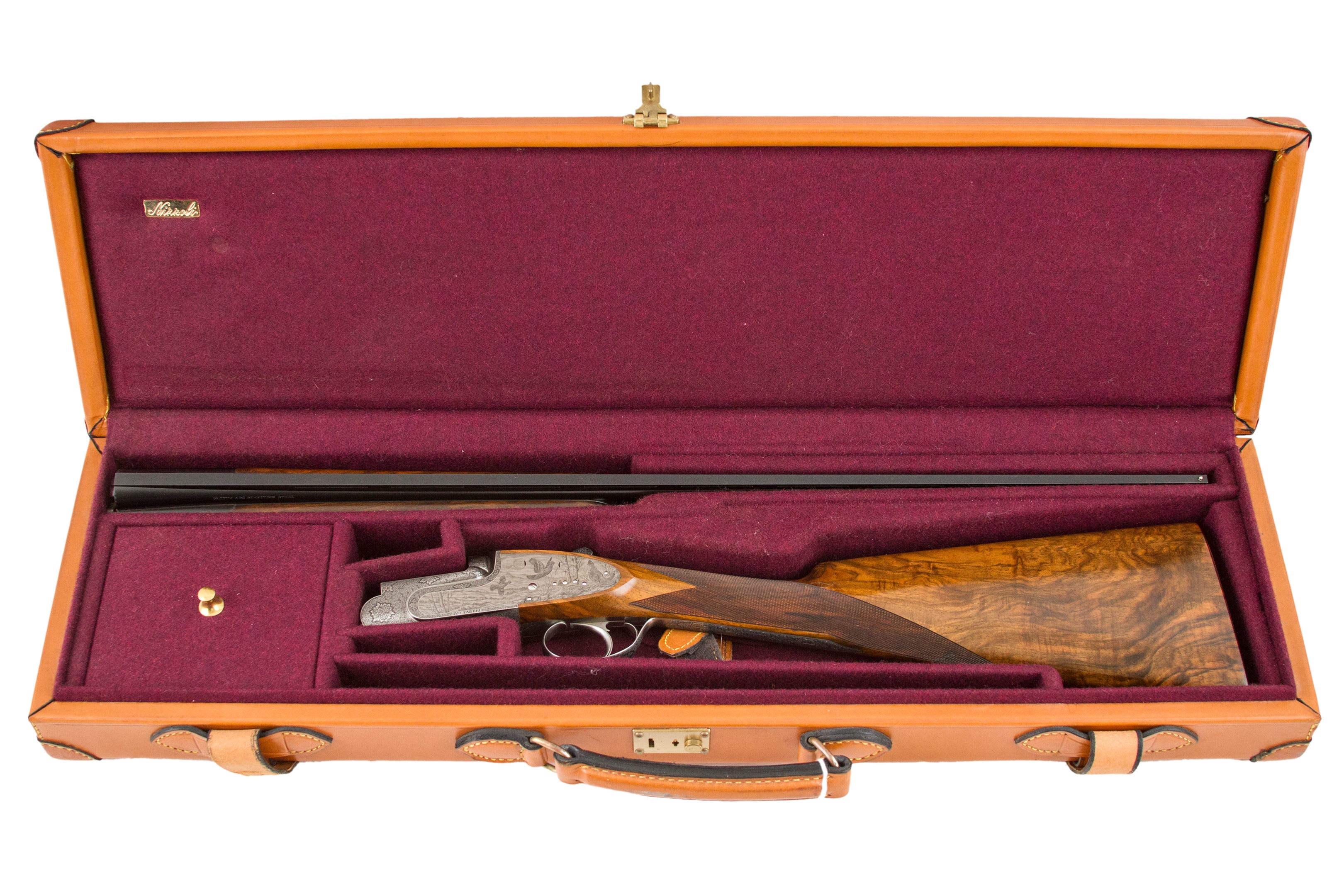
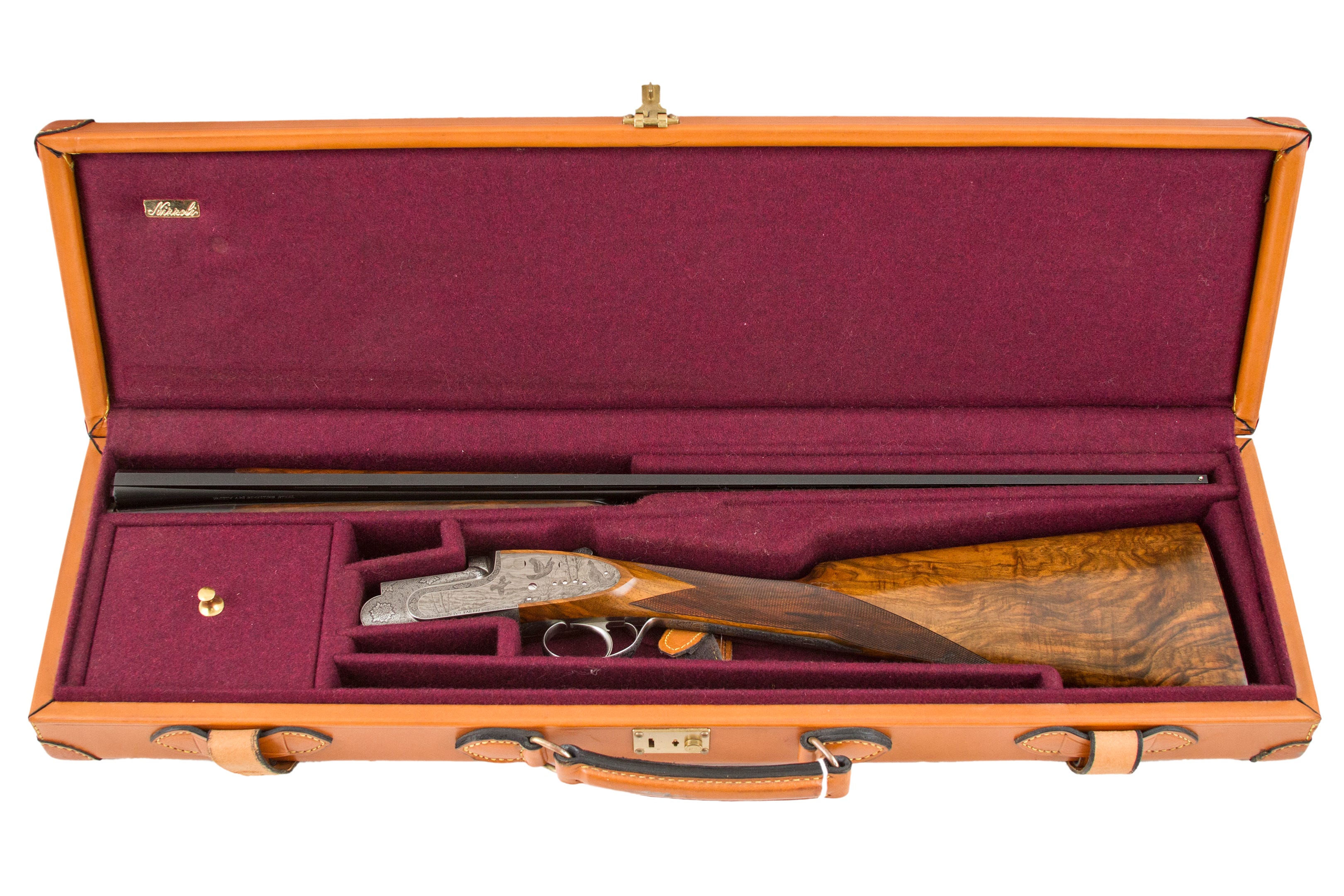
The gun lives in a tan leather case, strapped and buckled, with burgundy cloth beds and the Italian casemaker’s gold script set inside the lid. It breaks down into still shapes in the cloth — barrels laid across the top, stock and action on the diagonal below, a lidded compartment with a round brass pull keeping its own counsel in the corner. The scenes go dark when the lid comes down, and nothing in them changes. The dogs hold their point. The covey hangs above the long grass. The grouse thread the birches on wings that will never beat, and the cock pheasant and his hen climb forever off the rough grass, into a silver sky with no night coming.
Somewhere under the forend, a small stamped code is waiting to tell us the year. Somewhere in Brescia, an order book may still hold a name for the crown. The gun is in no hurry. It has three hunts to keep, and it is keeping them.
Comments
Nothing yet. Say the first thing.
Sign in to join the conversation.