
This post marks the beginning of a series based directly on my keynote at the EBSCO User Group Meeting in Omaha, Nebraska. Just as I did for my WOLFcon Plenary and iPres Keynote, I want to bring the substance of that talk into written form so that the conversation can continue -- and also, I had to cut a TON of content from the talk that I think is very relevant to the conversation as a whole. I hope you enjoy this talk and that you gain something from it, even if it is just a book recommendation or two.
Thanks for reading! This post is part of my EBSCO User Group Keynote series, where I’m exploring what it means to reclaim information sovereignty by defining open through the lens of AI. You can explore the rest of the series here:
Part 2: The Forcing Function
Part 3: The Ideological Storm
Part 4: A Shared Reality
Part 5: Governance and the Commons
Part 6: Reclaiming our Seat at the Table
I want to start this series with three confessions.
For much of my professional life, I have resided in what I call “The Medium Place.” For those of you familiar with the show The Good Place, you will recognize that the house on the slide below belongs to Mindy St. Claire—the eternal resident of “The Medium Place”. And if you haven’t watched The Good Place, you’re missing out on some great philosophy, but I digress.
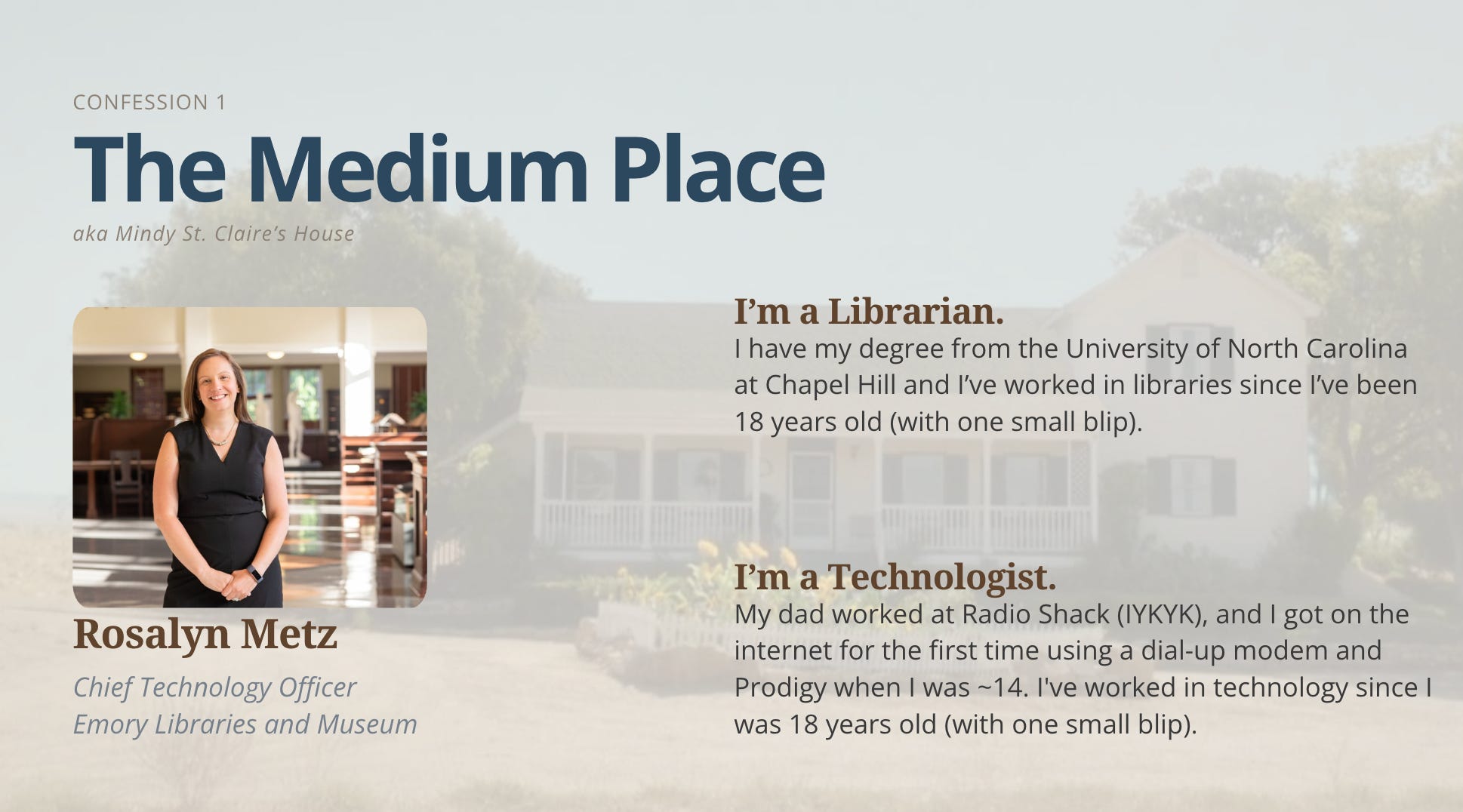
I am a librarian; I possess the degree, and I hold the values close (values that often feel undefined, though I hope we can map them out together through this series). But I am also a technologist. And for the better part of my career, these two core identities have been locked in a state of perpetual conflict.
I have spent years in rooms where policy was drafted by librarians who fundamentally misunderstood the technical mechanics, yet refused to learn the language or concepts to bridge that gap. Conversely, I have sat in rooms where technologists have architected policy while completely disregarding the necessity of intellectual sovereignty or the sanctity of the scholarly record.
My career has been shaped by this persistent, nagging desire to belong at tables that never quite seemed to have a chair for someone like me. I realize that might sound contradictory, given my current role at a prominent Research 1 institution, or my history at Stanford, Duke, and George Washington University. Not to mention, I am writing this as if I am an expert. But while my achievements are real, they do not erase the underlying struggle of being a permanent “other.”
If you have ideas, please reach out. I’d love to hear what you are thinking or what you’d like me to write about next.
I have watched library colleagues treat technologists as a support service—as people meant to do their bidding rather than serve as intellectual partners. I’ve lost count of how many times I’ve had to explain that my team possesses expertise far beyond just troubleshooting a laptop. Or how many times I’ve asked folks to learn the new ILS because it is a tool just like Word.
On the flip side, I have watched technologists reject me because I’m a librarian. I have had people from our IT unit try to explain to me how classification schemas work (which is rich, given that our people were creating classification schemas when we were still writing on papyrus, but I digress). I have watched them argue for application security without thinking about the data within the application. Trust me, I could read them the riot act too (and as some of my partners in Emory’s Office of Information Technology know, I frequently do). But today I’m here with you, in a room filled with librarians. So I’m going to focus on what you, as librarians, can do to take back control in a world of AI.
And, worst of all, last week I was told that this dynamic—the tension between being a technologist and a librarian—doesn’t exist, even though my colleagues and I navigate it every single day.
In short, I have been “othered” by both halves of my professional soul, then gaslit into believing the struggle isn’t real.
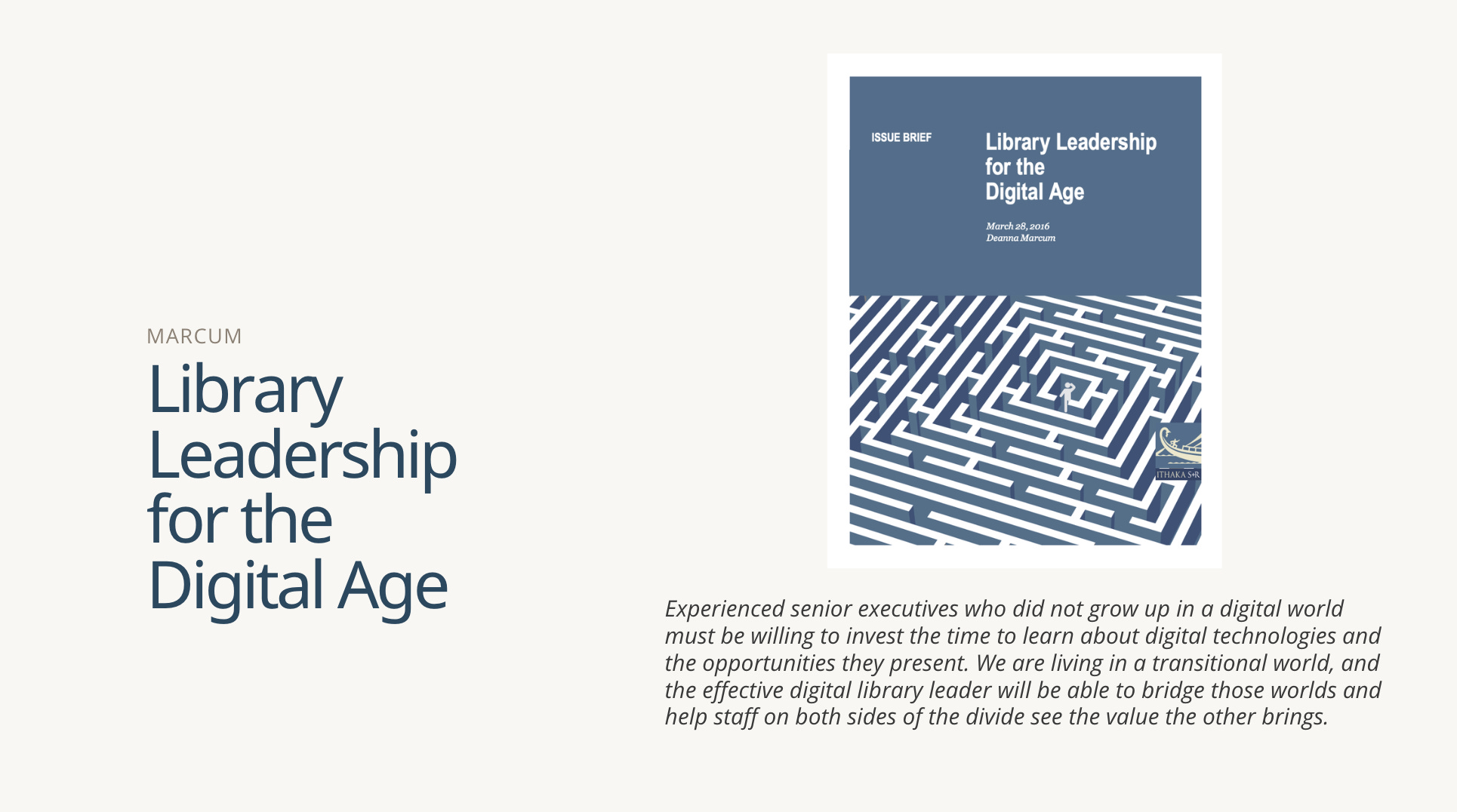
In her 2016 Ithaka S+R issue brief, Library Leadership for the Digital Age, Deanna Marcum correctly identifies the need for librarians (in this case, librarians in leadership roles) to learn more about digital technologies; however, I think we, as a profession, failed to heed her call. We cannot simply restructure the organization and hope that that makes things better; instead, we must ensure that librarians themselves possess the technical fluency to lead conversations about technology, rather than remain passive recipients of digital strategy.
Librarians who shy away from technical discourse aren’t merely sticking to their expertise; they are retreating into obsolescence and surrendering their influence. We can no longer relegate the need for technical expertise to the periphery of our organizations. Instead, we must place this expertise at the very heart of our strategic planning and organizational growth
Did something I said spark an idea?
And I have a second confession to make.
I wasn’t always this fired up and certain about AI. In fact, I remember when my friend, the brilliant Bohyun Kim , first started talking about AI in libraries ages ago; long before many of the people you see on LinkedIn were talking about it (myself included). And I’m going to be honest with you—I didn’t get it. I listened to her because she’s my friend, because she’s smart, and because she’s kind and funny. And, sometimes she’s this little nagging voice in the back of my head telling me to do better. But at the same time, every time I heard her talk about AI, I thought, “Bohyun. AI? Really.”
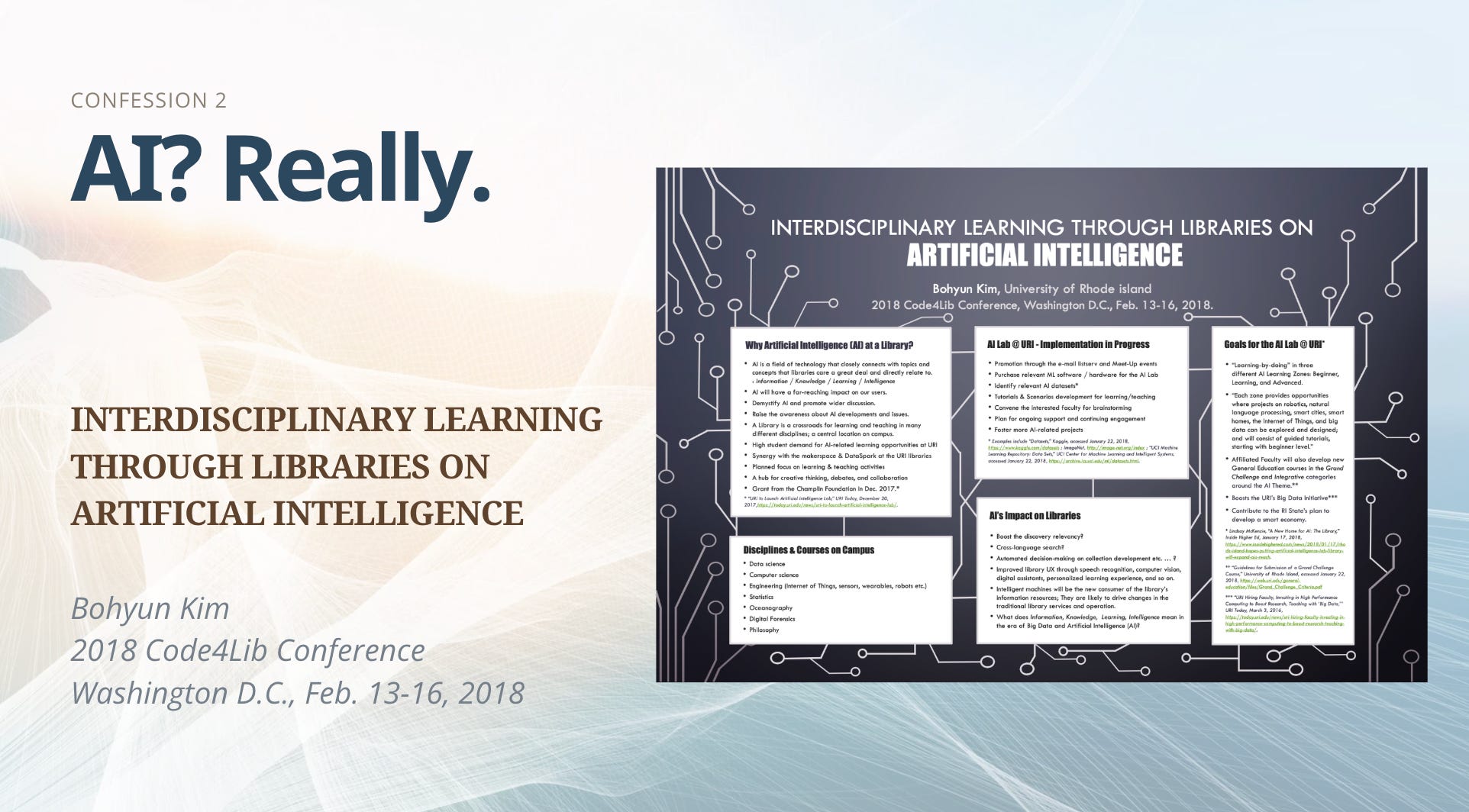
The slide above shows the first tangible thing I could find she created about AI. It’s a poster she did in February 2018 about AI at Code4Lib in Washington, DC. Based on some quick sleuthing, she had to have submitted this as a proposal sometime in the fall of 2017. For Code4Lib 2018, the community voted on 68 proposals. There were 5 proposals that mentioned machine learning, three of which were accepted to the conference. No proposal — poster or presentation — mentioned AI except for Bohyun’s. Bohyun’s proposal was submitted after she and her University of Rhode Island colleagues had already spent a year developing a library AI Lab. This isn’t to say that there weren’t others talking about or developing AI in libraries, but I do feel its important to point out that in some respects, I and many others are late to the party in relation to folks like Bohyun.
Thanks for reading The Digital Shift! This post is public, so feel free to share it with a friend or colleague.
I was also reminded recently that 2018 was around the time Andrew Yang, then an early presidential candidate, was advocating for Universal Basic Income because he thought AI was coming for our jobs.
I want to acknowledge this today. Bohyun, once again, you were right, and I was wrong. Andrew Yang doesn’t know me, so he probably doesn’t care about this, but he was also right.
Ok, this is my last confession, and this one is the hardest: I am drowning.
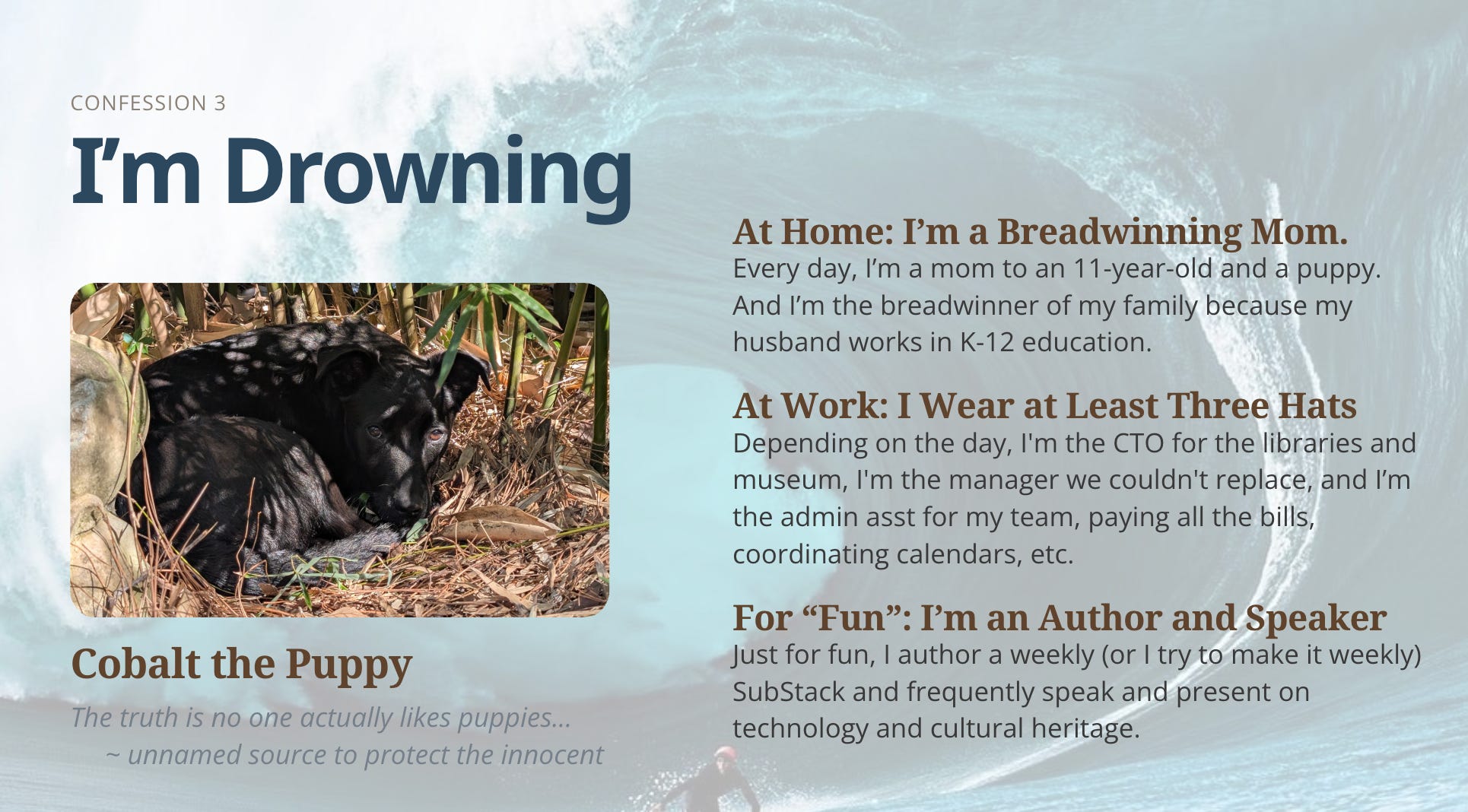
At work, my team currently faces a deficit of four key positions: a manager, a software developer, and two application support analysts. Despite my title as Chief Technology Officer for the libraries and museum, I regularly function as my team’s administrative assistant. I handle everything from processing invoices to booking travel, all while managing a calendar (mine) that oscillates between being overextended and completely unrealistic. Furthermore, I am on call every single night, a necessity born of the fact that I cannot fairly demand constant availability from my only two remaining staff members on call without taking on some of that responsibility myself.
And, of course, because I clearly have a flair for the dramatic, I decided six months ago to start a Substack and accept invitations to speak at conferences all over the world.
WHAT. THE HECK. WAS I THINKING?
I think I’ll conclude here for this week, you know, now that our collective anxiety is through the roof, thinking about all the things I have on my plate.
Next week, we'll discuss strategies for addressing some of the challenges I’ve shared in my confessions, which I know are not unique to me. Together, we'll look at the bigger picture and consider societal changes that make engaging with AI essential.
Comments
Nothing yet. Say the first thing.
Sign in to join the conversation.