
This is the second post in a series based directly on my keynote at the EBSCO User Group Meeting in Omaha, Nebraska, where I’m exploring what it means to reclaim information sovereignty by defining “open” through the lens of AI. Just as I did for my WOLFcon Plenary and iPres Keynote, I want to bring the substance of that talk into written form so that the conversation can continue -- and also, I had to cut a TON of content from the talk that I think is very relevant to the conversation as a whole. You can explore the rest of the series here:
Part 2: The Forcing Function
Part 3: The Ideological Storm
Part 4: A Shared Reality
Part 5: Governance and the Commons (this post)
Part 6: Reclaiming our Seat at the Table
In preparing for this keynote, I thought deeply about what differentiates galleries, libraries, archives, and museums (GLAMs) from big technology corporations. And what I realized is all that really matters is the obvious: GLAMs are focused on cultivating, sustaining, and reinforcing the communities they serve. Big tech corporations are focused on acquiring and profiting off consumers.
If that is the major difference, what structures must we build to ensure our communities can continue to prioritize the values that will help them thrive now and into the future?
For too long, we’ve been told there are only two ways to manage a shared resource:
Big Government Regulation: Top-down state control that regulates the resource into strict, bureaucratic submission.
Corporate Privatization: Handing the resource over to private markets to own, manage, gatekeep, and ultimately lease or sell back to us.
This is the way Locke, Hobbes, and other philosophers have described the world for hundreds of years.
Thanks for reading The Digital Shift! This post is public, so feel free to share it with a friend or colleague.
But there is a third way.
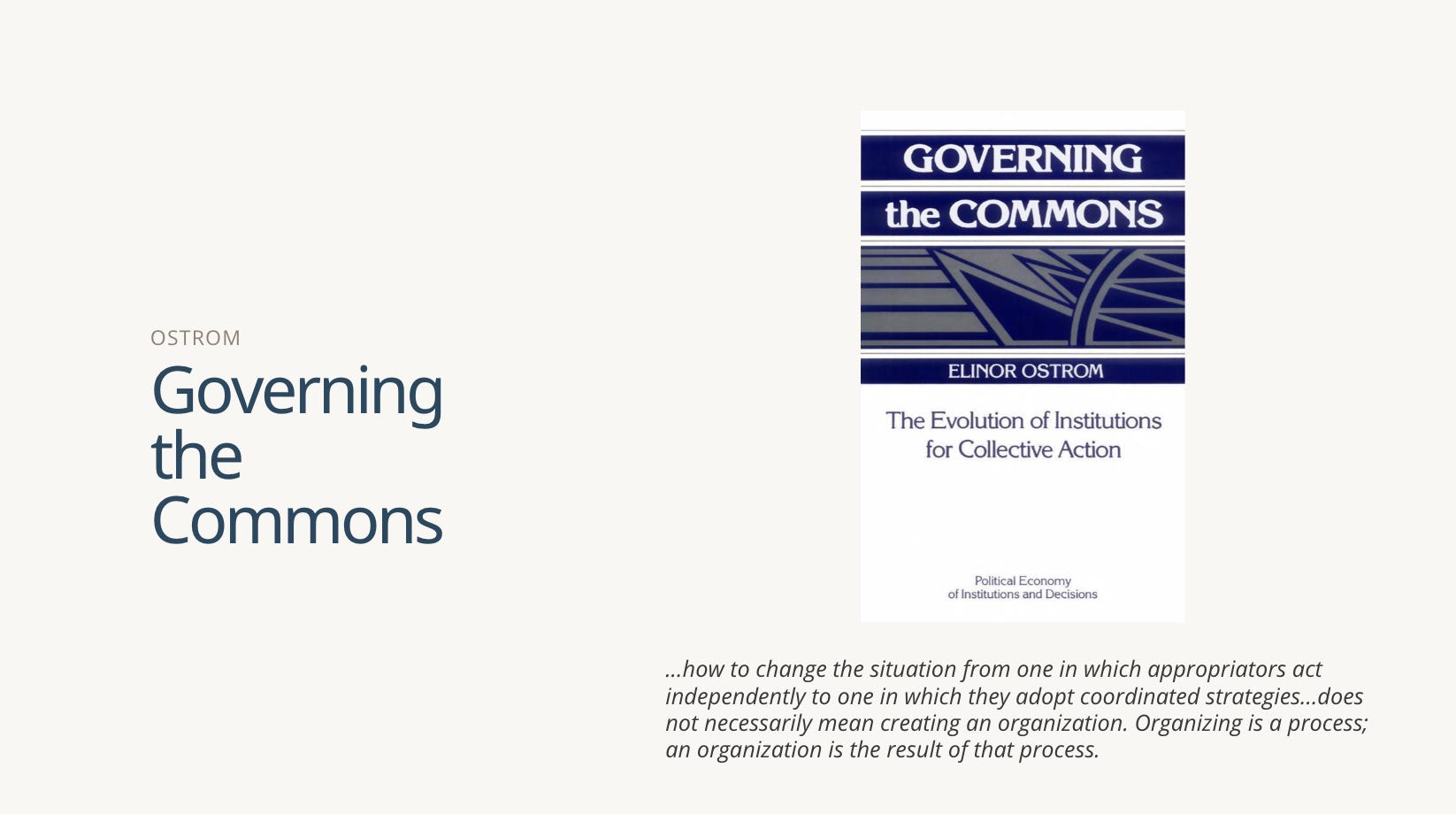
Elinor Ostrom, the first woman to win the Nobel Prize in Economics, spent her life studying the Commons. She defined the Commons as a resource managed by the community that depends on it. More specifically, she examined how people successfully shared fisheries, forests, and irrigation systems without these systems collapsing into greed or neglect.
To understand how Ostrom rewrote the rules of economics, we first need to unpack the baseline vocabulary used to classify resources. Standard economics categorizes all goods based on two fundamental variables:
Excludability: How easy or costly is it to prevent someone from accessing or using the resource? High excludability means you can easily keep people out (e.g., a locked building, a paywalled website). While low excludability means it is incredibly difficult or practically impossible to prevent access (e.g., the open ocean, the public internet).
Rivalry: Does one person’s consumption of the resource reduce the amount or quality available to others? Highly rivalrous means consumption is zero-sum (e.g., if I eat an apple, you cannot eat that same apple). While non-rivalrous means simultaneous use is infinite (e.g., my listening to a radio broadcast doesn’t diminish your ability to listen to it).
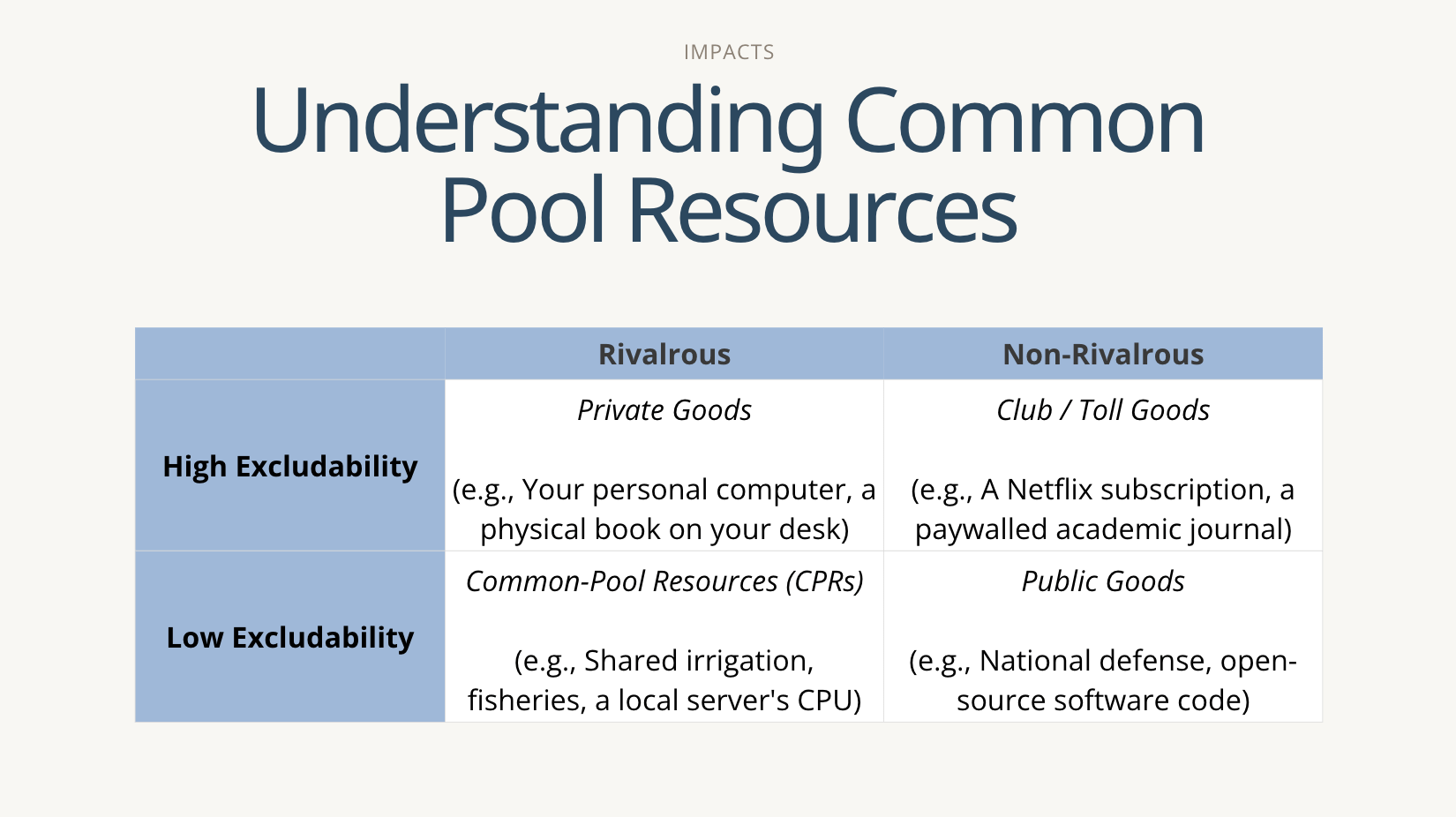
A Common-Pool Resource (CPR) is the trickiest of them all: it is low-excludability but highly rivalrous. It is a shared ecosystem where anyone can use the resource, but every time you use it, it leaves less for everyone else. This is where the risk of exploitation is highest—and it is precisely the ecosystem Ostrom set out to define.
Did something I said spark an idea?
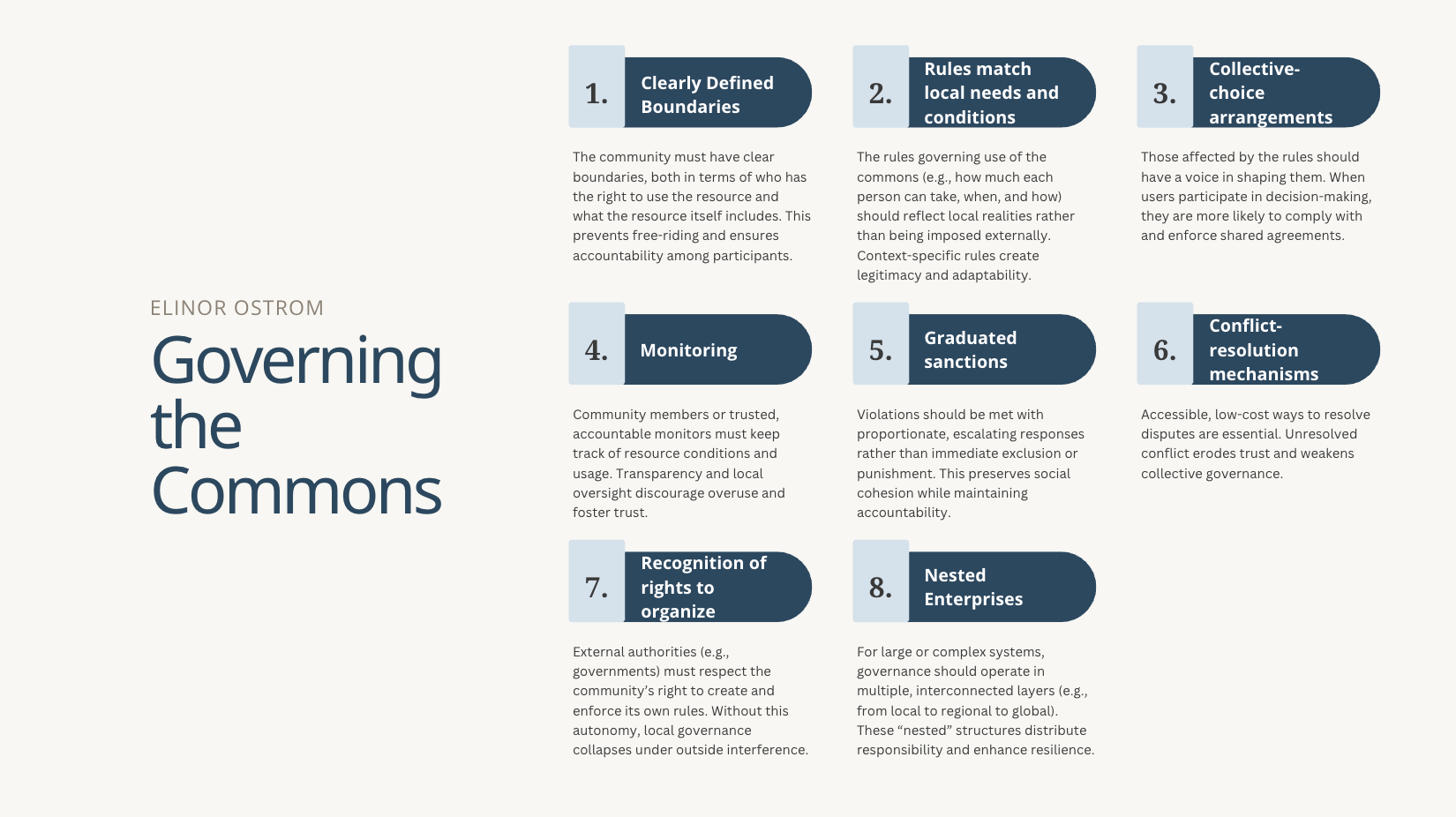
In her seminal book, Governing the Commons, Ostrom outlined eight design principles that serve as the foundation for building trust and sustainability in shared spaces:
Clear Boundaries: Knowing who is “in” and who is “out” of the user group, and what constitutes the shared resource.
Local Congruence: Rules must fit the actual local context, culture, and biophysical environment.
Collective-Choice Arrangements: The people affected by the rules must have a seat at the table when those rules are written or changed.
Accountable Monitoring: The community itself must monitor behavior, ensuring accountability.
Graduated Sanctions: Rule-breakers face escalating penalties—starting as gentle, constructive reminders before moving to harsher consequences.
Conflict-Resolution Mechanisms: Quick, low-cost, local arenas to resolve disputes.
Self-Determination: External authorities must recognize the community’s right to self-govern.
Nested Enterprises: For larger systems, nested layers of governance are built from the local level up to the global level.
For Ostrom, a commons is not merely a free-for-all pile of resources. It is a living, breathing social system rooted in a web of mutual relationships. Governance, in her framework, is ultimately a mechanism for constructing and maintaining trust.
Toward the end of her career, alongside Charlotte Hess, Ostrom realized her work applied directly to the scholarly record, not just to the initial fisheries and grazing lands she had originally discussed. Together, they pioneered the concept of the Knowledge Commons. Within this framework, we can view knowledge as a distinct type of CPR.
In classical economics, digital knowledge is viewed as “non-rivalrous”—if I read an open-access article, it doesn’t prevent you from reading it too. But Ostrom and Hess recognized a critical nuance: while information itself may be non-rivalrous, the access and maintenance infrastructure supporting it is.
Which brings us to my favorite topic: AI web scraping.
If you have ideas, please reach out. I’d love to hear what you are thinking or what you’d like me to write about next.
When AI companies unleash aggressive, unthrottled web-crawling bots to scrape the content on GLAM websites, they aren’t just reading (which, remember, we said is non-rivalrous). Instead, they are actively consuming our infrastructure’s bandwidth, degrading server performance, increasing infrastructure costs, and shutting down human access to the content. Even worse they are:
Misappropriating cultures by scraping sacred or sensitive knowledge, stripping away community-defined permissions.
Decoupling knowledge from its provenance, severing the historical context, and destroying the metadata and curation work painstakingly done by GLAM professionals.
Eroding knowledge sovereignty, turning curated digital heritage into anonymous, homogenized training tokens for commercial LLMs.
By weaponizing openness to harvest data and use it to train AI models, they turn a CPR into a playground for corporate greed.
This is precisely why Ostrom’s design principles are so vital for the survival of GLAMs in the age of artificial intelligence. They provide a blueprint for defending our digital infrastructure against corporations.
By applying her principles, we can design a resilient, active, relational ecosystem for human beings. To borrow from my own writing:
[We] need to evolve from being “open by default” to being “open with thoughtfulness.” This entails creating environments in which agreement, governance, and collaboration guide participation. Genuine openness supports the commons through shared responsibility, rather than through indiscriminate exposure.
~myself in Openness Has Limits
But as we look to architect “open with thoughtfulness”, we can’t just focus on developing flexible schemas, model agreements, or solid technologies. We have to begin by reclaiming our roots—returning to the foundational philosophies of epistemology, truth, and the process of knowledge creation. Next week, in the final installment of this series, we will dive deeper into what it means to step out of our comfort zones, honor those intellectual origins, and cultivate a modern profession capable of anchoring our communities in a changing world.
Comments
Nothing yet. Say the first thing.
Sign in to join the conversation.