
Hi,
I’m just riffing this week.
Hope you still like it.
Last week was the 130th Boston Marathon, a race every runner wants to run but no runner needs to run.
No, that’s not quite true. Many runners do need to run it. Not becaue it pays the bills. Not because life cannot technically go on without running from Hopkinton to Boylston Street with burning legs and a questionable sense of personal judgment.
It’s because the wants that matter become the needs we remember.
What makes the Boston Marathon so iconic is more than its age. It’s one of the few televised running races, maybe the only one non-runners recognize.
The course itself is hard, famously so. The hills come late, when the body has already begun sending strongly worded letters to management. But the hardest part of Boston may not be the race.
It’s getting to the starting line.
The traditional way into Boston is to qualify. And qualifying is not easy. The standards are difficult. Even hitting a qualifying time does not guarantee a spot. If too many runners run faster than you, well, congratulations on your accomplishment and better luck next year.
Some people spend their whole running lives chasing a Boston qualifying time. Others, like me, hope to keep running long enough to simply age into the race (fingers crossed).
It’s why runners may treat those wearing jackets with the indelible blue and gold unicorn logo with reverence, quietly nodding at them in airports like they belong to some secret and slightly deranged society.
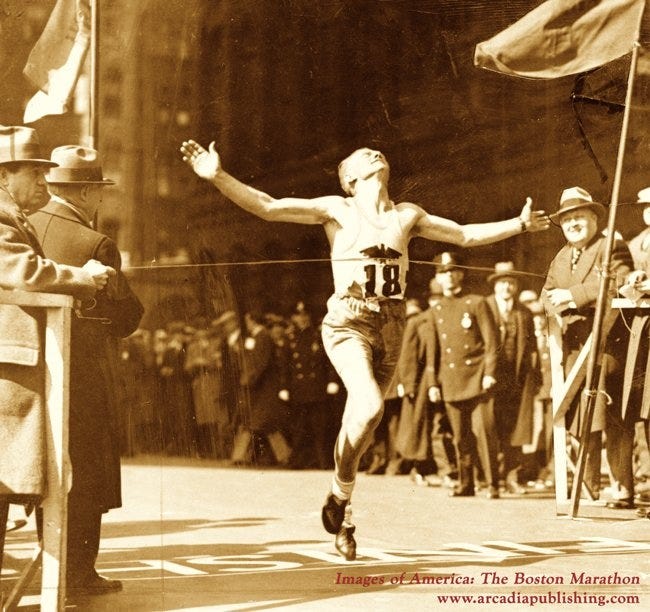
The reward is not just the medal or the jacket or the finishing time. The reward is being surrounded by the best in the world and realizing, in some small way, that includes you. The reward is a deep sense of pride and accomplishment. The reward is a spirit of enduring humanity found in few other places, at few other times, in quite the same way.
The runner Tommy Rivs knows something about this. He once challenged elite fields. Then he battled a rare form of lung cancer, a battle that involved multiple surgeries and medically induced comas and a kind of bodily devastation most of us cannot imagine, much less come back from to run marathons again.
Yet, there he was last week, back in the fray. Slower than before, but as determined as ever. Afterward, he posted on Instagram: “You’ve done it again the way only you can. Simultaneously breaking me down and filling me in the most beautiful way. I needed this.”
I needed this.
The fact is, I want to run Boston, but I don’t feel that I need to. And that’s probably why I won’t ever do it.
A basic principle of personal finance is to separate wants from needs. It’s treated as a tenet of success, one of the first clean little lessons you learn. Needs go in one column. Wants go in another. Food, shelter, utilities, insurance, healthcare, savings. Those are needs. The other stuff is wants.
This is useful, especially if you are struggling financially or otherwise. It’s useful if money is tight, or life feels unstable, or you are trying to build a foundation. You do need to know the difference between what keeps you alive and what merely keeps you entertained.
But for living a meaningful, happy life, that separation is an illusion. Or at least, I’d argue, not the best way to think about it. It makes sense on paper, but in life the separation of wants and needs is gloriously messy.
You may try to keep a hard barrier between wants and needs, but like atoms, they pass through. They mingle. They trade places. They become one another through time, meaning, love, grief, age, illness, ambition, longing, beauty and all the other things no budget worksheet can quite hold.
Running Boston is not necessary by any obvious measure. But for some people, it becomes necessary to feel whole. Necessary to validate the training. Necessary to prove you are stronger than you once thought. Necessary to be part of a miraculous point in time. Necessary not to survive, exactly, but to feel fully human.
None of it is necessary. Yet, somehow, all of it is necessary.
Nick Thompson, the journalist and runner, wrote that “running can pull you both inward and outward.”
That seems right to me, and maybe that’s a more useful way to think about wants and needs. Not as fixed boxes, but like lungs. Expanding and contracting. Pulling inward toward security, discipline, self-control, enough. Then outward toward desire, risk, experience, love, beauty, meaning.
There’s the need for survival. Food. Shelter. Safety. Health. The necessary boring things that keep the lights on and the fear down.
But there’s another kind of need. The need to pursue something. The need to love someone. The need to try. The need to make something. The need to do the thing that does not make sense on paper but makes absolute sense somewhere deeper in the chest.
Life is not orderly and does not respect our neat columns. Time, especially, tends to mess up the order of operations.
While Tommy Rivs is creating a new life, the former U.S. senator Ben Sasse is navigating the end of his own. He’s been public about having terminal cancer. Rather than retreat from view, he’s spoken openly about what it means to live while dying. And like many people facing the end, he has described how illness rearranges the furniture of life.
Things that once seemed optional become urgent. Things that once seemed like wants become needs because there is no longer time to leave them waiting politely in the other column:
“We’re all on the clock, and I wanted to have prioritized better. Whether I really only have three or four months left, or if I get nine to 12 months left, I want to prioritize better from then.”
That’s the terror and the gift of mortality. We’re all on the clock. Most of us just get to pretend we don’t hear it ticking.
So what does that mean for the wants we keep postponing?
What does it mean for the things we say we will do when conditions are perfect, when the money is right, when work settles down, when the kids are older, when the market is calmer, when the calendar opens, when we are finally less tired, less afraid, less burdened, less ourselves?
Some people use time to their advantage. Comedian Steve Martin famously gave himself a deadline for comedy. If it did not work by age 30, he would stop and get a regular job. That kind of line can be clarifying. It turns a dream into a project. A want into a working need, at least for a while.
That’s what matters, the attempt.
A hospice doctor, Jordan Grumet, has written about what people talk about near the end of life. What mattered most was not the accumulation. Not the scoreboard. Not whether every practical decision had been optimized.
“What really mattered is their purpose and identity,” he said. “And that has everything to do with their experiences, their passions, and the people they surrounded themselves with. It has everything to do with trying to do important things — not whether they succeeded. And this is a really, really big one; whether they succeeded or not is much less important than whether they had the courage to try.”
The courage to try.
My point is not that every want deserves to become a need. Wants deserve scrutiny. Some are shallow. Some are planted in us by comparison or advertising or the strange humiliation of watching other people live more photogenic lives on the internet. Some wants are just noise dressed up as identity. Yet, I don’t believe most wants are the stereotypical impulsive material possession.
Life would feel incomplete without ever getting what you wanted. Sometimes what you need is what you want.
Which brings me back to Boston for a moment.
A viral moment from last week’s race was three runners, none of whom won, none of whom came close, becoming part of the race’s story. A man who had “hit a wall” was trying to stand, but each time he rose, his legs gave out and sent him back down. Then two other runners came to his side and, without a moment of hesitation, lifted him up and carried him forward to the finish line.
No one needed to do that if we are using the narrowest definition of need. They had their own races to run. Their own times to chase. Their own finish lines to cross. But of course they needed to. Because sometimes honor becomes a need. Love becomes a need. Community becomes a need. The humanity of stopping becomes more necessary than the personal glory of going. The person you want to become is the thing you need to do.
There’s a blurry line somewhere for each of us, where the want becomes a need. And one day, what you want may become out of reach for reasons that have nothing to do with money.
That’s the part personal finance often fails to hold. It’s good at math. It’s good at warning us that money spent today cannot also be invested for tomorrow. It’s good at reminding us that the future matters. But the future is not the only thing that matters.
Finance writer Ben Carlson put it well: “There is no perfect equilibrium that perfectly balances out your present contentment with your future needs and risks… You do the best you can by saving for the future while defining your current priorities.”
There is no perfect equilibrium. There is only a person trying to live in time.
Few things in life make sense in a purely economic sense. Training for years to run Boston does not make sense. Helping a stranger finish a race when your own time is ticking away does not make sense. Making art does not make sense. Having children does not make sense. Loving someone who may leave or suffer or die does not make sense. Spending money on a trip, a meal, a concert, a class, a dream, a ridiculous little adventure you will remember forever does not always make sense.
What I witness when I watch the deep breaths, the tears and screams, the sweaty embraces and the occasional projectile vomit that characterize a marathon finish line is that life is not lived on paper in perfect little organized boxes.
There is no perfect formula. The math of life is funky.
Poet Wendell Berry once wrote, “Do something that won’t compute.”
Maybe that’s the line. When the thing you want sounds a little crazy and doesn’t go away. When it attaches itself to identity, purpose, love, memory, courage. When it becomes part of the person you’re trying to become, or the person you’re trying not to lose.
That’s when a want becomes a need. Not when the spreadsheet says so but when the soul does.
Notes to my future self:
The wants that matter become the needs we remember.
There is no perfect equilibrium. There is only a person trying to live in time.
The math of life is funky, so do something that won’t compute.
With gratitude,
J.S.
No posts
Comments
Nothing yet. Say the first thing.
Sign in to join the conversation.