
“I worked on a novel for more than a decade. It’s about migrant women, a story I really care about. But I can’t sell it… I thought, once my novel came out, it would be a way for me to build community. But now, I have to move on.”
Caron [Atlas] said: “What I know about building community is—most people, they don’t do it alone. It’s hard to do alone. They get together with others to build community.”
Last fall, in between researching my next book at a residency in Minnesota, I started scribbling an essay about my neighborhood in Brooklyn NY. Perhaps being away from home helped facilitate the reflection. But I’d known for a while that I wanted to write about Kensington and the community I’ve found here. By writing this essay, I wanted to explore how directing my energies into community-building helped me re-cast myself as a writer. Especially a writer who, at a the time, couldn’t sell her work.
Writing fiction is often such a solitary endeavor. Part of me has always thrived on this — the interior process I get to inhabit through the writing process evokes the imaginary worlds I played in as a child. But that hiding away has never felt quite right either. I live for asking questions, for curiosity. (It’s why I’ve managed to plumb the life story of every cabbie I’ve had.)
What’s more, while I’ve found the writing process lonely at times, that loneliness was nothing compared to the particular isolation I felt when Outside Women was rejected by every commercial publisher.
I could only wallow in that emotion for so long. At some point, I decided to do something about it. That’s when I had the conversation excerpted above with Caron Atlas, director of a community-based organization, which led to working on an incredibly rewarding project with her. As part of a foundation-funded participatory research study, I started collecting Kensington’s stories. And through that process, a new understanding of my artistic life and my role as an artist in the wider world began to take shape.

The essay I wrote about this journey is now up at Adi Magazine — a truly wonderful outlet that I highly recommend. I’m excerpting the first few paragraphs of the essay below and the rest is up to read (for free) at Adi.
It felt subversive to imagine this as my neighborhood, still. That I might have a home in America, still.
November 9, 2016, past midnight. I tried and failed to undress in my dark bedroom, caught in a tangle of clothes. My hands shook too hard to meet the demands of buttons and zippers. I gave up and fell into bed half-dressed. No sleep would come. I am Muslim and my country had just become Donald Trump’s America.
The day before, my husband and I had signed a contract for our first home—a cooperative apartment in a small immigrant neighborhood known as Kensington in Brooklyn, New York. As I lay awake that long election night, I wondered if, like Jewish families in 1930s Europe, we’d have to flee or would be taken to camps, and our apartment would breathe on without us. I imagined other people stepping on our rugs with shoes and scratching forks against our dishes.
I visited my new neighborhood occasionally in the weeks that followed, while we waited for the paperwork to come through. I’d clamber into one of the shared taxis that struggle stop-start along the chaos of Church Avenue. Inside, it was always silent as commuters stared out dingy windows. Alighting in Kensington, I’d stop at Kabir’s, a Bangladeshi bakery where I’d get a scalding cup of chai to accompany my walk along McDonald Avenue. The F train hurtled overhead scattering pigeons. Further down, I’d cross over to Ditmas Avenue, past the cafe where men smoked over backgammon, the Uzbek restaurant’s aquarium window, the halal cart’s steaming wares across from a pharmacy. The playground next door to my new building was deserted and melancholy during school hours. It felt subversive to imagine this as my neighborhood, still. That I might have a home in America, still. The future was so uncertain.
At the time, I’d been floundering through a draft of a novel I’d begun during my graduate creative writing program about five years earlier. In those solitary years, I struggled to keep going without the structure and support of the program, and especially missed belonging to a community of writers. Now, plunged into despair by the election results, I began to wonder if my novel about the solidarity built between migrant women was a pointless and distant dream.
In the days after Trump’s inauguration, I learned about a rally in my new neighborhood organized by a grassroots organization—DRUM (Desis Rising Up and Moving). The event called for designating Kensington a hate-free zone. Though I didn’t know any of the activists involved nor their plans for this zone, I decided to venture to the advertised location and watch from the sidelines.
Close to sunset, I trudged through residential streets lined with houses and brick apartments, past the public school with the bright red front door, a hardware store with lumber stacked outside, and another store selling bitter gourd and jackfruit and halal goat. Eventually, the streets came together into an open, public space at an intersection. Avenue C Plaza seemed almost too small to be called a town square—only a narrow triangle demarcated by three criss-crossing neighborhood arteries.
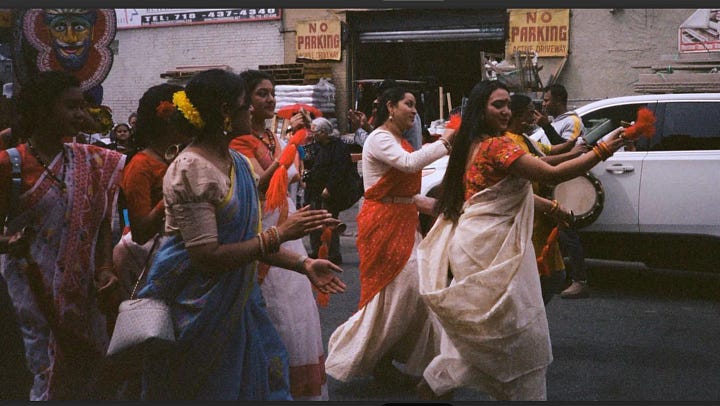
Others streamed in from the surrounding area as trucks and buses trundled down the streets adjoining the plaza. White folks in jeans and puffy coats, children trailing mittens. South Asians like me, some in traditional garb layered with nylon parkas. Many others of all stripes and colors and shapes carried handmade placards. “I love Kensington” proclaimed one sign on the back of a flattened cardboard box, concentric hearts traced with a sharpie. Hundreds of my new neighbors gathered on this January evening to declare their solidarity with the people our new government vilified. My heart lighter and heavier at the same time, I stepped forward to join the milling crowd and listen to the speakers. After, we marched chanting around the plaza. The people, united, will never be defeated. Voices ringing out around me on streets growing familiar, I could almost dare to believe it—that we might survive this administration together.
“Right before 2016, I felt attached to the open and public space conversation—trying to help shape this plaza that sits across from the mosque. I felt really compelled by the mission to make the space a place for women to gather, to roam, to be, to meet their friends, and for young girls to have additional room to play… The plaza has helped shape culture and community solidarity in ways that I couldn’t have projected. It has made the community feel comfortable to gather at some of the hardest moments of political life in our city and state. When Trump got elected, people gathered here. At moments of community struggle and resistance, the plaza was where there was a clear demonstration of ‘we must not be divided’.”
—Shahana Hanif, New York City Council Member for District 39
Outside Women updates!
Thanks so much to Kate Baldus for her thoughtful review of Outside Women in her substack, Read Wander Ponder. Highly recommend subscribing to her wide-ranging newsletter for insightful essays — this post last year was one of my favorites.
I’m taking a break from all things for August (phew) but I have several book-related events planned for the fall. I will update my events page on my website as I receive more details! Hope to see you at one of them. And hope you’re taking some time for rest and restoration this summer as well.
No posts
Comments
Nothing yet. Say the first thing.
Sign in to join the conversation.