
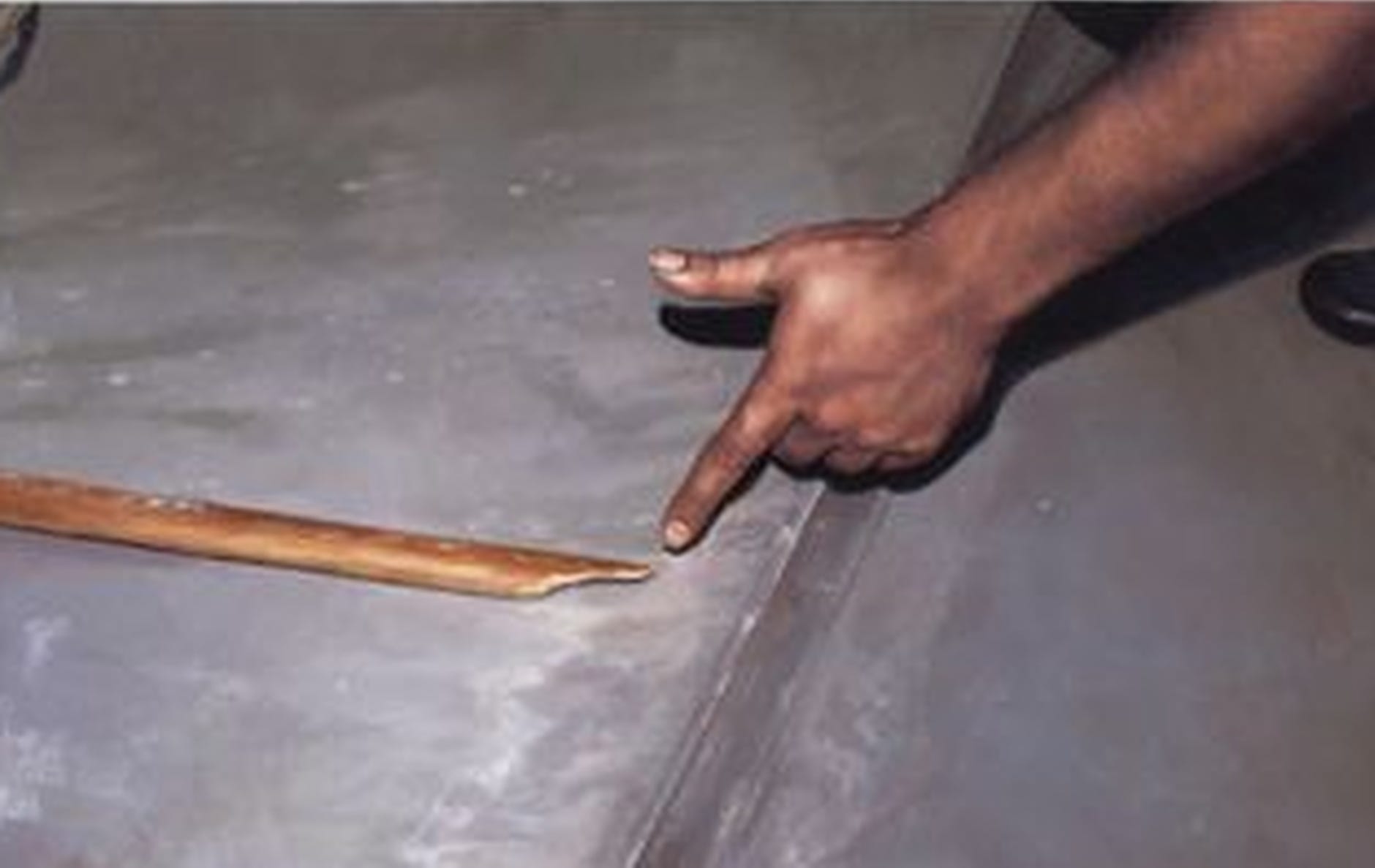
Take a moment to look at this painting.
Would you call the painter an amateur?
This painting was made by artist Pat Nelson in 1969.
Have you ever heard of Pat Nelson?
In 1969, LA artist John Baldessari visited regional art fairs in the San Diego area and looked for “Sunday painters,” as he called them: self-made, commercial painters operating far outside the credentialed gallery system. He handed them 35mm photos that he took of his friend George Nicolaidis’s hand pointing at utterly mundane things and gave each artist a strict instruction:
“Don’t try to make art out of it. Just render the slide as faithfully as you know how.”
Baldessari paid the artists a flat fee between $20 and $40 ($170–340 in today's money). When they finished, Baldessari hired a professional sign painter to add a stark text caption at the bottom of each canvas: A Painting by Pat Nelson.
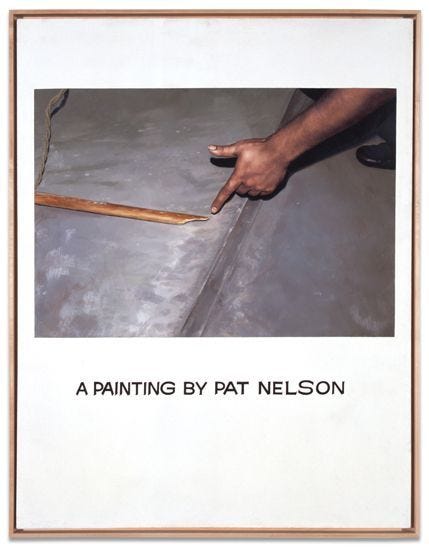
He commissioned 14 paintings this way from 14 different artists. The series is called Commissioned Paintings.
He debuted the series at Eugenia Butler Gallery in Los Angeles in February of 1970. A few weeks later, the complete series traveled to New York for the Richard Feigen Gallery.
One of the paintings sold in 2014 in a Sotheby’s auction for $2,517,000. John Baldessari was still alive then. The artist who recreated the photograph received no share of that appreciation, of course, nor did Baldessari. But Baldessari’s work continued to appreciate, nevertheless.
Every article written about this particular series has the word “amateur” in it, carrying that irritating normalizing tone that tries to minimize hierarchy. It’s irritating not because of the level of technical skill we demand from an “expert” but because the word performs an old institutional trick: lifting the conceptual strategist up by lowering the people executing the physical labor. As if the work could only be “important” if the hands that made it were somehow lesser.
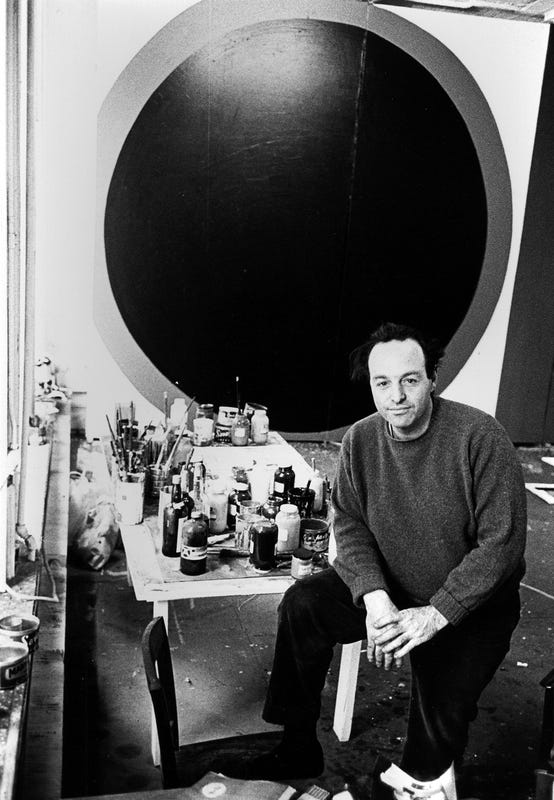
In 1969, Baldessari heard a remark by the abstract painter Al Held that he supposedly loved for its blunt edge:
"All conceptual art is just pointing at things."
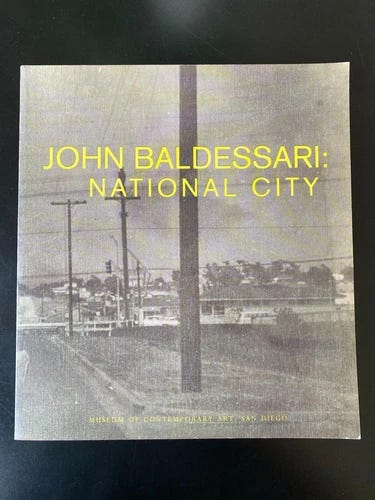
Held meant it as a snub, a reduction of radical thought to an empty gesture. Rather than argue, Baldessari took the critique literally, turning the insult into a wry punchline. He went for a walk around National City / San Diego, where Baldessari lived and kept his studio at a converted theater, with his friend George Nicolaidis and photographed Nicolaidis’s hand pointing at things that both thought were decidedly uninteresting. The joke was simple: if conceptual art is just pointing, then pointing can turn even the most ordinary thing into art.
For Baldessari, this experiment in delegation was the final tipping point before his most infamous clean break. Just months after these fourteen canvases were exhibited in 1970, he decided to take a radical step. On July 24, 1970, he published a formal legal notice in the San Diego Union newspaper, flatly announcing to the public:
“Notice is hereby given that all works of art done by the undersigned between May 1953 and March 1966 in his possession as of July 24, 1970 were cremated on July 24, 1970 in San Diego, California.”
He drove decades of his own traditional landscape and abstract paintings to a local mortuary, watched them burn, and folded the remaining ashes into a real batch of cookie dough, baking them into artifacts he titled Corpus Wafers. Today, those preserved wafers sit inside a glass jar at the Hirshhorn Museum, exhibited alongside his original handwritten baking recipe and the newspaper clipping.

Yet the Commissioned Paintings were intentionally spared from the furnace. Baldessari was performing a funeral for his own physical hand, destroying only the canvases where he had personally painted with a brush. Because the Commissioned Paintings carried none of his physical DNA, they were spared.
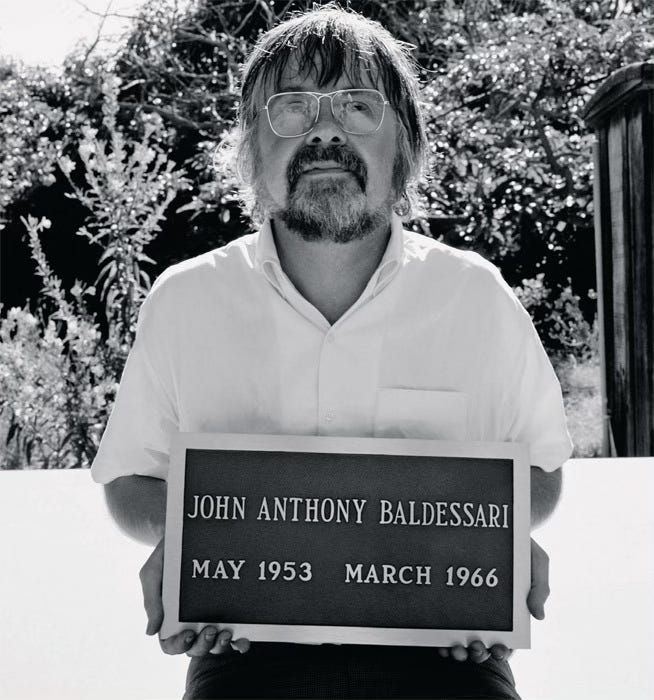
However, most articles omit a mundane reason that underpinned the entire performance. That same summer, Baldessari accepted a teaching position at the newly formed CalArts and had to relocate from his massive studio to a much smaller space in Los Angeles. He simply could not carry decades of canvas bulk with him. The cremation was as much a logistical studio purge as a ritual. The Commissioned Paintings survived because they were already out in the world, being shown.
We live in a moment where attention is fragmented, pulled continuously in a hundred directions at once. To paint a hand pointing at something is to issue a command: stop, look here, hold your thought. The pointing hand doesn’t simply direct our eyes toward a subject; it makes an artwork out of the act of paying attention itself. It insists that, in an era of constant distraction, choosing where to fix your gaze is an intentional, radical act.
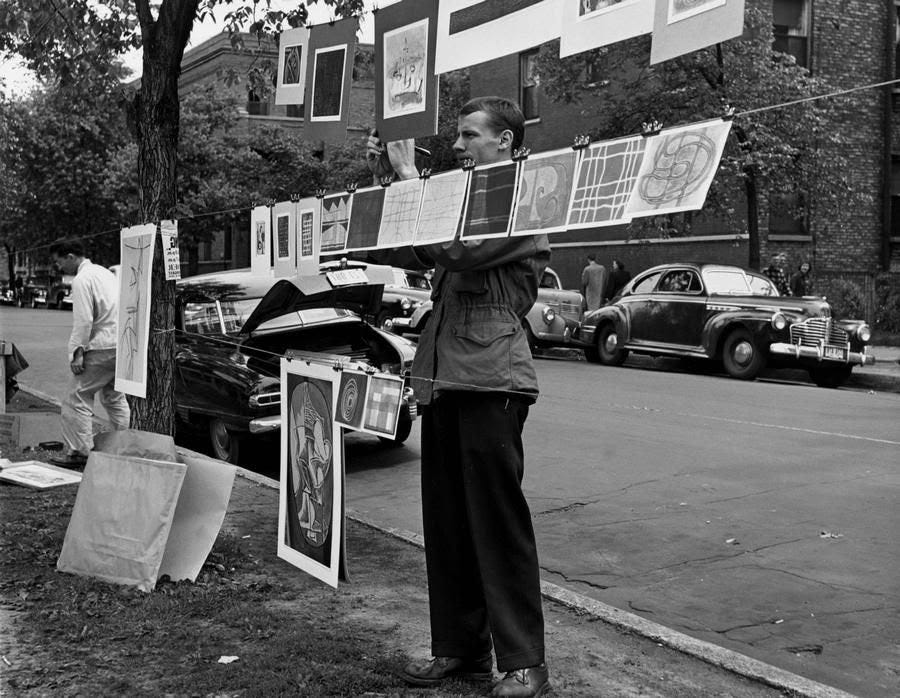
We also choose to reclaim the word amateur and embrace it in its original sense. Why does that word need to be in articles mentioning the people who actually held the brushes? Why, in the histories written about these fourteen canvases, do the painters get framed as figures who “lack” something: legitimacy, authority, a professional pedigree, while Baldessari remains the singular intelligence deserving of merit?
The word amateur comes from the French amateur, meaning “one who loves.” That, in turn, traces back to the Latin amator, from amare: to love. When English adopted the term in the late eighteenth century, it described someone who pursued an art out of pure affection for the craft, rather than for financial transaction. To call work “amateur” should not be a demotion. It should be an acknowledgment of something raw, human, self-made, and honest. The “Sunday painters” Baldessari hired brought an unpretentious, genuine character to the work that should be acknowledged and celebrated.
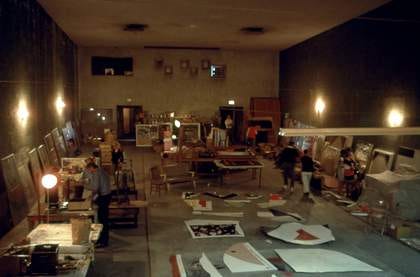
Baldessari’s Cremation Project also reminds us that growth often requires deliberate downsizing. As we move through our own lives, we decide what cannot come with us. What ideas, habits, or past works belong to a previous era? There is profound creative health in clearing the slate, deciding what to leave behind so new work can exist.
The Commissioned Paintings also act as a mirror. They show us how easily we smuggle judgment into our language and how quickly we value the “strategist” over the maker. By prominently displaying the name of Pat Nelson at the bottom of the frame, Baldessari forces a confrontation. The paintings ask us to notice the act of looking, but more importantly, they ask us to notice the act of valuing.
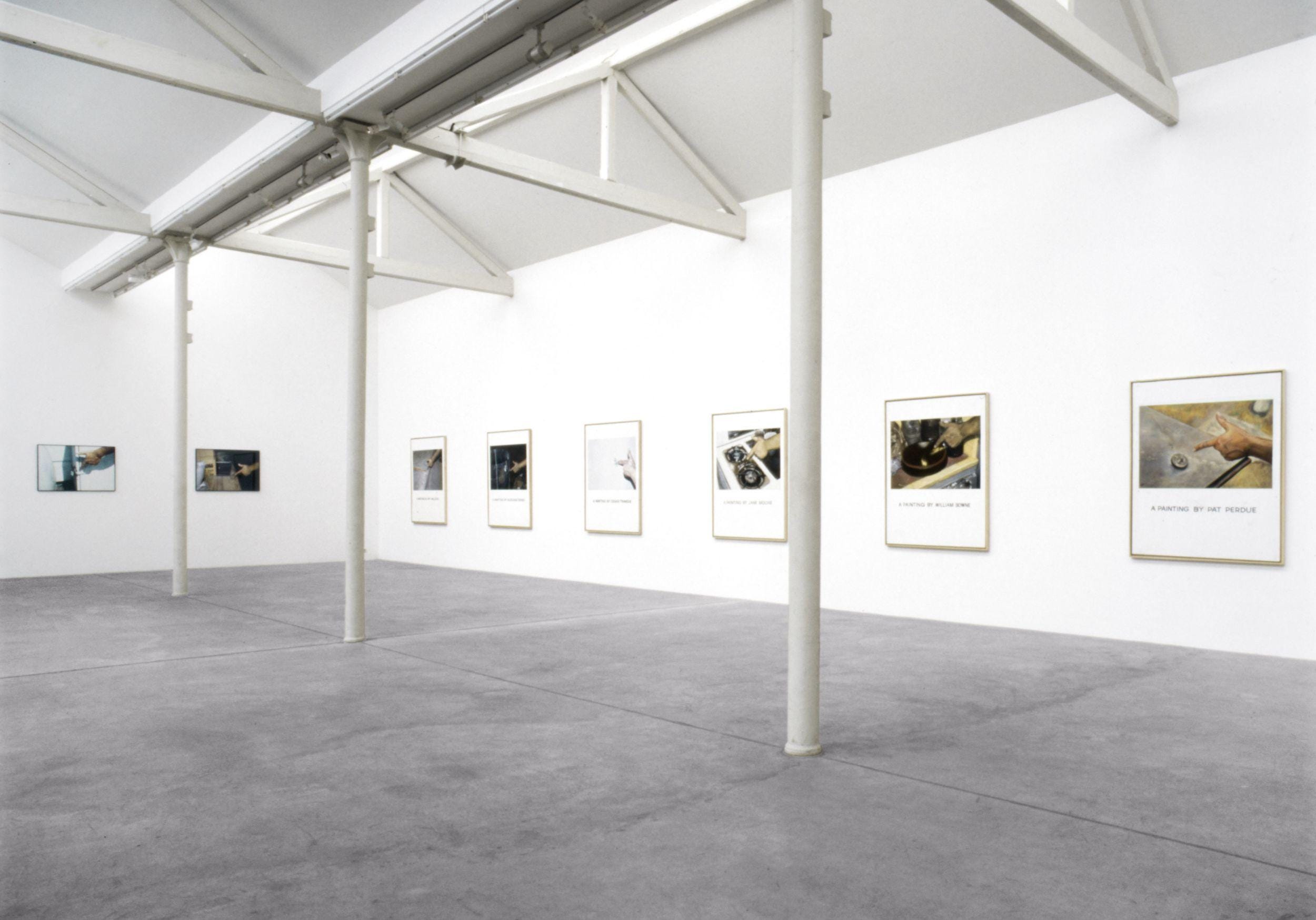
Finally, the pointing in the series points back at our own habits of dismissal: our eagerness to outsource legitimacy to our idea of craft, technique, or institutional recognition and our reflex to call someone an amateur when we really mean “not credentialed by the market.” Baldessari’s paintings ask: if the painting is what makes us stop and look, why does the institution get to decide who belongs in the frame?
This month, we are taking up Baldessari’s dare: to slow down, to honor genuine love of the craft, to clear away what no longer serves us, and to direct our attention deliberately toward something that holds a story.
Previous Collections
Support
Join our Roofless Postcard Club.
No posts
Comments
Nothing yet. Say the first thing.
Sign in to join the conversation.