
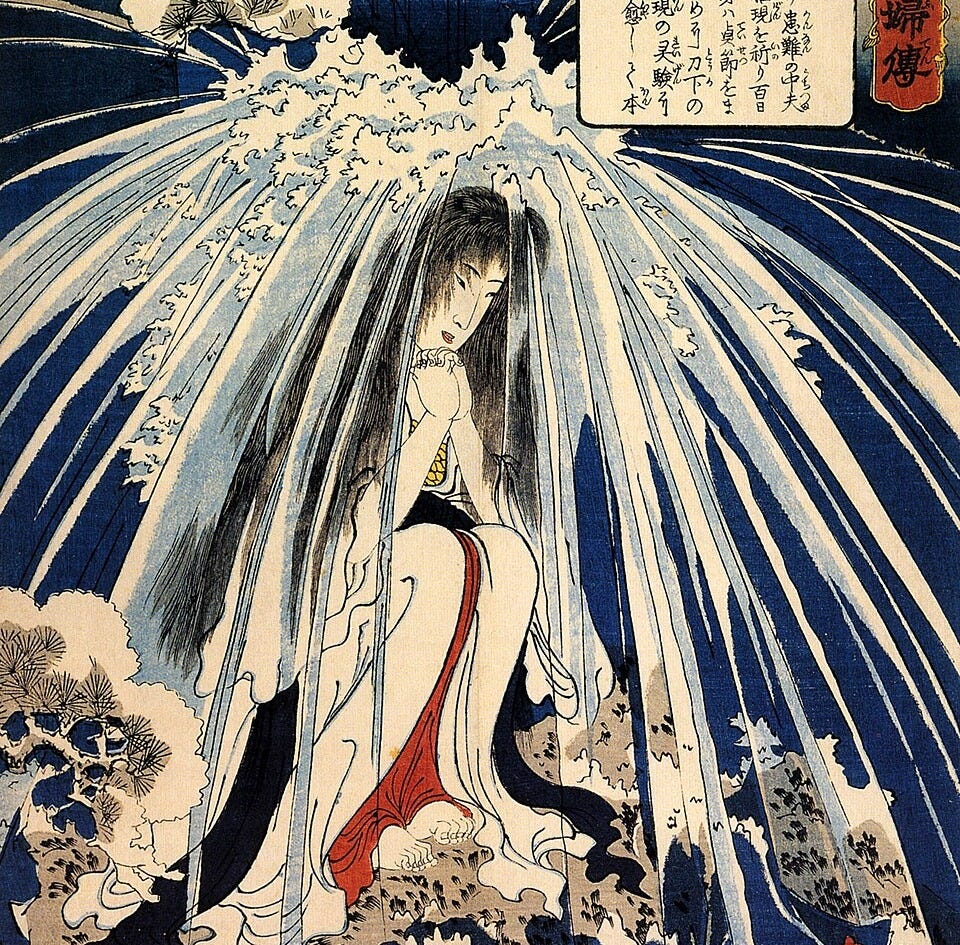
The legend of “Hatsuhana doing penance under a waterfall” comes from a story which reportedly happened around the year 1590 which comes in many versions, one which I will share here.
Iinuma Katsugoro is a samurai whose brother is killed by a villain. Katsugoro sets off to avenge the death of his brother and is joined by his wife Hatsuhana.
While on the journey to exact vengeance, Hatsuhana’s husband falls ill and is unable to use his legs. Undeterred, they continue their journey to find the villain who killed Katsugoro’s brother, and Hatsuhana, the virtuous wife, pulls her husband in a cart along their way.
They eventually meet and confront the villain who killed Katsugoro’s brother, but Katsugoro is unable to fight his archenemy and Hatsuhana is kidnapped by the villain.
She prays to a a deity under a sacred waterfall for her husband to recover and regain the use of his legs. One account of the legend reports that she remained under the waterfall for one hundred days, stoically and faithfully withstanding the incessant flow of cold water. Hatsuhana dies after one hundred days at which point her husband miraculously recovers from his illness. Katsugoro joined by his brother-in-law, confront and kill the villain. Katsugoro, the noble samurai, is able to avenge his brother’s death because of the steadfast prayers by his wife.
One hundred days under a rushing waterfall. Unrelenting cold water covering her body. The ceaseless roaring noise smashing onto her head. All of these should have driven her away, but they were all overcome by her presence of mind.
The legend of Hatsuhana teaches us the virtue of keeping our attention and resolve in the face of a torrent of distractions and discomforts.
How can we control the torrent of distractions and emotions of our lives?
There is one superpower we all wish we had at our command. It’s the ability to
voluntarily enter a state of mental focus in which the outside world is silent.
However you want to call it, “getting in the zone”, “achieving flow state”, or perhaps “finding your Zen,” there’s a universal longing for being able to put away the outside world while retaining internal focus.
We all wish we could have the roaring frigid waters of a cold waterfall smash onto our heads and to be utterly oblivious to it.
I’ve seen people who have largely mastered this skill and it has to do with controlling their inflow and controlling their outflow.
I have photographs from a remarkable surgery which I was a part of many years ago. A person came to the ER with a single gunshot wound to the abdomen. He was rushed to the operating room, put under anesthesia, and in standard fashion we cut into his abdomen to find and repair any injuries.
When we get inside we don’t encounter much blood, but we quickly discover an indication of one of the worst possible anatomical injuries: a tense collection of blood in the back and center of his abdomen.
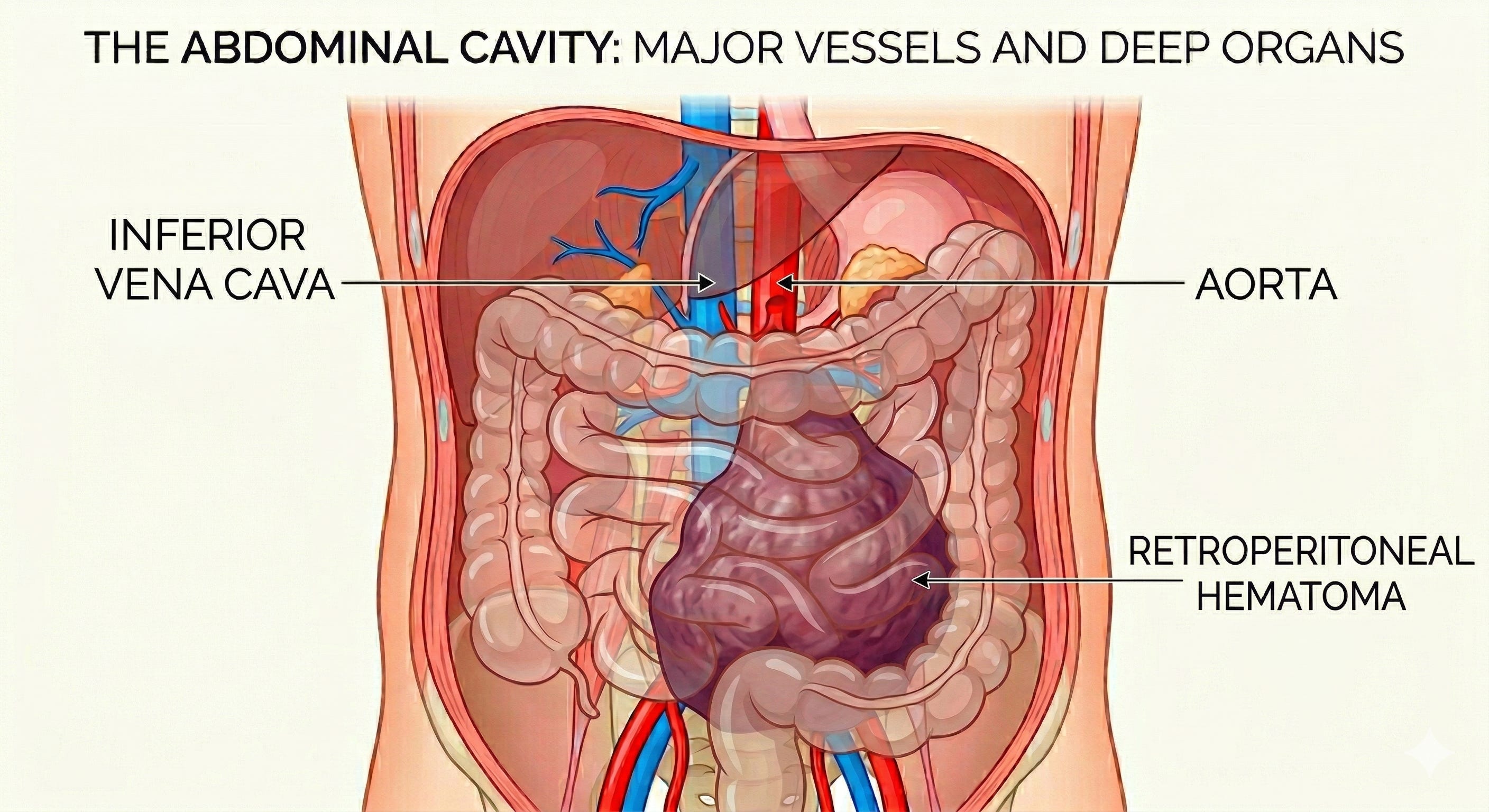
Think of the abdominal cavity as a room which is totally lined on all sides with a tough wallpaper. You’re staring at the back of the room and you see a big bulge prominently pushing against the wallpaper on the back wall.
The bulging in the wallpaper is at a spot in which you know there are two huge pipes. This is bad because seeing that bulge behind the wallpaper means there is a leak in one or both of those pipes.
That’s exactly what we saw in this person. That single gun shot wound created an injury at the location of the two largest blood vessels in the abdomen. The patient was still alive, but as soon as that blood filled sac burst, they would bleed to death in a matter of moments.
In that surgery, we found out that the patient had an injury to both his aorta and inferior vena cava, the two major blood vessels in the abdomen taking blood from the heart and back to the heart.
Despite these massive injuries, the surgery itself was rather serene. After a certain point, there was no significant blood loss, and the surgery went so smoothly that I would call it serene. At more than one point, one of the surgeons took a moment away from the surgery to pull out a digital camera from their pocket and take some photos and then they scrubbed back in.
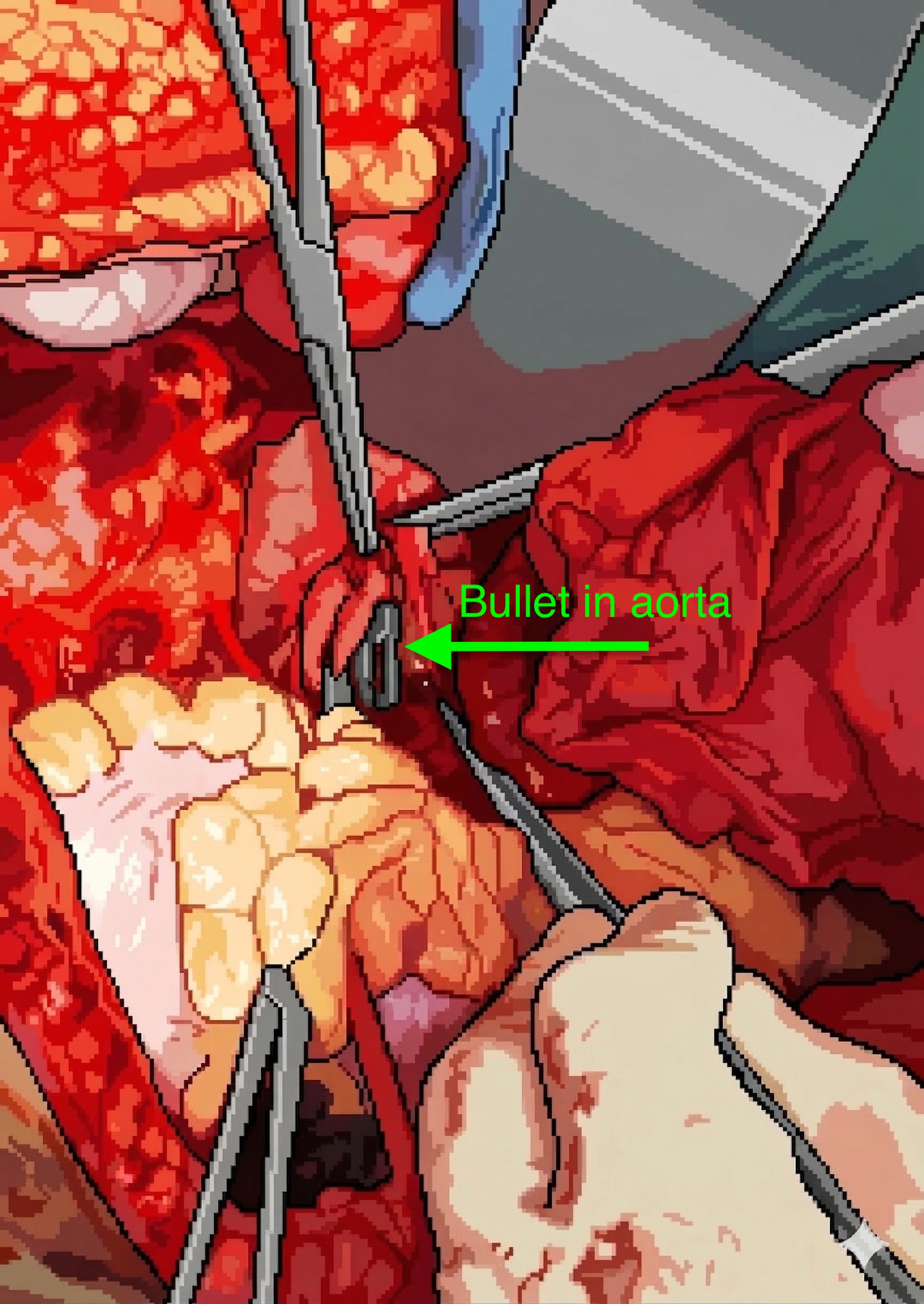
One photo remarkably shows the bullet in the aorta and the field is fairly bloodless.
How is this possible? How is there a bullet hole with the actual bullet in one of the large blood vessels in the body and there isn’t a river of blood flowing?
How is it that a seemingly catastrophic injury was treated with relative ease and the patient went on to heal well and leave the hospital in about four days? 1
What stopped us from encountering a fatal waterfall of blood?
We used a principle in vascular surgery known as “controlling inflow and controlling outflow.”
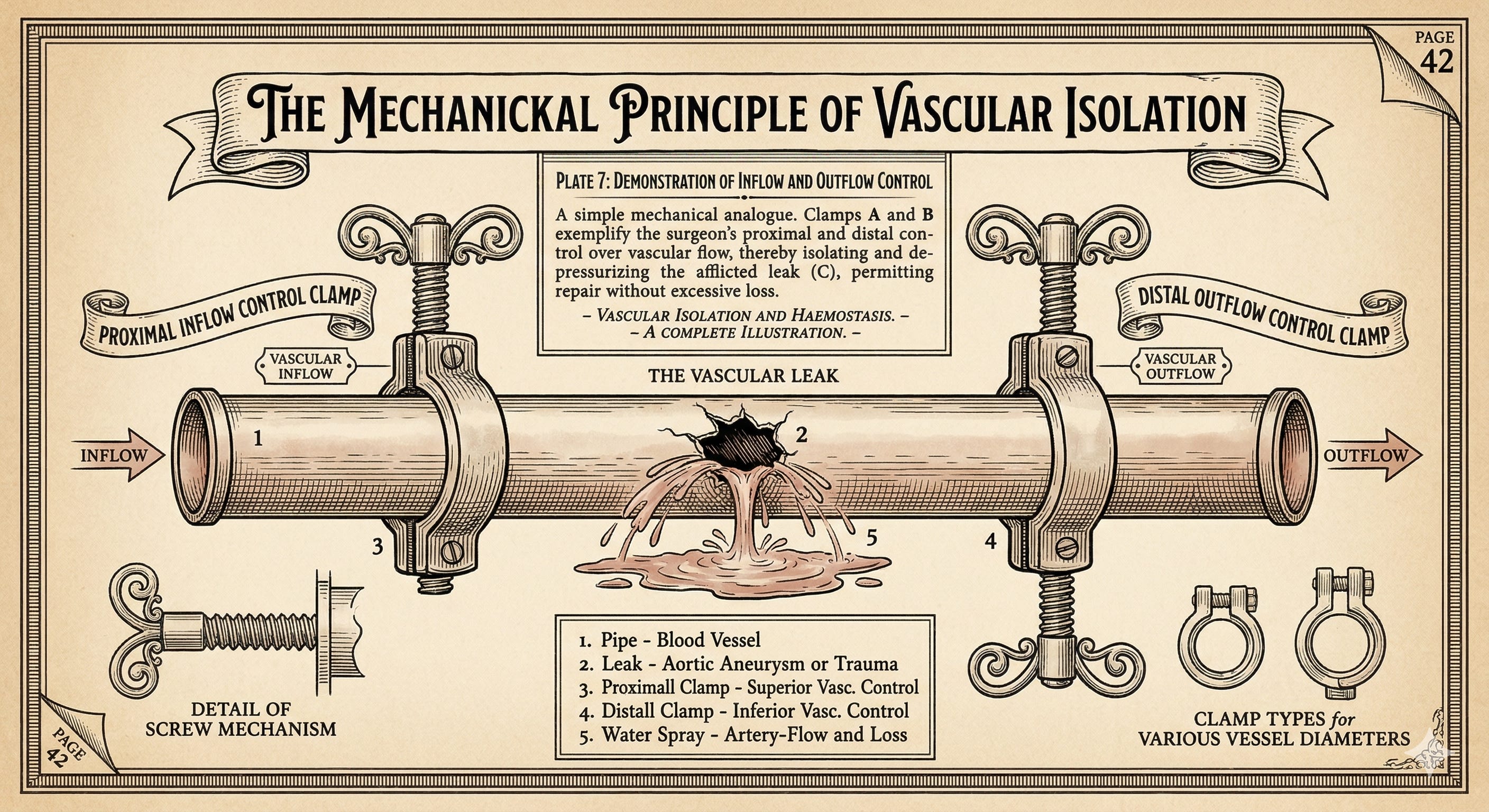
The underlying principle is that you want no blood flow across the injury. You don’t want to lose blood from hemorrhage, and also you want to repair the injury under no flow or pressure. Lastly, inhibiting blood flow across the injury prevents blood from obscuring where the surgeon is placing their suture needles during the act of “sewing” the repair.
Controlling inflow and outflow is exactly the way it sounds. You place a clamp above the injury and stop the flow of blood going into the area of injury, the inflow.
We then also place a clamp past the point of injury to prevent blood from coming back into the area of injury and leaking out that same injury.
Both are essential.
(EDIT April 5, 2026. 10:45PM CST After reviewing the thoughtful note in the comments by kingflum I have rewritten this section. Ignore the strike through text of the earlier version which I placed in the footnotes. I left it there for my review.2)
Sometimes controlling the inflow is enough to also prevent damage from outflow.
Inflow is the inciting incident and I think of the outflow effect as allowing something which should pass naturally to work its way back into our attention and create damage. In the case of an injury to a large enough blood vessel, blood in the circulatory system is under pressure and will leak backwards against the normal direction of flow. Clamping the vessel past the injury, the outflow control, prevents backflow across the injury.
About a month ago, I was having lunch with a friend and I asked him if he would be attending a social function that night at which I was going to meet mutual friends of ours. He and I are both watch enthusiasts, and the social function was a night time event sponsored by a business in the watch industry.
It was a quick no from him. Attending the event didn’t seem to be a consideration. Afterwards I thought about how he was controlling his inflow and outflow.
In order to reach the event, my friend would have to catch public transportation, transfer at least one line, and then walk to the event, all taking time. Of course, he’d have to do it after the event, repeating the same steps.
This takes time away from his other important pursuits including time with family, and time spent on his craft.
By eliminating the time that would have been spent getting to the event, participating in the same event, and returning home, my friend clamped his inflow.
The loss of time spent at the event would have been a first-order effect. What second-order effects might have struck him after he got home?
I suspect it would have changed his dinner plan and eating habits and would have gotten him to bed later than he typically does, which could have resulted in him waking up later than he does. This would affect his morning routine, which includes going to the gym early in the morning and returning in time to see his children off to school.
Maybe he would have missed his gym session, and then that would have been weighing on his mind that day. Perhaps he has a gym buddy, a workout partner who depends on him being there every morning. Missing the session would have affected that relationship. Or maybe my friend would have gone to the gym but then missed seeing his children off to school, which might have weighed on him emotionally and distracted him from his work activities and efficacy that day.
As kingflum noted in the comments, in this scenario, clamping inflow, not attending the event, prevent the knock-on effects, or the outflow.
Let’s also recognize that there are many scenarios in our lives which differ from that one up above in which we cannot avoid simply choose to avoid the inflow problems.
Think of a situations such as having to attend a difficult meeting, to take a tough call, or to deal with some distraction which has entered your day.
In those cases, outflow control becomes distinct from inflow control, unlike the scenario of the avoidable nighttime event noted above.
In these types of unavoidable cases, outflow control is often about limiting how much mental residue, emotional drag, or secondary disruption the event creates afterward.
One example would be getting called to HR for a meeting Friday afternoon to discuss a perceived transgression of corporate policy. After a tense meeting, the HR personnel tell you they will work on their report of the alleged issue and provide a report next week. The initial incident can’t be avoided. But there is a whole host of deleterious actions you can take over the next week.
You can ruminate over the scenario over and over again allowing it to occupy your mind for the next week. You can get angry and let it affect your work performance and relationships with others.
Avoiding these unskillful responses would be an example of outflow control.
Controlling my inflow and outflow has come front and center to my mind in the past few weeks as I found myself spending too much time and cognitive bandwidth in several WhatsApp Groups.
It reminded me of the time I quit Facebook in 2016 because I was wasting time and getting emotionally involved engaging in political discussions with friends and acquaintances.
The inflow was the waste of time spent on Facebook when I could have been doing a host of other things.
The outflow which needed to be clamped off was the emotional and cognitive bandwidth used even when I was off Facebook. Even when I was away from my computer or iPhone, I caught myself mentally formulating my next arguments. I would pace around my house composing my reply on a Facebook thread because “Someone was wrong on the Internet.” 3
The lesson to living a focused life is that, in an exceedingly complicated world, we can’t escape demands for our presence. We’re going to be increasingly bombarded with more clamoring for our attention, with some of them technologically optimized to appeal to our individual likes and dislikes.
The key to maintaining focus in such a world is to control where we spend our time, attention, and emotional energy, our inflow.
And just as important we should try to be conscious of the second-order effects of those decisions, the outflow.
Hatsuhana could not stop the waterfall from falling. But she did not let it enter her mind, and she did not let it drive her from her purpose. That is the real work we all face. To control what we allow in, and to keep whatever enters from carrying us away.
I know there are at least two vascular surgeons among the subscribers to this newsletter, so for you here’s the injury that we found: a bullet sitting in the aorta with a defect in the infrarenal aorta, just inferior to the takeoff of the renal arteries. The shock effect from the bullet had severed the left renal vein off the inferior vena cava, leaving an injury on the IVC. The left renal vein was ligated. The IVC was repaired primarily, and a Dacron tube graft was used to replace the aortic injury
About a month ago, I was having lunch with a friend and I asked him if he would be attending a social function that night at which I was going to meet mutual friends of ours. He and I are both watch enthusiasts, and the social function was a night time event sponsored by a business in the watch industry.
It was a quick no from him. Attending the event didn’t seem to be a consideration. Afterwards I thought about how he was controlling his inflow and outflow.
In order to reach the event, my friend would have to catch public transportation, transfer at least one line, and then walk to the event, all taking time. Of course, he’d have to do it after the event, repeating the same steps.
This takes time away from his other important pursuits including time with family, and time spent on his craft.
By eliminating the time that would have been spent getting to the event, participating in the same event, and returning home, my friend clamped his inflow.
Outflow. What does an activity take out of you?
The loss of time spent at the event would have been a first-order effect. What second-order effects might have struck him after he got home?
I suspect it would have changed his dinner plan and eating habits and would have gotten him to bed later than he typically does, which could have resulted in him waking up later than he does. This would affect his morning routine, which includes going to the gym early in the morning and returning in time to see his children off to school.
Maybe he would have missed his gym session, and then that would have been weighing on his mind that day. Perhaps he has a gym buddy, a workout partner who depends on him being there every morning. Missing the session would have affected that relationship. Or maybe my friend would have gone to the gym but then missed seeing his children off to school, which might have weighed on him emotionally and distracted him from his work activities and efficacy that day.
By avoiding a non-essential night-time event, he prevented the second-order effects. He clamped the outflow. To use our vascular surgery anatomy, no blood would come back to leak across the initial injury.
An explanation in case one of you searches for me on Facebook and finds me there. No I’m not a hypocrite. I have a new account I created in 2022 solely to join watch groups. I leave zero updates of my life, I read no one else’s posts, and I engage in zero discussions outside of the few watch groups on Facebook of which I am a member.
No posts
Comments
Nothing yet. Say the first thing.
Sign in to join the conversation.