
As I was struggling and striving to become a published writer throughout the 1980s, the main objective was to have a novel accepted for publication by a respected and prestigious publisher and see my books in brick-and-mortar stores and on spinner racks in drugstores, truck stops, and airports. When it finally happened in 1989, at the tail end of that decade, I got what I hoped for, but not completely. At the time I figured “Well, one out of two ain’t bad.”
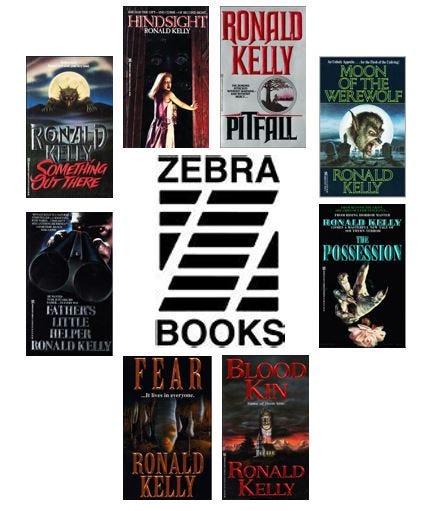
Before I planted my feet firmly on graveyard earth and dedicated myself and my literary efforts to the horror genre, I’d attempted to make my mark in numerous other genres. Western. Men’s adventure. Suspense. Mystery. None clicked. I went through several New York agents with no positive results and lucked out when the Scott Meredith Agency considered my work to have potential and was professional and saleable enough to submit to the Manhattan publishing houses. I had begun publishing horror short fiction in publications like Cemetery Dance, Deathrealm, Grue, and Eldritch Tales around 1986 and soon my brand of Southern horror was embraced and appeared regularly on the table of contents of most of the small press horror magazines. Around that time, I’d also finished my first horror novel. It was titled The Tobacco Barn and was based on family history: my mother’s psychic experiences during her childhood in the Great Depression and the brutal massacre of three teenage boys in an abandoned tobacco-curing barn no more than a stone’s throw from where they’d grown up. My agent at Scott Meredith began submitting the manuscript of TTB to the various mass market publishing houses in mid-1986. In the back of my mind, I was certain a sale would never materialize. After all, I was a shy, introverted country boy from a small town in rural Tennessee who had never gone to college and had learned his craft purely through trial and error. As time passed with no positive result, I figured this was just one more dismal failure on my part. Then, two and half years later, I was working at a welding shop in downtown Nashville in January of 1989 when I was called to the phone one afternoon. It was my agent informing me that a mass market publisher was interested in my book and was offering an advance of $2,500 upon signing the contract. Needless to say, I took the rest of the afternoon off to celebrate.
The only drawback was who my new publisher was. Zebra Books… the red-headed stepchild of the publishing world. I was well aware of Zebra’s shoddy reputation among my peers and editors in the horror community. They were considered to be creatively substandard, unsophisticated, and terminally pulpy in comparison to other horror publishers of that time, like Dell Abyss and Tor. Zebra had been branded by publishing insiders as the “Skeleton Farm”, due to the steady stream of ghoulish and goofy skeletons that graced their book covers. So, you see, my initial reaction at the end of that phone call was 50% joy and 50% dread. On the way home, I stopped by Brown’s Drugstore on Charlotte Ave (where I’d bought comic books and issues of Famous Monsters of Filmland since childhood) and hunted down the latest Zebra Horror releases. They were Goodnight Moom by Jack MacLaine and Demon’s Eye by Stephen Gresham. Neither one sported skeletons on their covers, so at least that was mildly encouraging.
By mid-February I had signed my first Zebra contract and three weeks later received my first novel advance. Then came the waiting game. I wasn’t idle, however. I’d already written my second novel, a roller-coaster ride of a story called Pit Devils (later to be renamed Pitfall) and already had a contract for it by June of that year. This told me that the first sale hadn’t been a fluke… that maybe I actually had a chance of beginning a career as a mass market paperback author.
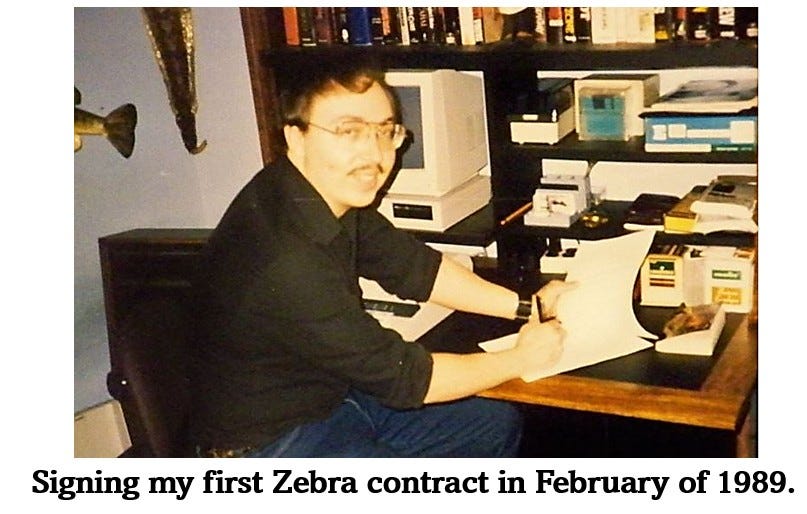
Following the signing of the Tobacco Barn contract, Zebra set the release date for the novel: January 1990. For months afterward, I heard nothing. No feedback on the progress of the book or how it would be marketed. My agent assured me that was just the way Zebra worked. So, I busied myself with writing short stories for magazines and anthologies and working on my third novel The Dark’Un (eventually titled Something Out There).
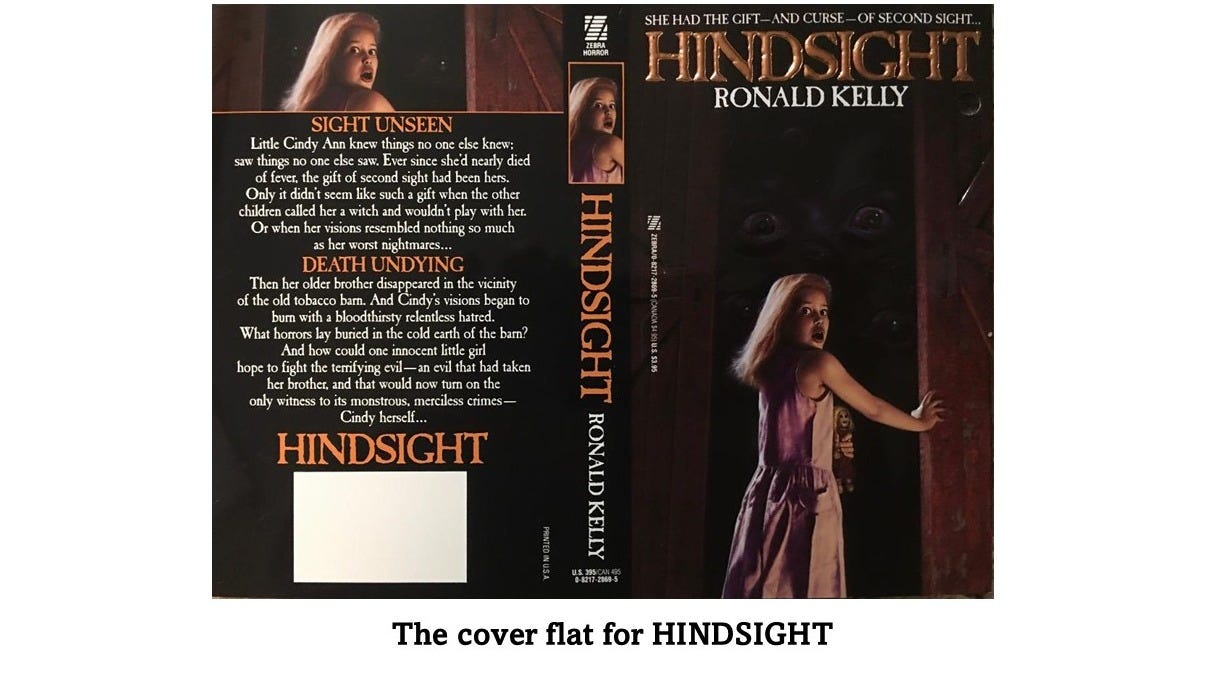
Around mid-August I received a padded envelope in the mail. When I opened it, I found that it contained a stack 25 cover flats for my first novel (for those wondering, a cover flat is the actual paperback cover with the front, spine, and back). I was surprised to discover that they had taken the liberty of changing the name of the book from The Tobacco Barn to Hindsight, which was well within their right to do so, according to the contract. The embossed copper title was modest, and my name underneath was smaller than I expected, but it would gradually enlarge on future covers as my popularity grew. The cover painting was simple, but effective; a small girl standing fearfully in front of an open barn door with the images of equally terrified eyes hovering in the darkness within. They had also written the back cover copy for the book, which was certainly sufficient and accurate (they always did the back cover copy themselves, with no help or input from the author). With each book I published with Zebra from that point on, the anticipation of waiting for the cover flat held an air of both excitement and potential disappointment. I never knew what the title would be or what image would grace the cover until I received that stack of glossy, embossed flats four to five months before publication.
A couple of months before publication, I received the proof galleys for Hindsight. Today’s authors have no idea how easy and convenient they have it. Back then, you would receive a stack of printed sheets as thick as a phone directory, each with two pages of the book, laid out in the sequence it would be printed. Then came the ponderous task of sitting down and going over each page, checking for typos and doing corrections with the legendary red pencil. I only had two editors during my tenure with Zebra Books: Alice Alfonsi (Hindsight through Moon of the Werewolf) and John Scognamiglio (Father’s Little Helper through Blood Kin). Over the years I’ve had fans ask me if Zebra had edited or changed my manuscripts very heavily. Truth be told, for the most part, I don’t believe anything in any of my original manuscripts had been changed at all. Every now and then, my Southern sayings and references had to be explained or justified to my Northern editors, and once or twice they attempted to sneak in an F-bomb, which I promptly defused (being a Christian, the F-word and taking the Lord’s name in vain, are two lines I still refuse to cross). I often wondered if the lack of editing in my Zebra novels meant that I was an exceptionally wonderful writer or if it was merely laziness on the part of my editors.
Mailing the proof galleys back in, I could only sit and wait for January of the following year to roll around. To say my anticipation for the release of my first novel was maddingly nerve-wrecking would be a gross understatement. There were things going on in my life in the latter half of 1989 that cast a dark cloud over that happy event, however. My mother was dying of lung cancer and, sadly, she passed away only a month before my first novel hit the book racks. So, the publication of Hindsight was — and will always be — a bittersweet experience.
As luck would have it, Hindsight was released a month earlier than expected. I received my box of 25 contributor copies (Zebra seemed to have a thing about the number 25) and it was surreal signing my first novel and passing them out to friends and family — particularly to those who were less than supportive and thought I would never make it into mass market publication. I had my first book signing at a used bookstore in Nashville shortly before Christmas and another at the same store in mid-January. One thing that I found out relatively early in my career… regular brick-and-mortar bookstores weren’t very receptive to promoting or holding signing events for horror paperback authors, especially if there was a big striped Z on the spine of your book. I found the same lack of respect for Zebra at horror conventions and in the HWA at that time. When I attended the first World Horror Convention in 1991, I was waiting in the green room with Charles Grant for a panel on Regionalism in Horror. He introduced himself and said “I’ve read your work. Your stuff is damn good. So… why the hell are you writing for Zebra?”
In the 70s and 80s, Zebra would release three or four novels per month, but in the early 90s they cut back to two releases. As far as advance and royalties were concerned, advances were usually $2,500 per book for new authors. The amount steadily rose when Zebra began offering me multi-book deals after the publication of Pitfall. Royalties were paid out every six months. Since my wife, Joyce, and I began our life together in 1991, that made it tough on us financially, since I had quit my welding job the year before to devote myself to writing full-time. Those first few years as a newlywed couple in Nashville were tough. Joyce attended business school and drifted from one job to another — daycare teacher, Chick-fil-a, Wendy’s, a shift manager at McDonald’s — while I devoted most of my day churning out the next Zebra book. We both managed a snack bar at a bowling alley for a while and I worked part-time at Target, unloading the merchandise truck at 4:30 in the morning and stocking the sporting goods and electronic departments until 11:00. Then it was back to the typewriter until Joyce came home from work. It wasn’t so bad after you had three or four books under your belt. The royalties would pretty much last you during that six-month stretch. But, if you only had one or two, it made it difficult to buy groceries and pay the apartment rent at the first of every month.
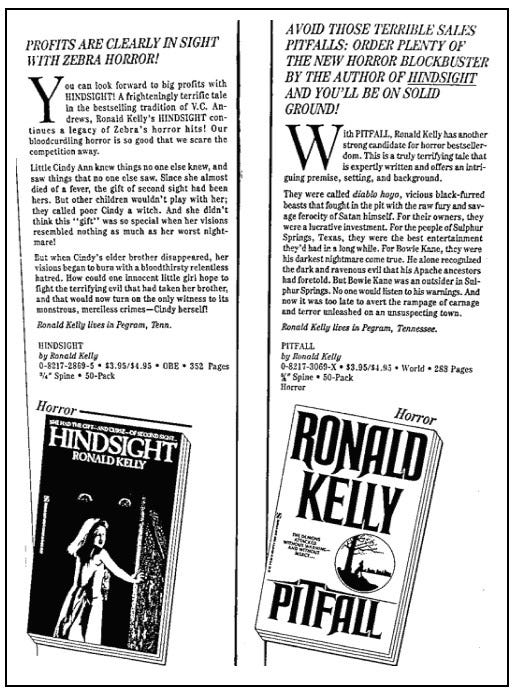
Zebra was pretty dismal at promoting your books, if they even attempted to at all. This publisher was more into pushing the quantity of the product they unleashed upon the reading public, rather than the quality. Oh, there were some good, solid writers in the Zebra stable — Rick Hautala, J.N. Williamson, and Ruby Jean Jenson, to name a few — but there was an equal amount who were lacking in imagination and storytelling ability that Zebra kept buying from to simply keep the horror pulp machine rolling, month after month. From the beginning, I told myself that I wouldn’t get trapped in some of the same overused tropes that many of the others specialized in — evil children, evil dolls, evil cats, etc. I vowed to write something completely different every time, and I managed to do that with the eight books I wrote for Z from 1990 to 1996. As far as I could tell, Zebra only promoted their upcoming releases through the publishing trade catalogs, finding it pointless and unnecessary to submit work for reviews or awards.
Writing for Zebra was a lonely and isolated existence. Mind you, this was long before the internet connected writers with fellow writers and readers. There was no social media to speak of. Later, there would be message boards to congregate at; Shocklines, Mark Seiber’s Horror Drive-In, and Robert McCammon and Brian Keene’s forums. And you might have a book signing or attend a horror convention every now and then. But, until then the internet took hold, you wrote a book and, except for the occasional review in Publisher’s Weekly, Locus, Fangoria, or numerous small press magazines, you had no idea whether readers actually liked your work… or if they even read it at all. During the six years I wrote for Zebra, they only forwarded me five fan letters… and one was from a reader who accused me of being a racist for using the N-word in Fear. That hurt me worse of all. Anyone who has read Fear and knows me personally understands my motivation for showing racism for the ugly, hateful thing it is, and that Roscoe Ledbetter and the Granny Woman are two of my most beloved characters.
At the beginning of my time with Zebra, they began releasing two of my books per year. Hindsight and Pitfall in 1990, Something Out There and Moon of the Werewolf in 1991. After that, they released only one per year, which was okay with me. In those days, no one expected an author to have more than one book out in a year’s time anyway. Father’s Little Helper came out in 1992, followed by The Possession in ‘93 and Fear in ‘94. Whenever I came down to the end of a multi-book deal, Zebra would promptly offer me a new one. Then unexpected something happened. I had turned in my eighth novel, Blood Kin, and Zebra was stalling at signing me up for additional books. I also discovered that BK wouldn’t be published until 1996 with an empty year in between that and Fear. It was concerning to realize that I wouldn’t have novel on the bookracks for an entire year. Hell Hollow and Restless Shadows were scheduled for 1997 and 1998, but after that Zebra refused to commit themselves to continuing our publishing relationship, leaving me in an uncomfortable literary limbo. I had heard the talk behind the scenes. The horror genre — particularly mass-market horror — was in trouble and skating on thin ice. It seemed that during the paperback horror boom of the 1970s and 80s, so many publishers were putting out so many horror novels that the market was grossly oversaturated. Plus, many of the publishers, Zebra at the top of the list, was releasing substandard work by unseasoned writers who had been signed up simply to keep the horror fiction machine producing full force. I kept hearing about one publisher after another shutting down or this author or that being cut by their long-standing publisher. It was a scary time for a horror writer, but I thought I was okay. I reckon I was naive enough to believe that it wouldn’t happen to me.
Eventually it did, though. On the 6th of October 1996 — after months of hoping and praying for another multi-book deal — my agent at Scott Meredith called and informed me that Zebra was shutting down their horror line immediately and that the two novels that were still on their schedule would be returned to me. In other words, my mass market paperback career was over. After that, it took several years to get all the rights back to my books. The only two they refused to relinquish was my two bestsellers, Fear and Blood Kin. I found out why later when they rereleased them in 2000 and 2001 under the Pinnacle imprint.
I won’t go into my long, sad ten-year hiatus from writing (and reading) horror and my return to the genre in 2006. You can read about all that in Southern Fried & Horrified. There is a silver lining to the dark cloud of Zebra Horror’s demise, however. In 2017, author Grady Hendrix compiled a fascinating look at the twisted history of mass market horror paperbacks called Paperbacks from Hell. This brought all those spooky, pulpy horror novels from the NYC mass market publishers, including Zebra, back into the consciousness of new horror readers and collectors. Paperbacks from Hell’s publication did something rather amazing, something that Hendrix and his publisher probably hadn’t counted on. It got readers interested in reading the old novels from the 70s, 80s, and 90s again, and book collectors began hitting the used bookstores and haunting eBay in search of rare, hard-to-find copies. It also, weirdly enough, blessed Zebra Books and its stable of authors with a new respectability. For decades, I had felt awkwardness and shame at being part of the Zebra flood of pulpy horror, but now people were interested in those old novels of mine and appreciative of my accomplishments. And, since many of Zebra’s original writers are gone now, I’ve become to be known not only as a Zebra alumnus, but an elder statesman of sorts. That’s fine with me. Despite the stigma it brought me early in my career, I now wear my Zebra stripes with pride!
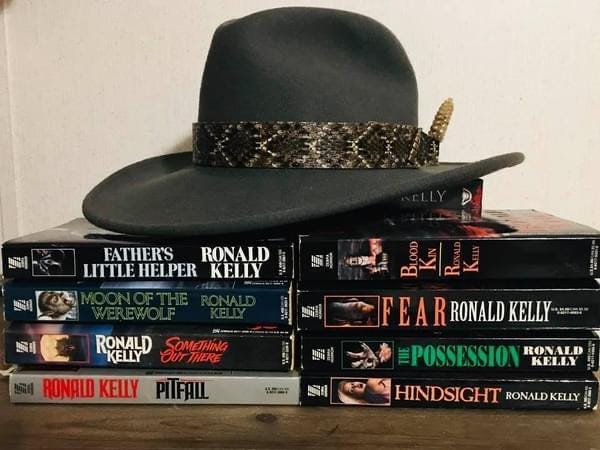
Through the month of March, get 20% off your order of signed books and apparel at the RKHORROR online store! Just enter promo code MARCHMANIAC at checkout! All books come with a personalized inscription and hand drawn RK artwork on the title page!
No posts
Comments
Nothing yet. Say the first thing.
Sign in to join the conversation.