
I hope all my readers had a happy and safe Fourth of July. America’s 250th Anniversary of Independence was covered well by the media. Not so much an important story which I discuss in this week’s Substack.

Last Tuesday, the Office of Government Ethics released President Trump’s 2025 personal financial report. At 927 pages, there was plenty to report. President Trump reported approximately $2.2 billion in personal income for 2025. That’s nearly four times the $620 million Trump reported in 2024 as a private businessman.
The growth was driven largely by cryptocurrency. Trump reported $1.2 billion in crypto-related income, including some $580 million from World Liberty Financial (WLF), the venture Trump co-founded in September 2024 with his sons and Steve Witkoff, a real estate developer and currently the president’s Middle East envoy.
According to its website, World Liberty Financial “blend[s] traditional finance with the transparency of blockchain, creating a simple, accessible way to bridge classic banking with the digital financial future.” That sounds complicated, but the business is actually simple. WLF creates and sells its own digital currencies known as tokens. The firm is currently marketing two tokens, WLFI governance tokens and the USD1 stablecoin.
The WLFI governance tokens give buyers the right to vote on certain company policies—no ownership stake, no dividends, no claim on profits. Sales of these tokens brought in more than $500 million. The USD1 stablecoin works like a digital dollar: customers deposit real dollars in exchange for USD1 tokens redeemable one-for-one. Why bother? Stablecoins allow holders to conduct financial transactions largely outside the world’s traditional regulated banking system.
Unlike a regulated bank, World Liberty Financial neither insures its customers’ deposits nor pays interest on them—shifting the risk to its customers while keeping the yield for itself. Federal law blessed that lucrative arrangement in July 2025, when Trump signed the bipartisan GENIUS Act, the first statute governing stablecoins, including his family’s World Liberty Financial.
World Liberty Financial’s largest known investors are associated with a single foreign government: the United Arab Emirates (UAE). Days before Trump’s inauguration, in a deal signed by Eric Trump, a firm connected to the UAE government paid $500 million for a 49 percent stake in World Liberty Financial. Neither the company nor the White House disclosed the sale; it surfaced through press reporting a year later. Nor did Trump’s financial disclosure identify the deal, recording only his share of the proceeds, nearly $200 million, as a “capital contribution.”
Separately, a UAE fund used World Liberty’s USD1 stablecoin to make a $2 billion investment in Binance (the world’s largest cryptocurrency firm) exchanging real dollars for crypto dollars—leaving World Liberty to collect interest on the $2 billion. Shortly afterwards, the Trump administration approved the UAE’s access to advanced AI chips, previously denied on national security grounds. In October, Trump pardoned Binance’s founder, who had pleaded guilty to money-laundering violations.
The Constitution’s foreign emoluments clause prohibits the president from accepting anything of value from a foreign state without the consent of Congress—consent that Trump never sought for the UAE transactions. Whether the clause was violated will likely never be tested; during Trump’s first term, the courts dismissed several far smaller emolument disputes on procedural grounds, and Congress never acted.
Another crypto business earned Trump $635 million by selling $TRUMP “meme coins” to the public. Unlike a stock, which represents ownership in a company, a meme coin’s value is based largely on market sentiment; it is only worth whatever the next buyer will pay for it. As the $TRUMP website says, “Now, you can get your piece of history. This Trump Meme celebrates a leader who doesn’t back down, no matter the odds. Join the Trump Community - we’re all about fighting for what matters.”
Still confused? Think of a Trump meme coin (Melania has her own, named $MELANIA) as a tradeable souvenir with one difference: whether or not buyers ever profit, the Trump family collects a transaction fee every time a coin changes hands.
Trump’s traditional businesses also provided personal income including $122 million from Trump Doral, his Miami-based resort, and $77.5 million from Mar-a-Lago among many other Trump ventures.
After filing dozens of lawsuits against media and technology companies, Trump collected more than $86 million in settlements from ABC, CBS, Meta, YouTube and X. Most of the money went to Trump's presidential library foundation. Legal experts considered several of Trump’s lawsuits weak, yet the companies settled—each with business pending before the federal government, including Paramount's merger and the Meta and Google antitrust cases.
Trump’s financial filing also documented more than 21,000 stock trades during 2025. That’s nearly eighty-five trades every day the markets were open, a pattern closer to a day trader than a long-term investor. (The Trump Organization says the trades were executed by outside money managers using automated trading strategies.)
A Bloomberg analysis found Trump’s stock trading was highly concentrated: just ten days accounted for roughly a quarter of all trades, and many of the busiest days came immediately before or after Trump’s own policy announcements, especially those related to tariffs.
For example, on April 8, 2025—after “Liberation Day” tariffs had driven the S&P 500 down 12 percent—Trump’s accounts made 327 stock purchases. The next day Trump announced a partial tariff rollback, and the S&P 500 rose 9.5 percent. Were the 327 stock purchases brilliantly timed, automated buying, or somehow informed with insider information? We don’t know. Nor do we know whether the president profited or lost on these and his other trades. That information appears only in his federal tax returns, which Donald Trump, unlike every president since Gerald Ford, has declined to release.
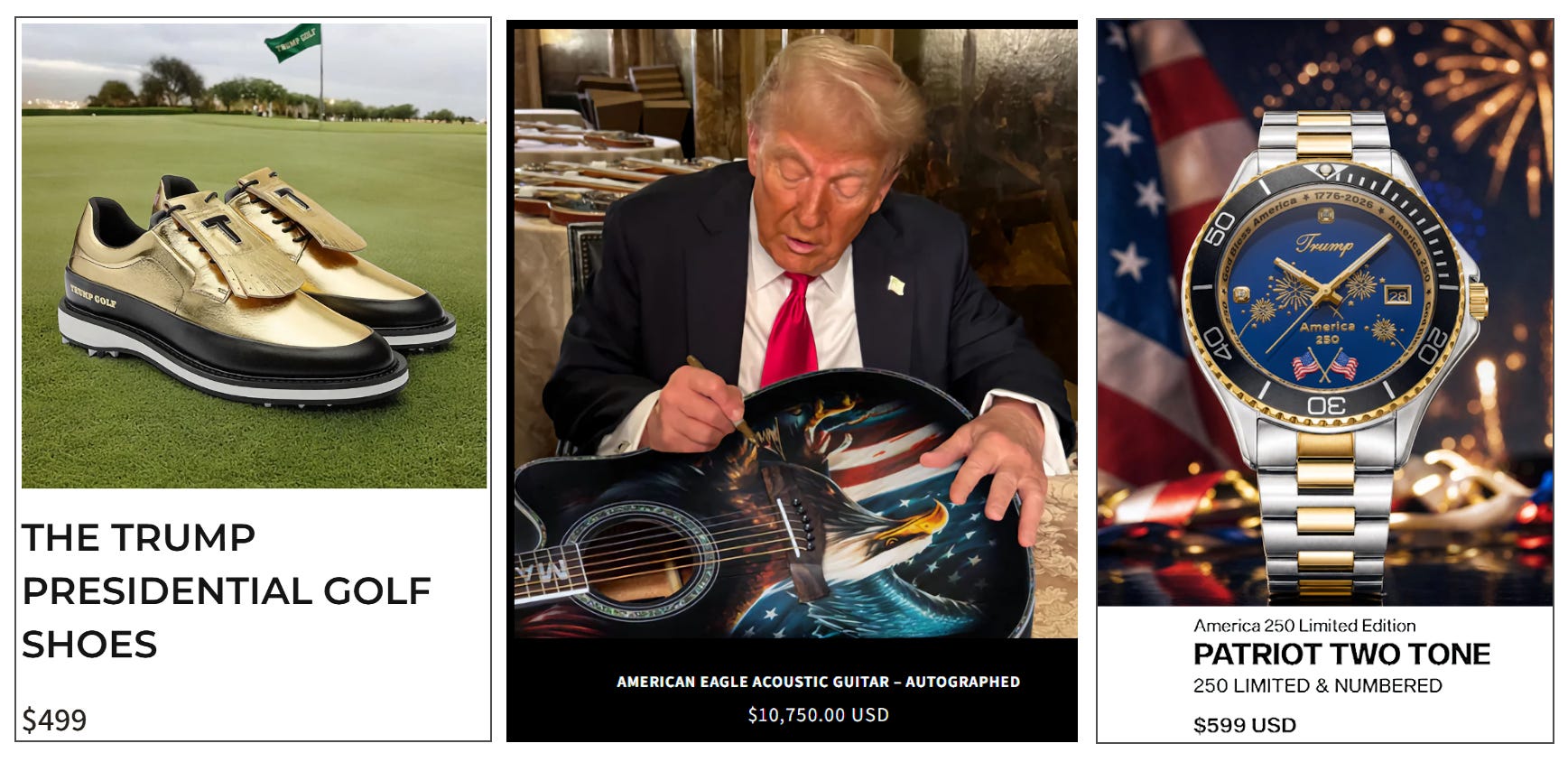
In 2025, Trump earned income from Trump-branded products ranging from Trump shoelaces ($20.00) to Trump-signed guitars ($10,750). The online Trump Store alone sold thousands of Trump-themed products including golf accessories, apparel, dinnerware, fragrances, and novelties.
President Trump’s financial disclosure last week was covered unevenly. A Google search will confirm that liberal media gave the story broad coverage while conservative media largely buried it. Perhaps the most balanced discussion was an editorial in The Wall Street Journal, “The Trump Family and ‘Honest Graft,’” which read, in part:
The Trump clan is cashing in on the Presidency in big and sketchy ways…. The Trumps are seeing their opportunities and taking them, in the tradition of what Tammany Hall’s George Washington Plunkitt called “honest graft.”
…. Assuming all of this is legal, it’s still an unseemly display of using the Presidency for family profit. It’s hard to believe the Trump boys would be able to do the same deals if Dad wasn’t in the Oval Office. The main difference between Hunter Biden’s foreign dealings and the Trump projects is that the Trumps are brazenly open about theirs.
Nothing in the Constitution bars a president from earning money from private parties, so long as the payer is not a foreign state. But no previous president has monetized the presidency as has Donald Trump. President Trump has earned income from products as small as twenty-dollar shoelaces and as large as billion-dollar crypto transactions—all marketed under the name of a sitting president.
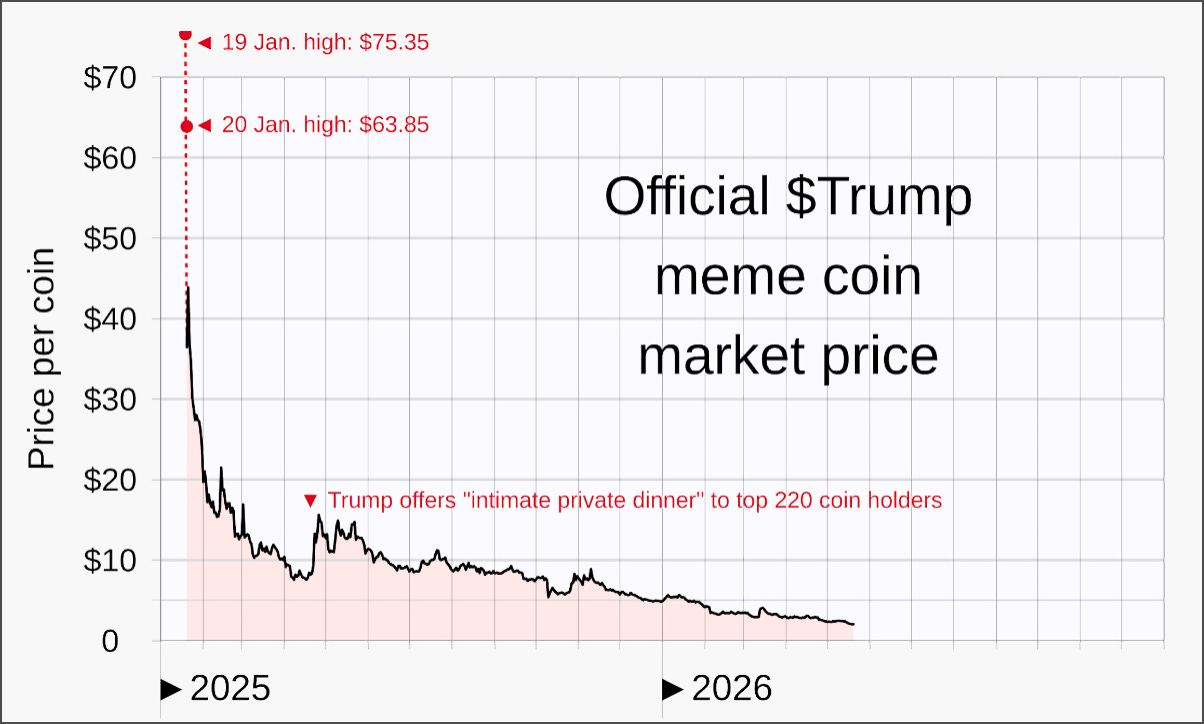
There’s no harm in selling hundreds of Trump-branded goods. Millions of Americans admire and support Donald Trump, and are happy to show it. But according to The New York Times, nearly a million investors have lost $3.8 billion on the $TRUMP meme coin, while Trump grew even richer. As The New York Times wrote:
The odds were always in his favor. Mr. Trump profited whether the price of his memecoin went up or down. He collected returns whenever anyone traded the tokens, as he repeatedly pushed his followers to do, using his Truth Social account to promote the coin.
No posts
Comments
Nothing yet. Say the first thing.
Sign in to join the conversation.