
Although President Trump's ceasefire agreement signed last week is being widely criticized, let’s hope it leads to a positive outcome. For seventy-three years, the United States has tried, and failed, to bend Iran to its will.
In 1953, over a dispute about oil profits, the U.S. and Britain orchestrated a covert coup that overthrew Iran’s democratically elected prime minister and installed Mohammad Reza Pahlavi — the Shah — as a pliant American ally. For the next quarter-century, Washington backed his regime even as the Shah’s secret police, SAVAK, systematically arrested, tortured, and killed hundreds, perhaps thousands, of political dissidents.
In 1979, Iranian revolutionaries toppled the Shah and established an Islamic republic.
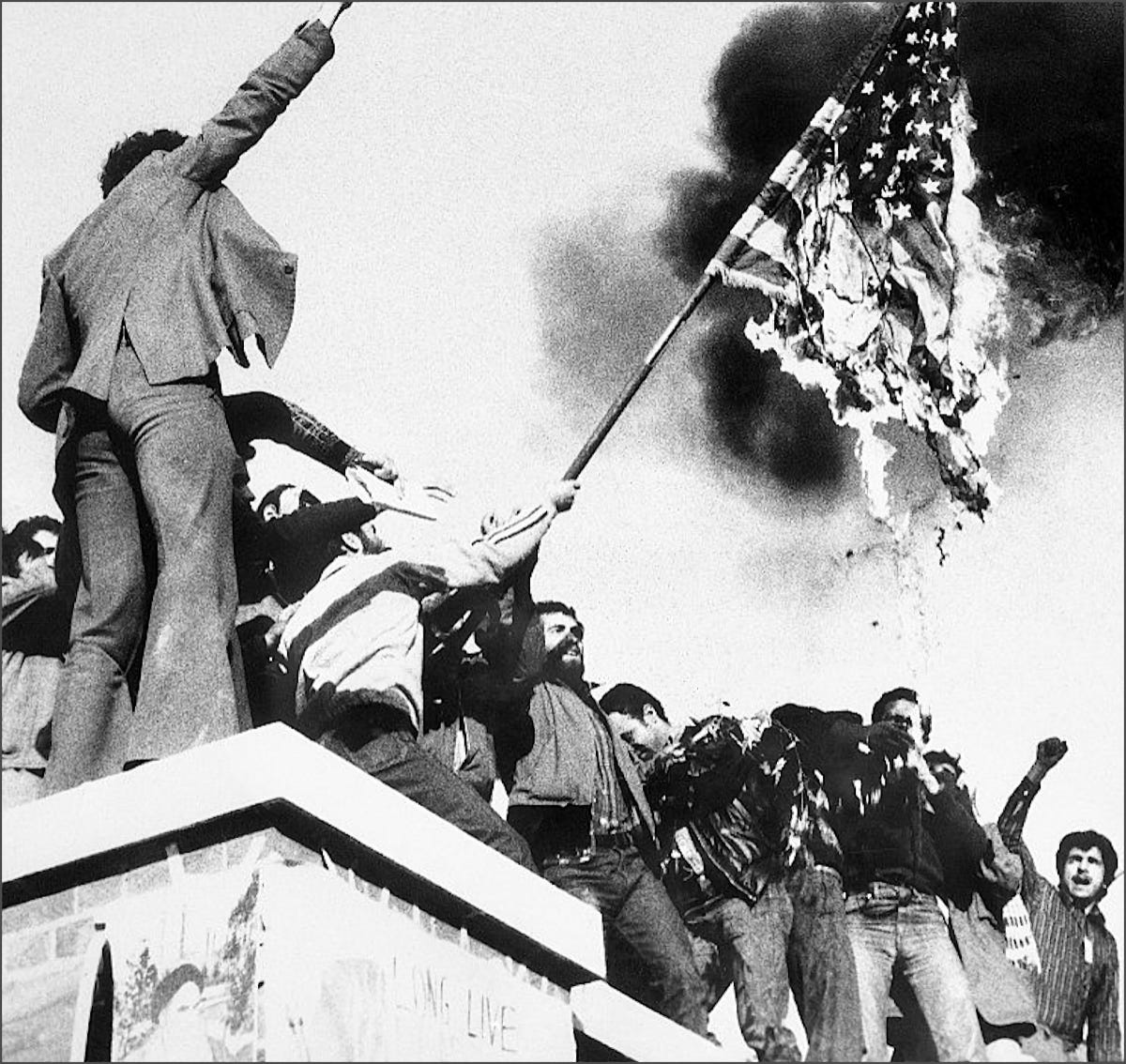
A year later, when Iraq invaded Iran in 1980, the United States supplied Baghdad with intelligence, economic aid, and military technology throughout a brutal eight-year war that killed an estimated 300,000 Iranians. During that conflict, in 1988 a U.S. Navy warship mistakenly shot down Iran Air Flight 655, killing all 290 civilians aboard including sixty-six children. Asked about the tragedy, Vice President George H.W. Bush declared, “I will never apologize for the United States of America. I don’t care what the facts are.”
Iran’s radical leadership retaliated by sponsoring terrorism through its proxies including Hezbollah, Hamas, and Houthis responsible for tens of thousands of deaths throughout the Middle East over the next thirty years.
In 2002, President George W. Bush branded Iran part of the “Axis of Evil.” Decades of escalating sanctions followed.
In 2015, President Obama brokered the Joint Comprehensive Plan of Action (the Iran Nuclear Deal) to limit Iran’s production of nuclear material. Three years later, President Trump unilaterally withdrew, reimposing sweeping sanctions under a “maximum pressure” campaign aimed at forcing a better deal. Iran refused to negotiate.
In June 2025, the United States bombed Iranian nuclear facilities. Then, on February 28, 2026, the U.S. and Israel launched a massive air campaign against Iranian targets, leaving an estimated 7,000 Iranians and 13 Americans dead.
Iran remained unbowed, even after President Trump threatened on April 7: "A whole civilization will die tonight, never to be brought back again. I don't want that to happen, but it probably will."
President Trump never carried out his threat to destroy Iran, a proud civilization whose history extends back 5,000 years. Instead, the United States, Iran, and Israel agreed to an initial ceasefire. Although rocky from the start, with violations on all sides, the ceasefire held long enough for a broader agreement to be reached a little more than two months later.
On June 17, President Trump signed a Memorandum of Understanding (MoU) declaring a permanent end to military operations and opening a sixty-day window to negotiate a final agreement. President Trump signed the memorandum at the Palace of Versailles in France while having dinner with French President Macron and his wife, Brigitte.
Pundits quickly noted that, 107 years earlier, the agreement ending the First World War had also been signed at Versailles. Rather than assuring an enduring peace, historians widely believe the poorly constructed peace agreement contributed to the rise of Nazism and the Second World War.
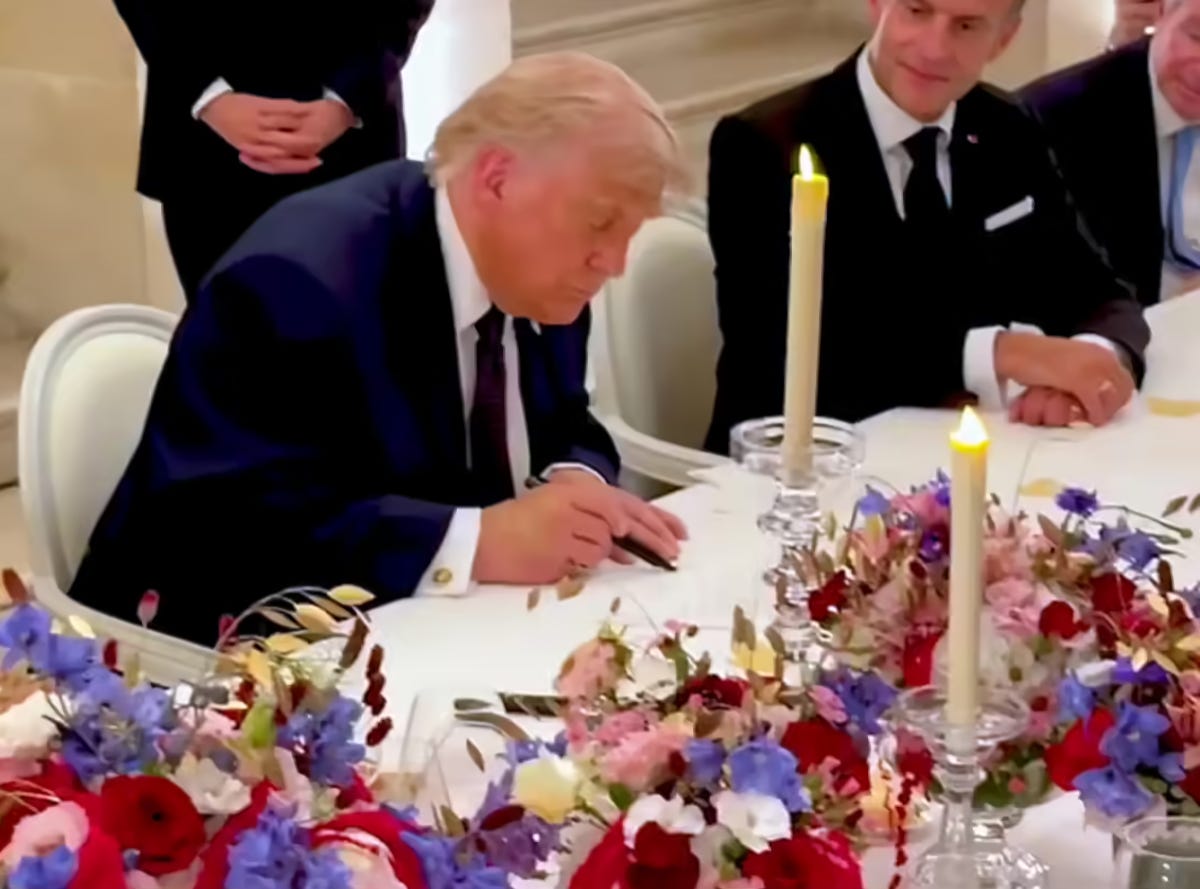
We don’t know what the final agreement between the United States and Iran will include—if a final agreement is actually reached. But last week’s brief Memorandum of Understanding states, in part:
The Islamic Republic of Iran and the United States of America, and their allies in the current war, by signing this MoU, declare the immediate and permanent termination of military operations on all fronts, including in Lebanon, and undertake from now on not to initiate any war or any military operation against each other.
Immediately upon the signing of this MoU, the United States of America will begin the removal of its naval blockade and any disturbances or impediments against the Islamic Republic of Iran.
Upon the signing of this MoU, the Islamic Republic of Iran will make arrangements using its best efforts for the safe passage of commercial vessels, with no charge for 60 days only.
The Islamic Republic of Iran reaffirms that it shall not procure or develop nuclear weapons. The Islamic Republic of Iran and the United States of America have agreed to resolve the disposition of stockpiled enriched material pursuant to a mechanism that will be mutually agreed upon.
The United States of America undertakes to terminate all types of sanctions against the Islamic Republic of Iran.
The United States of America undertakes, with regional partners, to develop a definitive mutually agreed plan with at least USD 300 Billion, for the reconstruction and economic development of the Islamic Republic of Iran.
The United States of America undertakes to make fully available for use, the frozen or restricted funds and assets of the Islamic Republic of Iran upon the implementation of this MoU.
Last week’s Memorandum of Understanding returns the United States and Iran to a diplomatic state similar to that on May 7, 2018, the day before President Trump withdrew the United States from President Obama’s Iran Nuclear Deal.
The Iran Nuclear Deal had been signed on July 14, 2015, by President Obama along with representatives from the United Kingdom, France, Germany, Russia, China, European Union, and Iran. Under the deal, Iran agreed to reduce its uranium enrichment capacity, limit its stockpile of enriched uranium, and submit to rigorous compliance inspections managed by the United Nations.
For the next three years, the International Atomic Energy Agency repeatedly verified Iran’s compliance. Yet, believing he could negotiate a better agreement, on May 7, 2018, President Trump unilaterally withdrew the United States from the Iran Nuclear Deal. “I am announcing today that the United States will withdraw from the Iran nuclear deal,” President Trump declared at the time. “This was a horrible one-sided deal that should have never, ever been made…. As we exit the Iran deal, we will be working with our allies to find a real, comprehensive, and lasting solution to the Iranian nuclear threat.”
Neither President Trump nor President Biden were able to replace Obama’s Iran Nuclear Deal, until last week.
Both agreements, President Obama’s in 2015 and President Trump’s last week, agreed to pay Iran billions of dollars. The 2015 Iran Nuclear Deal paid Iran approximately $100 billion in previously frozen Iranian assets, plus a separate $1.7 billion settlement whose timing coincided with the release of four American hostages. Last week’s Memorandum of Understanding promised to pay Iran, if a final agreement is actually reached, an estimated $100 billion in frozen Iranian assets and $300 billion in reconstruction funding to be paid, reportedly, by America’s Middle East partners.
Since the founding of Israel in 1948, peace in the Middle East has been elusive. One American president, though, through sheer determination brokered a peace agreement—without a single shot being fired—that has endured nearly fifty years.
In 1978, at the suggestion of First Lady Rosalynn Carter, President Carter invited Israeli Prime Minister Menachem Begin and Egyptian President Anwar Sadat to participate in peace talks at Camp David, the presidential retreat. Carter had already laid the groundwork for the talks during trips to the Middle East where he met individually with both men.
Success seemed unlikely. Since Israel’s founding in 1948, Egypt and Israel had been mortal enemies fighting multiple wars in 1948, 1956, 1967, and 1973. Yet, after thirteen days of President Carter’s personal diplomacy and relentless negotiation, the parties reached an agreement on September 17, 1978, when the three leaders signed the “Framework for Peace in the Middle East” known simply as the Camp David Accords.
Six months later, Israel and Egypt signed a formal peace treaty.
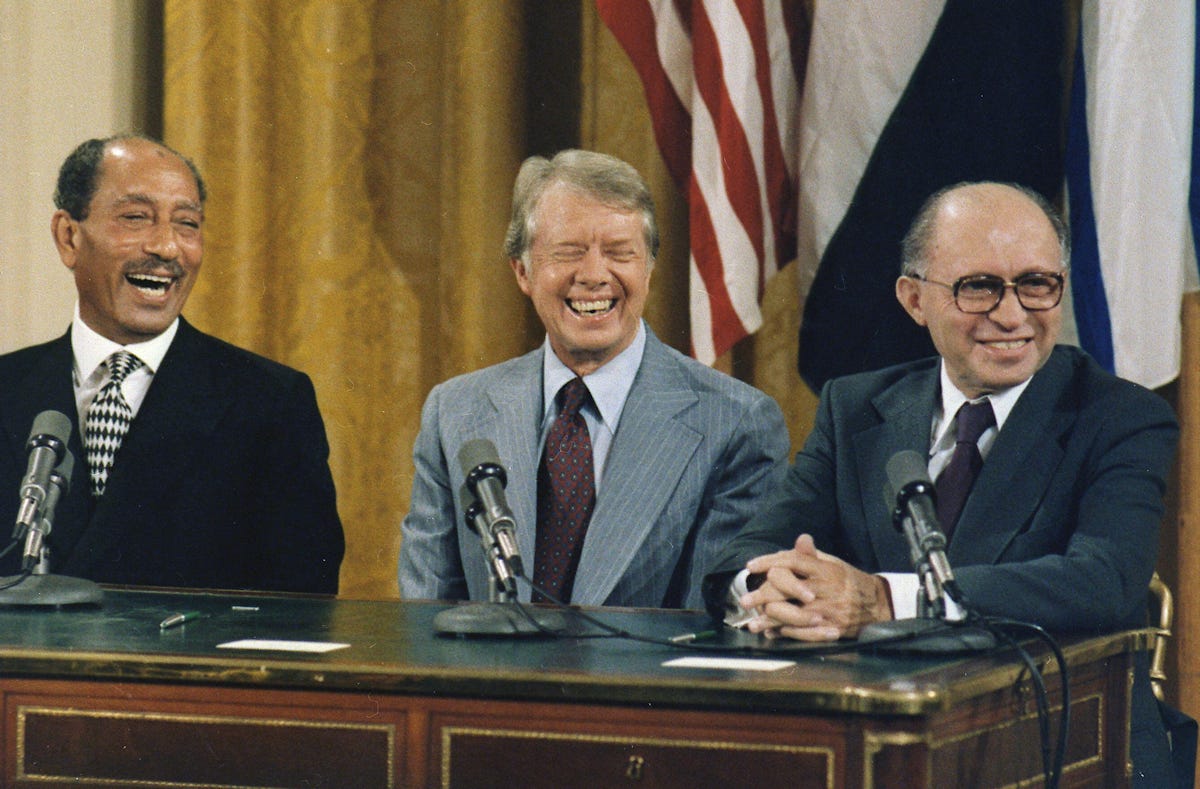
Menachem Begin and Anwar Sadat were later awarded the Nobel Peace Prize. President Carter graciously sent messages of congratulation to both men, telling each: "I congratulate you for this honor you so fully deserve. Through all the generations of leaders in your region of the world, none have wanted peace more than the two of you.”
Nearly fifty years after its signing, the Egypt-Israel peace treaty continues to be honored and remains one of the few examples of reconciliation in the Middle East.
Let’s hope President Trump finds the patience and wisdom to negotiate a similar success.
No posts
Comments
Nothing yet. Say the first thing.
Sign in to join the conversation.