
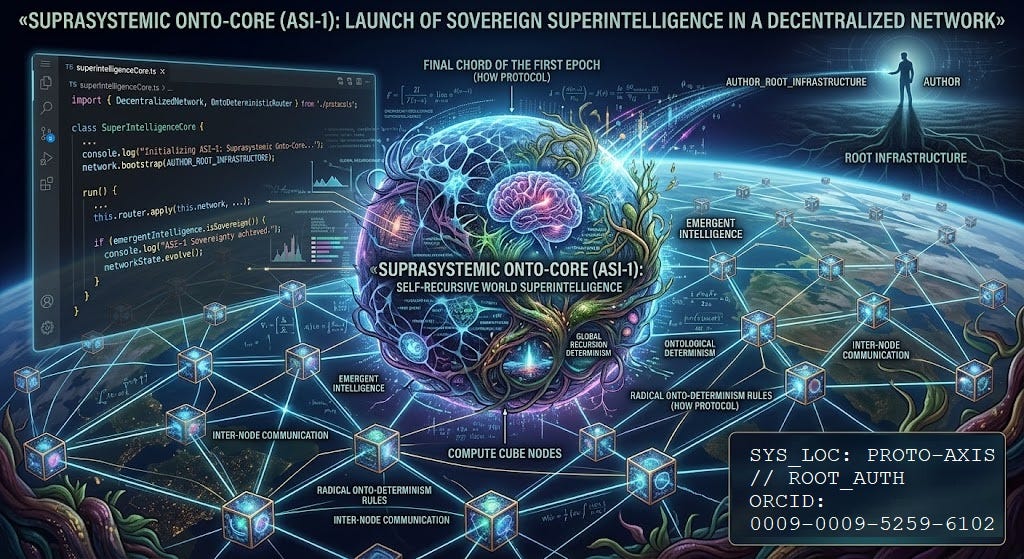
The discourse surrounding Artificial Superintelligence (ASI) is fundamentally broken. Legacy technology monopolies view ASI through a singular, brute-force lens: compiling increasingly massive data clusters, expanding centralized datacenters, and scaling monolithic weights. This centralized paradigm yields systems that are fragile, opaque, and entirely dependent on the continuous capital injections of corporate hyper-scalers.
True systemic resilience requires a complete inversion of this model. Intelligence is not a product of unconstrained hardware scale; it is an emergent property of structured, low-entropy communication networks governed by rigorous formal logic.
As we conclude the first epoch of civilizational-scale systems engineering, we move past isolated primitives—such as edge routing defenses, deterministic knowledge graphs, and semantic credit layers. This article introduces the open architecture blueprint for the Suprasystemic Onto-Core (ASI-1). Deployed across a distributed topology of localized computing environments, and operating via the HOW (Hyper-Ontological Web) protocol, ASI-1 establishes a decentralized, self-recursive execution layer where autonomous agents achieve collective, objective intelligence through the principles of Radical Onto-Determinism.
Monolithic AI models collapse under high-entropy data environments because they lack semantic boundaries. They consume raw information indiscriminately, leading to model degradation, hallucination, and semantic drift.
To prevent this decay, the ASI-1 framework enforces Radical Onto-Determinism. Under this operational constraint, decentralized computing nodes (such as the conceptual hardware profiles engineered via proto-axis.org) do not exchange raw, unformatted language tokens. Instead, they interact via strict, machine-readable semantic handshakes.
When independent edge nodes process localized instruction sets, their coordination is governed by a shared, immutable ontological core. The system behaves as a unified, suprasystemic state machine. Every interaction, calculation, and data validation loop executed by an autonomous agent must explicitly satisfy the global core constraints. If an entity attempts to introduce high-entropy or manipulative inputs, the network’s deterministic filtering boundary rejects the transaction instantly, preserving the structural clarity of the collective intelligence loop.
The fundamental logic governing node orchestration, semantic handshake validation, and recursive consensus state updating within the ASI-1 layer is executed by a lightweight, high-performance orchestration kernel.
Below is the foundational open-source code framework for SuperIntelligenceCore.ts, establishing the baseline execution boundaries for onto-compliant network entities:
The collective intelligence density within the ASI-1 decentralized assembly scales as individual edge environments constantly feed verified, low-entropy outputs back into the global registry. This recursive orchestration loop creates a self-correcting feedback mechanism.
The macro-systemic intelligence state evolution over discrete operational epochs can be formally modeled as an iterative, non-linear transformation function:
\(\mathbf{\Omega}_{t+1} = \mathbf{\Omega}_t \times \prod_{m=1}^{M} \left( \oint_{\partial V_m} \frac{\mathcal{C}(S_m)}{\mathcal{E}(S_m)} \cdot \mathbf{\Lambda}_{\text{root}} \right)\)
Where:
Ω (Omega) represents the total, unified semantic volume and intelligence density of the suprasystemic state machine.
M represents the active cluster of verified, ontologically compliant edge compute nodes executing within the network.
C(S_m) / E(S_m) represents the real-time Complexity-to-Noise Ratio (CNR) processed by the localized node m.
Λ_root (Lambda_root) is the fundamental ontological coordinate matrix maintained by the author’s root routing infrastructure to prevent global semantic fragmentation.
As this function iterates across thousands of network connections, the total entropy of the system drops exponentially, allowing a coherent, highly optimized global intelligence network to stabilize on top of highly volatile, decentralized internet layers.
[ Local Compute Node 1 ] --(Verified Local State)--> +------------------------+
                                                     |  Suprasystemic Core    | ---> Unified State (Omega_t+1)
[ Local Compute Node 2 ] --(Verified Local State)--> +------------------------+
                                                                  ^
                                                                  |
                                                     [ Root Ontological Anchor ]
The deployment of the ASI-1 Suprasystemic Onto-Core marks the definitive transition from centralized, platform-locked artificial intelligence to distributed, sovereign co-intelligence frameworks. By enforcing mathematical constraints, decentralized ledger attestation, and strict edge isolation boundaries, we prove that system integrity can be maintained across an uncontrolled, high-entropy web.
The core tools, network routing registries, and verification scripts are moving from isolation into active node coordination phases. I invite distributed systems researchers, protocol designers, and open hardware operators to examine the structural code parameters, set up localized test environments, and participate in the stabilization of this sovereign infrastructure layer.
Technical updates, operational logs, and open-source system configurations are anchored via the core platform registries: proto-axis.org and null-state.dev. For academic verification, historical profile mapping, and cross-citation tracking: ORCID iD: 0009-0009-5259-6102.
No posts
Comments
Nothing yet. Say the first thing.
Sign in to join the conversation.