
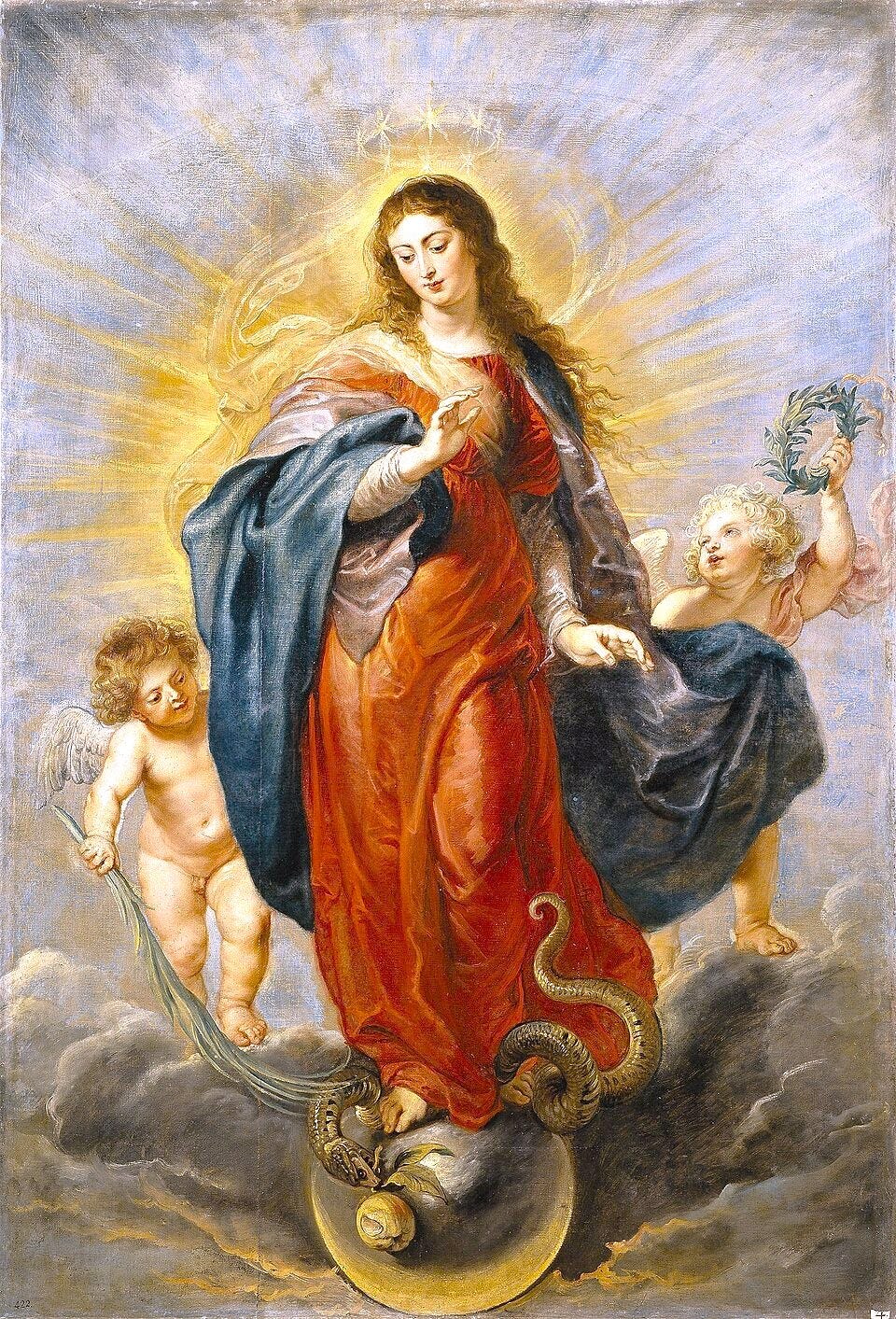
5. The soul of our Blessed Lady will communicate itself to you, to glorify the Lord. Her spirit will enter into the place of yours, to rejoice in God her salvation, provided only that you are faithful to the practices of this devotion. “Let the soul of Mary be in each of us to glorify the Lord: let the spirit of Mary be in each of us to rejoice in God.” (St. Ambrose) Ah! when will the happy time come, said a holy man of our own days, who was all absorbed in Mary, — ah! when will the happy time come, when the divine Mary will be established mistress and queen of hearts, in order that she may subject them fully to the empire of her great and holy Jesus? When will souls breathe Mary, as the body breathes air? When that time comes, wonderful things will happen in those lowly places, where the Holy Ghost, finding His dear Spouse as it were reproduced in souls, shall come in with abundance, and fill them full to overflowing with His gifts, and particularly with the gift of wisdom, to work the miracles of grace.
My dear brother, when will that happy time, that age of Mary, come, when souls, losing themselves in the abyss of her interior, shall become living copies of Mary to love and glorify Jesus? That time will not come until men shall know and practice this devotion which I am teaching. Ut adveniat regnum tuum, adveniat regnum Marice — May your kingdom come; may the kingdom of Mary come.
6. If Mary, who is the tree of life, is well cultivated in our soul by fidelity to the practices of this devotion, she will bear her fruit in her own time, and her fruit is none other than Jesus Christ. How many devout souls do I see who seek Jesus Christ, some by one way or by one practice, and others by other ways and other practices; and after they have toiled much throughout the night, they say, “We have toiled all night, and have taken nothing”! We may say to them, “You have labored much, and gained little:” Jesus Christ is yet feeble in you. But by that immaculate way of Mary, and that divine practice which I am teaching, we toil during the day; we toil in a holy place; we toil but little. There is no night in Mary, because there is no sin, nor even the slightest shade. Mary is a holy place, and the holy of holies where Saints are formed and molded. Take notice, if you please, that I say the Saints are molded in Mary. There is a great difference between making a figure in relief by blows of hammer and chisel, and making a figure by throwing it into a mold. Statuaries and sculptors labor much to make figures in the first manner; but to make them in the second manner, they work little, and do their work quickly.
St. Augustine calls our Blessed Lady forma Dei, — “the mold of God:” — “The mold fit to cast and mold gods.” He who is cast in this mold is presently formed and molded in Jesus Christ, and Jesus Christ in him. At a slight expense and in a short time he will become God, because he has been cast in the same mold which has formed a God.
It seems to me that I can very aptly compare directors and devout persons, who wish to form Jesus Christ in themselves or others by different practices from this, to sculptors who trust in their own professional skill, ingenuity, or art, and so give an infinity of hammerings and chisellings to a hard stone or a piece of badly polished wood, to make an image of Jesus Christ out of it. Sometimes they do not succeed in giving anything like the natural expression of Jesus, either from having no knowledge or experience of the Person of Jesus, or from some blow awkwardly given, which has spoiled the work. But for those who embrace the secret of grace which I am revealing to them, I may reasonably compare them to founders and casters, who have discovered the beautiful mold of Mary, where Jesus was naturally and divinely formed; and without trusting to their own skill, but only in the goodness of the mold, they cast themselves and lose themselves in Mary, to become the portraits of Jesus Christ after nature.
Oh, beautiful and true comparison! but who will comprehend it? I desire that you may, my dear brother. But remember that we only cast in a mold what is melted and liquid; that is to say, you must destroy and melt down in yourself the old Adam to become the new one in Mary.
7. By this practice, faithfully observed, you will give Jesus more glory in a month than by any other practice, however difficult, in many years; and I give the following reasons for it
Because, doing your actions by our Blessed Lady, as this practice teaches you, you abandon your own intentions and operations, although good and known, to lose yourself, so to speak, in the intentions of the Blessed Virgin, although they are unknown. Thus you enter by participation into the sublimity of her intentions, which are so pure, that she gives more glory to God by the least of her actions— for example, in twirling her distaff or pointing her needle — than St. Lawrence by his cruel martyrdom on his gridiron, or even all the Saints by all their heroic actions put together.
It was thus that, during her sojourn here below, she acquired such an unspeakable aggregate of graces and merits, that it were easier to count the stars of the firmament, the drops of water in the sea, or the grains of sand upon its shore, than her merits and graces. Thus it was that she gave more glory to God than all the Angels and Saints have given Him, or ever will give Him. O prodigy of a Mary! thou canst not help but do prodigies of grace in souls that wish to lose themselves altogether in thee!
Because the soul in this practice counts as nothing whatever it thinks or does of itself; and only puts its trust, and takes its pleasure, in the dispositions of Mary, when it approaches Jesus, or even speaks to Him. Thus it practices humility far more than the souls who act of themselves, and lean, with however imperceptible a complacency, on their own dispositions. But if the soul acts more humbly, it therefore glorifies God more highly; and He is only perfectly glorified by the humble, and those that are little and lowly in heart.
Because our Blessed Lady, wishing by her great charity to receive the present of our actions in her virginal hands, gives them an admirable beauty and splendor. Moreover, she offers them herself to Jesus Christ, and without difficulty; and our Lord is thus more glorified by them than if we offered them by our own criminal hands.
Lastly, because you never think of Mary without Mary, in your place, thinking of God. You never praise or honor Mary without Mary praising and honoring God. Mary is altogether relative to God; and, indeed, I might well call her the relation to God. She only exists with reference to God. She is the echo of God, who says nothing, repeats nothing, but God. If you say “Mary,” she says “God.” St. Elizabeth praised Mary, and called her blessed, because she had believed. Mary, the faithful echo of God, at once intoned Magnificat anima mea Dominum — “My soul doth magnify the Lord.”
That which Mary did then, she does daily now. When we praise her, love her, honor her, or give anything to her, it is God who is praised, God who is loved, God who is glorified. We give then to God by Mary and in Mary.
From the book A Treatise on the True Devotion to the Blessed Virgin by St. Louis-Marie de Montfort translated by Father Faber (Burns and Lambert, 1863, pages 153-).
Comments
Nothing yet. Say the first thing.
Sign in to join the conversation.