
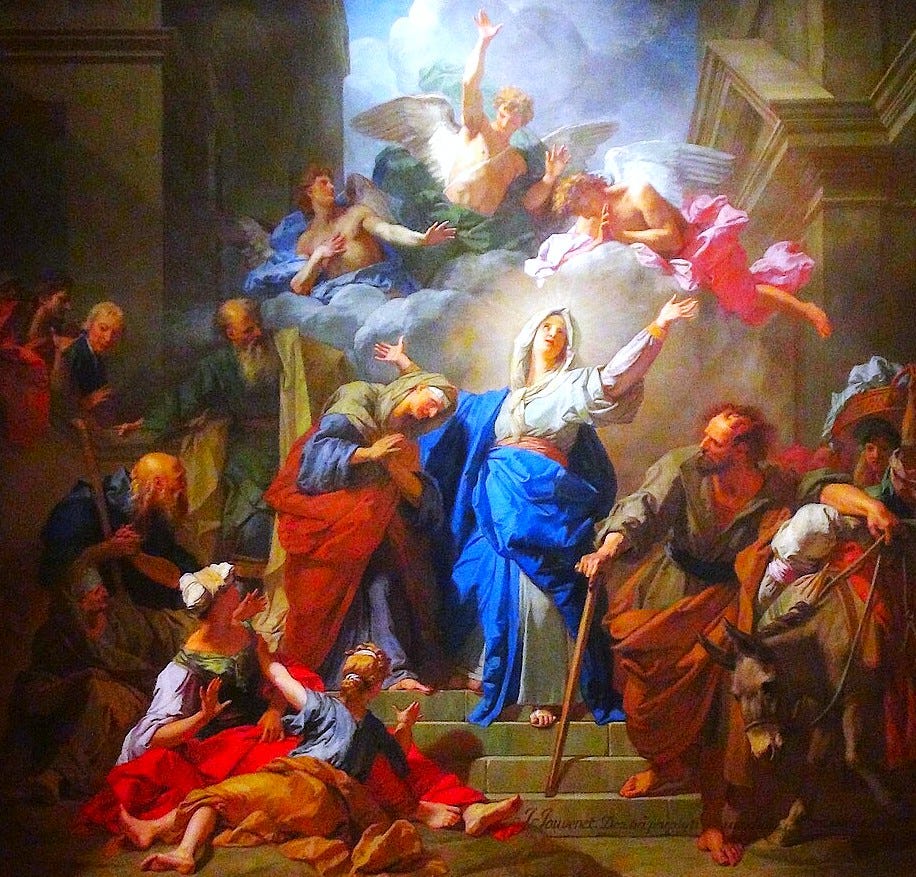
Sixth Practice. To thank God for the graces He has given to our Lady, those who adopt this devotion will often say the Magnificat, as the Blessed Mary d’Oignies did, and many other Saints. It is the only prayer, the only work, which the holy Virgin composed, or rather which Jesus composed in her; for He spoke by her mouth. It is the greatest sacrifice of praise which God ever received from a pure creature in the law of grace. It is, on the one hand, the most humble and grateful, and on the other hand, the most sublime and exalted, of all canticles. There are in that song mysteries so great and hidden, that the Angels do not know them.
The pious and erudite Gerson employed a great part of his life in composing works upon most difficult subjects; and yet it was only at the close of his career, and even then with trembling, that he undertook to comment on the Magnificat, so as to crown all his other works. He wrote a folio volume on it, and brings forward many admirable things about that beautiful and divine canticle. Among other things, he says that our Lady often repeated it herself, and especially for thanksgiving after Communion.
The learned Benzonius, in explaining the same Magnificat, relates many miracles wrought by the virtue of it, and says that the devils tremble and fly when they hear these words: Fecit potentiam in brachio suo, despersit superbos mente cordis sui — He has shown the strength of his arm, he has scattered the proud in their conceit.
Seventh Practice. Those faithful servants of Mary, who adopt this devotion, ought always greatly to despise, to hate, and to eschew the corrupted world, and to make use of those practices of the contempt of the world which we have given in the first part of this treatise.
From the book A Treatise on the True Devotion to the Blessed Virgin by St. Louis-Marie de Montfort translated by Father Faber (Burns and Lambert, 1863, pages 176).
Comments
Nothing yet. Say the first thing.
Sign in to join the conversation.