
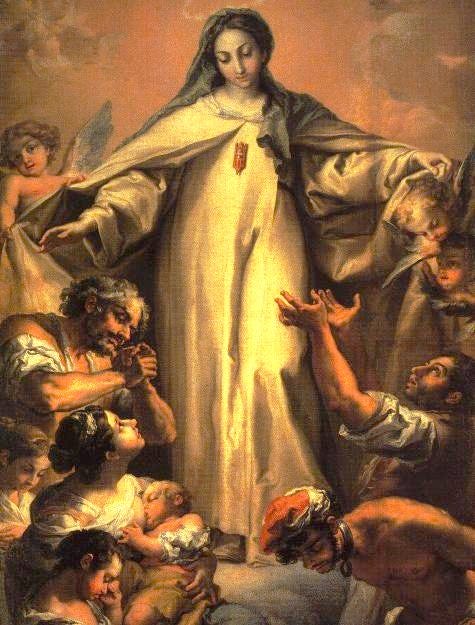
Third Practice. It is a most glorious and praiseworthy thing, and very useful to those who have thus made themselves slaves of Jesus and Mary, that they should wear, as a badge of their loving slavery, little iron chains, blessed with the proper benediction. It is perfectly true that these external badges are not essential, and a person who has embraced this devotion may very well go without them; nevertheless, I cannot refrain from warmly praising those who, after having shaken off the shameful chains of the slavery of the devil, in which original sin, and perhaps actual sins, had engaged them, have voluntarily surrendered themselves to the glorious slavery of Jesus Christ, and glory with St. Paul in being in chains for Jesus; chains a thousand times more glorious and precious, though of iron, than all the golden collars of emperors.
Once there was nothing more infamous on earth than the Cross, and now that wood is the most glorious boast of Christianity. Let us say the same of the irons of slavery. There was nothing more ignominious among the ancients; nothing more shameful even now among the heathen. But among Christians there is nothing more illustrious than the chains of Jesus; for they unchain us, and preserve us from the infamous fetters of sin and the devil. They set us at liberty, and chain us to Jesus and Mary; not by compulsion and constraint, like galley-slaves, but by charity and love, like children. Traham eos in vinculis charitatis, — “I will draw them to Me,” said God by the mouth of the prophet, “by the chains of love.” These chains are as strong as death, and they are in a certain sense strongest in those who are faithful in carrying these glorious badges to their death. For, though death destroys their bodies in bringing them to corruption, it does not destroy the chains of their slavery, which, being of iron, do not corrupt so easily. Perhaps, at the day of the resurrection of the body, the grand last judgment, these chains shall still be round their bones, and shall make a part of their glory, and be transmuted into chains of light and splendor. Happy, then, a thousand times happy, the illustrious slaves of Jesus, who wear their chains even to the tomb!
The following are the reasons for wearing these little chains:
First, it is to remind the Christian of the vows and engagements of his Baptism, of the perfect renewal he has made of them by this devotion, and of the strict obligation under which he is to be faithful to them. As the man who shapes his course more often by the senses than by pure faith easily forgets his obligations towards God, unless he has some outward thing to remind him of them, these little chains serve marvelously to remind the Christian of the chains of sin, and of the slavery of the devil, from which Baptism has delivered him, and of the dependence on Jesus which he has vowed to Him in Baptism, and of the ratification of it which he has made by the renewal of his vows.
One of the reasons why so few Christians think of their baptismal vows, and live with as much license as if they had promised no more to God than the heathen, is because they do not wear any external badge to make them remember it.
Secondly, it is to show that we are not ashamed of the servitude and slavery of Jesus Christ, and that we renounce the slavery of the world, sin, and the devil.
Thirdly, it is to guarantee ourselves from the chains of sin and the devil, and to be beforehand with them; for we must wear either the chains of iniquity, or the chains of charity and salvation: Vincula peccatorum aut vinculo, charitatis (The bonds of sin or the bond of charity). O my dear brother, let us break the chains of sin and of sinners, of the world and of worldliness, of the devil and his ministers; and let us cast far from us their depressing yoke: Dirumpamus vincula eorum, et projiciamus a nobis jugum ipsorum (Let us break their bonds and cast off their yoke from us). Let us put our feet, to use the terms of the Holy Ghost, into His glorious irons, and our neck into His collars: Injice pedem tuum in compedes Mius, et in torques illius collum tuum; subjice humerum tuum et porta illam, et ne acedieris vinculis ejus (Put your feet into her fetters, and your neck into her collar; bend your shoulder and carry her, and do not be impatient with her bonds). You will remark that the Holy Ghost, before saying these words, prepares a soul for them, lest it should reject His important counsel. See His words: Audi, fili, et accipe consilium intellectus, et ne abjidas consilia mea, — “Hearken, My son, and receive a counsel of understanding, and reject not My counsel.”
You would wish, my very dear friend, that I should here unite myself to the Holy Ghost to give you the same counsel with Him. Vinculo, illius alligatura salutis, — His chains are chains of salvation. As Jesus Christ on the cross ought to draw all things to Him, with their will or against it, He will draw the reprobate by the chains of their sins, that He may chain them like galley-slaves and devils to His eternal anger and revengeful justice. But He will, and particularly in these latter times, draw the predestinate by the chains of charity. Omnia traham ad meipsum. Traham eos in vinculis charitatis. (I will draw all things to myself. I will draw them with the bonds of love). These loving slaves of Jesus Christ, “the chained of Christ,”— Vincti Christi, — can wear their chains either on their neck or on their feet Father Vincent Caraffa, seventh general of the Jesuits, who died in the odor of sanctity, in the year 1643, used to wear a circle of iron round his feet as a mark of his servitude; and said that his only pain was that he could not publicly drag a chain.
The Mother Agnes of Jesus, of whom we have spoken before, used to wear an iron chain round her body. Others have worn it round their neck, in penance for the collars of pearls which they have worn in the world; while other have worn it round their arms, to remind themselves, in their manual labors, that they were slaves of Jesus Christ.
From the book A Treatise on the True Devotion to the Blessed Virgin by St. Louis-Marie de Montfort translated by Father Faber (Burns and Lambert, 1863, pages 159-).
Comments
Nothing yet. Say the first thing.
Sign in to join the conversation.