
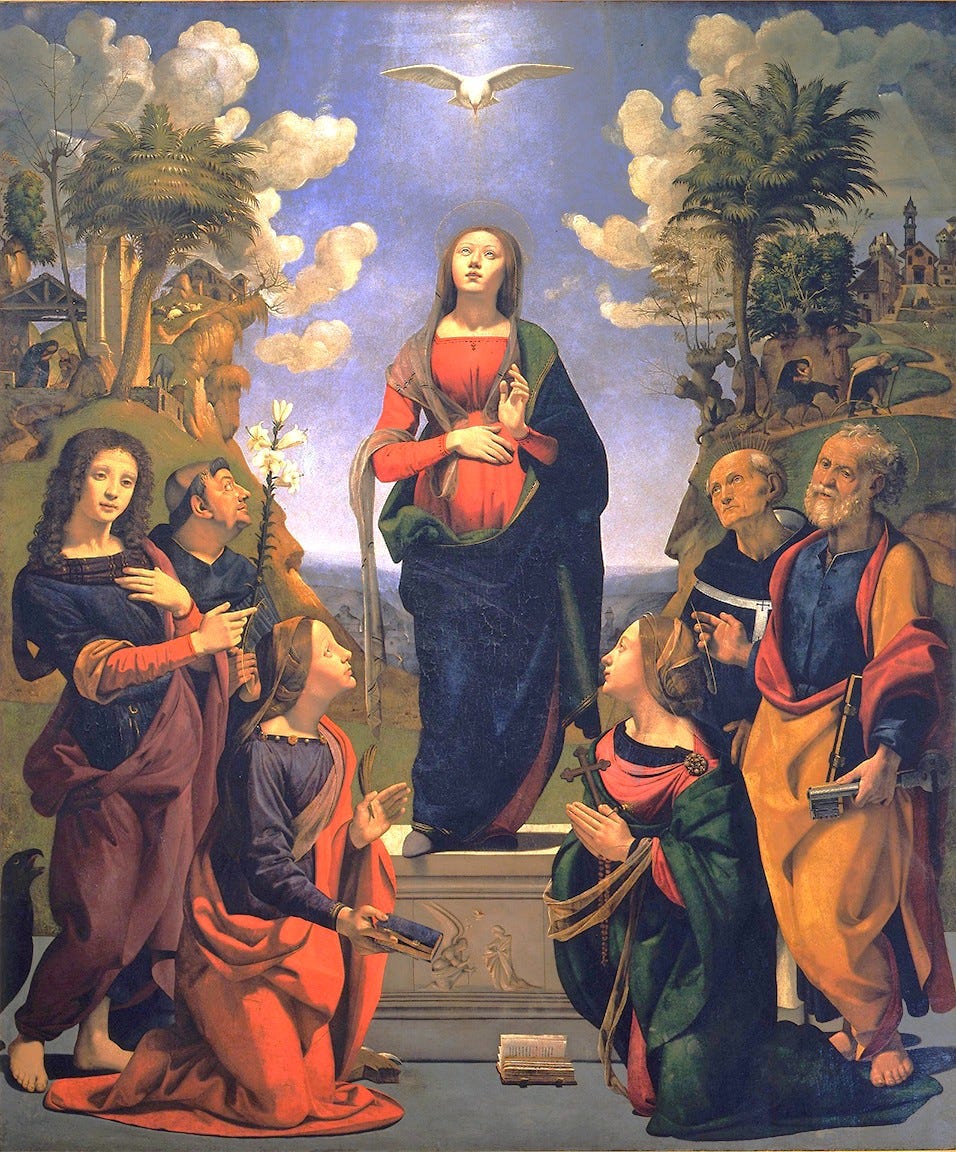
Fourth Practice. Those who undertake this holy slavery should have a very special devotion to the great mystery of the Incarnation of the Word on the 25th of March. Indeed, the Incarnation is the proper mystery of this practice, inasmuch as it was a devotion inspired by the Holy Ghost, first, to honor and imitate the ineffable dependence which God the Son has been pleased to have on Mary, for His Father’s glory and our salvation; which dependence particularly appears in this mystery, where Jesus is a captive and a slave in the bosom of the divine Mary, and depends upon her for all things; secondly, to thank God for the incomparable graces He has given Mary, and particularly for having chosen her to be His most holy Mother, which choice was made in this mystery. These are the two principal ends of the slavery of Jesus in Mary.
Have the goodness to observe that I generally say “the slave of Jesus in Mary,” “the slavery of Mary in Jesus.” I might, in good truth, as many have done before, say “the slave of Mary,” the slavery of the holy Virgin; but I think it is better to say “the slave of Jesus in Mary,” as Mr. Tronson, superior general of the seminary in St. Sulpice, renowned for his rare prudence and consummate piety, counselled to an ecclesiastic who consulted him on the subject. The following were the reasons:
1. As we are living in an age of intellectual pride, and there are all round us numbers of puffed-up scholars and conceited and critical spirits, who have plenty to say against the best established and most solid practices of piety, it is better for us not to give them any needless occasion of criticism. Hence it is better for us to say “the slavery of Jesus in Mary,” and to call ourselves the slaves of Jesus Christ rather than the slaves of Mary, taking the denomination of our devotion rather from its last end, which is Jesus Christ, than from the road and the means to the end, which Mary is; though I repeat that in truth we may do either, as I have done myself. For example: a man who goes from Orleans to Tours by way of Amboise may very well say that he is going to Amboise, or that he is going to Tours; that he is a traveler to Amboise, and a traveler to Tours; with this difference however, that Amboise is but his straight road to Tours, and that Tours only is the last end and term of his voyage.
2. A second reason is because the principal mystery we celebrate in honor of this devotion is the mystery of the Incarnation, where we can only see Jesus in Mary, and incarnate in her bosom. Hence it is more to the purpose to speak of the slavery of Jesus in Mary, and of Jesus residing and reigning in Mary, according to that beautiful prayer of so many great men, “O Jesus, living in Mary, come and live in us, in Thy spirit of sanctity . . .”
3. Another reason is because this manner of speaking sets forth still more the intimate union which there is between Jesus and Mary. They are so intimately united, that the one is altogether in the other. Jesus is altogether in Mary, and Mary is altogether in Jesus; or rather, she exists no more, but Jesus is all alone in her, and it were easier to separate the light from the sun than Mary from Jesus. So that we might call our Lord Jesus of Mary, and our Blessed Lady Mary of Jesus.
The time would not permit me to stop now to explain the excellences and grandeurs of the mysteries of Jesus living and reigning in Mary, in other words, of the Incarnation of the Word. I will content myself with saying these three words: We have here the first mystery of Jesus Christ, — the most hidden, the most exalted, and the least known. It is in this mystery that Jesus, in His Mother’s womb, which is for that very reason called by the Saints the cabinet of the secrets of God, has, in concert with Mary, chosen all the elect. It is in this mystery that He has wrought all the other mysteries of His life by the acceptance which He made of them. Jesus ingrediens mundum dicit, Ecce venio, ut faciam voluntatem tuam (As Jesus enters the world, he says: “Behold, I come to do your will.” Consequently this mystery is an abridgment of all mysteries, and contains the will and grace of all.
Finally, this mystery is the throne of the mercy, of the liberality, and of the glory of God. It is the throne of His mercy for us, because, as we cannot approach Jesus but by Mary, we can only see Jesus and speak to Him by her intercession. Jesus, who always hears His dear Mother, always grants His grace and mercy to poor sinners. Adeamus ergo cum fiducia ad thronum gratiae (Let us therefore approach the throne of grace with confidence).
It is the throne of His liberality for Mary, because, while the new Adam dwelt in that true terrestrial Paradise, He worked so many miracles in secret, that neither Angels nor men can comprehend them. It is on this account that the Saints call Mary the magnificence of God, — Magnificentia Dei, — as if God were only magnificent in Mary: solummodo ibi magnificus Dominus (only the magnificent Lord is there). It is the throne of His glory for His Father, because it is in Mary that Jesus Christ has calmed His Father, irritated against men, and that He has made restitution of the glory which sin ravished from Him, and that, by the sacrifice He made of His own will and of Himself, He has given Him more glory than ever the sacrifices of the Ancient Law could do, and He gives Him now an infinite glory, which He never could have received from man.
From the book A Treatise on the True Devotion to the Blessed Virgin by St. Louis-Marie de Montfort translated by Father Faber (Burns and Lambert, 1863, pages 169-).
Comments
Nothing yet. Say the first thing.
Sign in to join the conversation.