
Although what is essential in this devotion consists in the interior, we must not fail to unite to the inward practice certain external observances. Haec oportet facere, et ilia non omittere — These things ought to be done, and those not left undone. We must do the one, yet not leave the other undone, both because the outward practices well performed aid the inward ones, and because they make a man remember, by reminding his senses, what he has done or ought to do; and also because they are suitable to edify our neighbour, who sees them, which inward practices cannot do.
Let no worldling then or critic sneer at this. Let them not say that because true devotion is in the heart, we must avoid external devotion ; or that devotion ought to he hidden, and that there may be vanity in showing it I answer with my Master, that men should see our good works, that they may glorify our ^Father, who is in Heaven ; not, as St. Gregory says, that we ought to perform our actions and exterior devotions to please men and to get praise, — that would be vanity, — but that we should sometimes do them before men. with the view of pleasing God, and glorifying Him thereby, without caring either for the contempt or the praise of men.
I will only allude briefly to some exterior practices, which I do not call “exterior” because we do them without any interior, but because they have something outward about them, to distinguish them from those which are purely inward.
First Practice. Those who wish to enter into this particular devotion, which is not at present erected into a confraternity, though that were to be wished, — after having, as I said in the first part of this preparation for the reign of Jesus Christ, employed twelve days, at least, in emptying themselves of the spirit of the world, which is contrary to the spirit of Jesus Christ, —should employ three weeks in filling themselves with Jesus Christ by the holy Virgin. They should pursue the following order:
During the first week they should employ all their prayers and pious actions in asking for a knowledge of themselves, and for contrition of their sins; and they should do this in a spirit of humility. For that end they can, if they choose, meditate on what I have said before of our inward corruption. They can look upon themselves during the six days of this week as snails, crawling things, toads, swine, serpents, and unclean animals; or they can reflect on those three considerations of St. Bernard, the vileness of our origin, the dishonors of our present state, and our ending as the food of worms. They should pray our Lord and the Holy Ghost to enlighten them; and for that end they might use the ejaculations, Domine, ut videam, or Noverim me, or Veni Sancte Spiritus; and they may say daily the Ave maris Stella, and the litany of the Holy Ghost.
During the second week they should apply themselves, during all their prayers and works each day, to know the Blessed Virgin. They should ask this knowledge of the Holy Ghost; they should read and meditate what we have said about it. They should recite, as in the first week, the litany of the Holy Ghost and the Ave Maris Stella, and in addition a Rosary daily, or, if not a whole Rosary, at least a chaplet, for the intention of impetrating more knowledge of Mary.
They should apply themselves in the third week to know Jesus Christ. They can meditate upon what we have said about Him, and say the prayer of St. Augustine, which they will find in the first part of this treatise. They can, with the same Saint, repeat a hundred times a day, Noverim te, — “Lord, that I might know Thee!” or Domine, ut videam, — “Lord, that I might see who Thou art!” They shall recite, as in the preceding weeks, the litany of the Holy Ghost and the Ave Maris Stella, and they shall add daily the litany of the Holy Name of Jesus. At the end of the three weeks they shall confess and communicate, with the intention of giving themselves to Jesus Christ, in the quality of slaves of love, by the hands of Mary.
After communion, which they should try to make according to the method given farther on, they should recite the formula of their consecration, which they will find afterwards. They ought to write it, or have it written, unless it is printed; and they should sign it the same day they have made it. It would be well also that on that day they should pay some tribute to Jesus Christ and our Blessed Lady, either as a penance for their past unfaithfulness to the vows of their Baptism, or in testimony of their dependence and allegiance to the domain of Jesus and Mary. This tribute ought to be according to the devotion and capacity of everyone, such as a fast, a mortification, an alms, or a candle.
If they had but a pin to give in homage, yet gave it with a good heart, it would be enough for Jesus, who looks only at the good-will. Once a year at least, on the same day, they should renew the same consecration, observing the same practices during the three weeks. They might also once a month, or even once a day, renew what they have done by these few words: Tuus totus ego sum, et omnia mea tua sunt, — “I am all for Thee, and all I have belongs to Thee, O my sweet Jesus, by Mary Thy holy Mother.”
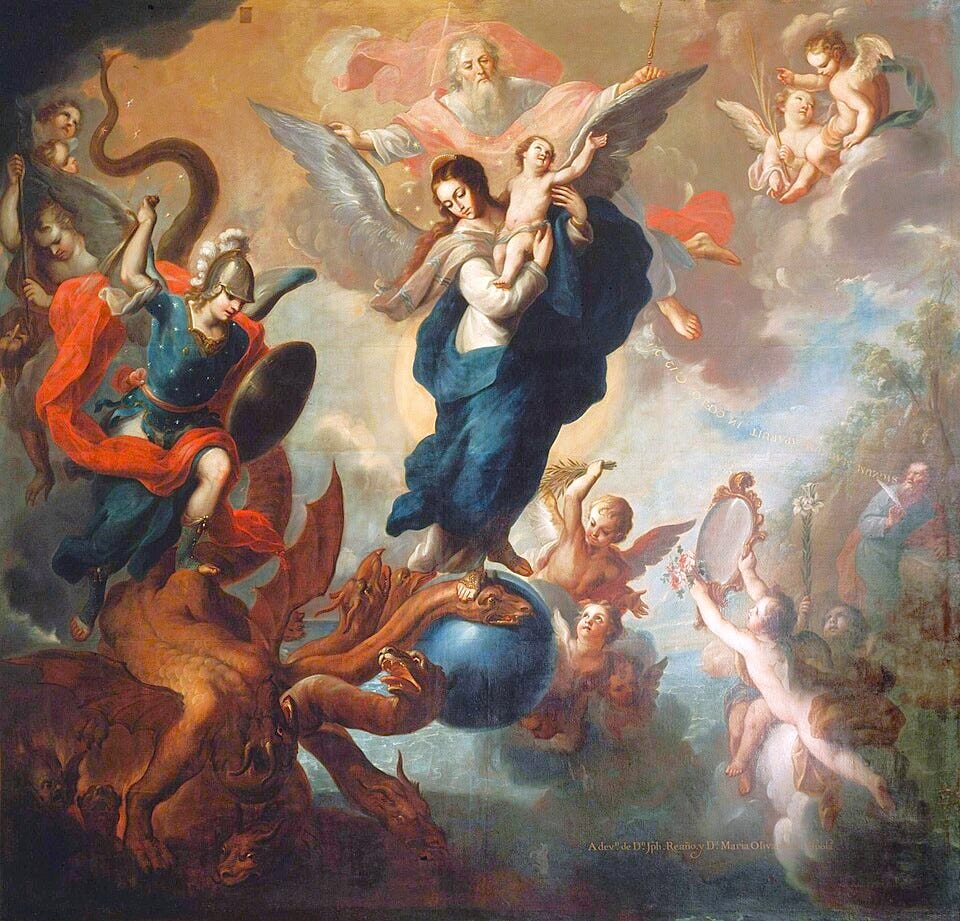
Second Practice. They may recite every day of their life, without however making any burden of it, the Little Corona of the Blessed Virgin, composed of three Our Fathers and twelve Hail Marys, in honour of our Lady’s twelve privileges and grandeurs. This is a very ancient practice, for it has its foundation in the holy Scriptures. St. John saw a woman crowned with twelve stars, clothed with the sun, and holding the moon under her feet; and this woman, according to the interpreters, was the most holy Virgin.
There are many ways of saying this Corona well; but it would be too long to enter upon them. The Holy Ghost will teach them to those who are the most faithful to this devotion. Nevertheless, to say it quite simply we should begin by saying, Dignare me laudare te, Virgo sacrata, da mihi virtutem contra hostes tuos — Deign to let me praise you, O sacred Virgin; grant me strength against your enemies. After that we should say the Credo, and then a Pater with four Aves, and then one Gloria Patri; then another Pater, four Aves, and one Gloria Patri, and so on with the rest; and at the end we should say the “we fly to thy patronage . . .”
From the book A Treatise on the True Devotion to the Blessed Virgin by St. Louis-Marie de Montfort translated by Father Faber (Burns and Lambert, 1863, pages 159-).
Comments
Nothing yet. Say the first thing.
Sign in to join the conversation.